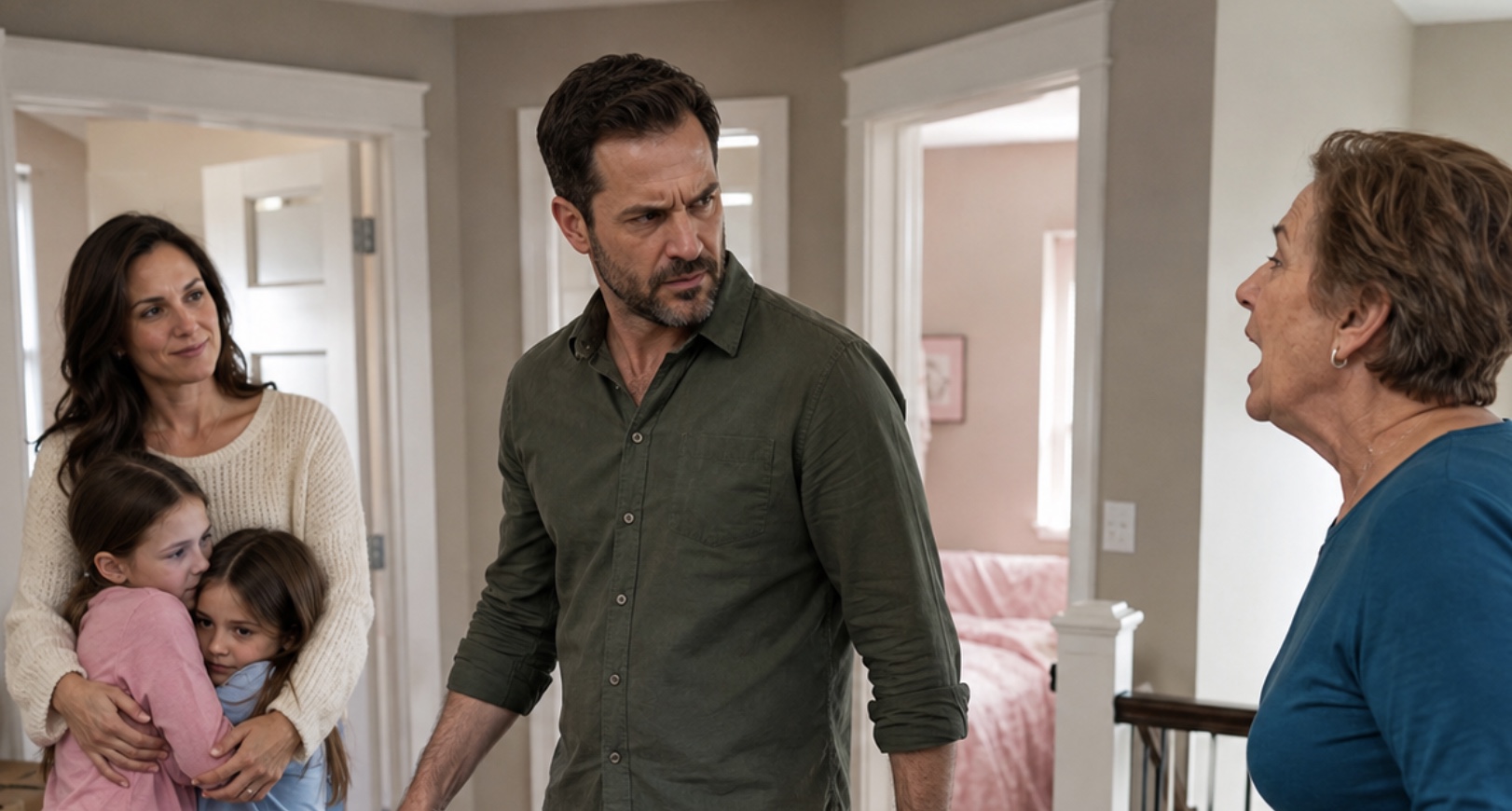
I came home for lunch and froze at what I saw: my mother was throwing my wife and children out of our new house, insisting that she was the one in charge now.
That day, I finished work earlier than usual. The car wash I had opened five years ago had finally begun bringing in a stable income, and for the first time in ages, I allowed myself to leave in the middle of the day and have lunch with my family.
Lisa wasn’t expecting me home so early. On the drive back, I kept imagining how surprised my daughters would be when I suddenly walked through the door.
As I approached the house, I noticed something strange from a distance. The upstairs bedroom window was wide open even though the weather was chilly.
Then I heard a sharp, shrill voice coming from inside.
A voice I could recognize anywhere.
My mother’s.
I switched off the engine and remained sitting in the car for several seconds, listening.
 
Fragments of her shouting drifted outside.
“…You’ve completely lost your mind! You think that just because you gave him two girls, you can do whatever you want?!”
My stomach dropped.
I jumped out of the car and hurried toward the front door. It was unlocked.
A huge travel suitcase I had never seen before stood in the hallway. Lisa’s handbag lay on the floor beside it, its contents scattered everywhere—keys, her wallet, and several of the children’s drawings.
I froze for only a second before racing upstairs two steps at a time.
My mother, Taisia Stepanovna, stood in the middle of our bedroom.
She was still wearing her usual dark coat even though the house was warm. In one hand, she held a hanger with one of Lisa’s dresses, looking as if she had been about to throw it onto the floor.
Her face was twisted with anger. Her eyes flashed, and her lips were curled into a contemptuous smile.
In the corner of the bed sat our daughters, Ksyusha and Anya, pressed tightly against each other.
Ksyusha, who was ten, had her arms wrapped around her seven-year-old sister. Both girls were sobbing so hard their shoulders shook.
Anya was clutching the stuffed rabbit I had given her for her last birthday.
Lisa stood near the window, pale as a sheet.
She wasn’t crying, but there was terror and confusion in her eyes. She looked at me from behind my mother’s shoulder, silently begging me to help.
“What is going on here?” I demanded.
I tried to stay calm, but my voice betrayed me.
“Mom, why are you shouting? And why did you bring a suitcase?”
The moment my daughters saw me, they ran toward me.
Ksyusha grabbed my arm while Anya hid behind my back, still crying.
“Dad, Grandma is throwing us out!” Ksyusha cried through her tears. “She came here with her things and started ordering everyone around. She says she’s going to live here now instead of us!”
“Throwing you out? What are you talking about?”
Part of me still wanted to believe the children had misunderstood something. That this was some horrible mistake.
I looked at my mother, expecting her to laugh, explain herself, or admit she had made some ridiculous joke.
Instead, Taisia Stepanovna looked so smug and confident that I immediately realized my daughter was telling the truth.
“Mom, I’m waiting for an explanation. What exactly do you think you’re doing?”
“What is there to explain?” she snapped, immediately shifting into the role of the offended victim.
She theatrically pressed a hand to her chest.
“My son builds himself a luxurious two-story house with all these rooms and a huge yard, while his own mother is supposed to spend the rest of her life in a tiny old apartment? Have you ever thought about me? Don’t I deserve to spend my old age somewhere comfortable?”
She stepped closer, but I didn’t move.
 
“I raised you alone! I stayed awake with you at night after your father abandoned us for another woman. I gave you an education and helped you become the man you are. Don’t I have the right to a peaceful, dignified life?”
“Mom, what are you even talking about? We never discussed you moving in here. You never once said you wanted to live with us. And now you show up with a suitcase while I’m at work?”
“What, I need an official invitation to visit my own son now? Do I have to make an appointment? Since when does a son lock his own mother out? I came to see my granddaughters!”
“She’s lying!” Ksyusha shouted.
She was still crying.
“She told us to leave! She said Mom is a terrible housewife and that she doesn’t need us because we’re girls instead of boys!”
Anger boiled inside me.
I turned toward Lisa.
“Is that true? Lisa, tell me. Don’t stay silent.”
Lisa took a shaky breath and glanced nervously at my mother.
Then she gathered herself.
“It’s true, Seryozha,” she said, her voice trembling. “Taisia Stepanovna arrived about half an hour ago and started pounding on the door. When I opened it, she pushed past me with her suitcase and immediately started giving orders. She told me to pack my things, take the girls, and leave. She said I could go back to our old rented apartment or move in with my parents.”
My mother planted her hands on her hips and smiled sarcastically, behaving as if she were the one being unfairly accused.
“She also said she was the mistress of the house now,” Lisa continued. “She said she was going to live here with you. She claimed the two of you had already discussed everything over the phone and that you had agreed to let her move in. She even showed me some kind of paper, but she put it away before I could read it.”
“That’s complete nonsense!” I shouted, finally losing my patience.
“Mom, do you understand what you’ve done? What possible claim do you have to this house? Who gave you the right to decide who gets to live here and who has to leave?”
“Don’t you dare raise your voice at your mother!” she shrieked. “Have you forgotten who raised you? Have you forgotten everything I did for you? And now some seamstress gets to live in this house while I don’t?”
“That ‘some seamstress’ is my wife and the mother of my children!” I snapped.
 
“She worked just as hard as I did. Her father helped build this house. In a year and a half, you never once offered to help us with anything. You only came here to humiliate her and create drama. And now you think you can throw her out of her own home?”
“And what has she done?” my mother yelled back. “She climbed onto your back, gave you two daughters, and now she lives in luxury! While you worked yourself to death, she sat around at her little sewing business! Which one of us deserves this house more?”
“Enough!”
My voice cut through the room.
“You will not speak about my wife like that. Pack your things and leave. Right now.”
“What?”
She stumbled backward and clutched her chest.
“You’re throwing your own mother out? Do you want me to have a heart attack? Do you want me to die right here in front of your children?”
“Stop the performance. You’re perfectly fine. I said leave.”
Taisia Stepanovna straightened.
For a second, I thought she might actually attack Lisa, but instead she clenched her fists and hissed through her teeth.
“You’ll regret this, Sergey. Remember my words. I won’t let this go. I’ll take you to court! I’ll prove I have the right to live here! I’ll disinherit you! I’ll tell everyone how you threw your own mother out!”
“Disinherit me?” I gave a bitter laugh. “You own nothing except your old apartment, Mom. And the court will explain to you that this house belongs to Lisa and me. You have no rights here. Now get out.”
I carried the suitcase she had left in the hallway and placed it beside the front door.
My mother slowly came downstairs, muttering curses and shouting so loudly the whole house echoed.
“Seryozha, maybe don’t be so harsh,” Lisa whispered, touching my arm. “She is still your mother.”
“That’s the only reason I didn’t call the police immediately. But if she ever enters this house without permission again, I will file a report.”
I walked my mother to the gate.
 
She turned around on the path and stared at me with hatred.
“You’ll remember this day, son. I’ll make sure you lose this house and that seamstress of yours. Just wait.”
I slammed the gate shut and returned to my family.
Lisa was crying now, and the girls were clinging to her.
I wrapped my arms around all three of them.
“It’s over,” I said. “She won’t come back. I promise.”
I was wrong.
Two days later, the real nightmare began.
That same evening, after everyone had finally calmed down and we were sitting at the dinner table, my phone rang.
I didn’t recognize the number.
“Sergey Viktorovich?” a calm male voice said when I answered. “I’m calling on behalf of your mother, Taisia Stepanovna. I’m her attorney. She asked me to inform you that tomorrow she intends to file a complaint with child protective services alleging improper care of your children. Have a good evening.”
The call ended.
I slowly lowered the phone and looked at Lisa.
She understood immediately.
“Something bad is coming, Seryozha.”
I squeezed her hand.
I knew the war had only just begun.
Part Two: A Mother’s Revenge
After the attorney’s call, Lisa and I sat silently in the kitchen for a long time.
I stared at the tea going cold in my cup while Lisa nervously twisted the edge of the tablecloth between her fingers.
The girls were already asleep, unaware of the new trouble heading toward us.
A cold anxiety was growing inside me.
 
“Do you really think she’ll do it?” Lisa finally asked. “Go to child protective services?”
“It sounds like she will. An attorney wouldn’t call just for entertainment. She’s serious.”
“But this is insane. We’re a normal family. The children are taken care of, the house is clean. Who would believe we’re bad parents?”
“No one, as long as we stay calm and have evidence. But even the investigation itself will exhaust us. Especially you and the girls.”
Lisa covered her face and began to cry.
“I’m so tired of her, Sergey. She follows us like a curse. I don’t want the girls growing up around this.”
I got up and wrapped an arm around her shoulders.
“We’ll get through it. Tomorrow I’ll hire an attorney and arrange security cameras. She won’t be able to catch us unprepared again.”
Over the next three days, I contacted a lawyer I knew through the car wash business and asked him to recommend someone experienced in family and property disputes.
He gave me the number of an attorney named Gorelov.
I saved it but decided to wait before arranging a meeting.
On the fourth day, just as I was preparing to leave for work, the doorbell rang.
Two women in business suits were standing outside.
One was holding a folder. The other carried a small document case.
“Good morning,” the older woman said. “We’re from child protective services. I’m Irina Viktorovna Sokolova, and this is my colleague, Maria Alexeyevna. We are here to conduct an inspection following a complaint.”
“Come in.”
I stepped aside, trying to sound calm even though my stomach tightened.
The women entered, removed their shoes, and looked around.
Lisa walked out of the kitchen, saw them, and immediately went pale.
I took her hand.
“Don’t worry. It’s only a formality.”
 
“Unfortunately, it isn’t always just a formality,” Sokolova said quietly. “The allegations are serious. The complaint claims the children live in unsanitary conditions, that their mother neglects their upbringing, that there are frequent conflicts in the household, and that their father is rarely present. We are required to investigate.”
“That’s a lie,” I said firmly. “The house is new and clean. Our children are well cared for. We’re an ordinary family. My mother submitted the complaint because she wants to hurt us.”
“The complaint was anonymous,” Sokolova corrected me. “But we still have to investigate. Please show us the house and allow us to speak with the children.”
I showed them every room.
The girls’ bedroom was bright and neat, with two beds, a desk, shelves full of books, and toys.
I showed them our bedroom, the living room, the kitchen, and the bathroom.
Everything was clean and organized.
The women looked inside cupboards, checked the refrigerator, and inspected the bathroom.
“You prepared very well for our visit,” Maria Alexeyevna said with a slight smile.
“We didn’t prepare,” Lisa replied for the first time. “This is how we normally live. I don’t like mess.”
Ksyusha and Anya appeared from their bedroom after hearing our voices.
They froze when they saw the unfamiliar women.
“Girls, don’t be afraid,” Sokolova said gently. “We just want to see how you live. Can we talk for a minute?”
Ksyusha looked at me.
I nodded.
 
They sat on the sofa while the women took seats opposite them.
“What do you like doing?” Irina Viktorovna asked.
“I like drawing,” Anya said softly, hugging her stuffed rabbit. “And Mom reads stories to us.”
“What do you like drawing?”
“Princesses. Flowers. Our house.”
Ksyusha sat tensely, biting her lower lip.
“And you, Ksyusha?” Maria asked.
“I like reading and going for walks with Dad. We also built a dollhouse together.”
Sokolova hesitated.
“Does your grandmother visit often?”
Ksyusha flinched.
“She used to come when Dad wasn’t home and yell at Mom. She said Mom was bad and didn’t know how to do anything. Then she came with a suitcase and told us to leave. I was scared.”
Anya began crying again and buried her face in her stuffed rabbit.
“She wanted Mom to go away,” she whispered. “We didn’t want her to.”
The women exchanged glances.
Sokolova wrote something in her notebook.
“Thank you, girls. You can go play now.”
After the children left, she turned toward me.
“Sergey Viktorovich, the inspection shows that the living conditions are excellent. Your children are well cared for, developing appropriately, and clearly attached to both parents. We have found no reason for concern. However, because a complaint was submitted, we were legally required to respond.”
She paused.
“I recommend installing security cameras and documenting any visits from relatives, especially anyone who arrives without permission. And most importantly, do not allow outside relatives to interfere with your family.”
“Thank you,” I said, finally breathing normally again. “We will.”
As soon as they left, Lisa burst into tears.
I pulled her against me.
“It’s okay. They saw the truth. Nobody is going to take our children.”
“She was willing to destroy us just to get revenge!” Lisa sobbed. “What happens next? She won’t stop!”
“She will,” I promised, although I wasn’t entirely convinced. “I’ll hire the attorney, install cameras, and change the locks. Whatever she tries next, we’ll be ready.”
That same day, I called Gorelov and arranged a meeting for the following morning.
 
I also ordered a complete surveillance system.
That evening, after the girls had gone to bed, Lisa and I sat in the kitchen and made a list of everything we needed.
“We need all the documents for the house, land, and loans,” I said. “We should also get statements from neighbors. And recordings of phone calls, if possible.”
“I can speak to the neighbors,” Lisa offered. “They’ve seen your mother come here and cause scenes.”
“Okay. Just don’t drag them too deeply into it. Ask whether they’d be willing to testify if necessary.”
The next day, I met attorney Gorelov.
He was around fifty, with a tired-looking face and sharp, observant eyes.
He listened carefully and reviewed all the documents I had brought.
“Let’s start with the most important point,” he said, leaning back in his chair. “The house and land were acquired during your marriage. They are registered to you, but legally they are marital property. Your mother has no claim to them unless she can prove she contributed her own money toward construction. Can she?”
“No. She didn’t give us a penny. Her housewarming gift was an old saucepan.”
“Then any claim for residence is extremely weak. A relative gains the right to use an owner’s residence only after moving in with the owner’s consent. You never gave that consent. She isn’t registered at the address and has never lived there.”
“What about financial support? Can she demand that I support her?”
“She can try, if she proves she is disabled or genuinely unable to support herself. But she receives a pension and owns her own apartment. A court may reject the claim, particularly given the circumstances. Still, she can file things simply to cost you money and cause stress.”
“What should we do?”
“Prepare for court. Gather witness statements and recordings. Install the cameras. Most importantly, don’t react to provocations. If she comes to the house again, call the police.”
I returned home with a clear plan.
Lisa and I spoke to several neighbors. Every one of them agreed to testify if necessary.
Some told us they had repeatedly seen my mother coming to the gate and shouting at Lisa when I wasn’t home.
Three days later, technicians installed cameras around the property, at the front door, and inside the entrance hall.
Everything happening around the house would now be recorded.
 
I also changed the locks on the front door and gate.
My mother might have copied one of the old keys.
Lisa became a little calmer, although every unexpected sound still made her jump.
Five days after the child protection visit, my mother returned.
It was early evening, and we had just sat down to dinner when the doorbell rang.
I went to the video intercom.
My mother was standing outside the gate.
Beside her stood a young police officer.
She was waving some kind of paper in the air.
“Sergey, open the gate!” she shouted. “I have the right to be here! I have an official order!”
Lisa looked at me.
“Don’t open it,” she whispered.
“We need to deal with this. She brought a police officer, so she clearly wants to make a legal spectacle.”
I stepped outside but kept the gate locked.
“What do you want?”
“Sergey Viktorovich,” the officer said, “your mother, Taisia Stepanovna, contacted us claiming that you illegally denied her access to a residence where she says she is registered. This is her complaint.”
“She isn’t registered here,” I replied. “She has never lived here. The house belongs to my wife and me. We bought the land and built the property ourselves.”
“That’s a lie!” my mother screamed, waving the paper. “I have an order! I have rights!”
“Taisia Stepanovna,” the officer said wearily, “I already explained this to you. What you’re holding is a copy of your lawsuit. It is not a court order granting you the right to move in. Your son is correct. You cannot enter the property without his permission.”
“But he’s my son! I raised him! He has to let me in!”
“Mom, you already tried to throw my wife and children out of their home. You reported us to child protective services. Now you’ve brought a police officer here. What comes next? You are not entering this house until you apologize and stop threatening us.”
“Threatening you? You’re threatening me! You threw your own mother onto the street!”
She grabbed her chest.
 
“Call an ambulance! I’m sick!”
The officer frowned.
“Taisia Stepanovna, if you are genuinely unwell, I will call an ambulance. But that does not change the fact that you are attempting to enter private property without permission. Please leave.”
“I’m not leaving!” she screamed. “This is my house! I’m his mother!”
I took out my phone and began recording.
“Officer, I want this attempted unlawful entry officially documented. The security camera is recording everything. She has no legal right to be here without my permission.”
The officer asked me to write a statement and formally warned my mother against violating the law.
“If you attempt this again,” he told her, “I may have to issue an administrative citation. Your son may also be entitled to file a complaint regarding your actions. Please leave.”
My mother stared at me with hatred.
Then she looked at the officer, turned sharply, and walked away.
“You’ll regret this!” she shouted over her shoulder. “I’m not finished! I’ll take you to court! I already complained to child protection! I’ll write to the prosecutor too!”
The officer apologized for the disturbance, took my contact information, and left.
I returned inside.
Lisa was standing in the hallway, pale, one hand pressed to her mouth.
 
“She isn’t going to stop,” she whispered.
“We’re ready now,” I said, wrapping my arms around her. “Let her try whatever she wants. The law is on our side.”
Two days later, a courier delivered a registered letter.
I signed for it and opened the envelope.
Inside was a court summons.
The hearing was scheduled for one month later.
Taisia Stepanovna Ivanova had filed a lawsuit demanding recognition of her right to use the residence and asking the court to prohibit us from preventing her from living there.
Lisa and I were both listed as defendants.
I read the summons aloud.
Lisa slowly sat down.
“So the war continues.”
“Yes.”
I clenched the papers in my hand.
“But we’re going to win.”
Part Three: The Court Decides
The month leading up to the hearing passed in a blur.
Lisa and I lived under constant tension, doing our best not to show it in front of the girls.
Ksyusha and Anya obviously sensed that something was wrong.
Ksyusha became quieter. Anya started crying more often at night.
At work, I sometimes realized I had been staring at my phone for several minutes instead of concentrating.
Attorney Gorelov was thorough and calm.
He prepared documents, gathered witness statements, and examined every detail.
We met several times.
Each time, he repeated the same warning.
 
“Your mother has no legal right to the house. But she will appeal to emotion. Judges are human. They may feel uncomfortable ruling against an elderly woman. So your job is not to appear cruel. You are protecting your family. Stick to facts and the law. No insults and no emotional outbursts.”
I understood.
But inside, I was furious.
I knew my mother would do everything she could to make us look like monsters.
One week before the hearing, Lisa finally broke down.
After the children went to bed, she sat in the kitchen and began to cry.
“I can’t take this anymore, Sergey. She calls me ten times a day. She sends messages. One minute she threatens me, the next she begs me. I blocked her number, but she calls from other phones. I’m scared to leave the house. Sometimes I feel like she’s somewhere behind the fence, waiting.”
I hugged her.
“Why didn’t you tell me sooner?”
“I didn’t want to upset you. You’re already under enough stress.”
“Lisa, we’re dealing with this together. I need to know everything she does. Tomorrow we’ll install another camera near the back gate, and I’ll speak to the officer again.”
“What if she gets arrested?” Lisa suddenly asked. “She’s still your mother. I don’t want her to go to jail.”
“It won’t come to that. But she needs to understand that actions have consequences. Otherwise, she’ll never stop.”
The following day, I went to the police station and filed a complaint explaining that my mother was repeatedly harassing and threatening us.
The same young officer handled the report.
 
“Sergey Viktorovich,” he said, “if she continues, administrative measures may be possible. But a criminal case is unlikely based on what you’ve described.”
“I’m not trying to put her in prison,” I replied. “I just want her to leave us alone.”
“I understand. We’ll speak to her.”
For several days afterward, my mother went quiet.
I began to hope she had finally reconsidered.
Gorelov warned me not to relax.
“She may become more active immediately before the hearing.”
He was right.
The day before court, she called from an unfamiliar number.
I didn’t answer.
A minute later, a message arrived.
“Sergey, I know you’re angry. But I’m your mother and I only want what’s best. Give up the house and I’ll withdraw everything. We can live together. Lisa and the girls can come visit. I don’t wish them any harm. Just think about my old age. You wouldn’t abandon me, would you?”
I read it without responding.
Then I forwarded it to Gorelov.
He called me almost immediately.
“Do not answer that message. She may be provoking you into writing something angry that can later be presented in court as evidence of cruelty.”
“I wasn’t going to answer. I just wanted you to see it.”
“Good. Tomorrow, arrive thirty minutes early. And remember: stay calm.”
On the morning of the hearing, Lisa and I dressed simply and formally.
I wore a dark suit. She wore a gray dress.
The girls stayed with Lisa’s parents.
Her father, Fyodor Vasilyevich, firmly shook my hand.
“Stay strong, son. The truth is on your side.”
The courtroom was small.
Lisa, Gorelov, and I sat on one side.
My mother and her attorney sat on the other.
She entered like an offended queen, wearing a dark coat and clutching a handkerchief.
She never looked at us.
The judge was a woman around fifty with a tired but attentive expression.
She opened the hearing and summarized the claim.
My mother was invited to speak first.
Taisia Stepanovna stood, sniffed dramatically, and began in a trembling voice.
“Your Honor, I am asking you to protect my rights. My son threw me out of a house he built himself. I raised him alone and devoted my life to him. I worked two jobs so he would never go without anything. And now he has chosen another woman over his own mother.”
She raised the handkerchief to her eyes.
“I’m alone in an old, cramped apartment. I don’t have enough money. My health is poor. I have the right to live with my son. He should care for me in my old age.”
The judge interrupted her.
 
“Do you own residential property, Ms. Ivanova?”
“Yes, but it’s in terrible condition. The roof leaks. There hasn’t been any renovation. I can’t live like that. My son has a huge house with many rooms, yet there’s no place for me. Is that fair?”
“Please address the legal basis of your claim. On what grounds do you believe you have a right to reside in the defendants’ property?”
Her attorney stood.
He was a young man who looked increasingly nervous.
“Your Honor, my client is the defendant’s mother. She believes she is entitled to use the residence as a family member of the property owner. She also states that she provided financial assistance during the construction of the house, which may establish an interest in the property.”
“What evidence supports that assertion?” the judge asked.
The attorney hesitated.
“We have my client’s statement.”
“That is not documentary evidence. Do you have receipts, bank transfers, or written agreements?”
“No, but—”
“Then we will hear from the defendants.”
Gorelov stood and calmly presented our case.
“Your Honor, the house and land are marital property belonging to Sergey and Elizaveta Ivanov. The claimant has never resided in the property, has never been registered there, and has never maintained a shared household with the defendants. She therefore has no established right of residence.”
He placed documents on the desk.
“She also provided no financial contribution toward construction. The bank statements and construction records confirm this. In addition, the claimant owns residential property of her own, where she currently lives. There is no lawful basis for the relief she requests.”
The judge asked several questions.
My mother repeatedly became emotional and drifted away from the legal issues.
“She turned him against me!” Taisia Stepanovna suddenly shouted, pointing at Lisa. “That woman manipulated my son because she wanted the house!”
“Ms. Ivanova,” the judge warned, “watch your language. Another outburst and I will remove you from the courtroom.”
Our witnesses were called.
The first was our neighbor, Nina Pavlovna, an older woman who lived two houses away.
“I’ve seen that woman come to the Ivanovs’ property several times and create arguments,” she said, indicating my mother. “Once she shouted at Lisa right outside the gate. She called her lazy and said she didn’t deserve to live in such a beautiful house. The children were crying, but she didn’t care.”
The judge took notes.
Next, the police officer testified.
He confirmed that my mother had attempted to enter our property despite having no legal grounds to do so.
“She presented a copy of her own lawsuit as though it were a court order authorizing her to move into the house,” he explained. “I informed her that it had no such legal effect, but she continued to insist that she had the right to enter.”
When the witnesses finished, my mother was given another opportunity to speak.
 
She stood and pressed the handkerchief against her eyes.
“Your Honor, I only wanted to be close to my son. I’m an old woman and I’m alone. I’m afraid of spending the rest of my life by myself. Don’t I deserve a little warmth?”
Her voice trembled convincingly.
I could feel anger rising inside me, but I stayed silent.
Then Lisa spoke.
Her voice was quiet but steady.
“I never wanted to fight with my mother-in-law. I tolerated her insults because I respected my husband. But the day she entered our home and told our children they had to leave was the moment everything changed.”
Lisa took a breath.
“Our daughters cried because they couldn’t understand why their own grandmother wanted to throw them out of their home. I cannot allow them to live in fear. I am asking the court to protect our family.”
My mother jumped to her feet.
“You’re lying! You planned all of this! You want me to die alone!”
“Ms. Ivanova!” the judge raised her voice. “If you do not calm down, I will have you removed for contempt.”
My mother sat down but continued glaring at Lisa.
Closing arguments continued for nearly another hour.
Eventually, the judge announced a recess and withdrew to deliberate.
We waited in the hallway.
Lisa was trembling.
I held her hand.
My mother stood at the other end of the corridor, whispering angrily to her attorney.
He looked defeated.
 
“It’s going to be okay,” I whispered to Lisa. “We’ve done everything we could.”
Around forty minutes later, we were called back into the courtroom.
The judge returned and began reading the decision.
“Having reviewed the testimony and evidence presented, the court finds as follows. The claims of Taisia Stepanovna Ivanova against Sergey Viktorovich Ivanov and Elizaveta Nikolaevna Ivanova seeking recognition of a right to use the residential property and an order prohibiting interference with her residence are denied in full. The related claim for financial maintenance is also denied. The decision may be appealed in accordance with law.”
I finally breathed out.
Lisa squeezed my hand.
Tears of relief ran down her cheeks.
My mother jumped up.
“This is unfair!” she screamed. “I’ll appeal! I’ll go all the way to the Supreme Court! You’re all against me!”
“Ms. Ivanova, leave the courtroom,” the judge said wearily.
My mother stormed out and slammed the door.
Her attorney hurried after her.
When we stepped outside the courthouse, the sun was shining and the sky was clear.
I wrapped my arms around Lisa.
“It’s over,” I whispered. “She can’t hurt us anymore.”
When we arrived home, Lisa’s parents and the girls were waiting.
Ksyusha and Anya ran into our arms, hugging and kissing us.
Fyodor Vasilyevich shook my hand.
“Congratulations, son. You held your ground.”
That evening, after everyone had gone home and the girls were asleep, Lisa and I sat together in the kitchen.
She poured tea while I looked through the window toward the dark garden.
 
“You know,” she said quietly, “part of me keeps expecting her to come up with something else.”
“Let her. We’re ready now. We have the court ruling, cameras, and the police know the situation. She can’t simply force her way into our lives anymore.”
“I still feel sorry for her,” Lisa admitted. “She is your mother. Maybe one day she’ll understand what she did.”
“Maybe.”
I sighed.
“But right now, I’m not ready to forgive her. She hurt you and the girls too much.”
One week after the court hearing, my phone rang during dinner.
It was my mother.
I declined the call.
A minute later, a message arrived.
 
“Forgive me, son. I was wrong. I never wanted to destroy your family. I was just terribly lonely. Can we talk?”
I read it and put the phone down.
“Who was it?” Lisa asked.
“Mom. She’s asking me to forgive her.”
“What are you going to do?”
“Nothing. Not yet. She caused too much pain. I’m not ready.”
Lisa nodded.
“I understand. Maybe someday you’ll be able to forgive her. Not for her sake—for your own.”
I looked at our daughters.
They were peacefully eating dinner, talking excitedly to each other as though none of the ugliness of the past weeks had ever happened.
For their sake, I needed this house to remain a place of safety.
A place of peace.
 
“Maybe one day,” I said. “But not now.”
I turned off my phone and left it off for the rest of the evening.
Lisa and I stayed in the kitchen for a long time afterward, talking about the future.
As I looked at her, I realized we had survived a real storm together.
Our home had become our refuge again—a place filled with love, calm, and the certainty that we belonged there.
And I knew I would protect that peace from whatever storm came next.