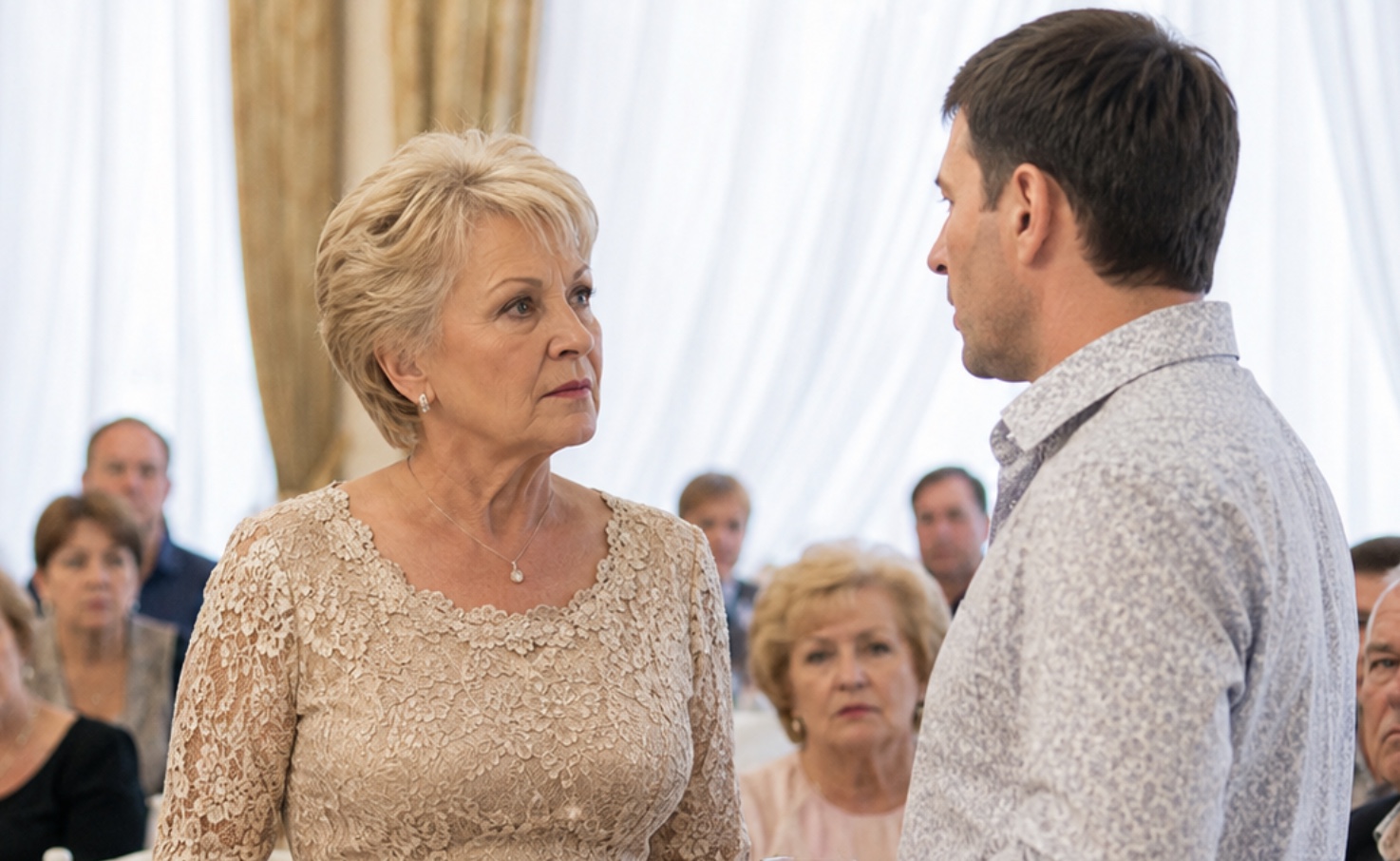
My son-in-law stood up and tapped his fork against a glass of juice. I was straightening my napkin at that very moment. He looked around at the guests, smiled, and began:
“Dear guests! I’d like to raise a glass to our anniversary couple. Forty years together—that’s no small thing. That’s an achievement.”
The guests nodded, and a few people reached for their glasses. I watched my son-in-law and immediately sensed that something was coming. He was always like that: first he would say something pleasant, then add a remark that left you sitting there wondering where to look.
I had known him for twelve years. When my daughter first brought him home to meet us, he was working as a purchasing manager. He was loud, confident, constantly cracking jokes about mothers-in-law and separate grocery budgets. Back then, I thought he was lively and energetic, especially compared with my daughter’s previous boyfriend, who had spent two years unable to decide whether he wanted to marry her. This one made up his mind in three months.
“Forty years,” my son-in-law continued. “Just think about that. Some people in this room weren’t even born when these two were already standing at the registry office.”
He paused.
He looked at me. Then at my husband.
And said:
“Galina Petrovna, you deserve credit for still putting up with your husband after all these years. Most of us wouldn’t manage it.”
The room erupted in laughter.
At first it was hesitant, then louder. Someone even applauded. My cousin snorted with laughter. Our neighbor from the apartment building—the woman who had lived beside us for forty years—nodded as if she had been waiting all her life for someone to finally say it aloud.
I sat there feeling my face grow hot—not from anger, but from humiliation.
I was ashamed because my husband was sitting beside me and had to listen to it. Ashamed because the people we had invited to celebrate our marriage were laughing at a joke whose whole point was that our life together had supposedly been some kind of punishment. And ashamed that my daughter’s husband considered that an appropriate toast at our fortieth wedding anniversary.
My husband sat to my left.
He didn’t move.
Only his fingers tightened slightly against the tablecloth. I knew that gesture. It meant everything inside him was boiling, but he would never show it.
He was sixty-seven, a retired strength-of-materials lecturer at a technical college, and in all our years together I had never once seen him raise his voice in front of strangers. He believed a man should maintain his dignity and that showing emotion publicly was a sign of weakness.
Sometimes I wondered whether that was exactly why our son-in-law allowed himself to behave this way.
He knew my husband wouldn’t answer back.
He wouldn’t start an argument in front of everyone or create a scene.
My son-in-law had already moved on to something else. He was good at that—throw out an unpleasant remark, then immediately start talking about something positive as though nothing had happened.
He talked about how we had helped them with their apartment and how I had looked after our grandson.
I heard him without really listening.
All I could see was my husband: a man who had spent forty years teaching students, educating hundreds of young people, practically raising our daughter by himself during the years when I worked double shifts at the library—and now he was sitting silently while someone presented him as a burden.
And our guests—friends, relatives, neighbors—were laughing.
As if it were a clever joke.
I looked across the table at my daughter. She sat beside her husband, smiling the way people smile when they don’t know what else to do.
I understood immediately.
She had heard the words, but she hadn’t understood what they really meant.
This wasn’t simply awkward humor.
It revealed an attitude.
An attitude toward her father as someone who needed to be “put up with.”
I stood up.
“May I say something?”
My son-in-law turned toward me.
He hadn’t expected it.
He was used to me keeping quiet. I had always been the convenient mother-in-law: I didn’t interfere, lecture, or criticize. I babysat when necessary, gave them money when they asked, and quietly listened to his endless speeches about how difficult his job in retail was and how incompetent all his competitors were.
And yes, I had kept quiet.
I didn’t want family arguments.
My own mother had once fallen out so badly with my sister’s husband that they didn’t speak for fifteen years. My sister used to cry at night because she was constantly torn between them.
I never wanted that for my daughter.
So I endured things.
But not today.
“Of course, of course,” my son-in-law said with a broad gesture. “The floor belongs to the anniversary girl.”
I looked around the room.
Twenty-four people.
Relatives, friends, my husband’s former colleagues, women I had once worked with.
Everyone looked at me expectantly.
They probably thought I was going to give a traditional response—thank everyone for coming, say something touching about my husband, raise another toast.
Instead, I said:
“Forty years ago, when we were getting married, my mother told me, ‘Don’t marry him. He’s too quiet. You’ll be bored with him.’ I laughed back then. But today I want to ask all of you something. Have you ever seen a quiet person start a scandal in a shop? Demand special treatment? Humiliate someone in front of a room full of people and hide behind the excuse that it was only a toast?”
The room went silent.
From the kitchen, I could hear dishes clattering.
“My husband,” I continued, “has never raised his voice at me once in forty years. Not once. When we had no money and I cried at night, he took extra teaching hours at an evening school. When our daughter went to university in another city, he traveled there every single week just to make sure she was all right—even if all he could do was speak to her for a few minutes at the entrance. Every week for two months.
“When I was offered a department head position and was terrified I wouldn’t manage, he told me, ‘You can do it. I believe in you.’
“And I did.
“Because he believed in me.”
I stopped for a second.
My husband remained still, but his eyes were wet.
He wasn’t looking at the guests.
He was looking at me.
“You were laughing just now because someone said I ‘put up with’ him,” I said, looking directly at my son-in-law. “But I don’t put up with him. I live with him. There’s a huge difference.
“When you live with someone, you don’t count the days until it ends. You don’t wait for it to be over. You simply live.
“You wake up in the morning knowing there is someone beside you who won’t betray you, won’t set you up, won’t make you the object of a joke. Someone who will stand on your side even if the whole world is against you.”
My son-in-law was still holding his glass.
I noticed his ears turning red.
That always happened when he became angry or uncomfortable. First his ears went red, then the rest of his face.
He had definitely not expected this.
“I’m not going to make a toast,” I said. “I just want all of you to know that my husband is the best person I have ever met. And the fact that he doesn’t shout about himself from every corner doesn’t make him weak.
“It makes him strong.
“Strong enough that he doesn’t need to make someone else look small in order to feel important.”
I sat down.
Silence.
Then someone started clapping.
One person.
Then two more.
And eventually almost everyone.
Everyone except my son-in-law.
He stood there with his glass lowered, staring at the tablecloth.
My husband placed his hand over mine.
He didn’t say anything.
He simply covered my hand with his.
And that was enough.
I understood that he didn’t need some grand speech in return.
All he had needed was for me to stand up and say the truth.
Perhaps he had remained quiet all those years because somewhere inside he trusted that when the right moment came, I would speak.
The main course arrived—roast chicken with potatoes—and soon the guests were talking again, cutlery clinking against plates.
But the atmosphere had changed.
My cousin, the one who had laughed so loudly, now looked embarrassed.
Our neighbor whispered something to the woman beside her while glancing at my son-in-law.
My daughter placed her hand over her husband’s and quietly said something to him.
I couldn’t hear what.
And I didn’t want to.
It wasn’t important at that moment.
Something else was.
I sat there thinking that this toast would probably never have happened if I hadn’t helped create the conditions for it myself.
For twelve years, I had brushed aside his little jabs.
I had made excuses for him to myself and to my husband.
“He’s just joking.”
“That’s simply his personality.”
“He doesn’t mean anything by it.”
And because of that, he became accustomed to believing he could say whatever he wanted.
There was no boundary.
His mother-in-law would swallow it, and his wife’s father would remain silent.
We had taught him that through our silence, through our determination to preserve peace in the family at any cost.
And yes, we had peace.
But what kind of peace?
Peace purchased at the price of allowing forty years of marriage to be reduced to a joke about “putting up with” someone.
After dinner, the dancing began.
My husband invited me onto the dance floor, just as he had forty years earlier.
We stepped into the middle of the room, and I felt the familiar way he led me—calmly, confidently.
“How are you?” he asked quietly.
“I’m fine. I am now.”
“I wanted to stand up and answer him. I swear I did. But you beat me to it.”
“I know,” I smiled. “That’s why I stood up. You would have said something you regretted later. I said something I don’t regret.”
He was silent for a while.
“He isn’t a bad man, you know. He just doesn’t understand. He thinks if you don’t shout, prove yourself, fight back all the time, then you must be weak. You and I know better.”
“We do,” I agreed.
Half an hour later, when tea and cake were served, my daughter came over and led me toward the window.
“Mom, I wanted to apologize. For him. I didn’t know he was going to say that. He didn’t show me the toast beforehand.”
I looked at her.
My daughter.
Thirty-seven years old, with her own family and her own child.
And she was apologizing to me for something her husband had done, as though it were somehow her responsibility.
“You don’t need to apologize. He’s an adult. He is responsible for his own words.”
“He didn’t mean to hurt you,” she said, twisting a napkin in her hands. “It’s just… well, you know what he’s like. He jokes like that all the time. At work, everyone teases each other, and he doesn’t understand that this isn’t work.”
“Exactly. This is family. And you don’t joke like that with family. Because a joke that portrays someone as a burden isn’t really a joke. It’s a judgment. Today the burden is my husband. Tomorrow it could be somebody else.”
My daughter lowered her eyes.
“I’ll talk to him when we get home.”
“Talk to him. Just don’t make excuses for him. Ask him how he would feel if somebody said something like that about his own father.”
We returned to the table.
My son-in-law picked at his cake with his fork and barely looked up.
He didn’t make another toast for the rest of the evening.
When the guests started leaving and we were packing untouched slices of cake—the venue allowed us to take the leftovers home—the same neighbor who had laughed earlier came over.
She shifted awkwardly from foot to foot and fiddled with the strap of her handbag.
“I… I’m sorry. I was wrong. I laughed without thinking. But then I listened to what you said, and I realized something. I never had what you have.
“My husband left fifteen years ago. Do you know why? Because I really did ‘put up with’ him. That’s exactly what I did. Every single day.
“But you live together.
“You were right. There’s a huge difference.”
I hugged her.
We had known each other for forty years, ever since we moved into neighboring apartments.
She had seen us raise our daughter. She had seen our difficult years, seen my husband grading papers late into the night while I worked late shifts.
She knew what our life had been like.
And still, that evening, she had laughed with everyone else because laughing was easier.
Because refusing to laugh when everyone else does means standing out.
And most people don’t like standing out.
At home, my husband and I sat in the kitchen.
We put the kettle on the stove but forgot to switch it on.
We talked about unimportant things—the cake had been too sweet, the music too loud, we needed to call my sister and thank her for the gift.
But both of us knew we were avoiding the real subject.
We were delaying the conversation.
He broke first.
“You know,” my husband said, staring at the table, “I’ve never thought you were putting up with me. Not once in forty years. But today, when he said it, for one second I got scared.
“Not because the guests were laughing.
“I was scared because maybe it was true.”
I took his hand—the same hand I had held thousands of times.
“It isn’t true. And I said it in front of everyone so you would know. So they would know. And so he would know too.”
“He’s still young. He thinks marriage is supposed to be fun and easy all the time. And if it becomes difficult, then something must be wrong and you need to change things. He doesn’t understand that difficulties are part of marriage. Or rather, overcoming difficulties together is part of marriage.
“And the person who stays beside you when things are hard isn’t a burden.
“They’re your support.”
“You think too highly of him,” I said with a faint smile.
“I’m not thinking about him. I’m thinking about our daughter. She chose him. If we start a war with him now, who suffers most? She does. And our grandson.”
I understood his reasoning.
But I couldn’t fully accept it.
There was a difference between preserving family peace for our daughter’s sake and allowing someone to wipe their feet on you.
“We aren’t going to fight. I didn’t stand up because I wanted an argument. I stood up because I wanted him to understand.”
“And if he doesn’t?”
“Then we’ll decide what to do next.”
Three days later, my son-in-law came to our apartment alone.
No daughter.
No grandson.
Just him.
He climbed to the fourth floor and rang the bell.
The moment I opened the door, I understood everything from his ears.
They were bright red.
He stood awkwardly in the hallway, unsure what to do with his hands.
“Galina Petrovna, I came to apologize. For the toast.”
I remained silent.
“I shouldn’t have said that. Especially in front of everyone. I didn’t think.”
“Do you ever think before you speak?”
He paused.
“I try. But sometimes I don’t manage it. I’m used to work being like that. If you don’t hit back, people walk all over you. I guess I carry that reflex everywhere. I didn’t mean to hurt you. I really didn’t.”
“You didn’t hurt me. You hurt my husband. You made him sound like a man people have to tolerate. He is someone hundreds of former students respect. He has treated me like something precious for forty years, even when life was difficult for him. Do you even understand what you said?”
He lowered his head.
“I do. Now I do. I thought about it the whole way home after the celebration. And I started thinking about my own father.
“He’s quiet too.
“People made jokes about him his whole life. My mother did it. Relatives did it. And he just stayed silent.
“When I was a kid, I laughed along with everyone else.
“Then I grew up and started making the same kinds of jokes.
“It’s like some kind of relay race, I suppose.”
I looked at him and, for the first time in twelve years, I didn’t see the loud, confident manager who supposedly had an answer for everything.
I saw a confused man who had suddenly realized that the behavior he considered a defense mechanism was actually a weapon.
And that weapon was hurting the people closest to him.
“Tell my daughter that,” I said. “About your father. About this ‘relay race.’ She needs to understand.”
“I will.”
“And tell my husband the same thing. He’s in the living room. Go talk to him.”
My son-in-law nodded, removed his shoes, and went into the room.
I stayed in the hallway.
I couldn’t hear what they said because the door was closed.
Twenty minutes later, they both came out.
My husband’s face looked calm.
Not stiff and expressionless like it had at the anniversary dinner.
Just normal.
Alive.
There was even the hint of a smile.
“We talked,” he said simply.
I didn’t ask for details.
If he wanted to tell me, he would.
A month later, the whole family gathered for an ordinary dinner.
No celebration. No special occasion.
My daughter baked fish, I brought a pie, and my husband helped set the table.
My son-in-law was unusually quiet.
He didn’t make his usual jokes.
He didn’t interrupt anyone.
He listened.
I could see it was difficult for him.
He was forcing himself to behave differently.
But he was trying.
My daughter eventually asked:
“Why are you so quiet today?”
He replied:
“I’m learning.”
“Learning what?”
“That you don’t always have to be loud to be heard.”
I exchanged a glance with my husband.
He gave me the slightest nod.
Something had begun.
It wouldn’t happen overnight.
Perhaps in a week my son-in-law would slip back into his old habits. Perhaps we would have to remind him more than once that family life isn’t a business meeting where everyone has to fight for position.
But he had taken the first step himself.
That evening, after we returned home, I sat down on the sofa and suddenly began to cry.
I hadn’t expected it.
My husband sat beside me.
“What’s wrong?”
“I’m tired. Tired after forty years. And tired after these last twelve years too. I kept trying to be convenient. Easy to deal with. I didn’t want arguments. I didn’t want our daughter to be upset.
“And do you know what I realized?
“Convenient people aren’t always respected.
“They’re used.
“And when you finally tell the truth, people get offended.”
“But he wasn’t offended.”
“He had to come here. Our daughter made him. I know her. She probably gave him such a lecture at home that he spent three days not knowing what had hit him.”
“Maybe. But that doesn’t change the fact that he came. Or that he talked about his father. For the first time in twelve years, he spoke about his own family. About how people used to laugh at his father too. He had never told us that before.”
I wiped my tears away.
“Do you think he’ll change?”
“I don’t know. But I know one thing. If you hadn’t stood up that night and said what you said, nothing would have changed. Not today, not next year, not ten years from now.
“Now there’s at least a chance.
“Even if it’s only a chance.”
I took his hand.
“Forty years. Forty years together. And only now have I understood that silence doesn’t always mean peace. Sometimes silence is simply a conversation postponed.
“We postponed this one for twelve years.
“If it hadn’t been for that toast, we might have continued postponing it.”
“But you spoke up,” he said. “And you did it beautifully. I was proud of you then.
“I’m proud of you now.”
We sat together until late into the evening.
Outside, darkness settled over the city, and lights began appearing one by one in the windows of the building across from ours.
I thought about the ordinary things waiting for me tomorrow: stopping by the shop, paying the utility bills, making a hair appointment.
Nothing extraordinary.
And yet something inside me had shifted.
I knew that from now on, I would no longer remain silent merely for my daughter’s sake, or my grandson’s sake, or for the sake of preserving some fragile appearance of peace.
Because peace that depends on allowing one spouse to be publicly described as a burden is not peace at all.
It is only a temporary ceasefire.
And after forty years together, we deserved something better.
Can a public joke at the expense of someone close to you really be dismissed as simple awkwardness, or does it usually reveal a genuine attitude that had simply never been spoken aloud before?