Part One: The Ultra-Pure Optics Workshop
The constant drone of the ventilation ducts always reminded Svetlana of an aircraft struggling down a runway, unable to lift into the air.
Inside the sterile inspection zone, the atmosphere was dry and lifeless, with the faint metallic scent of ozone hanging in the air. Svetlana adjusted her antistatic coat and narrowed her eyes against the harsh fluorescent lights flooding the long worktables covered in black velvet.
Her job demanded a level of concentration that bordered on surgical precision.
A quality-control inspector was not merely someone who examined glass through a magnifying lens. She was the final barrier between the factory and the customer. Once approved, these complex optical components would be installed in geodetic satellites, medical lasers, and other high-precision equipment.
A single microscopic scratch or one barely visible distortion inside the glass could condemn an entire batch and cost the factory millions.
Svetlana picked up the next blank.
The thick, icy disk of optical glass settled heavily into her palm.
As heavy as my life has been this past year, she thought bitterly, rotating the piece beneath the inspection lamp.
Internal defects in glass could only be seen from a particular angle. Marriage, she had recently realized, worked much the same way.
From the outside, hers had seemed smooth and transparent.
Oleg was an impressive-looking man. He did not drink himself senseless, and when he felt like it, he could fix almost anything with his hands. He worked at the same factory, in the finished-products warehouse.
Or rather, he used to.
A wave of anger rose from somewhere deep in Svetlana’s stomach and tightened around her throat. It was not hysteria or wounded pride. It was something colder and far more dangerous: controlled, deliberate fury.
A year earlier, Oleg had supposedly injured himself at work.
He had climbed onto one of the upper storage racks to look for a box, claimed that he had slipped, and fallen. He spent two months in a cast with a sprained ligament and severe bruising.
At the time, Svetlana had treated him like a helpless child. She drove him to medical appointments, bought expensive ointments, braces, and painkillers, and waited on him constantly.
Then the cast came off.
The doctors declared him healthy.
Oleg continued insisting that his leg hurt.
He spent his days stretched across the sofa, groaning whenever Svetlana entered the room. He asked her to bring him tea, hand him the remote control, adjust his pillow, and fetch whatever else he happened to want.
Eventually, the factory reduced its staff. No one wanted to keep paying a warehouseman who spent more time on sick leave than at work.
“Svetlana Yuryevna, there’s a discrepancy in Batch Forty-Eight,” called Pavel, the young trainee working the shift with her. “The paperwork says one thing, but we’ve found broken material.”
Svetlana froze.
Batch Forty-Eight.
That batch had been processed during Oleg’s shift. His last supposedly disastrous shift before he lost his job.
She moved to the computer and typed rapidly.
The entry appeared on the screen:
Accepted for secure storage. Responsible warehouseman: O. V. Smirnov. Condition upon receipt: No defects.
But Pavel was holding several fragments of an extremely expensive optical lens.
The glass was designed to withstand tremendous force. It could not simply crack on its own. Someone had to drop it from a significant height onto a concrete floor.
“He concealed it,” Svetlana said quietly.
“What?” Pavel asked.
“He broke the blank, entered it into the records as undamaged, and hid the pieces at the back of the warehouse. Then he left the company. The temporary warehouseman signed the transfer documents without checking because Oleg bought him drinks.”
Svetlana felt her lips curve into a smile that did not feel entirely natural.
Oleg had always considered himself cleverer than everyone else.
He had spent a year sitting at home playing online tank games while Svetlana took extra shifts, inspecting lenses late into the night so she could pay the utilities and keep food in the refrigerator.
Even Svetlana’s retired mother had secretly pushed money into her hand, saying it was “for new tights.”
That money had usually ended up paying for Oleg’s cigarettes.
He had not betrayed Svetlana with another woman.
He had betrayed her for the sake of his own laziness, entitlement, and cowardice.
“Pavel,” Svetlana said, her voice now as hard as a diamond cutting tool, “prepare a report documenting the concealed damage. List the responsible employee as Smirnov, Oleg Viktorovich. The compensation amount should reflect the full value of the product according to the official price list.”
Pavel stared at her.
“Svetlana Yuryevna, that’s nearly two hundred thousand rubles. He doesn’t have that kind of money.”
“Whether he has it or not is no longer my concern. File the report.”
Part Two: The Apartment Overlooking the Industrial District
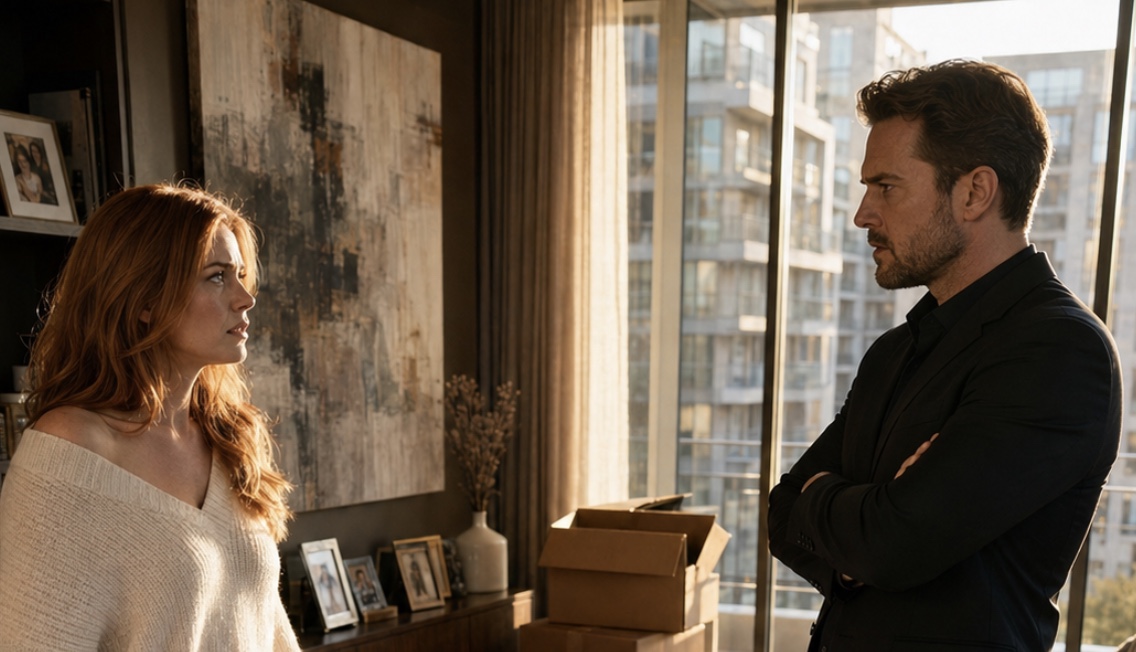
The hallway smelled of dust and cheap men’s cologne, the kind Oleg poured over himself in excessive amounts.
A swollen suitcase stood beside the front door. Oleg had never learned how to fold clothes properly. He simply forced them inside until the zipper barely closed.
“You filed for divorce, didn’t you?” Svetlana asked, looking directly into her husband’s cold eyes. “You refused to work for an entire year. And now you’re demanding compensation from me?”
Oleg smirked and adjusted the collar of his jacket.
He looked remarkably healthy. His skin had a rested glow, and his face was fuller than it had been before. A year without alarm clocks, supervisors, or responsibilities had clearly benefited him.
“What did you expect, Sveta?” he said, leaning lazily against the doorframe. “Did you think I would walk away with nothing?”
He folded his arms.
“I ruined my health because of our marriage. Constant stress, constant pressure. Your mother never stopped criticizing me, and you nagged me every day. ‘Find a job, Oleg. Go to work, Oleg.’ Maybe you caused me serious psychological trauma.”
Svetlana remained motionless.
In the past, she would have cried.
She would have begun defending herself, reminding him how hard she had tried and asking how he could treat her this way.
But something inside her had shifted. It was as though a switch had finally clicked into place.
“You’re demanding half of everything I earned during the year you stayed at home?” she asked. “You’re claiming financial support as a disabled spouse?”
“Exactly. And the law is on my side. I’ve already spoken to people who understand these things.”
Oleg gave her a satisfied look.
“I have documents showing that I was registered as unemployed. I have medical records proving that my leg hurt. So prepare yourself, darling. We’re dividing the property too. The television, laptop, washing machine—everything. Either we split the items or you pay me the value of my share. I need money to start over.”
He discussed it as casually as though he were deciding what kind of bread to buy.
He genuinely believed he was the victim.
In his distorted version of reality, Svetlana was a cruel tyrant who had tried to force a sick, defenseless man to work before throwing him out onto the street.
It had started with small requests.
“Sveta, give me two hundred rubles for my phone.”
Then came new trainers because the old ones supposedly squeezed his injured foot and made it swell.
Later, he caused a scandal because she refused to buy him a new graphics card.
“You don’t appreciate me!” he had shouted from the sofa. “I’m the provider in this family! I’m only going through a temporary setback!”
A week earlier, Svetlana had finally given him an ultimatum.
“Find any job. Sweep streets if you have to. Otherwise, leave.”
Oleg found work as a security guard.
Three days later, he quit because the building was “too drafty.”
Then he moved in with his mother.
Now he had returned to demand money.
“All right, Oleg,” Svetlana said calmly. “You want everything handled according to the law? Then that is exactly what we will do.”
“Oh, so you agree?” Oleg laughed. “Finally frightened some sense into you?”
He shook his head indulgently.
“Don’t worry. Maybe I’ll forgive part of what you owe me if you behave yourself. We aren’t complete strangers, after all.”
Triumph shone in his eyes.
He believed he was looking at the same obedient wife he had always been able to corner with threats, shouting, and manipulation.
He did not notice Svetlana clench her fists.
A moment later, she relaxed her hands.
“Leave, Oleg. We’ll meet at the notary’s office.”
“And give me the car keys while you’re at it,” he added. “We bought that car during the marriage.”
“The car is being repaired. You will receive whatever the court decides you are entitled to. Now get out.”
Her voice was quiet, but there was something in her tone that made Oleg stop smiling.
He was familiar with tears and shouting.
He was not familiar with this glacial calm.
“Fine, Sveta,” he said as he grabbed his suitcase. “You asked for this. By the time I’m finished with you, you won’t have a penny left.”
Part Three: A Two-Room Apartment in the Suburbs
Tamara Pavlovna, Oleg’s mother, stirred a thin soup in a dented saucepan.
The smell of boiled onions filled the kitchen and seemed to cling to the faded wallpaper.
Oleg sat at the table, staring at his phone.
“Well?” his mother asked without turning around. “Did you see her?”
“I did.” Oleg tore off a piece of bread and put it into his mouth. “I frightened her half to death. She just stood there blinking at me.”
“Good. She deserves it,” Tamara Pavlovna said. “I warned her often enough that a woman must take care of her husband. But she kept nagging and nagging until she destroyed her own marriage. Now she can sit alone and regret it. Who needs a thirty-five-year-old divorced woman?”
“She owes me money, Mom.”
Oleg put down his phone.
“I calculated it. It should be a decent amount. She earned well last year, and the factory paid bonuses. Half of it belongs to me. That’s the law. Everything earned during a marriage is shared.”
“Will a court really give it to you?” Tamara Pavlovna asked doubtfully.
She had always been greedy when other people’s property was involved, but legal proceedings made her nervous.
“Of course it will. I’ve been reading men’s rights forums. The law protects husbands now too. Besides, I was ill. She practically abandoned me while I was helpless.”
Tamara Pavlovna placed a bowl of watery soup in front of him.
There was not a trace of meat in it.
“Eat. And Olezhek, have you started looking for work?”
Oleg grimaced.
“What work, Mom? I’m preparing for a court case. This is serious. I need to find a lawyer and collect documents. I don’t have time for a job right now.”
“And how are you planning to live?” she asked. “My pension is not unlimited. You ate all the sausage this morning.”
“You’re my mother. You can manage for a month or two. Once I win the case, I’ll give you something from the compensation. I’ll buy you one of those… what do you call them? A multicooker.”
“A multicooker?” Tamara Pavlovna pursed her lips. “I paid five thousand rubles for utilities this month. You leave the lights on, use endless amounts of water, and that computer of yours hums all day.”
“Mom, don’t start. You sound just like Sveta. Let a man get back on his feet!”
Oleg shoved the bowl away with a loud scrape.
“I’m not eating this soup. It tastes awful. Do you have dumplings?”
“Dumplings cost money,” his mother snapped. “Go and buy some yourself.”
“I will, once I get the money from Sveta. And then I’ll move out, since you’re counting every bite I eat.”
He stormed out of the kitchen and slammed the door.
Tamara Pavlovna released a long sigh.
Her pleasure at having her “poor abandoned son” back home—and at seeing her supposedly heartless daughter-in-law punished—was disappearing rapidly.
The grown man now living under her roof ate enough for three people, insulted her cooking, and expected to be served like a guest at a hotel.
I hope Sveta pays him off quickly, she thought guiltily. Otherwise, he’ll ruin me before he ruins her.
Part Four: The Notary’s Office
The office was furnished with expensive, solemn restraint. Leather sofas lined the walls, massive oak desks dominated the rooms, and shelves were packed with neatly labeled legal files.
Oleg felt perfectly at ease.
He arrived early, sprawled across an armchair, and leafed through a magazine as though he already owned the place.
Svetlana entered at precisely the appointed time.
She looked different.
Her hair was pulled back, she wore a severe business suit, and there was no makeup on her face. In one hand, she carried a thin document folder.
“Hello, future ex-wife,” Oleg said with a grin. “Did you bring my money, or are we going to waste years fighting in court?”
“Sit down, Oleg. This will not take long.”
They took seats opposite one another at the conference table.
The notary, an older woman wearing glasses, silently arranged the documents before her.
“You said you wanted to divide our marital property,” Svetlana began. “Let us discuss exactly what there is to divide.”
“Everything,” Oleg declared. “The apartment, the car, the bank accounts. And I want compensation. I made a list.”
He threw a folded sheet of paper onto the table.
Svetlana did not even look at it.
“Very well. We’ll begin with the apartment. It was purchased while we were married.”
Oleg leaned back, looking pleased.
“However,” Svetlana continued, “the apartment was purchased entirely with money my mother gave to me as a personal gift.”
She opened her folder.
“Here is the notarized gift agreement. It specifically states that the funds were transferred to me for the purchase of real estate. Under Article Thirty-Six of the Russian Family Code, property bought with personally gifted funds remains separate property.”
She looked him straight in the eye.
“The apartment belongs to me. You have no legal claim to any part of it.”
Oleg’s smirk disappeared.
“What do you mean, no claim? We renovated it together. I put up the wallpaper!”
“The wallpaper cost three thousand rubles,” Svetlana said. “You are welcome to peel it off the walls and take it with you. But you will not receive half the value of the apartment.”
“You’re lying!” he shrieked. “That document is fake!”
“You may verify it. The notary can confirm its authenticity.”
Oleg began breathing more quickly.
The apartment had been the main prize. He had imagined selling it or forcing Svetlana to buy out his share.
Now it had vanished from his grasp.
“Fine,” he said. “What about the car? The Renault. We bought it with a loan, and we both paid for it.”
“That is correct. The car is jointly owned. But there is a complication.”
Svetlana removed another document.
“I had it professionally valued. In its present condition, the car is worth approximately four hundred thousand rubles. You damaged the bumper and destroyed part of the suspension while driving it. The remaining loan balance is three hundred and fifty thousand.”
“So?”
“The loan is in my name. I am willing to give you the car. You may take ownership of it along with responsibility for the remaining debt. You will make the payments to the bank.”
“Why would I want a car with a loan attached to it?” Oleg stared at her. “I want cash.”
“There is no cash. There is an asset with outstanding debt.”
She folded her hands on the table.
“Do you want the car or not? If you refuse, I will keep it and continue paying the loan myself. Its net value is fifty thousand rubles, which means your half amounts to twenty-five thousand.”
“Twenty-five thousand?” Oleg shot to his feet. “Are you mocking me? I haven’t worked for a year! You owe me compensation for emotional damage!”
Svetlana slowly opened the folder again and removed a single sheet of paper.
“And now we come to the most important matter.”
She placed the document in front of him.
“You wanted a legal battle. You wanted justice. Look at this.”
The paper bore the factory’s blue official stamp.
“Do you recognize it? It is an internal warehouse audit report.”
“What is this?” Oleg asked, though the blood was already draining from his face.
He recognized the factory logo.
“This document confirms that a batch of specialized optical glass was damaged during your final shift at the warehouse. As the employee responsible for the material, you concealed the damage. You hid the broken components and falsified the inventory records.”
Svetlana’s eyes remained calm.
“Quality control eventually finds everything.”
“You reported me?” he whispered, staring at her in horror.
“I did my job, Oleg. I am an inspector. My responsibility is to identify defects.”
She paused.
“And the quality of your work, much like the quality of your life, turned out to be completely defective.”
Oleg sank back into the chair.
“The factory’s legal department has already prepared a claim against you. The damaged component was valued at two hundred and eighty thousand rubles. With additional penalties for falsifying the records, the total may reach approximately three hundred and fifty thousand.”
“That can’t be…”
“The factory will seek repayment from any income you earn. If you cannot pay the entire amount immediately, deductions may be made from your future wages.”
Svetlana stood.
For the first time in months, she felt almost weightless.
“The twenty-five thousand rubles representing your share of the car can be applied toward the debt. That will still leave approximately three hundred and twenty-five thousand outstanding.”
She gathered her papers.
“One more thing. I packed your belongings into boxes and placed them in the shared entryway outside the apartment. Collect them before five o’clock today. After that, the neighbors may throw them away.”
Oleg sat with his mouth open.
He looked crushed.
Svetlana had not shouted.
She had not cried or smashed plates.
She had simply collected the facts, arranged them in the correct order, and destroyed him with them.
Part Five: His Mother’s Living Room
Oleg sat on the old sofa, staring blankly at the dark television screen.
A dull roaring filled his head.
There was no apartment.
There was no car.
There was no compensation.
There was only a debt of more than three hundred thousand rubles owed to the factory.
Court orders, deductions, frozen bank accounts, and enforcement officers gathered in his imagination like an approaching storm.
Tamara Pavlovna entered the room carrying shopping bags.
She had returned from the supermarket in a foul mood because prices had risen again.
“Well, hero?” she asked as she unpacked her groceries. “How did the meeting go? When are you getting the money? I’ve been thinking—I need new winter boots.”
Oleg said nothing.
“Why are you silent? Have you swallowed your tongue?”
She stepped closer and looked at his face.
“What happened? Did you lose?”
“Mom… it’s complicated. The apartment belongs to her. The car still has a loan on it. And I owe the factory money.”
“How much?” Tamara Pavlovna’s voice sharpened.
“About three hundred thousand.”
Silence fell over the room.
It was the kind of silence that seemed to ring in the ears.
Tamara Pavlovna slowly lowered herself into a chair.
“You idiot,” she whispered. “Why would I need you here with debts like that?”
“Mom, support me. I feel terrible.”
“You feel terrible?” she snapped. “What about me? Am I supposed to feed you forever? You are a healthy grown man!”
The last traces of sympathy disappeared from her face.
They were replaced by raw fear for her own comfort and finances.
She realized that her son was no longer merely an unemployed freeloader.
He was a burden heavy enough to drag her down with him.
“Here is what is going to happen,” she said, planting her hands on her hips. “There will be no more ‘staying here for a while.’ You will pay for your room like any other tenant. Ten thousand rubles a month, plus your share of the utilities.”
“Mom! Are you serious? I don’t have any money!”
“Then find a job. Work as a porter, sweep streets, collect bottles—I don’t care. If you don’t pay, I will change the locks. I did not spend my life working so I could support a grown man in my old age.”
She pointed toward the door.
“Sveta may have been foolish enough to tolerate you. I am not.”
Oleg stared at his mother as though he had never seen her before.
The same woman who had encouraged him the day before, agreed with every accusation he made, and insulted Svetlana now looked at him with open hostility.
His plan had collapsed.
He had imagined himself as a king punishing a disobedient wife.
Instead, he had stepped directly into a trap built from his own greed.
“But I have nowhere else to go,” he whispered.
“That is your problem.”
Tamara Pavlovna switched off the light.
“Electricity costs money. Go to sleep. Tomorrow morning, you start looking for work. And by tomorrow evening, I expect you to bring home an advance.”
Oleg remained alone in the darkness.
He remembered Svetlana’s eyes—cold, steady, and merciless.
She had warned him.
She had given him opportunities.
She had told him exactly what he needed to do.
He had refused to listen.
He had mistaken shamelessness for strength.
Only now did he understand that real strength did not need to shout. It moved quietly, gathered evidence, and brought entire walls crashing down.
Oleg curled into himself on the worn sofa.
There would be no escape from the consequences.
And the worst punishment was not the debt.
It was the realization that he had driven away the only person who had supported him—and that now he was completely alone, despised even by his own mother.