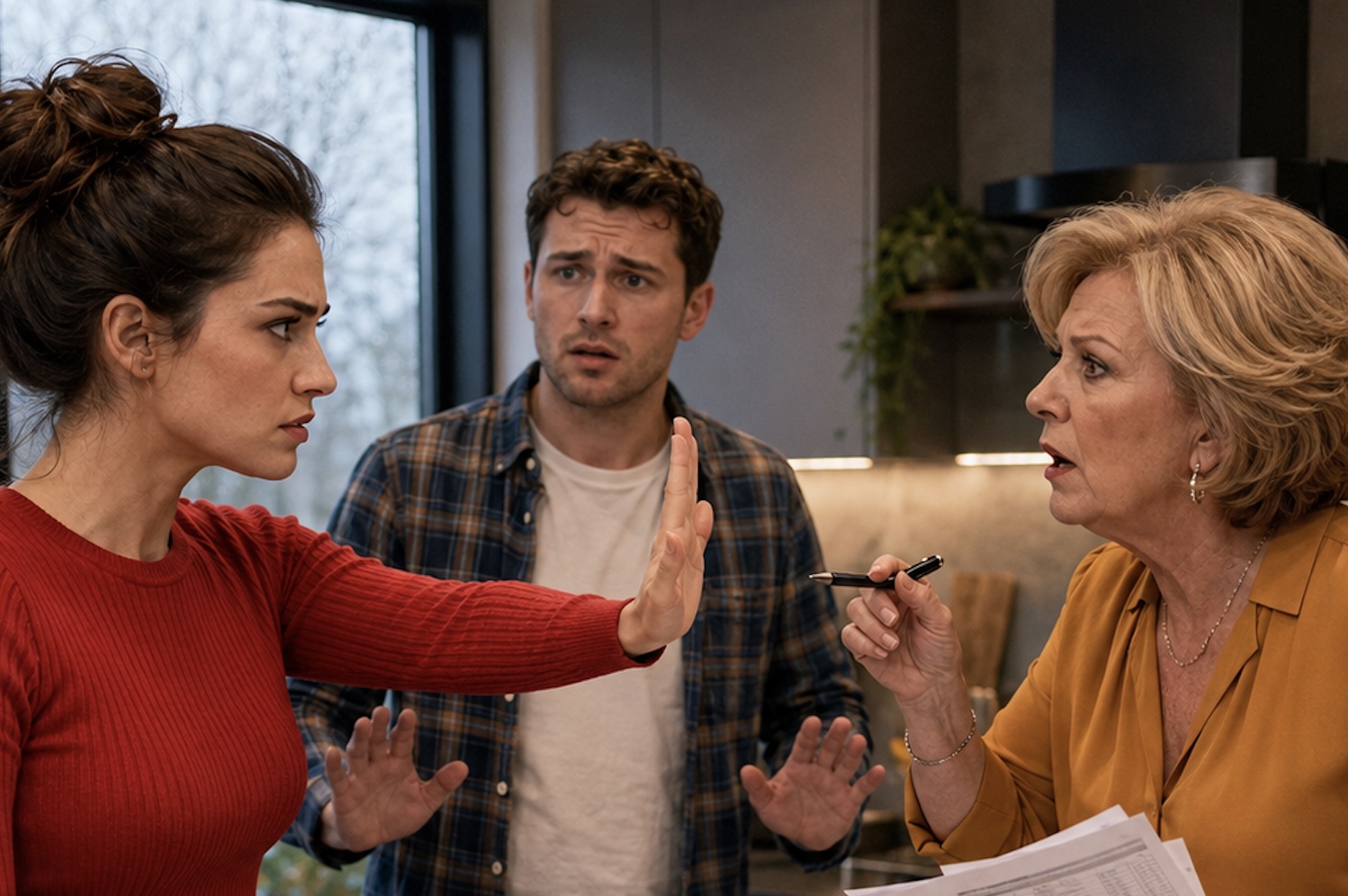
The soup was boiling far too violently, and Yana turned down the heat, even though she knew perfectly well that the soup was not the real problem.
The real problem was that Irina Valeryevna would arrive in half an hour. And whenever she came, the soup was somehow always underseasoned, the meat was overcooked, and the table was never set the way people did it “in respectable homes.”
Yana wiped her hands on a towel and looked out the window. Seventh floor. A courtyard below. Bare poplar trees. Cold November drizzle. Somewhere down in the parking lot, a neighbor was trying to start his car. The engine coughed, sputtered, and died again.
“Nikita, what time did your mother say she was coming?” Yana called toward the living room.
“Seven,” Nikita answered without looking up from his phone. “And listen… don’t get worked up right away, okay? She means well.”
She means well.
Yana almost laughed to herself. In their home, those words had acquired a very special meaning.
She and Nikita had been together for three years. They rented an apartment on the outskirts of the city. It was affordable, but far from everything. It took Yana forty minutes by bus to get to work.
She worked as a purchasing manager for a trading company and earned a decent salary—about ten thousand rubles more than her husband. Nikita worked in some technical-support department and had been talking for years about finding “a proper job,” though he never seemed to get around to it.
Their finances were shared, which in practice mostly meant Yana’s money paid for everything. That was simply how things had developed, and for a long time she had never stopped to ask whether it was fair.
Irina Valeryevna, however, thought about their finances constantly.
And she voiced those thoughts during every visit.
Her mother-in-law arrived at exactly seven carrying a cake in a cardboard box and wearing the expression of an inspector arriving to assess a property. She removed her coat in the hallway, hung it up, and glanced around as though checking the baseboards for dust.
“Hello, Yanochka,” she said, offering her cheek for a kiss. “What are you feeding us tonight?”
“Chicken soup and meat patties.”
“Store-bought patties again?”
“I made them myself.”
“Oh.”
Irina Valeryevna walked into the kitchen, lifted the lid of the pot, and sniffed.
“You use too much onion. Onion upsets Nikita’s stomach. Don’t you know that? You’ve been married for three years and still haven’t learned what your husband can eat.”
Nikita said nothing from the other room.
Yana tightened her grip on the wooden spatula.
“I know him perfectly well, Irina Valeryevna. He eats onions and has no problems.”
“He just doesn’t complain in front of you. He complains to me.”
They sat down to dinner.
Irina Valeryevna ate and commented on everything. The soup was bland. The bread was stale. The tea was too strong.
Between criticisms, she asked how much Yana had spent on her new boots. She had spotted the box in the hallway. Then she wanted to know what kind of foolishness had possessed Yana to spend that much money when she could have bought an identical pair at the market for half the price.
“They’re genuine leather,” Yana said.
“And who needs your genuine leather? You’re only going to walk through puddles in them. You clearly have money to throw away. You should be saving. You keep dreaming about buying your own apartment, but then you waste money on boots.”
Yana looked at her husband.
Nikita was carefully fishing pieces of onion out of his soup—the same onion that supposedly upset his stomach—and made no attempt to join the conversation.
As always.
As he had done for three years.
That evening, after Irina Valeryevna had left and Yana was washing the dishes, she finally lost patience.
“Nikita, did you hear the way she spoke to me? About the boots, about that ridiculous onion? Why do you always stay silent?”
Nikita came up behind her, wrapped his arms around her waist, and kissed her cheek.
“That’s just the way Mom is. You know that. She doesn’t mean any harm. She worries about us. About me. Just be patient. Is it really that difficult? One wrong word leads to another, and then there’s a scandal. What’s the point? Let’s not make things worse.”
“I don’t want to be patient. I want you, just once, to tell her that we have our own family.”
“I will. I will. Later. Just not now.”
Yana had heard that word so many times that it no longer meant anything.
Later.
Somewhere deep inside, she was still holding on to the hope that Nikita would eventually grow up. That one day he would stand between her and his mother and say enough.
Every visit from Irina Valeryevna wore that hope down a little more, like water slowly eroding stone.
But Yana endured it.
They were a family, after all.
Three years together.
Where was she supposed to put all of that?
Money was Irina Valeryevna’s favorite subject. She genuinely believed Yana’s salary belonged in a shared family pot, one she had every right to inspect because she was the elder.
Whenever she had the chance, she asked how much Yana had saved. She advised her on where to cut costs and scolded her for “unnecessary” spending: meeting friends at a café, buying a new phone case, paying for a swimming-pool membership.
In Irina Valeryevna’s view, all of that was childish indulgence. A respectable wife had no business wasting money while the family still did not own a home.
Then something happened that changed everything.
Yana’s great-aunt Tamara Stepanovna passed away.
She had been a lonely, childless woman who had spent her entire working life in the far north and, as it turned out, had managed to save a considerable amount of money.
Yana was her closest remaining relative. During the last years of the old woman’s life, Yana had visited her regularly and helped buy medicine.
According to the will, Yana inherited a little over two million rubles.
After learning about the inheritance, she barely slept for several nights. It was not only grief keeping her awake. One thought kept circling in her mind.
This was her chance.
The down payment she had dreamed about.
A home of her own.
No more rented apartments. No more forty-minute bus rides. No more living in a place where someone could arrive carrying a cake and begin inspecting the baseboards.
“Nikita,” she said one evening, switching off the television so he would listen. “I’ve thought everything through. The money from Aunt Tamara—I want to use it as a down payment on an apartment. A place of our own. For us. I’m tired of moving from one rental to another.”
At first, Nikita nodded.
He clearly liked the idea. Who would not want to move away from the outskirts?
“It sounds good,” he said slowly. “It’s a lot of money, though. Listen, why don’t we ask Mom for advice? She understands these things. She’s lived longer than we have. She might know the best way to handle it.”
Something inside Yana turned cold.
Not even because of the words themselves, but because of how casually her husband was ready to bring her inheritance before his mother for approval.
“What is there to discuss?” she asked carefully. “The money is mine, the plan is mine, and we both need an apartment.”
“Well, yes, technically. But Mom will be offended if she finds out we made such an important decision behind her back. Let’s discuss it together over dinner on Saturday. As a family. What’s the problem?”
Yana agreed.
Later, she realized that had been a mistake.
At the time, she still hoped things might go peacefully. Perhaps she was overreacting.
She was not.
Saturday’s dinner began in the usual way, with an inspection of the salad and a comment that the tablecloth should have been ironed.
Yana expected another discussion about boots, onions, or anything else from Irina Valeryevna’s usual repertoire.
Instead, the moment tea was served, her mother-in-law went straight to the point.
“Well, tell me,” she said, resting her elbows on the table. “Nikitushka mentioned that some money has fallen into your lap. An inheritance, right? How much are we talking about?”
Yana shot a glance at her husband.
Nikita stared into his cup.
So he had already told her.
Probably down to the last ruble.
“A little over two million,” Yana answered evenly.
“My goodness, that much!”
Irina Valeryevna threw up her hands.
“You cannot spend that kind of money carelessly. I’m telling you this as a mother. It has to be divided wisely, so it benefits the family instead of being thrown away.”
“That’s exactly what I intend to do. I’m using it for a down payment on an apartment.”
“Wait with your down payment.”
Her mother-in-law waved the idea away as if it were an annoying fly.
“Let me finish. I’ve been thinking. Look.”
She began counting on her fingers.
“First, a summer house. I need one. I’ve needed one for years. I spent my whole life helping both of you. I raised Nikita alone, without a father. Don’t I deserve a little garden in my old age? That’s number one.
“Next, Nikita needs a car. A man cannot get anywhere without a car these days. He needs it for work, and there is the matter of status. A man should have his own vehicle. That’s number two.
“Whatever remains can go into a bank account and earn interest. Let it sit there and grow. That is how sensible people handle money, instead of paying a down payment on some mortgage and letting a bank squeeze you by the throat for twenty years.”
Yana listened in disbelief.
She was sitting in her own kitchen while a woman who was, essentially, an outsider calmly explained how Yana’s money would be spent.
Her great-aunt’s money.
Money that represented years of hard work, sacrifice, and the last tangible memory Yana had of Tamara Stepanovna.
And there was no place for Yana anywhere in the plan.
A summer house for her mother-in-law.
A car for her husband.
The rest in a bank.
What did Yana get?
“Irina Valeryevna,” she said slowly, “where exactly am I in this arrangement?”
“What do you mean, where?”
Her mother-in-law looked genuinely surprised.
“You are part of the family. Everything belongs to everyone. It benefits you too. You’ll have a summer house to visit, your husband will have a car, and there will be savings in the bank. You should not think only about yourself, Yanochka. It is not a good look.”
Yana turned to Nikita.
This was the final test.
His last chance.
“Nikita, why are you silent? This is my money. My aunt left it to me. Say something.”
Nikita shifted uncomfortably in his chair and put down his cup.
“Well, Mom does make sense in general,” he muttered. “The money should be used wisely. A summer house would be nice. And I really do need a car. You know how much time I waste on buses.”
That was it.
In that instant, everything became clear to Yana.
Completely clear.
Irreversibly clear.
The realization clicked into place like a lock snapping shut.
Three years of hoping that her husband would eventually grow up collapsed in a single second.
He would not grow up.
He would never stand beside her.
He had already chosen his side, probably long before that dinner.
Yana simply had not wanted to see it.
“So you need a car,” she repeated quietly. “And apparently I need nothing.”
“Why nothing?” Nikita spread his hands. “It all belongs to both of us.”
Meanwhile, Irina Valeryevna was becoming increasingly enthusiastic. She took a pen and a sheet of paper from her handbag and began calculating aloud.
“Let’s see. Eight hundred thousand should be enough for the summer house. I’ve already looked at one in Malinovka. The owners are willing to negotiate. About seven hundred thousand for the car—not new, obviously, but something respectable. The rest goes into the bank. I’ll even tell you which bank to use. I know a girl there who can arrange a good interest rate. We can go tomorrow. No reason to delay.”
She spoke about the money as though it were already inside her handbag.
As though all that remained was to divide it into neat little piles.
And then everything Yana had been storing inside for three years—all the remarks about onions, boots, and strong tea, all the times Nikita had told her to be patient because his mother “didn’t mean any harm”—rose inside her at once and overflowed.
“Keep your hands off my money! It is not your wallet, and you do not get to decide how it is spent!” Yana snapped.
The pen froze between Irina Valeryevna’s fingers.
The kitchen fell silent.
Only the kettle gave a thin whistle from the stove and then went quiet.
Irina Valeryevna slowly lowered the pen.
Red patches spread across her face.
“What did you just say?”
“You heard me perfectly well.”
Yana stood up and placed both hands firmly on the tabletop.
“That money is mine. It came from my aunt. It is not yours, not his, and not some shared family fund. It belongs to me. I never gave you permission to divide it between summer houses and cars. There will be no property in Malinovka. There will be no car. I am using the money as a down payment on an apartment. End of discussion.”
“How dare you speak to me like that!”
Irina Valeryevna jumped to her feet, and the chair scraped loudly across the floor.
“I am old enough to be your mother! You greedy little woman! The moment money falls into your hands, you want everything for yourself! Who is going to think about the family? What about my son?”
“Your son?”
Yana gave a short laugh. It held no humor.
“Your son can earn money for his own car. He is a grown man. Am I supposed to support him, feed him, clothe him, and then buy him a car with the money my aunt left me?”
“A good wife does not think only about herself!” Irina Valeryevna shouted. “You are selfish! Tamara would turn in her grave if she saw how you treated your own family!”
“Do not speak about my aunt.”
There was something in Yana’s voice that made her mother-in-law fall silent.
For one second.
Only one.
“Nikita!” Irina Valeryevna turned toward her son. “Do you hear how your wife is talking to me? Are you going to stand there and say nothing?”
Nikita rose from his chair.
For one foolish fraction of a second, Yana allowed herself to hope.
Perhaps now.
Perhaps this time.
“Yana, you really are going too far,” her husband said without looking her in the eyes. “Mom has a point. You are a wife. You should be thinking about the family, not only yourself. Besides, you received the money while we were married, so technically it belongs to both of us.”
There it was.
Not his mother’s shouting.
Not the red patches on her face.
Not the summer house in Malinovka.
Those calm words from her husband hurt more than anything else.
“You should think about the family.”
“It belongs to both of us.”
He had not merely failed to defend her.
He had openly taken his mother’s side.
Right there, in front of her, without bothering to hide it anymore.
Yana looked at him for a long moment.
Then she looked at her mother-in-law.
Finally, she glanced around the rented kitchen—the stove that belonged to someone else, the curtains chosen by someone else, the table where she had spent three years listening to another person tell her how to live.
“You know what?” she said almost calmly. “Thank you. Honestly. Both of you have just helped me enormously. I finally understand everything.”
“What do you understand?” Nikita muttered.
“That I am alone here. I always have been. I just kept pretending there were two of us.”
She left the kitchen.
From the wardrobe, she pulled out the travel bag she used for business trips and began packing her clothes.
Nikita hovered in the bedroom doorway.
“What are you doing? Yana, come on. Where are you going this late? Is this really because of the money? Forget it. We don’t need the summer house. I’ll tell Mom.”
“This is not about the summer house, Nikita.”
“Then what is it about?”
Yana zipped the bag and straightened.
“It is about the fact that you are only willing to give up the summer house now that I am leaving. Five minutes ago, you needed a car and your mother was right.
“You always turn toward whoever is shouting the loudest. Tonight, she was louder, so you turned toward her. Tomorrow, perhaps I’ll shout louder and you’ll turn toward me. The day after that, she will start again.
“I cannot live like that anymore. I’m tired of constantly turning with you.”
Irina Valeryevna appeared in the kitchen doorway.
“Good! Let her go!” she declared. “Good riddance! We’ll have a much more peaceful life without her!”
Nikita weakly hissed at his mother to be quiet, but there was no force behind it.
Yana lifted the bag onto her shoulder.
In the hallway, as she pulled on the same genuine-leather boots her mother-in-law had criticized, she suddenly realized she did not feel angry or even hurt.
Instead, she felt something strange.
Something she had nearly forgotten.
Lightness.
As though she had finally removed a heavy backpack she had carried for so long that she had stopped noticing its weight.
Yana spent the first night in an inexpensive hotel near the railway station.
She lay on a hard mattress and stared at the water stains on the ceiling. For the first time in years, she did not replay her mother-in-law’s complaints or worry about how to avoid another conflict.
She simply lay there.
In silence.
The following morning, she bought coffee from a machine in the lobby. It tasted terrible, but it was her coffee, and no one told her it was too strong.
Three days later, she rented a small studio apartment.
It was tiny, but for the moment, it was hers.
A week after that, she filed for divorce.
Naturally, Nikita came looking for her.
He called. He sent messages. Once, he even waited outside her office with flowers. He looked exhausted, disheveled, and deeply apologetic.
“Yana, please come home,” he said. “I understand everything now. I had a serious conversation with Mom. She won’t interfere anymore. Forget about the argument. It’s your money. Do whatever you want with it. Let’s start again.”
Yana accepted the flowers only because refusing them in the middle of the street felt awkward.
Then she spoke quietly.
“It is too late, Nikita. I did not leave because of the money. The money was only the trigger. You both opened my eyes, and for that, I suppose I should thank you.
“I left because I spent three years waiting for you to stand beside me. But all that time, you were everywhere except by my side.”
“I can change!”
“Maybe you can. But it will not be for me.”
The divorce was straightforward and uneventful.
There was nothing to divide. The couple had never acquired any significant property together, and legally, Yana’s inheritance remained hers alone. No matter what Nikita had claimed at the dinner table, he had no right to it.
Money received as a gift or inheritance was not considered marital property. Yana confirmed that with a lawyer, just to be safe, though she had already been fairly certain.
Nikita did not seriously attempt to claim any of it. Perhaps his conscience finally bothered him. Or perhaps he simply understood that there was no point.
Until the very end, Irina Valeryevna remained convinced that her daughter-in-law had destroyed the family out of greed.
That was the story she told everyone she knew.
Money had fallen into the girl’s lap, she said, and Yana had immediately become arrogant and abandoned a perfectly good man.
Naturally, those stories never mentioned the onions.
Or the boots.
Or the summer house in Malinovka.
That summer, Yana took out a mortgage.
She used the entire inheritance—the same two million rubles—as the down payment, exactly as she had intended from the beginning.
The apartment was not large. It had two rooms in a newly built residential complex. But it had enormous windows and a balcony facing east. Every morning, sunlight flooded the kitchen all the way across the floor.
On the day she received the keys, Yana went to the empty apartment alone.
She sat directly on the floor in the middle of the living room, surrounded by bare walls that still smelled of fresh paint. There was not a single piece of furniture inside.
Beyond the windows, the city hummed.
On the windowsill, she placed a tiny pot of violets—the only thing she had brought on the first day.
She took out her phone to call someone and caught herself almost dialing an old number out of habit, ready to tell someone that it had finally happened.
Then she smiled to herself.
She closed her contacts.
There was no one she needed to call.
For the first time, that did not feel like loneliness.
It felt like silence.
The kind of silence in which she could finally hear her own thoughts.
Yana looked around the empty rooms and imagined where the sofa would go, where she would place the bookcase, and where she would hang the painting she had admired for years but never bought because she had nowhere to put it.
Now she did.
Now she was the owner of her own life.