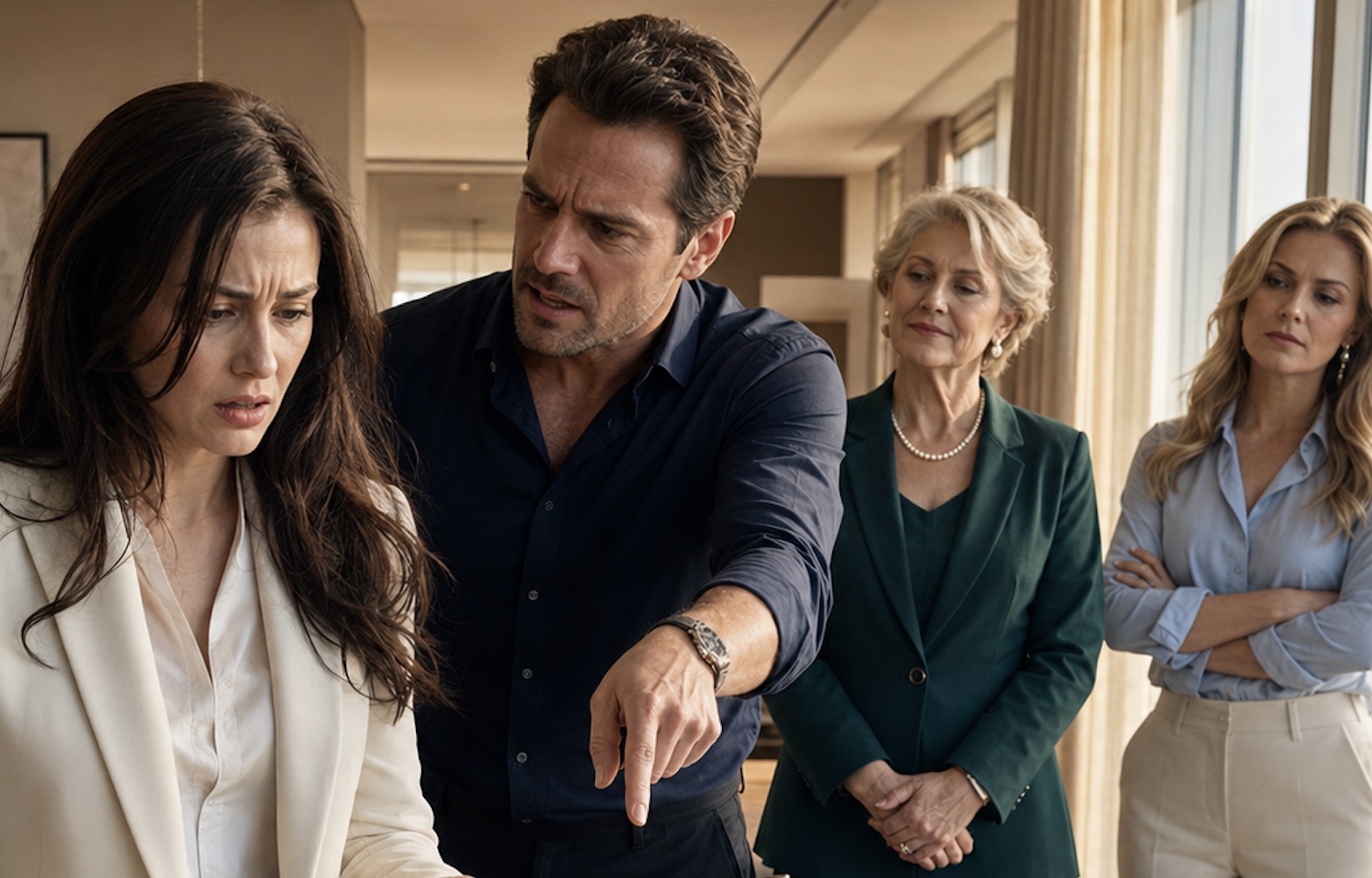
“Perfect. In a couple of years, we’ll transfer the apartment to my nephew. It’s not as if we’re going to have children anyway,” Artyom announced over dinner, without even noticing how drastically his wife’s expression had changed.
Veronika slowly placed her spoon beside her plate and studied her husband so intently that he finally looked up.
“What apartment?” she asked evenly.
“What do you mean, what apartment? Your aunt’s place. Well, yours now. Don’t get hung up on the wording.” Artyom waved his hand as though they were discussing something insignificant. “What’s the point of leaving it empty? Larisa’s son is growing up. Someone has to think about the boy’s future.”
Veronika remained silent for several seconds. There were no tears or anger on her face, only tension around her eyes and an unnaturally rigid posture.
That very morning, she had held the inheritance documents in her hands. Six months of waiting, visits to the notary, collecting certificates, sorting through her aunt’s papers, old notes, receipts, and photographs.
None of it had ever been about profit.
The apartment was the last remaining connection to the woman who had once been almost Veronika’s entire family.
Aunt Raisa had lived alone. She disliked complaining and never asked for help, but Veronika visited her anyway. She brought medicine and groceries, cleaned the windows, organized the cupboards, and sat beside her whenever her condition worsened.
Artyom had never objected.
Then again, he had never really helped either.
Sometimes he drove his wife to Raisa’s building, but more often he found some excuse or suddenly remembered that he had other things to do.
When Raisa passed away, Veronika did not fight anyone over the property. There were no other immediate heirs, and the will named her as the sole beneficiary. She quietly completed the required six-month process, received the inheritance certificate, registered ownership, and decided that she would first give herself time to breathe.
She wanted to renovate the apartment gradually, preserving the things that reminded her of her aunt.
Now Artyom sat across from her, calmly discussing someone else’s future as though Veronika had brought home not a legal document, but a family prize that everyone was free to divide.
“Artyom,” she said slowly, “that apartment belongs to me. I inherited it.”
“Who’s arguing with that?” He even smiled. “It belongs to you for now. But we have to think about the bigger picture. We don’t have children. Who will get everything after us? The government?”
“Why would it go to the government?”
“Well, it isn’t something I should decide alone.” He reached for the bread, but Veronika noticed that his fingers paused above the plate.
That meant he understood perfectly well that this was not merely an innocent suggestion.
“Mom is right,” he continued. “Property should stay in the family.”
Veronika tilted her head slightly.
“Whose family?”
Artyom frowned.
“Ours, Veronika. Don’t start.”
“At this table, our family consists of you and me. And the apartment belongs to me. Not to your mother, not to your sister, and not to your nephew.”
Her husband set down the bread and straightened in his chair.
“You’re only talking like this because you’re exhausted. All the paperwork, the stress—I understand. But think about it logically. Sveta has only one son. He’s a smart boy. Why should he spend his adult life renting rooms from strangers?”
“He is eleven years old.”
“Exactly. In a couple of years, we can arrange everything in advance and avoid unnecessary complications later.”
Veronika looked at her husband differently now.
Not as though he had said something foolish, but as though he had accidentally revealed a plan that had existed in his mind for a long time.
“In a couple of years?” she repeated. “So you didn’t come up with this today?”
Artyom looked toward the window, picked up his glass, and took several long sips of water.
“We discussed it. There’s nothing wrong with that.”
“Who is ‘we’?”
“Me, Mom, and Sveta. Vadim heard us talking too.”
Vadim was his nephew.
For a moment, Veronika could not think of anything to say.
Then several recent oddities clicked into place.
Her mother-in-law, Valentina Petrovna, had begun calling more often than usual, asking how large the apartment was, what neighborhood it was in, and whether there was a good school nearby.
Her sister-in-law, Svetlana, had suddenly started sending Veronika affectionate messages with heart emojis, although she had previously remembered her existence only before family holidays.
A couple of weeks earlier, Artyom had carefully asked whether they should “get everything arranged properly.” At the time, Veronika had assumed that he meant the utility accounts.
Now she understood.
They had already divided her inheritance among themselves.
“Interesting.” Veronika folded her hands on the edge of the table. “When were you planning to inform me?”
“Why are you reacting like this?” Artyom shoved his plate away irritably. “No one is taking anything from you. It’s just a normal family arrangement.”
“An arrangement made without the owner of the apartment?”
He exhaled loudly.
“You’re obsessing over wording.”
“No. I’m protecting my right to decide what happens to my own property.”
“Veronika, try to be compassionate. Sveta is raising her son alone. Life is difficult for her.”
“Svetlana is an adult woman. Her son does not automatically become my heir because your mother finds that convenient.”
Artyom’s face reddened. His jaw tightened visibly.
“So you’re too selfish to help?”
“I don’t resent a child for having a good future. I resent the fact that my home has already been mentally signed over to him without my consent.”
“What home? It’s an ordinary old two-bedroom apartment.”
“If it is so ordinary and outdated, why has everyone suddenly become so interested in it?”
Her husband did not answer.
The kitchen fell so quiet that Veronika could hear the refrigerator humming.
She stood, carried her plate to the sink, and then returned to the table with her phone.
“What are you doing?” Artyom asked warily.
“I’m writing to your mother. Tomorrow, all of us are meeting here. Since you discussed my apartment without me, we can discuss it again in my presence.”
“Don’t turn this into a circus.”
“Too late. The circus began before anyone invited me.”
The following evening, Valentina Petrovna did not come alone.
Svetlana arrived with her, gripping Vadim firmly by the hand even though the boy clearly had no idea why he had been brought along.
Artyom stood in the hallway, unusually silent.
Veronika immediately noticed that none of them looked surprised or confused.
They had prepared for the meeting.
“Dear Veronika,” her mother-in-law said sweetly as she entered the kitchen. “Please don’t get worked up. We’ve come with the best intentions.”
“Then we’ll begin with something simple.”
Veronika placed a folder on the table.
“This is the inheritance certificate. This is the official property record listing me as the owner. The apartment came to me through inheritance, which means it is not marital property.”
Svetlana immediately frowned.
“No one said it belonged to Artyom.”
“Your conversation yesterday suggested otherwise.”
“We were only proposing a reasonable solution,” Valentina Petrovna interjected. “You don’t have children. Surely you aren’t planning to leave it to strangers one day.”
Veronika looked at Vadim.
The boy stood near the doorway, nervously pulling at the zipper of his jacket. He looked deeply uncomfortable. Perhaps this was the first time he had realized that the adults genuinely considered him the future owner of someone else’s apartment.
“Vadim, there’s an album about different cities on the shelf in the living room. You can look through it if you’d like,” Veronika said calmly.
“He’ll stay here,” Svetlana snapped. “This concerns him.”
“No, Sveta. This concerns the adults who decided to use a child as an argument.”
Her sister-in-law flushed, but Valentina Petrovna raised a hand, signaling for her to remain silent.
“Veronika, you are an intelligent woman. Stop pretending that we came here to steal from you. We’re talking about the future. You aren’t getting any younger.”
Artyom coughed quietly, but his mother continued.
“Anything could happen. This way, the apartment would remain in reliable hands. Blood relatives, after all.”
A faint, humorless smile appeared on Veronika’s lips.
“My aunt’s blood relative is me. She chose me. Not Artyom, not you, and not Vadim.”
“Why do you keep bringing up your aunt?” Svetlana burst out. “She’s gone. The living are the ones who need help.”
Veronika slowly turned toward her.
“Aunt Raisa was a living person when I visited her after work. When I went to the pharmacy for her. When I sat beside her in hospital corridors. You never once asked whether she needed help.”
“I wasn’t obligated to!”
“Exactly. You weren’t. Just as I am not obligated to give your son an apartment.”
Svetlana opened her mouth but could not immediately find a response.
Valentina Petrovna took a handkerchief from her handbag, despite having no tears to wipe, and placed it dramatically on the table.
“You’ve become so cold, Veronika. We welcomed you into our family, and now you’re waving legal papers in our faces.”
“I’m not waving anything. I’m establishing boundaries.”
“Boundaries are for strangers,” her mother-in-law said, raising her voice. “In a real family, everything is shared.”
“Then transfer your apartment to Vadim,” Veronika suggested calmly.
Valentina Petrovna froze.
“What does my apartment have to do with this?”
“You said blood relatives should be helped. Vadim is your grandson. Sign your apartment over to him.”
“My mother lives there!” Svetlana snapped, leaning toward the table.
“And according to you, I should stop considering my aunt’s apartment mine simply because no one is living there at the moment?”
Artyom finally intervened.
“Veronika, enough. You’re taking this too far. No one is forcing you to run to a notary tomorrow.”
“Not tomorrow. You planned to do it in a couple of years.”
“Because it would be more convenient!”
“For whom?”
He pressed his lips together and looked away.
Veronika noticed the movement and decided to stop circling around the issue.
“Artyom, answer me honestly. Did you promise your sister that apartment?”
Svetlana sharply turned toward her brother.
Valentina Petrovna stopped touching her handkerchief.
The answer became obvious before Artyom even spoke.
“I said I would talk to you.”
“No. At dinner, you said, ‘We’ll transfer the apartment to my nephew.’ You didn’t say we would discuss it or think about it. You said we would do it.”
“It just came out wrong.”
“It didn’t come out wrong. It came out honestly.”
Vadim finally slipped away into the living room.
A minute later, they heard the soft sound of a page turning.
The adults in the kitchen fell silent so abruptly that it was as though the boy’s departure had stripped away their final excuse.
Svetlana was the first to speak.
“Fine. Yes, we were hoping it would happen. So what? You don’t have children anyway. You said yourself that you weren’t planning to try anymore.”
Veronika inhaled slowly, ran one palm along the edge of the table, and raised her eyes.
“I said that to my husband. In private. It was not information for a family council.”
“What’s the big deal?” Svetlana shrugged. “Everyone knows.”
Veronika looked at Artyom.
He immediately lowered his eyes.
That hurt more than the conversation about the apartment.
Not simply because his relatives knew something personal, but because Artyom had exposed what they had discussed late at night, exhausted by doctors, broken hopes, and intrusive questions.
He had taken her most vulnerable pain and turned it into an argument for giving her property to his nephew.
“I understand,” Veronika said quietly.
Artyom reached for her hand, but she pulled it away.
“Ver, I didn’t realize you would take it this way.”
“How was I supposed to take it? You discussed my inheritance, my health, and my life, then decided that because I don’t have a child, the apartment is available.”
Valentina Petrovna stood up.
“Stop being dramatic. No one has harmed you.”
“You are leaving now,” Veronika said.
“What?”
“You, Svetlana, and Vadim are leaving. This conversation is over.”
Svetlana jumped to her feet.
“Unbelievable! Artyom, are you hearing this? She’s throwing us out!”
Artyom stood pale and confused.
He had clearly expected his wife to calm down and his mother to pressure her into surrendering.
But Veronika had not calmed down.
She walked to the front door and opened it.
“Vadim, please get ready to go,” she called more gently. “This has nothing to do with you.”
The boy returned with the album in his hands and placed it carefully on the hallway cabinet.
“I’m sorry,” he murmured.
“You have nothing to apologize for,” Veronika replied.
Svetlana grabbed her son by the shoulder.
“Come on. Remember what relatives can be like.”
“Yes,” Veronika said with a nod. “Remember this. You do not take or make plans for other people’s belongings without asking.”
After they left, Artyom shut the door and turned toward his wife.
“You humiliated my mother.”
“No. I stopped her.”
“You could have been gentler.”
“And you could have avoided discussing my apartment behind my back.”
He walked into the kitchen, then returned, apparently unable to decide where to stand.
“I was trying to do what was best.”
“For whom?”
“For the family.”
Veronika looked at him wearily.
She suddenly understood that they were speaking entirely different languages.
To her, family meant respect, trust, and protection.
To Artyom, family apparently meant his blood relatives, while his wife was expected to surrender whenever it made life easier for his mother and sister.
“Artyom, tomorrow I’m going to my aunt’s apartment. I’ll collect her personal belongings and replace the lock. I will be the only person with keys.”
“Why change the lock? The old one works perfectly well.”
“Because you’ve already discussed the apartment with people who consider it practically theirs.”
“Do you really think I would give them keys?”
Veronika looked at him in silence.
Artyom lowered his eyes.
“I haven’t given them any,” he said more quietly.
“Not yet.”
The following day, Veronika took time off work and drove to Aunt Raisa’s apartment.
It was a two-bedroom flat in an old brick building beside a quiet park. The stairwell smelled of dust and fresh paint from renovations on the first floor.
Raisa’s former neighbor, Nina Sergeyevna, opened her door almost immediately, as though she had been waiting.
“Veronika, finally,” she said with relief. “I’ve wanted to call you, but I wasn’t sure whether I should.”
“Did something happen?”
Nina Sergeyevna adjusted her glasses.
“A woman came yesterday. She said she was related to the new owner. She asked when the renovation would begin and whether she could bring a few belongings over in the meantime.”
The keys twitched between Veronika’s fingers.
“What woman?”
“Blonde, loud, rather pushy. She had a boy with her. She also said, ‘The nephew will be living here soon.’ I didn’t let her in, of course. I only spoke to her through the security chain.”
Veronika closed her eyes for a few seconds, then nodded.
“Thank you for telling me.”
Inside the apartment, almost everything remained exactly as it had been during Raisa’s lifetime.
Books stood neatly on the shelves. A box of old postcards rested on a sideboard. The sewing machine remained beside the window, and the glass-fronted cabinet was still filled with carefully arranged dishes.
Veronika ran her fingertips over the sewing machine and unexpectedly smiled.
Her aunt had always said that possessions were meant to serve people, not opportunistic relatives who appeared the moment they smelled something valuable.
The locksmith arrived an hour later.
Without unnecessary questions, he removed the old lock, installed a new one, and tested all the keys.
Veronika paid him, accepted the set, and immediately placed one key in a separate compartment of her handbag.
There would be no copies for anyone else.
No spare key “just in case.”
Then she sat at the table in the small kitchen and called Artyom.
“Sveta went to my aunt’s apartment yesterday.”
The pause on the other end was long.
“How do you know?”
“The neighbor told me.”
“Maybe she only wanted to see it.”
“She asked whether she could bring belongings there.”
Artyom drew in a sharp breath.
“I’ll deal with her.”
“There’s no need. I’ve already dealt with it. The lock has been replaced.”
“Veronika, you’re making everything more complicated.”
“No. For the first time, I’m making everything simple.”
Artyom came home late that evening.
He hung his jacket unevenly, left his shoes near the entrance, then returned and placed them neatly beside the wall.
Veronika noticed and almost laughed.
Her husband was afraid of small domestic imperfections, yet apparently not afraid of major betrayals.
“I spoke to Sveta,” he began.
“And?”
“She admitted she got carried away. But you also need to understand that Mom filled her head with ideas. Sveta thought that since we had already discussed it—”
“You discussed it. Not we.”
“Fine. I discussed it. I was wrong. Are you satisfied?”
Veronika looked up from the documents.
She had been sorting her aunt’s papers into folders: utility bills, old medical records, the death certificate, and the property documents.
Everything needed to be properly organized.
“No, Artyom. I am not satisfied. This is not a marketplace where you can say ‘I was wrong’ and bargain your way out of the consequences.”
He sat across from her.
“What do you want from me?”
“I want you to understand that my aunt’s apartment will never be transferred to your nephew. Not in two years, not in ten. And no one will ever discuss it again.”
“And what if I disagree?”
Veronika raised her eyebrows.
“Disagree with what, exactly? The fact that someone else’s property does not belong to you?”
Artyom struck the table with his palm.
It was not especially hard, but the movement was sudden enough to make a pen jump and roll toward the edge.
“You’re making me sound like some kind of invader!”
“No. You’re doing that perfectly well on your own.”
He stood and paced to the window and back.
“You know what the worst part is? You don’t trust me.”
Veronika did not answer immediately.
Then she carefully closed the folder.
“Trust did not disappear by itself. You told your mother and sister about our private conversations regarding children. You allowed them to plan the future of my inheritance. Your sister has already gone to the apartment. And after all that, you’re accusing me of not trusting you?”
Artyom sat down again.
His face had gone pale and tired.
“I didn’t think Sveta would actually go there.”
“But you gave her the address?”
He remained silent.
“I see.”
The following days passed in heavy silence.
Artyom tried to behave as though everything were normal. He asked what groceries he should buy, suggested watching a film together, and once even brought Veronika flowers.
She thanked him, placed the bouquet in a vase, and never mentioned it again.
Not out of spite.
Beautiful gestures simply could not cover what had happened.
A week later, Valentina Petrovna arrived without warning.
Veronika opened the door because she was expecting a delivery.
Her mother-in-law stood on the landing with the expression of someone who had not come to make peace, but to test how far she could push.
“I’m here to see my son,” she said, trying to step inside.
Veronika did not move aside.
“Artyom isn’t home.”
“I’ll wait.”
“No.”
Valentina Petrovna narrowed her eyes.
“So now you won’t even let me into my son’s apartment?”
“This apartment belongs to Artyom and me. We bought it during our marriage. But at the moment, I am home alone, and I am not receiving guests.”
“You learned your legal rights very quickly.”
“I had to.”
Her mother-in-law leaned closer.
“Do you really think it is worth destroying a family over some two-bedroom apartment? Artyom will come to his senses eventually. Men don’t like greedy women.”
Veronika looked at her calmly.
“Women don’t like being treated as attachments to property documents.”
“You’ll see.” Valentina Petrovna tightened her grip on her handbag. “Artyom will eventually understand who his real family is.”
“He is free to decide. Just not while standing in my doorway.”
Veronika closed the door.
Her hands trembled, but not from fear.
They trembled from disgust at the astonishing confidence with which people came to claim what belonged to someone else, then behaved as though they were the ones being mistreated.
That evening, she told Artyom what had happened.
He listened silently and rubbed his face.
“Mom is from a different generation. She doesn’t mean any harm.”
“Did Sveta go to the apartment without meaning harm too? Did you give her the address without meaning harm? Did you reveal our private conversations about children by accident?”
“Ver, how long are you going to keep this going?”
“Until you start listening.”
“I am listening!” He stood abruptly. “But you need to listen to me too. I’m being torn apart between you.”
“Between whom? Your wife and the people trying to claim her property?”
“It isn’t only about property! They are my relatives!”
“And who am I?”
Artyom opened his mouth but said nothing.
That silence was answer enough.
Veronika walked into the bedroom, took a small travel bag from the wardrobe, and brought it to the hallway.
“Pack enough clothes for a few days.”
“What?”
“Go stay with your mother. Think about where your home is and who your family is.”
“You’re throwing me out?”
“Yes.”
“From our apartment?”
“From an apartment where I no longer feel safe beside a man who gives his relatives addresses and plans involving my property.”
He stared at her as though he were seeing her for the first time.
Then he gave a short, unpleasant laugh.
“Seriously? Are you going to call the police?”
“If you start a scene and refuse to leave, I will.”
For several seconds, Artyom studied her face, apparently searching for uncertainty.
He did not find any.
He went to the bedroom and threw underwear, jeans, a sweater, and a charger into the bag.
Veronika remained in the hallway, making sure that he took only his own belongings.
When he reached for the shared folder containing their documents, she immediately stepped closer.
“That stays here.”
“My papers are in there too.”
“You can remove your own documents while I watch.”
He took his passport, driver’s license, and health insurance papers.
Veronika returned everything else to the folder.
At the front door, Artyom hesitated.
“The keys?”
“Leave them.”
“This apartment belongs to me too.”
“You’re leaving for a few days. You have one set of keys. Leave it.”
“What if I need something?”
“Call me. We’ll arrange a time.”
He placed the keys on the cabinet.
He did not throw them down. He set them there slowly and deliberately, like a challenge.
Then he walked out and slammed the door so hard that the metal shoehorn hanging in the hallway rattled.
Veronika immediately locked the door from the inside.
Then she picked up the keys, counted the sets, took out her phone, and scheduled a locksmith for the following morning.
She was not trying to permanently deny Artyom access to their jointly owned home.
She simply had no idea how many copies might already be in the possession of his relatives.
The locksmith arrived the next morning, replaced the cylinder, and gave her new keys.
Veronika placed them in the drawer with the important documents.
Artyom called on the third day.
“Mom says you changed the locks.”
“Yes.”
“That was quick.”
“After your mother’s visit, it was quick enough.”
“She wasn’t planning to break in.”
“She intended to wait for you inside our home without my permission.”
He was silent for a moment.
“I want to come back.”
Veronika closed her eyes.
For one brief second, an old habit stirred inside her: smooth everything over, explain, avoid a final rupture.
But Aunt Raisa’s photograph lay on the table beside her.
Raisa looked directly into the camera, slightly stern, as though reminding Veronika that compromise was acceptable in small matters, but not at the cost of losing yourself.
“We’ll meet on Saturday and talk,” Veronika said. “Somewhere neutral.”
“Can’t we talk at home?”
“No.”
They met in a small riverside park.
The day was cool, and only a few people occupied the benches.
Artyom arrived without flowers and without his former confidence. He sat beside her and clasped his hands together.
“I spoke to Mom and Sveta. I told them never to bring up the apartment again.”
“Good.”
“Sveta is offended.”
“She has the right to be.”
“Mom says you turned me against my own relatives.”
Veronika looked toward the water.
“And what did you say?”
Artyom remained silent for a long time.
“Nothing.”
She nodded.
“That is exactly the problem.”
“I don’t know how to argue with her.”
“Then she will spend the rest of our lives arguing with me through you.”
“I can change.”
“You can. But I am not willing to test that promise at the expense of my peace or my property.”
He turned toward her.
“Are you talking about divorce?”
“For now, I am talking about a separation. But if the pressure continues, I will file for divorce through the courts. We own an apartment together, so it will not be a simple visit to the registry office. And I will not pretend that everything is easy or that the problem will disappear by itself.”
Artyom went pale.
“Have you already decided everything?”
“I’ve decided that I will no longer allow myself to be placed on trial before your family.”
He lowered his head.
For the first time, he did not look irritated.
He looked lost.
But Veronika had finally understood that pity could not replace sound judgment.
During the following months, Artyom stayed with his mother and later rented a room of his own.
Veronika remained in their jointly owned apartment because she had no intention of leaving her home simply to make life easier for other people.
She and Artyom communicated only when necessary.
He collected his belongings at agreed times and only while Veronika was present. He no longer had keys.
When the time came to discuss their future, she offered two options.
They could sell the jointly owned apartment and divide the money through the proper legal process, or one of them could buy out the other’s share based on an independent valuation.
At first, Artyom objected.
Eventually, he realized that his family’s usual methods of pressure no longer worked.
Veronika gradually restored Aunt Raisa’s apartment.
She sorted through her aunt’s belongings without rushing. She kept some things, donated others, and gave the books to a school club where Raisa had once taught classes.
In the kitchen, she preserved a small shelf with the cups her aunt had especially loved.
She was not trying to create a museum or cling desperately to the past.
She simply wanted the apartment to retain some of the warmth of the woman who had trusted her with everything she had left.
One day, Svetlana called.
Her voice was tense, but the former arrogance was gone.
“Vadim asked why we went to your apartment that day. I had to explain it to him.”
“And what did you tell him?”
“That adults sometimes behave stupidly.”
Veronika said nothing.
“He told me he doesn’t want someone else’s apartment. Can you imagine? A child understood the situation faster than we did.”
“That’s a good thing, Sveta.”
“I’m not calling to apologize,” her sister-in-law added immediately, although her voice trembled. “I just wanted to say that we won’t go there again.”
“That is the right decision.”
The conversation ended quickly.
Veronika felt no triumph.
Only tired relief.
No one in the story had suddenly become a better person overnight. No one had transformed after a single argument.
A firm boundary had simply been drawn, and at last, everyone could see it.
Veronika and Artyom eventually divorced through the courts.
There were no dramatic public scenes.
They sold their jointly owned apartment and divided the proceeds according to an agreement approved during the proceedings.
Aunt Raisa’s apartment was excluded from the division because inherited property was not considered jointly acquired marital property.
Once, Artyom tried to argue that he should at least have some kind of “moral claim” to it.
Even he heard how absurd the words sounded.
He never mentioned it again.
On the day Veronika received the final documents confirming that every financial and property matter had been settled, she drove to Raisa’s apartment.
She unlocked the door with her new key, stepped inside, removed her shoes, and stood in the hallway for a long time.
The apartment was quiet.
Not empty.
Quiet.
She walked into the kitchen, placed the documents in the top drawer of the cabinet, and set her aunt’s photograph beside them.
Then she took down a cup and poured hot water into it, but she did not drink.
She simply held the cup in both hands and looked through the window at the park.
The apartment had not destroyed her family.
It had merely revealed that the walls of that family had been cracking for a long time, while Veronika had worked far too hard to pretend otherwise.
Sometimes an inheritance brings more than property.
Sometimes it gives a person back their voice.
And for the first time in many years, Veronika knew one thing with complete certainty:
No one would ever again enter her home and decide, on her behalf, who was entitled to her memories, her effort, or her right to live in peace.