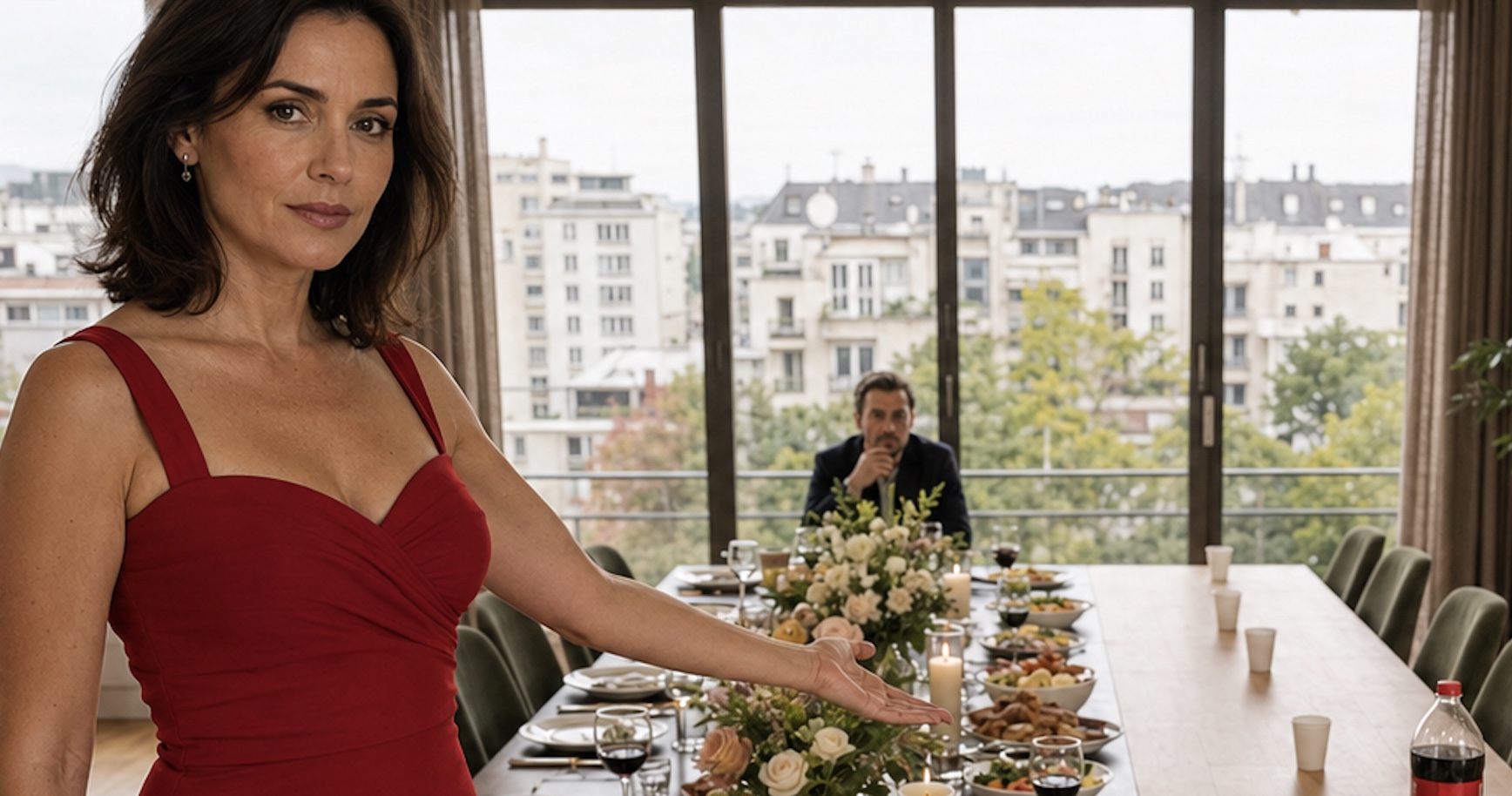
As I arranged the plates, my hands trembled slightly.
Not from fear, but from the anger I had been carefully keeping under control for months. Now it was finally escaping, like steam forcing its way out from beneath a tightly closed lid.
The table had been divided exactly in half.
On the left was a faded floral tablecloth Larisa had once brought back from the country house. I had always hated it. On top of it stood the plates from my mother-in-law’s special dinner set—the elegant ones with gold around the edges that she saved “for guests.”
There were large bowls of salad, a steaming pot of the main course, roasted meat on a serving platter, and a bottle of good wine. Candles stood in polished holders, and fresh chrysanthemums filled a small vase.
The right side was covered with an ordinary gray tablecloth, the one usually spread across the kitchen table.
There were three plain plates, a small dish of sliced sausage, a bowl of pickles taken straight from a jar, a loaf of bread, and a bottle of cheap soda.
That was all.
I stepped back and studied what I had created.
At that moment, I knew there was no turning back.
Anton entered the kitchen, saw the table, and stopped in the doorway.
“Katya,” he said.
“What?” I replied without turning around.
A long silence followed.
“Nothing,” he finally said.
But I heard the words he had not spoken.
You’re right.
Almost a year had led us to that moment.
And it had begun in the most ordinary way.
Anton and I rented a small two-bedroom apartment in a concrete nine-story building on the outskirts of the city. It was cramped, the hallway carried the lingering smell of other people’s lives, and our neighbor on the other side of the wall liked to play music far too loudly.
Still, we had grown used to the place. In our own way, we had even come to love it.
Most importantly, it felt like ours—as much as rented housing could ever belong to anyone. Our belongings were there. We woke up there every morning. We planned our future within those walls.
And our plans were real.
We were saving for an apartment of our own.
We saved carefully and stubbornly, giving up many of the things we wanted. Anton accepted extra jobs, while I worked evenings whenever I could. Every month, we put aside a fixed amount and imagined that money slowly transforming into square meters somewhere on a quiet street.
We pictured decent neighbors, windows overlooking a courtyard, and trees growing beneath them.
Our progress was slow, but it was progress.
Anton’s sister, Marina, had already bought an apartment, although she had taken a very different approach.
She had acted decisively, the way she did everything. She found a suitable place, took out a mortgage, and moved in.
We were genuinely happy for her.
The apartment was in a new building, and for Marina and her husband, Vitya, everything seemed to be going well.
Then their strict economy began.
At first, it was barely noticeable.
Marina simply started calling her mother, my mother-in-law Nina Pavlovna, more often and asking her to “bring something tasty.”
Whenever we happened to meet at a café, Vitya became less eager to pay for his own food.
They were small things, and we paid little attention to them.
The first real warning came on Vitya’s birthday.
Marina called us a week beforehand.
“Listen, we’re thinking of celebrating at Mom’s place,” she announced in the tone of someone describing a decision that had already been made. “Vitya is turning thirty-five, so we should do it properly. Could you take care of the main course and the cake? We’re living on a very tight budget right now. You know, because of the mortgage.”
Anton looked at me.
I looked out the window.
It was raining.
“All right,” Anton said.
We prepared the entire table.
We bought meat, made salads, and I baked a cake.
Marina and Vitya arrived carrying one bottle of juice and a packet of cookies from the convenience store near their building.
Nina Pavlovna looked uncomfortable and kept trying to help us arrange the food, but we told her not to worry.
The evening passed pleasantly enough.
Then came New Year’s Eve.
“Why don’t we celebrate at our place?” Marina suggested. “The apartment is big and new, and we’ve already put up the tree. You’ll bring the food, though, right? We can cook, of course, but groceries are so expensive now, and we have that payment every month.”
We brought the food.
Then there was a family celebration in the spring.
Another one in the summer.
Then one in the autumn.
Every time, Marina explained that they had a mortgage.
Every time, she said, “You understand.”
And every time, we did.
Meanwhile, our money was disappearing.
The same money that was supposed to become the walls and floors of our future home.
One evening, Anton calculated how much we had spent on their celebrations.
The total was unpleasantly large.
We both fell silent and sat for a long time in our rented kitchen, looking in opposite directions.
The conversation that finally changed everything happened at the end of September.
We were visiting Nina Pavlovna without any particular occasion. We were sitting together, drinking tea.
Marina and Vitya also stopped by “unexpectedly,” as they put it.
By then, I had already begun to suspect that their spontaneous visits to Nina Pavlovna were carefully planned. Somehow, she always had enough time to prepare something for them to eat.
We talked about ordinary things for a while.
Then Marina suddenly said, “You know, I’ve been thinking. Vitya and I still have years of mortgage payments ahead of us. A really long time. Every month, nearly all our money disappears, and we can hardly afford anything for ourselves.”
She paused and looked at us.
“You two have more freedom. You’re not tied down by a mortgage. So why don’t we agree that you’ll handle all the family celebrations from now on? You can buy the food, cook, and organize everything. Once we’ve dealt with our debts, we’ll pay you back. Or we’ll make it up to you somehow.”
The silence in the room became almost solid.
Nina Pavlovna looked away.
She always did that when something made her uncomfortable and she did not know how to respond.
Anton slowly placed his cup back on its saucer.
I looked at Marina.
At the confidence on her face.
Then I looked at Vitya, who sat beside her wearing the expression of a man who fully supported the idea but did not want to say so out loud. That way, if things went badly, he could always pretend it had nothing to do with him.
“We’re saving for a home too,” I said.
Marina waved her hand dismissively.
“Yes, but you’re renting. You don’t have the same kind of financial responsibilities we do. We’re living under extremely difficult conditions.”
“We’re struggling too,” I replied, almost calmly.
“Katya, surely you understand that these are completely different situations,” Marina said.
Her voice had taken on the tone I knew all too well: patronizing and slightly offended, as though she were explaining something obvious to an unreasonable child.
I smiled.
Then I stood up and went to wash the dishes.
Anton remained in the room.
Later, I heard him speaking quietly. Marina’s voice was louder and more forceful.
Eventually, the voices stopped.
We were silent all the way home.
Only when we reached our building did Anton speak.
“I’ll talk to her.”
“Go ahead,” I said.
He did speak to her.
Judging by the fact that nothing changed, he had not been convincing enough.
Nina Pavlovna was turning sixty in November.
It was an important birthday, but she wanted to celebrate it simply—at home, surrounded by family, in a warm and comfortable atmosphere.
Two weeks before the date, Marina sent a message to the family group chat.
“Everyone, I suggest we all contribute toward Mom’s gift and divide the food preparations. Katya, you’re the best cook among us, so will you handle the main dishes? Vitya and I will bring something light. You understand our situation.”
By “our situation,” she meant the mortgage.
Anton read the message over my shoulder.
“Katya,” he began.
“What?”
“Maybe we could just do it one last time…”
“No,” I said.
He fell silent.
Then he asked, “What are you planning to do?”
I thought about it for several days.
Not because I was torn or uncertain.
It was more like something inside me had been developing slowly, like pressure beneath the skin. Eventually, I simply understood that I had had enough.
It was not about revenge.
I did not want to humiliate anyone.
I was simply overwhelmed by a clear and undeniable sense of fairness.
I sent Marina a private message.
“We’ll come to your mother’s birthday. We’ll prepare food for ourselves and for her. You and Vitya should bring your own.”
Marina replied almost immediately.
“Katya, what is that supposed to mean?”
I explained.
Briefly and directly.
Then Marina called me.
She spoke for a long time, loudly and indignantly. She used words like “family,” “support,” and “selfishness.”
I listened.
When she finally stopped, I said, “Marina, we want to buy an apartment too. We need money as well. I understand that you have a mortgage, but your mortgage is your responsibility, not ours.”
“But we’re family!” Marina exclaimed.
“Exactly,” I said. “That’s why I’m telling you honestly instead of remaining silent and growing more resentful.”
She ended the call.
Anton was sitting beside me, staring at the floor.
“She’s upset,” he said.
“I know.”
“This is going to look terrible at Mom’s birthday.”
“I know,” I repeated.
He was quiet for a long time.
Then he finally said, “You’re right.”
The day before the celebration, I went to the market and then to the supermarket.
I chose everything carefully: good-quality meat for roasting, fresh vegetables, and cream for the cake.
I decided to bake the cake myself.
Nina Pavlovna loved honey cake, and mine always turned out well.
Anton cleaned the apartment and then went to buy flowers.
Chrysanthemums.
They were Nina Pavlovna’s favorite.
We worked together smoothly and almost without speaking.
But there was no tension in our silence.
It felt strangely calm, like the air before a storm, when everything becomes heavy and clear at the same time.
I set the table early in the morning, before the guests arrived.
When everything was ready, I stepped back to look at it.
I felt the strange combination of satisfaction and anxiety that comes when a person finally decides to say something important.
Anton stood in the doorway.
“This is their side of the table, and this is ours,” I said aloud, simply because I needed to hear the words with my own ears.
They remained suspended in the room.
Heavy.
Honest.
Anton came over, wrapped his arms around me from behind, and pressed his cheek against mine.
“Everything will be all right,” he said.
Or perhaps he was asking.
I could not tell.
“It will,” I replied.
Nina Pavlovna arrived first.
We met her in the hallway with flowers. She kissed us both, admired the honey cake, and gently touched the chrysanthemums.
Then she entered the dining room.
When she saw the table, she stopped.
There was a long silence.
“What is this?” she asked quietly.
I explained.
Briefly, without going into every detail.
Nina Pavlovna listened while looking from one tablecloth to the other.
First the floral one.
Then the gray one.
Finally, she nodded slowly without saying anything.
She simply took my hand and gently squeezed my fingers.
Marina and Vitya arrived half an hour later.
Marina was carrying a shopping bag.
I glanced inside and saw a packet of chips, some sliced sausage, and a jar of pickles.
Exactly what she had meant by “something light.”
Vitya wore a polite, automatic smile.
They entered the room.
Marina saw the table and froze.
“What is this supposed to be?” she asked in a voice that promised an approaching storm.
“This is your side of the table, and this is ours,” Anton said.
He spoke more quietly than usual.
Marina turned toward me.
“Katya, are you serious?”
“Completely.”
Several seconds passed in silence.
Marina looked at Vitya.
He shrugged with the expression of a man who preferred to become invisible whenever conflict appeared.
Then Marina turned to her mother.
“Mom, are you seeing this? Do you really think this is acceptable?”
Nina Pavlovna was sitting at the head of the table, exactly where the two halves met, although her chair was slightly closer to ours.
She looked at her daughter for a long moment.
“Yes,” she finally said. “I see it.”
“And you think this is normal?”
“Marina,” Nina Pavlovna said.
There was a firmness in her voice that I had rarely heard during my years of marriage, but I knew it well.
“Sit down.”
Marina opened her mouth.
Then she closed it.
She dragged her chair out with an irritated scrape and sat.
“There is something I want to say to you,” Nina Pavlovna continued. “Not because I want to ruin the celebration, but because this is my birthday, and I have the right to say what I think.”
Vitya carefully lowered himself onto the edge of his chair.
“You took out a mortgage,” Nina Pavlovna said. “That is a good thing. It was a responsible decision, and I’m happy for you. But the mortgage was your choice. It is your responsibility. You are adults, and you understood what you were agreeing to.”
Marina stared down at the table.
“Anton and Katya want a home of their own too,” her mother continued. “They also need money. They have their own goal. When you say they should pay for every family celebration because they supposedly have nothing important to spend their money on, you are ignoring that.”
“Mom, I never said every celebration…”
“That is exactly what you said,” Nina Pavlovna replied gently but firmly. “Anton told me.”
Anton did not look up.
I realized that he and his mother had spoken without telling me.
Something warm and sharp moved through my chest.
“Do you know what I’ve learned during my sixty years?” Nina Pavlovna continued. “I raised two children, and I know this much: a family survives because of respect. It does not survive because one person drains another person’s strength and then calls it mutual support.”
Her gaze remained fixed on Marina.
“You help someone when they are in trouble. But buying an apartment and then expecting everyone else to pay for your celebrations is not an emergency. It is a choice.”
The room was so quiet that we could hear the clock ticking on the wall.
Marina lifted her head.
Her eyes were red.
I could not tell whether she was furious or trying not to cry.
“So you’re taking their side,” she said.
“I’m taking the side of fairness,” Nina Pavlovna answered. “And I’m also thinking about my future grandchild.”
She looked at me with something close to a smile.
My throat tightened.
Vitya cleared his throat.
“Maybe…” he began cautiously. “Maybe we shouldn’t do this today…”
“We’ve already started,” Nina Pavlovna said. “It’s better to finish.”
She turned back to her daughter.
“Marina, I love you. I love Vitya too. But I also love Katya and Anton. I want all of you to be happy. For that to happen, everyone must be responsible for their own decisions.”
Another long silence followed.
Then Marina said quietly, almost too softly to hear, “I’m sorry.”
It was unclear whether she was speaking to her mother, to me, to Anton, or to all of us.
Nina Pavlovna stood, walked over to her daughter, and embraced her.
Marina buried her face in her mother’s shoulder.
Vitya looked away with the expression of someone who felt ashamed but did not entirely understand what he was supposed to be ashamed of.
I stood and went into the kitchen to bring the breadbasket I had forgotten.
Mostly, I wanted to give them a moment alone.
Afterward, we all sat down at the table.
Marina moved her chair slightly closer to our half.
Vitya followed her.
Nina Pavlovna cut the first slice of honey cake and solemnly announced that it was the best cake she had ever eaten.
At first, the conversation was cautious, like people testing the surface of newly formed ice to see whether it would hold.
Gradually, the atmosphere warmed.
Marina asked me for the recipe for the cake cream.
Vitya unexpectedly turned out to be an interesting conversationalist when he discussed something other than money.
Nina Pavlovna laughed at old family stories as though she were hearing them for the first time.
At the end of the evening, when Marina and Vitya were preparing to leave, Marina paused in the hallway.
“Katya,” she said.
I turned toward her.
“I heard you today. What you did…” She hesitated. “It was harsh. But it was honest.”
I nodded.
“We’ll manage on our own,” she added, although it sounded almost like a question.
“I know,” I replied. “You will.”
Then she left.
The door closed behind her.
Nina Pavlovna stayed a little longer.
We cleared the table together while she talked about how delicious the roasted meat had been and how long it had been since she had spent such a peaceful evening with her family.
“You did well,” she said after Anton went outside to take out the rubbish.
“I was simply tired,” I replied.
“I know,” she said. “You were tired, but you still did the right thing.”
I laughed.
A moment later, she laughed too.
At the door, while putting on her coat, Nina Pavlovna stopped and said thoughtfully, “You’ll have your apartment. People like you always get there eventually.”
I helped fasten one of the buttons on her coat.
“We will,” I agreed.
After she left, Anton and I stood quietly in the empty hallway.
Outside, it was November—gray, heavy, but not hostile.
“Well?” Anton asked.
I considered the question.
“It was all right,” I said.
And it was true.
Not because everything had been solved forever.
Not because everyone had suddenly understood everything or because difficult conversations would never happen again.
Life did not work that way.
But something had shifted.
Slowly and with resistance, like a heavy piece of furniture that had not been moved for years.
At last, it had been pushed back into its proper place.
Anton wrapped his arms around me.
I rested my forehead against him.
“We’ll save enough next year,” he said.
I nodded.
The apartment somewhere on a quiet street, with trees growing in the courtyard, could wait a little longer.
We were not rushing anywhere.
We were simply moving toward it.