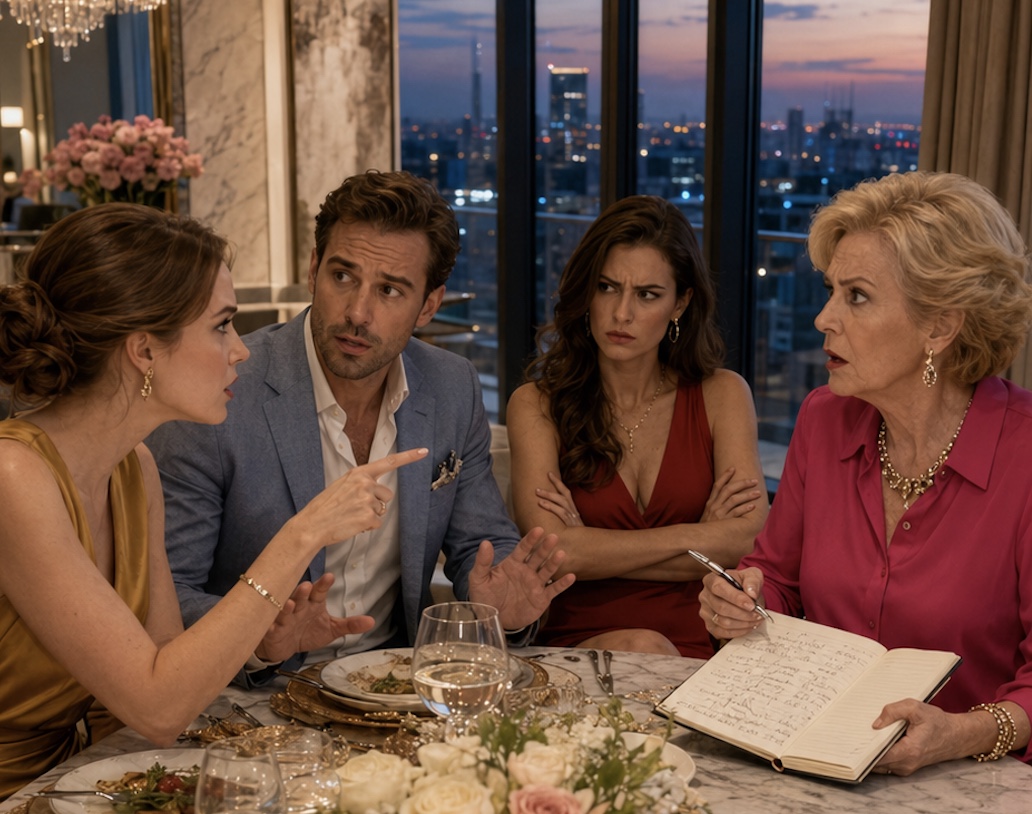
Yesenia did not like remembering how those small concessions had begun. At first, each one had seemed harmless. What was the big deal? It was her husband’s family, after all, and peace in the family mattered. Then the concessions became routine, the routine became expectation, and expectation eventually turned into entitlement. She never even noticed the exact moment when the line had been crossed.
She would not have called her three years of marriage to Rostislav unhappy. He was calm, hardworking, and knew how to ease the tension with a joke whenever something went wrong. Yesenia worked as a senior accountant for a construction company and earned around one hundred and ten thousand rubles a month. She saved carefully and spent her money only on things she considered worthwhile.
Rostislav earned a little less, about eighty-five thousand, working as an engineer at a design bureau. They lived in Yesenia’s two-bedroom apartment in a good neighborhood. She had bought it with a mortgage before they married and had nearly paid it off on her own by the time Rostislav entered her life.
The apartment was legally hers. Only about four hundred thousand rubles remained on the mortgage, and she planned to pay it off early before the end of the year. Rostislav covered groceries and utility bills. That was the arrangement they had agreed upon, and it suited them both. Overall, their life together was stable and mostly free of conflict.
Rostislav’s mother, Nina Arkadyevna, lived on the other side of the city with her husband and daughter, Kristina.
Kristina had no official job. She occasionally resold various things online—clothes, cosmetics, and other products Yesenia never fully understood. Her income was unpredictable, so she depended heavily on her parents and regularly complained to her mother that she never had enough money.
From the first few months of marriage, Yesenia sensed that Nina Arkadyevna viewed her as a kind of resource.
Not maliciously. There was no open hostility in it.
It was simply a quiet certainty that once Yesenia had married into the family, she had become part of their system. And that system operated according to a very simple rule: whenever someone in the family needed help, everyone was expected to contribute.
Especially those whom Nina Arkadyevna believed could afford it.
And, naturally, she believed that person was Yesenia.
It was not because Yesenia bragged about her salary. She was reserved and never discussed her finances. Nina Arkadyevna was simply good at calculating other people’s wealth. A nice apartment, respectable clothes, and a five-year-old car that was fully paid for—all of that formed a clear picture in her mind.
Yesenia could afford it.
At first, the requests were small.
Help buy groceries. Add a little money toward a gift for some distant relative. Drive Kristina across town because she could not afford a taxi.
Yesenia rarely refused. It honestly seemed like the ordinary chaos that came with being part of a large family. Whenever she helped, Rostislav looked at her gratefully and said things like:
“You’re wonderful. Life is so easy with you.”
At the time, Yesenia had smiled.
Now she understood those words very differently.
Gradually, something began to change. Not suddenly and not all at once. Yesenia simply started noticing that whenever Rostislav’s family talked about money, her name came up more and more often.
Not as someone participating in the discussion.
As the solution to someone else’s problem.
Once, Nina Arkadyevna casually remarked that it was fortunate Rostislav had married such a practical, capable woman.
She said it lightly, as though it were a compliment, but the word stayed with Yesenia.
Practical.
At first, she could not explain why it bothered her. Then she understood.
She had not been praised as a person. She had been assessed according to her usefulness.
There had also been the time Kristina borrowed thirty thousand rubles. She claimed a payment from one of her suppliers had been delayed and promised to return the money within a month.
A month passed.
Nothing.
Then two months.
Still nothing.
When Yesenia quietly reminded Rostislav about it, he frowned and said they should not make the situation worse. Kristina was having a difficult time.
Yesenia nodded and never mentioned the money again.
But something shifted inside her that day. Quietly and almost invisibly, yet permanently.
Rostislav was skilled at avoiding uncomfortable conversations. He never became rude or forceful. He simply changed the subject, softened the edges, assured her everything would sort itself out, and asked her not to create unnecessary tension.
For a long time, Yesenia had believed that was simply his personality.
Eventually, she understood it was a choice.
Kristina was turning thirty in September, and Nina Arkadyevna decided the anniversary had to be memorable.
A simple dinner at home would not do. There had to be a restaurant, a professional host, live music, and beautiful decorations. Everything had to look impressive and sophisticated.
The planning began in July, nearly two months before the birthday.
Yesenia learned about it by accident. One evening during dinner, Rostislav mentioned that his mother wanted to organize a proper celebration for Kristina.
Yesenia nodded without comment.
Rostislav added that they would probably need to contribute toward the restaurant.
Yesenia put down her fork.
“What exactly do you mean by contribute?” she asked.
“Well, everyone will take part. Us too.”
“When you say us, do you mean you, or both of us?”
Rostislav shrugged.
“We’re a family. And Kristina is turning thirty. That’s an important milestone.”
Yesenia did not argue that evening.
But she remembered the conversation.
Over the next two weeks, the subject came up several more times. Always casually. Always as though her participation had already been decided.
Rostislav mentioned that his mother was looking at venues, and one of them cost around seventy thousand rubles for the evening.
Then Nina Arkadyevna called Yesenia and, in the middle of an ordinary conversation, casually asked how much she was prepared to contribute.
Yesenia gave a vague answer.
“We’ll see.”
Nina Arkadyevna interpreted that as agreement.
Then it turned out the host would cost another thirty thousand. Nina Arkadyevna had supposedly arranged a discount through someone she knew, but the reservation had to be confirmed quickly.
There was also Kristina’s present—a piece of jewelry Nina Arkadyevna had found in a shop for twenty-five thousand.
Somehow, all of those expenses landed on Yesenia.
Not because anyone had asked her.
Nina Arkadyevna simply announced the prices and waited for the transfer.
One evening, Yesenia sat alone in the kitchen with a cup of tea and a sheet of paper. Without even thinking about it, she wrote down the numbers.
Restaurant: seventy thousand.
Host: thirty thousand.
Gift: twenty-five thousand.
Total: one hundred and twenty-five thousand rubles.
Almost her entire monthly salary.
For the birthday of a woman who had borrowed thirty thousand rubles from her three years earlier and never returned it.
Yesenia crumpled the paper and threw it into the trash.
Not out of anger.
She simply did not want to look at those numbers anymore.
During those days, Rostislav behaved strangely. He seemed guilty and persistent at the same time. He would approach his wife and begin talking about how important family relationships were, how much the celebration meant to his mother, and how Kristina had been going through a difficult period.
Yesenia listened in silence.
Rostislav interpreted her silence as hesitation and continued applying pressure—gently, but relentlessly.
He asked her to be understanding.
He promised the money would somehow come back later.
He repeated that family meant helping one another.
“When have they ever helped us?” Yesenia asked one day.
Rostislav fell silent.
Then he said, “That’s different.”
Yesenia did not ask him to explain how it was different. She simply stood up, cleared the table, and went into another room.
She refused calmly, without shouting or crying.
She told him she was not prepared to finance someone else’s celebration.
Rostislav treated every refusal as temporary and returned to the subject the following day.
The same conversation repeated itself for several days.
Rostislav talked about family and keeping the peace.
Yesenia said no.
Rostislav walked away looking offended.
During those conversations, Yesenia noticed something important.
Not once did Rostislav say that his mother was wrong.
Not once did he question Nina Arkadyevna’s assumed right to decide how Yesenia’s money should be spent.
He did not challenge his mother.
He tried to persuade his wife.
This was not about protecting the family.
It was about pressuring one part of the family for the benefit of another.
Nina Arkadyevna called on Wednesday and announced that everyone would gather for a family dinner on Friday evening. They needed to finalize the plans and divide the expenses.
Her tone made it sound like a business meeting where all decisions had already been made and the only remaining task was to collect signatures.
Yesenia agreed to come.
Rostislav was delighted. He assumed his wife had softened.
Yesenia did not explain anything. She simply nodded and returned to what she had been doing.
On Friday, she dressed plainly in dark trousers and a simple blouse. Nothing flashy.
She arrived with Rostislav, greeted everyone, and sat down at the table.
Nina Arkadyevna’s apartment was large, with three rooms in an old building. The ceilings were high, and the heavy furniture looked as though it had been standing in the same places for thirty years.
The table was covered with food. The air smelled of roasted meat and homemade pies.
Under different circumstances, it might have felt warm and welcoming.
Kristina sat across from Yesenia in a new dress, her manicure perfect, looking pleased with herself. She already carried herself like the guest of honor, even though the birthday was still six weeks away.
Beside Nina Arkadyevna lay an open notebook. She had clearly prepared in advance.
At first, they ate.
The conversation moved from one harmless subject to another: the weather, neighborhood news, and a nearby resident whose renovation work was disturbing everyone.
Rostislav was animated and laughed often.
Yesenia ate quietly. Not demonstratively. She simply had no desire to join the conversation.
Then Nina Arkadyevna opened the notebook.
“Well, let’s get down to business,” she said in the voice of someone accustomed to having her words treated as decisions. “I found a good venue in the city center. It holds forty people and costs sixty-eight thousand rubles for the evening, including service. The host is Sergey. I’ve known him for years, and he’s reliable. That will be thirty-two thousand. I also found a beautiful pendant with a stone for Kristina. That costs twenty-six thousand. The total is one hundred and twenty-six thousand. Yesenia, you will cover the restaurant and the host. Your father-in-law and I will pay for the gift and the remaining expenses.”
Nina Arkadyevna said all of this without pausing. Then she immediately lowered her eyes to the next note in her notebook, something about the menu.
Kristina nodded in approval.
Rostislav looked at his wife.
Yesenia placed her fork on the plate.
Quietly and carefully.
Then she raised her eyes to her mother-in-law.
“Nina Arkadyevna,” she said evenly, “I think you have confused me with someone else. I do not finance other people’s celebrations.”
Silence fell over the table.
It lasted only three or four seconds, but it felt heavy and solid.
Nina Arkadyevna looked up from the notebook.
Kristina stopped chewing.
Rostislav slowly lowered his glass.
Nina Arkadyevna frowned and put down her pen.
“What do you mean, you do not finance them? This is family, Yesenia. Or do you not consider yourself part of this family?”
“I am part of Rostislav’s family,” Yesenia replied. “That does not mean I am obligated to pay for his sister’s birthday.”
“Kristina is your sister-in-law!” Nina Arkadyevna raised her voice. “She is turning thirty. This is not just an ordinary birthday. It is an important event. Are you really unable to help?”
“Helping and paying for almost everything are two different things,” Yesenia said calmly. “You did not ask me to help. You distributed my money without involving me in the decision.”
Kristina leaned back in her chair and folded her arms.
“Is it really so difficult to do something nice for the family?” she asked in the wounded tone of someone who felt unfairly mistreated. “I’m not asking for the moon.”
“One hundred thousand rubles is not asking for the moon?” Yesenia looked directly at her. There was no anger in her expression, but there was no apology either. “Three years ago, you borrowed thirty thousand from me and never returned it. I did not remind you because I did not want a conflict. But that does not mean I forgot.”
Kristina opened her mouth.
Then closed it again.
Nina Arkadyevna began talking about Kristina’s difficult circumstances, how complicated everything had been at the time, and how petty it was to keep count of money within a family.
“That is not pettiness,” Yesenia interrupted. Not rudely, but firmly, like a full stop at the end of a sentence. “That is memory.”
Rostislav had not said a single word.
He sat there, looking from his mother to his wife, clearly uncomfortable with the situation.
Not because he felt sorry for Yesenia.
Because the conflict had disrupted the picture he was used to maintaining: his mother remained satisfied, his wife tolerated everything, and life continued peacefully.
Nina Arkadyevna gathered herself and went on the offensive.
“So you are greedy,” she said slowly, as though delivering a diagnosis. “We accepted you into this family without caring that you had no special dowry or influential connections, and this is how you repay us?”
Yesenia looked at her mother-in-law and thought the words were probably meant to hurt.
By ordinary logic, they should have.
They had clearly been chosen for that purpose.
But Yesenia remained seated calmly, and the only thing she felt was a strange exhaustion from having to explain something so obvious.
“Nina Arkadyevna, you did not accept me. I married Rostislav. Those are two different things. And this has nothing to do with greed. I am simply not going to pay for something I neither want nor agreed to.”
“Rostislav,” Nina Arkadyevna turned to her son, “tell your wife to apologize to Kristina. Her behavior is unacceptable.”
Rostislav looked at Yesenia.
There was a pleading expression in his eyes.
Please, just back down.
Please, not now.
Yesenia waited.
Not hopefully. She simply waited to hear what he would say.
“Yesenia, you could have been gentler,” Rostislav finally began. “Mom only wants Kristina to be happy. Maybe you didn’t need to say it so harshly.”
“What exactly was harsh?” Yesenia asked.
“Well… you refused like that, in front of everyone.”
“Would you have preferred me to refuse differently?” She tilted her head slightly. “Or would you simply have preferred me to agree?”
Rostislav did not answer.
After a pause, he said Yesenia could apologize to Kristina—not for refusing, but for her tone.
Yesenia looked at her husband for a long moment, her expression perfectly calm.
“I am not going to apologize,” she said. “Because I did nothing wrong.”
Nina Arkadyevna began saying that nothing like this had ever happened in their family before and that daughters-in-law did not behave this way.
Kristina added something about respect.
Rostislav tried to speak again, but Yesenia had already stood up and picked up her handbag.
She calmly thanked them for dinner.
“Where are you going?” Rostislav half rose from his chair.
“Home,” she replied. “I have said what I needed to say. I see no point in continuing.”
She left without slamming the door.
The evening air was cool.
Yesenia walked to her car, got inside, placed her hands on the steering wheel, and sat there for several minutes without moving.
Streetlights glowed outside. People passed by carrying shopping bags. Somewhere in the distance, music drifted through an open window.
It was an ordinary evening.
She thought that perhaps this was what the end of something looked like.
Not an explosion.
Not shouting.
Just an empty silence inside a parked car and streetlights shining through the windshield.
Rostislav came home about an hour and a half later.
Yesenia was sitting with a book, though she was not reading it. She simply held it in her hands.
He entered, sat across from her, and began to speak. His voice sounded tired and slightly offended, like that of a man who believed he had been unfairly trapped between two opposing sides.
“You put me in an awkward position,” he said.
“Me?” Yesenia set the book aside.
“Who else? Mom is upset. Kristina is offended. Couldn’t you have avoided turning it into a performance?”
Yesenia stared at him and wondered whether he truly failed to understand what he was saying.
Or whether he understood perfectly and was pretending not to.
“Rostislav,” she said evenly, “your mother decided how my money would be spent without asking me. That was not a performance. That was me saying no.”
“She was only trying to help Kristina.”
“With my money.”
“You could have helped out of respect for the family.”
Yesenia stood and walked to the window.
Outside, the last strips of light were fading beyond the horizon.
“Rostislav, I want to tell you something, and I want you to listen. Not so we can argue, but so you understand. Every time there has been a conflict between me and your family, you have never stood beside me. You have asked me to move aside. Today was no different. I am not asking you to fight with your mother. I am asking you to understand that I have boundaries too, and you, as my husband, are supposed to respect them.”
Rostislav remained silent for a while.
Then he said, “Mom is still my mom. I can’t go to war with her.”
“I’m not asking you to go to war. I’m asking you to stand on my side at least once in a while.”
Rostislav looked away.
Yesenia watched him and waited.
Not even for an answer.
Just for some sign that he understood. For something inside him to shift. For him to say something that mattered.
Instead, Rostislav sighed and repeated the same thing she had already heard many times before.
“You know it’s complicated. Next time, just try to be gentler. For me.”
Yesenia slowly nodded.
Not because she agreed.
Because she finally understood that the conversation was over.
Not only that evening’s conversation.
All of it.
For the next several days, the apartment remained quiet.
Not the comfortable silence of two people who were tired and content to be near each other.
It was the silence of two people lost in separate thoughts, neither of whom wanted to begin another conversation.
Rostislav went to work, came home, ate dinner, and stared at his phone.
Yesenia worked. Her company was preparing its quarterly reports, which gave her a good excuse not to think about her personal life.
Nina Arkadyevna called on the third day.
Yesenia saw her name on the screen and did not answer.
A message from Rostislav arrived soon afterward.
Mom wants you to call her back. She wants to talk.
Not now, Yesenia replied.
Rostislav did not insist.
A week later, Nina Arkadyevna sent a long voice message. It was full of wounded indignation and included a list of everything she claimed to have done for the young couple, followed by the rhetorical question of how anyone could be so ungrateful.
Yesenia listened to half of it, stopped the recording, and put her phone aside.
That same evening, she sat at the kitchen table with her laptop.
Several browser tabs were open: legal consultation websites, articles about dividing property during divorce, and an online forum where people discussed similar situations.
Yesenia read everything methodically and took notes in a notebook.
The apartment was hers. She had bought it before the marriage. The mortgage had been almost entirely paid with her money.
That mattered.
They had no shared loans and no major jointly owned purchases.
Everything was relatively straightforward.
She did not cry.
Not because it did not hurt.
It did.
But the pain was quiet, without drama. It felt more like exhaustion from refusing for so long to see what had always been obvious.
Rostislav had never chosen her.
Not because he was cruel or malicious. He was, in most ways, an ordinary and decent man.
He was simply a man with a firmly established hierarchy.
His mother came first.
His wife came wherever there was space left.
Yesenia filed for divorce the following Friday.
There was no scandal and no warning speech.
She gathered the necessary documents, went to the appropriate office, and submitted them.
Then she returned home, made buckwheat with vegetables because she did not have the energy to cook anything complicated, and ate by the window while looking down at the evening courtyard.
Rostislav found out that same evening.
Yesenia placed a copy of the application in front of him and told him everything he needed was written there.
He went pale.
“Are you serious?”
“Yes.”
“Because of Kristina’s birthday?”
“No,” Yesenia replied. “Because of the last three years.”
Rostislav was silent for a long time.
Then he asked her to wait, not to rush, and to give them a chance to talk properly.
Yesenia said she was willing to talk.
They sat in the kitchen for almost two hours.
Rostislav made excuses, became angry, and then returned to making excuses again.
He said his mother had always been that way and he could not change her.
He said Yesenia was making everything more complicated.
He said she used to be calmer.
“I used to think it was temporary,” Yesenia said. “I thought you would notice. I thought it would matter to you.”
Rostislav looked at her, clearly unable to decide what to say.
Not because there was nothing he could say.
Because every possible answer would either defend his mother or admit that his wife was right.
And admitting the second was very difficult for him.
A few days later, Nina Arkadyevna started calling again. First she called Yesenia, then the home number, then Rostislav, demanding that he bring his wife to her senses.
Yesenia did not answer.
Rostislav called her himself and asked to meet. He said he wanted to try doing things differently.
She agreed to see him once, in a café on neutral ground.
Rostislav said all the correct things.
He said he was willing to work on himself.
He said he now understood how wrong everything had been.
Yesenia listened.
“You’re saying this because I filed for divorce,” she said eventually. “Not because you truly understood.”
Rostislav protested.
Yesenia did not argue.
She only pointed out that not once during the entire conversation had he said his mother was wrong.
Not once.
Even now, when he was supposedly trying to save their marriage.
Rostislav fell silent.
Then he said his mother was suffering and taking everything very hard.
Yesenia finished her coffee and stood.
“I’m not angry with you,” she said near the exit. “I truly am not. We simply want different things from life.”
The divorce was finalized three months later.
There were no serious complications. The apartment remained Yesenia’s, and there was very little property to divide.
Rostislav moved back in with his mother.
Later, Yesenia heard through mutual acquaintances that Nina Arkadyevna was telling everyone her former daughter-in-law had been greedy and arrogant, and that Rostislav was fortunate to be rid of her.
When someone repeated this to Yesenia, she merely shrugged.
Kristina’s birthday celebration still took place, though on a much smaller scale than originally planned.
They rented a modest café, hired no host, and bought a simpler gift.
Yesenia learned about it by accident and thought that, in the end, the situation had revealed exactly who had been expected to pay for the grand celebration.
Without her money, the family had discovered a more modest version of reality.
That winter, after everything was over, Yesenia paid off the mortgage ahead of schedule.
The final payment left her account on a quiet November morning while the first snow of the season fell outside.
A notification appeared on her phone.
Outstanding balance: zero.
No debt remaining.
Yesenia looked at the message and felt something she could not immediately name.
It was not exactly joy.
Nor was it simple relief.
It was something firmer.
The feeling that the ground beneath her feet was finally solid—and that no one could take it away from her.