Yulia had never understood people who lived in chaos and failed to notice it. Not chaos in the sense of dirt or mess, but in the order of things. When everything was where it was supposed to be, when nothing had to be searched for, when you came home and knew everything was exactly as you had left it. For her, it was not a whim. It was something like air. Without it, she began to feel as if she were suffocating.
Yulia bought her apartment when she was thirty-one. Before that, she had rented for seven years — first a room, then a one-bedroom apartment. She saved money from every paycheck, denied herself vacations, and put off buying new clothes. She worked as a senior specialist at an insurance company, earned a steady income, and knew how to manage money. She took out a ten-year mortgage and paid it off in eight. She made the final payment in January, and that evening she sat in the kitchen with a glass of wine, simply looking out the window.
It was her apartment.
A two-room place on the fifth floor, overlooking a park. Every shelf, every curtain, every flower on the windowsill had been chosen by her, paid for by her, decided on by her.
Yulia met Andrey about a year after she paid off the mortgage. Andrey worked as a design engineer and earned decent money — around ninety thousand a month, sometimes more when he took on extra projects. He was not handsome, not the life of the party, but reliable. That was the word Yulia kept in her mind during the first year and a half.
Reliable.
Thoughtful.
He listened when she spoke.
The conversation about the apartment happened before Andrey moved in. Yulia brought it up herself — not because she did not trust him, but because she believed important things needed to be said out loud instead of hoping the other person would somehow guess.
“Andrey, I want you to understand one thing,” she said one evening as they sat in the kitchen drinking tea. “The apartment is mine. I bought it myself, and it is registered in my name. If we live together, then we share a life, but not ownership. Do you agree with that?”
Andrey looked at her without offense.
“Of course, Yulya. You spent years earning this place. I understand.”
“Good. I just wanted it to be said clearly.”
“I appreciate that,” Andrey said, covering her hand with his. “Everything is fine.”
Back then, Yulia exhaled with relief. It seemed they had agreed.
Olga Viktorovna entered their life gradually, the way certain people know how to appear — rarely and briefly at first, then more often, and not so briefly at all. She was Andrey’s mother, sixty-seven years old, a large woman with a loud voice and absolute confidence that her presence was appropriate everywhere. During their first New Year together, Yulia thought of her as an ordinary mother-in-law — a little intrusive, perhaps, but harmless overall. By the second New Year, Yulia began to notice something else.
Olga Viktorovna always arrived with bags. Always. Inside were foods Yulia had never asked for: jars of jam, homemade cutlets in containers, pies. All of it immediately went into the refrigerator — placed there by Olga Viktorovna herself, who opened the fridge and began rearranging things without asking. She moved items around, pushed aside what was already there, and made room for her own.
“Olga Viktorovna,” Yulia once said, catching her at it, “please don’t rearrange things in my refrigerator. I’ll sort it out myself.”
“I’m helping, Yulechka,” Olga Viktorovna replied without turning around.
“I understand. But there’s no need. Truly.”
Olga Viktorovna turned, looked at her with mild surprise — the way people look at someone who has complained about something completely insignificant — and closed the refrigerator.
“As you wish.”
And the next time she visited, she opened it again and started rearranging everything.
Whenever Yulia spoke to Andrey about it, he answered in more or less the same way.
“Yulya, she just wants to help. Don’t pay attention.”
“Andrey, I ask her not to touch my things. That’s not difficult.”
“She doesn’t mean anything by it. She’s used to running a household.”
“Then let her run her own.”
“She’s my mother, Yulya. What’s the big deal?”
Yulia would go silent. Explaining further was pointless. Andrey heard her words, but he did not hear their meaning. To him, it was just a minor household conflict his wife was blowing out of proportion.
Anastasia — Andrey’s sister, thirty-four, with two boys — added another layer to the story. Platon was nine, Arseny seven. They were lively and noisy, like most children their age, but in Yulia’s apartment their presence felt especially intense because the apartment was not arranged for children. Fragile things stood on shelves, books were lined up in neat rows, and her work desk held papers that were not to be touched.
Yulia was not against children on principle. She was against children appearing in her home without her knowledge.
Anastasia brought Platon and Arseny over whenever it suited her. She would call Andrey and say, “Can we stop by?” Andrey would say, “Of course.” No one asked Yulia. Anastasia would come in, settle on the sofa, pick up her phone, and the boys would spread out through the apartment — entering rooms, touching whatever came within reach.
One day Arseny knocked over a glass of water directly onto Yulia’s work documents lying on the desk. Anastasia said, “Oh, sorry,” and wiped up the water with a towel she had taken from the bathroom rack. Yulia tried to save the papers and did her best not to look up, because if she had, she would have said something that would have taken a long time to untangle afterward.
“Andrey,” Yulia said that evening after Anastasia and the boys had left. “I need you to hear me.”
“Go ahead.”
“I’m tired. Do you understand? Tired. I come home after eight hours at work, and someone is here again. Either your mother or your sister with the children. I want to come home to my own home. Do you understand the difference?”
“Yulya, they’re not strangers.”
“Andrey, I’m not saying they’re strangers. I’m saying I’m tired. I’m saying I want to know in advance who is coming. I want to be able to say, ‘Today isn’t a good day. Let’s do it another time.’”
“So you want to forbid them from coming over?”
“No. I want to be asked.”
“Yulya, it’s strange to ask your wife for permission for your mother to come over.”
Yulia looked at him for a long time.
“Andrey. This is my apartment. We discussed this before you moved in. You said you understood.”
“I do understand. But living together is different.”
“Different how?”
“Well, when you live together, it becomes a shared home.”
“No,” Yulia said. “No, Andrey. It is not a shared home. It is my apartment, and you live in it. That was discussed.”
Andrey grimaced — not out of anger, but because the conversation had taken a direction he did not like.
“Fine,” he said. “I’ll tell you in advance.”
He did not.
Three weeks passed. During that time, Olga Viktorovna came over twice. Both times, Andrey opened the door and informed Yulia after the fact: “Mom came over.” The second time, Olga Viktorovna stayed for lunch, occupied the kitchen for three hours, and cooked something of her own using Yulia’s groceries without asking.
Yulia sat in the bedroom with the door closed, trying to finish a book she had started a week earlier and still could not get through.
“Yulya, come eat!” Olga Viktorovna called from the kitchen in the tone of a person who had taken command of someone else’s territory while sincerely believing she was doing a good deed.
“Thank you, I’m not hungry,” Yulia replied without coming out.
“At least try some. I made stuffed cabbage.”
“No, thank you.”
A pause. Then Olga Viktorovna’s voice, apparently directed at Andrey:
“Something is wrong with her. She won’t even come out to eat.”
Yulia closed the book and stared at the ceiling.
A few days later, Anastasia arrived with Platon and Arseny. Again, without warning. Yulia came home and found three pairs of shoes in the hallway, plus a child’s backpack. The television was playing in the living room, and Anastasia’s voice drifted out as she explained something to Arseny.
Yulia entered the living room. Anastasia was sitting on the sofa. Platon was digging through the bookcase, pulling books out and looking at the pictures. Arseny was playing with cars on the carpet. The cars, apparently, he had brought with him, but the carpet was Yulia’s, and for some reason that bothered her especially.
“Hello,” Yulia said.
“Oh, hi!” Anastasia smiled. “We won’t be long. Andrey said it was okay.”
“Platon,” Yulia said evenly, “please don’t touch the books.”
Platon looked at her, then at his mother.
“Platosha, did you hear?” Anastasia said without much interest, then lowered her eyes back to her phone.
Yulia turned and went into the kitchen. She poured herself water, drank it, and set the glass down. Andrey appeared in the hallway.
“Yulya, what’s wrong?”
“Nothing. Andrey, why didn’t you warn me again?”
“Well, Nastya called and said she was nearby. Yulya, you act as if you’re not happy to see people.”
“Andrey.” Yulia set the glass down. “I’m not happy that no one asked me again. Not because I’m evil. Because I’m tired. We have talked about this several times already. Every time, you say you’ll warn me. And you never warn me. Why?”
“It just kind of happens.”
“It just kind of happens,” Yulia repeated. “I see.”
She went into the bedroom and closed the door.
The hardest part began a little later, when Olga Viktorovna started coming over constantly. Not once a week, but two or three times. Sometimes she stayed until late evening. She sat in the living room, watched television, talked with Andrey, called someone on the phone. She behaved the way people behave at home, not as guests.
One day, Yulia discovered that Olga Viktorovna had rearranged the books on the living room shelf. The neat rows had become chaotic stacks. Her mother-in-law had clearly decided she had found a more convenient way to store them. Next to them stood some kind of trinket — a porcelain cat she had brought with her and placed there, apparently, as decoration.
“Andrey,” Yulia called.
Her husband came out of the kitchen.
“What happened?”
“Your mother rearranged my books.”
“Well, maybe she wanted to tidy up.”
“Andrey.” Yulia turned around. “Look at me. Not at the shelf. At me.”
Andrey looked at her.
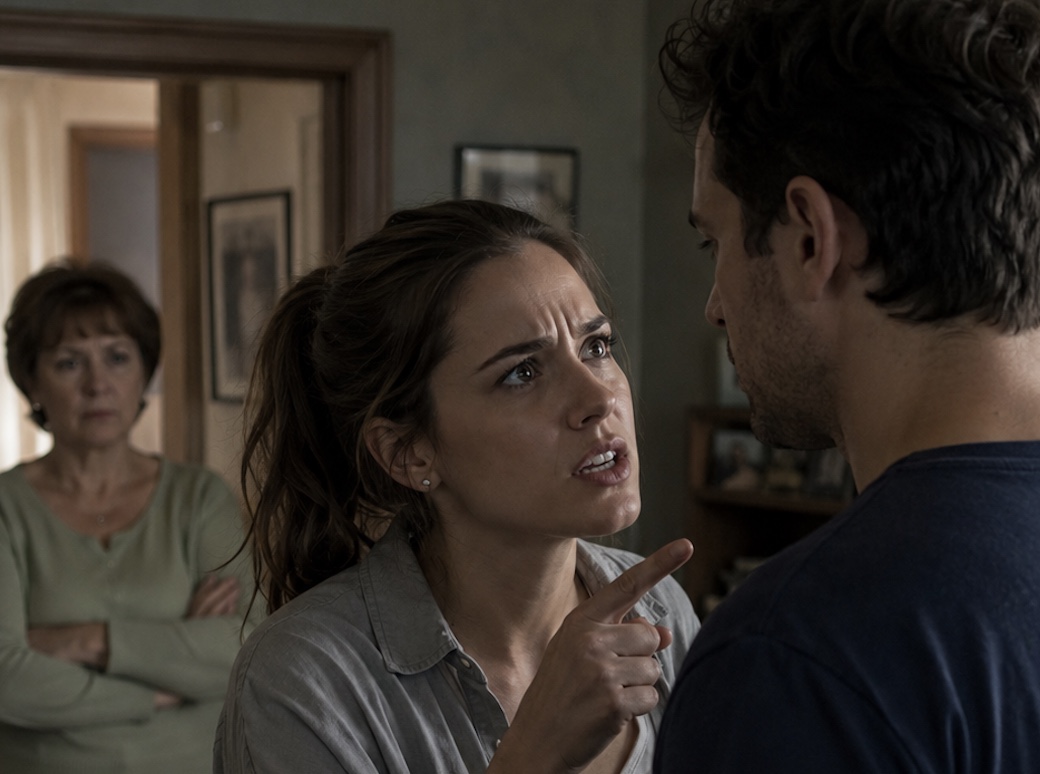
“I am not asking anymore. I am saying this one last time calmly: warn me when someone is coming. And explain to your mother and sister that my things are my things. If that does not happen, I will act on my own. Did you hear me?”
“I heard you, Yulya,” Andrey said, but in such a way that it was impossible to know whether he had heard the words or their meaning.
The decisive evening came on a Thursday. Yulia came home from work earlier than usual because a meeting had been postponed. She arrived at half past five. In the elevator, she already sensed something was wrong — she did not know what exactly, just some kind of premonition.
She opened the door.
In the hallway stood Olga Viktorovna’s boots, Anastasia’s sneakers, and two pairs of children’s shoes. Other people’s jackets hung on the rack.
Yulia stopped on the threshold. Voices came from the living room. Slowly, she took off her shoes and hung up her coat. Then she walked down the corridor.
In the living room, Olga Viktorovna was sitting in the armchair, talking to Anastasia. Anastasia was settled on the sofa. Platon and Arseny were lying on the carpet with a tablet. Andrey was sitting in the corner of the sofa with the look of a man who knew his wife would come home and had prepared an explanation in advance.
Four seconds of silence.
“Yulya’s home,” Olga Viktorovna said in a tone that made it sound like an unexpected and pleasant surprise.
“Yulya, listen,” Andrey began, “Mom called…”
“Andrey,” Yulia interrupted. “No explanations.”
She turned and went back to the hallway. Andrey followed.
“Yulya, they’re already here. It would be awkward to throw them out.”
“It isn’t awkward for me,” Yulia said and opened the living-room door. “Olga Viktorovna, Anastasia,” she said calmly, “please gather your things. You need to leave.”
Olga Viktorovna lifted her head.
“What does that mean?”
“It means exactly that. You came without warning. I did not invite you. Please get ready and leave.”
“Yulya, are you serious?” Anastasia stared at her in open astonishment. “We just got here.”
“I hear you. Nevertheless.”
“Platon, Arseny,” Yulia added, “get up, please. You’re leaving.”
The boys glanced at each other. Platon stood up, and Arseny followed.
“Andrey!” Olga Viktorovna appealed to her son in the tone of someone calling for rescue. “Are you going to say something?”
“Mom, wait,” Andrey stepped toward Yulia. “Yulya, let’s not do this. They’re not strangers.”
“I know who they are. Please get dressed.”
Olga Viktorovna stood up slowly, with the dignity of a person who had been publicly offended, and went to the hallway. Anastasia began gathering the boys’ things sharply, with demonstrative irritation. Platon quietly put on his jacket. Arseny got tangled in his sleeve, and Anastasia yanked it into place, muttering something under her breath.
Yulia stood by the door and waited.
“This is ugly, Yulya,” Olga Viktorovna said once she had put on her shoes. “People don’t treat others this way.”
“Olga Viktorovna, I asked many times to be warned in advance. Goodbye.”
Anastasia left last and threw over her shoulder:
“You do realize how awful this looks, don’t you?”
“Perhaps,” Yulia said and closed the door.
The silence in the hallway was deafening. Andrey stood two steps away.
“Do you understand what you just did?” His voice was quiet, but in that silence it was perfectly clear.
“Yes. I asked people who came without permission to leave.”
“That’s my mother, Yulya.”
“I know whose mother she is.”
“You humiliated her.”
“Andrey, I asked her to leave. Politely. Without insults.”
“It is humiliating to be thrown out of a home.”
“Out of my home,” Yulia said. “And listen to me carefully.” She looked straight at Andrey without looking away. “If she sets foot here one more time without permission, I will call the police. Do you understand?”
Andrey opened his mouth. Closed it.
“You… you can’t be serious.”
“I am very serious. The apartment is mine. The documents are in my name. If there are people in my apartment without my permission, that is a violation, and I will use my rights. I am telling you this directly, without emotion. Remember it.”
Andrey sat down on the sofa and said nothing for about five minutes. Then he said:
“You’re cruel.”
“No. I’m tired of explaining the same thing in different ways.”
“Mother is upset. Do you understand how she feels right now?”
“Andrey, I understand. And my answer remains the same.”
Andrey’s phone vibrated. He answered. Yulia could hear Olga Viktorovna’s voice, loud and offended, though she could not make out the words.
“Mom, wait,” Andrey said. “I’ll talk to her… No, Mom, don’t say that… I understand…”
Yulia went into the kitchen, poured herself water, drank it, and turned on the kettle. She listened as Andrey talked to his mother in the living room. His voice was soothing — the voice people use with someone they need to calm down while also making it clear that everything will be fixed. Yulia knew what he was most likely promising: that he would talk to his wife, that everything would settle down.
The kettle boiled. Yulia made tea, took the mug, and went into the bedroom.
Over the next several days, Andrey moved around the apartment silently — not aggressively, just silently, like a person lying low and waiting for the right moment. Yulia did not try to ease the tension. She went about her life: cooked, worked, read in the evenings. Sometimes they exchanged necessary phrases — who would pay for the internet, what needed to be bought at the store — but they did not talk about the main issue.
On the fourth day, Andrey approached her during dinner.
“Yulya, I’ve been thinking about it.”
“About what exactly?”
“About what happened. I understand I should have warned you. I admit that.”
Yulia looked at him.
“Good. And what happens next?”
“Well… I’ll warn you. And I think Mom understood too.”
“Andrey, you’ve said this before.”
“Yulya, this time I really understood.”
“Fine,” Yulia said. “We’ll see.”
She did not believe him. Not because she was vindictive, but because by then she knew very well what genuine change looked like and what temporary calm looked like. Andrey looked like the second.
A week later, Yulia came home.
She sensed something wrong from the staircase — the smell of Olga Viktorovna’s cutlets had seeped through the door, a smell Yulia had learned to recognize without mistake. She inserted the key and opened the door.
The hallway.
Olga Viktorovna’s boots.
Anastasia’s sneakers.
Two pairs of children’s shoes.
Yulia closed the door. Stood there for a moment. Then she took out her phone and dialed 102.
“Good evening,” she said when someone answered. “I want to report unauthorized people in my apartment. The address is…”
From the living room came Andrey’s voice.
“Yulya, are you home already?” And then, much quieter, clearly to someone else: “Damn.”
Yulia spoke to the dispatcher calmly and clearly, gave the address, and explained the situation. Then she went into the living room.
The scene was familiar.
Olga Viktorovna in the armchair. Anastasia on the sofa. Platon and Arseny on the carpet. Andrey stood in the middle of the room, looking like someone who had been caught off guard.
“Yulya, Mom asked me, I couldn’t…”
“The police are on their way,” Yulia said.
Olga Viktorovna straightened in the armchair.
“What?”
“I called the police. I warned you this would happen.”
“Andrey,” Olga Viktorovna turned to her son. “She called the police because of me?”
“Mom, wait…”
“Do you think this is normal? Your wife is calling the police on your mother?”
“Olga Viktorovna,” Yulia said without irritation. “I warned you a week ago. Clearly and directly. I assume Andrey passed it on to you.”
“This is my son! I have the right to visit my son!”
“This is my apartment. The rules are different here.”
The police arrived twenty minutes later. Two officers — one young, one older. They introduced themselves and asked for an explanation. Yulia calmly told them: the apartment was her property, here were the documents, the people inside were there without her consent, and she had not allowed the visit.
The older officer looked through the documents and nodded.
“This property belongs to you. That is confirmed.” Then he turned to Olga Viktorovna. “You need to leave the apartment.”
“My son lives here!” Olga Viktorovna protested.
“That does not change the owner’s rights. Please gather your things.”
Anastasia was already dressing the boys, silently, with her lips pressed tight. Platon looked at the police officers with curiosity. Arseny held his mother’s hand.
Olga Viktorovna took a long time getting dressed, preserving her dignity and muttering under her breath:
“Well, we’ve reached that point… calling the police on your own mother…”
The officer stood nearby and said nothing.
When everyone had left, one of the policemen said to Yulia:
“You acted within your rights. If it happens again, call us again.”
“Thank you,” Yulia said.
The door closed behind them.
Andrey stood in the hallway, looking at his wife. His face was strange — not angry, not guilty, but somehow emptied out, like a person who had just seen something he had been dismissing for a long time, only to realize it was real.
“Yulya,” he began.
“Wait,” Yulia said. “I’ll speak. Are you listening?”
“Yes.”
“I am not angry. I am not even offended. I am simply stating a fact: I talked to you about this many times. Each time, you said you understood. And each time, you did the same thing again. Today you let them in again without permission after I told you exactly what would happen. You made your choice. I made mine.”
“Yulya, she is my mother. I can’t refuse her.”
“Andrey. Do you hear what you’re saying? You cannot refuse your mother when she wants to come into my apartment without permission.”
“Well, yes, the apartment is yours, fine. But I live here too.”
“You lived here.”
Andrey looked up.
“What?”
“Pack your things. Please.”
“Yulya…”
“Andrey, I’m not saying this out of emotion. I’ve been thinking about it for the past few weeks. You won’t change. Not because you’re a bad person, but because to you, your mother and sister matter more than what I ask of you. That is your right. But then we cannot live together. Not here. Not like this.”
Andrey was silent for a long time. Then he asked:
“Have you really decided?”
“Yes.”
Another pause.
“All right,” he said quietly.
He packed for about an hour. Yulia sat in the kitchen, drinking tea, listening as he moved through the rooms, opened closets, and shifted things around. Twice he came into the kitchen — once to pour water, once to take something from the table. Both times he said nothing. Yulia said nothing either.
When Andrey stepped into the hallway with a bag and a backpack, he stopped by the door.
“I’ll pick up the rest later, if that’s okay.”
“We’ll arrange it in advance,” Yulia said.
Andrey nodded. He opened the door. At the threshold, he turned back.
“You are very principled, Yulya.”
“Yes,” Yulia agreed. “That’s true.”
The door closed.
Yulia sat in the kitchen for another ten minutes. Then she got up, went into the living room, took Olga Viktorovna’s porcelain cat — she had forgotten it on the shelf — and placed it on the windowsill. Then she thought for a moment and put it into a bag by the door. Andrey would take it when he came for his things.
She arranged the books on the shelf again, exactly as they had been before. In straight rows, by author. It took about fifteen minutes, and it was strangely calming.
The following days belonged to her.
Yulia came home, and there was no one there.
It sounds simple, but she did not immediately realize how important that feeling was: to enter, take off her shoes, go into the kitchen, and know that no one was sitting in the armchair, no one was cooking without permission, no one was touching her things.
Anastasia sent one message three days later — short and offended. Yulia read it and did not reply.
Olga Viktorovna did not write. Perhaps she considered it beneath her dignity.
Andrey came for his things two weeks later. He wrote in advance, as they had agreed. Yulia opened the door. They greeted each other. He collected the rest of his belongings — silently, quickly, politely. Before leaving, he said, “Well… good luck to you.”
Yulia answered, “You too.”
The door closed for the second time, and this time it was final.
She filed for divorce at the end of the month. There was nothing to divide — the apartment was hers, and they had not acquired any shared property. Everything went quietly, without scandal.
In the spring, Yulia did something she had been putting off for two years: she enrolled in a foreign language course. Not because she planned to move abroad or had some grand plan. She simply wanted to. She had wanted to for a long time, but there had always been something more important, something urgent, something demanding her attention.
Now, on Tuesdays and Thursdays, she went to classes in the evening and came home with a notebook full of new words.
One spring evening, Yulia was drinking tea in the living room and looking out the window at the park. The trees were just beginning to turn green — cautiously, little by little. The books stood on the shelf in even rows. On the windowsill were her flowers, not someone else’s trinkets.
The apartment was quiet.
It was her quiet.
Her apartment.
Her order.
She turned the page of her notebook and wrote down a new word.