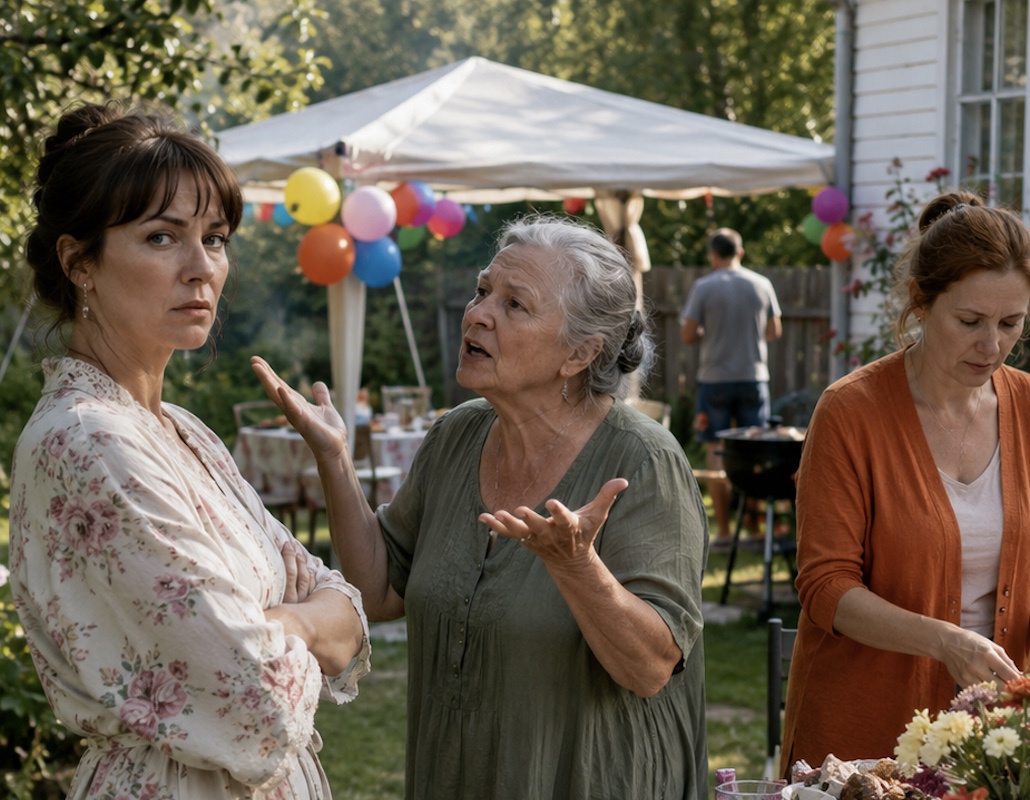
“An anniversary like mine happens only once in a lifetime, and you’re counting pennies! You’re just like your accountant mother. You don’t know how to welcome people!”
Margarita placed the phone on the table.
Lyudmila Arkadyevna’s voice blasted from the speaker across the entire dacha yard. It was on loudspeaker because her mother-in-law “couldn’t hear any other way, her ear had been blocked after the bus ride.” There had indeed been a bus ride. Whether the ear was actually blocked was another matter. But it certainly didn’t stop her from shouting loudly enough for the whole settlement to hear about her anniversary.
It was late July. Margarita was standing on her own veranda, the very same veranda where, three days earlier, they had celebrated her mother-in-law’s seventieth birthday.
“I handled everything myself!” the voice wailed from the phone. “And now you’re waving an estimate in my face like I’m some stranger! This is family, Rita, family! Blood should share, not count every coin!”
On the table in front of Margarita lay her sister-in-law’s phone. Irina had come over “to help sort things out,” though so far the only thing she had sorted out was the refrigerator, pulling out jars of her own pickled honey mushrooms and placing them on the table. Her large plastic hoop earrings swung every time she bent down.
“Mom, enough already,” Irina muttered toward the phone without looking away from the fridge. “And Rita, you’re not exactly innocent either. It was an anniversary, after all.”
Gennady, Irina’s husband, sat on the porch, intently poking the dirt between the floorboards with a twig, as if studying a pattern. Beside him on the bench lay a box with a quad bike navigator he had brought to show off but had never even unpacked.
Margarita looked at all of them in silence.
The anniversary had really happened. Twenty-five people, a tent on twelve hundred square meters of land, and a barbecue that smoked until midnight. A month earlier, her mother-in-law had written in the family chat, “I’ll take care of everything, girls, you just come and enjoy yourselves.” Twelve messages. With dates. With exclamation marks and heart emojis.
And on Monday, the bill arrived.
One hundred sixty-eight thousand “for the shared table,” with a demand that Margarita reimburse half “as part of the family.” Eighty-four thousand.
Margarita opened her banking app and scrolled through it. Meat for twenty-five people: twelve thousand. Fish, vegetables, charcoal, and a new grill because the old one had burned through: another thirteen. Tent rental: twenty-two. Fuel for her mother-in-law’s guests, whom she herself had gathered from across the district: fourteen thousand for taxis and gas. Cleaning afterward, because twenty-five people had left the place looking like a battlefield.
Seventy-four thousand. Paid from Margarita’s own card. Margarita, chief accountant of a retail chain.
She and Kostya had bought the dacha four years earlier. Twelve hundred square meters, a ninety-meter house, and a bathhouse. It had cost them three million two hundred thousand. They registered it in Margarita’s name. Kostya himself had signed the notarized consent, saying, “It’s only fair, you invested more.” Back then, Lyudmila Arkadyevna had said nothing. She had been happy that “Kostik had his own little nest.”
“Are you even listening to me?!” the phone screeched. “Am I your mother or what?!”
“My mother-in-law,” Margarita said.
“What?!”
“You are my mother-in-law. I had one mother.”
The person on the other end of the line seemed to choke.
“Is that how you speak to your elders?” Lyudmila Arkadyevna dropped her voice to a whisper, which was more frightening than shouting. “I have lived seventy years. I know how to receive guests, unlike some people! I laid out a table the whole settlement was talking about! And you’re sitting there counting your accountant pennies! Sitting in your office, adding up numbers, never having smelled real life! No children, an empty house, nothing but folders!”
Margarita set her cup down on the saucer. Quietly. Evenly.
“Folders,” she repeated.
“Folders, folders! Just like your mother!”
“All right.”
Gennady kept scraping the dirt on the porch more and more intensely. Margarita’s husband Kostya had left an hour earlier “to buy bread.” Apparently, the bread was being baked somewhere very far away. His online status was not showing.
Irina straightened up from the refrigerator and looked over the table with the practiced eye of someone used to household negotiations.
“Rita, honestly. Mom tried hard. Are we really going to divide everything by receipts now?”
“By receipts,” Margarita nodded. “Good idea, Ira.”
She picked up her phone and opened the family chat. Twenty-five people: active aunts, uncles, in-laws, relatives.
Her mother-in-law was still saying something through the speaker about ingratitude, about how she had “raised Kostik on her own,” about how “blood is sacred, while a freeloader will always be a freeloader.”
Margarita was no longer listening. She was typing.
First, she took a thin folder from her bag. Yes, a folder. Lyudmila Arkadyevna had been right about that part. Inside were the receipts. The tent rental agreement. The card statement. Screenshots of the June correspondence, including those very twelve messages saying, “I’ll take care of everything.”
She photographed every page. One by one. Without rushing.
“Why have you gone quiet?” the voice from the phone grew suspicious. “Rita!”
The photos flew into the chat.
Then came a spreadsheet. Margarita had prepared it the previous evening, calmly, like a quarterly report. She loved Excel more than people, and right now that came in handy.
“Breakdown of actual expenses for L.A.’s anniversary, July 26. Food: 25,000. Tent rental: 22,000. Guest transport: 14,000. Cleaning: 13,000. Total paid from M.’s card: 74,000.”
And below:
“Mother-in-law demanded that I pay half of her estimate: 84,000. I am deducting my 74,000 from that half. Balance: Lyudmila Arkadyevna owes Margarita 32,000. Repayment schedule at your discretion, due by September 1.”
She sent it.
Check marks appeared in the chat. Read. Read. Read. Twenty-five times.
The phone was silent for about ten seconds. Then Lyudmila Arkadyevna gasped once, sharply, and the cup she was apparently holding clinked against something hard.
“Gena,” Irina said quietly, staring at her own phone. Her hoop earrings froze. “Gena, did you see this?”
Gennady had finally discovered a very interesting splinter on the porch.
“I’ll look in the car,” he said, standing up. “Need to check the tire. Seems a little flat.”
The tire was not flat. But Gennady was already heading toward the gate with the quick, businesslike stride of a man urgently needed somewhere far away from that table.
Irina sank onto a stool. The jar of mushrooms remained open on the table.
“Rita,” she said in a completely different voice. “Are you seriously asking for thirty-two thousand?”
“I’m serious about seventy-four,” Margarita replied. “Thirty-two is after deduction. As a family arrangement. You wanted half, didn’t you?”
She put the folder back into her bag and zipped it shut.
The veranda became quiet. From the phone abandoned on the table came only distant, uneven breathing. Her mother-in-law had not hung up, but she had stopped speaking. Somewhere in her city apartment, over her own estimate of one hundred sixty-eight thousand, she was, it seemed, calculating silently for the first time that evening.
Margarita lifted the phone to her ear.
“Lyudmila Arkadyevna, are you there?”
“…I’m here,” the phone squeezed out.
“By September first,” Margarita said. “No rush. Goodbye.”
And she ended the call.
Kostya came back an hour later. Without bread. He spent a long time fussing in the entryway, then looked onto the veranda, glanced at his wife, at the empty jar of mushrooms, and at the phone.
“She called?” he asked.
“She called.”
He stood there for a moment, wanting to say something. In the end, all he said was:
“I didn’t know she was going to demand that kind of money. Honestly.”
“I know you didn’t,” Margarita said, carrying someone else’s mushrooms back to the refrigerator. “You were out buying bread.”
Kostya scratched the back of his head and went to watch television.
A week later, Lyudmila Arkadyevna called her son in tears, saying that his wife had gone mad, that she was counting his own mother by receipts, sending documents into the family chat, “shaming everyone in front of the whole family.” Kostya listened, stayed silent, and hummed in agreement. Margarita caught bits of it from the next room.
Two weeks later, Margarita sent a registered letter. With delivery confirmation. Neatly addressed to her mother-in-law. The same calculation, the same spreadsheet, only this time on paper, with a signature. Aunt Valya, Lyudmila Arkadyevna’s neighbor across the landing, later retold the story: Lyudmila Arkadyevna opened the letter, read it, and spent the entire day refusing to open the door to anyone.
A month later, Irina wrote, “Rita, let’s just forget it, okay? It’s summer. We’re family, after all.”
“We’ll forget it,” Margarita typed back. “When the transfer arrives.”
The transfer came. In parts. First eight thousand, then another ten. Lyudmila Arkadyevna couldn’t manage more at once. Her pension and the old sponge cake she sold at the market didn’t go far, and it turned out even the anniversary had been paid for on credit. According to that same Aunt Valya, Gennady never did unpack his navigator. Irina made him return it, saying the family needed the money more.
By the end of August, her mother-in-law had gone quiet. And at the beginning of September, for the first time all summer, she wrote not an order in the chat, but a question:
“Rita, may Grandpa and I come over for the weekend? I’ll let you know a week in advance, of course.”
Margarita read it. She did not answer right away. Let it sit there for a while, the way her own estimate had sat since Monday. Then she put the folder with the receipts into a metal box and snapped the lid shut.