When Artyom came back from his business trip and saw my face, he understood immediately: something had happened. Something serious.
I was standing by the window, holding a cup of tea that had gone cold long ago, staring into the courtyard as if something important were happening there, and not just other people’s dogs running around and mothers pushing strollers.
“Sasha,” he said carefully, setting his bag down on the floor. He came up behind me and touched my shoulders. “What happened?”
I turned around. And only then, when I saw his warm, confused eyes, did I feel something inside me finally begin to loosen. Everything I had been holding clenched inside me for several days started to slowly unclench. Not without pain.
“Your mother came,” I said evenly.
He read something in my tone. He sat down on the sofa and held out his hand.
“Tell me.”
And I told him. From the very beginning.
Artyom had left on Monday morning. Alyonka was still asleep, and he went into her room, kissed the top of her head, then quietly said goodbye to me in the hallway. The business trip was long — almost three weeks. I was used to his absences. I managed, settled into my own rhythm, put our daughter to bed, read aloud to her, cooked what I wanted, not what men usually liked. Three weeks without him was not a disaster. Just a different routine.
On Wednesday, closer to evening, the doorbell rang.
I had just finished washing the dishes after dinner. Alyonka was in her room, building something grand and very important out of blocks. I dried my hands on a towel and went to open the door, completely unprepared for what I was about to see.
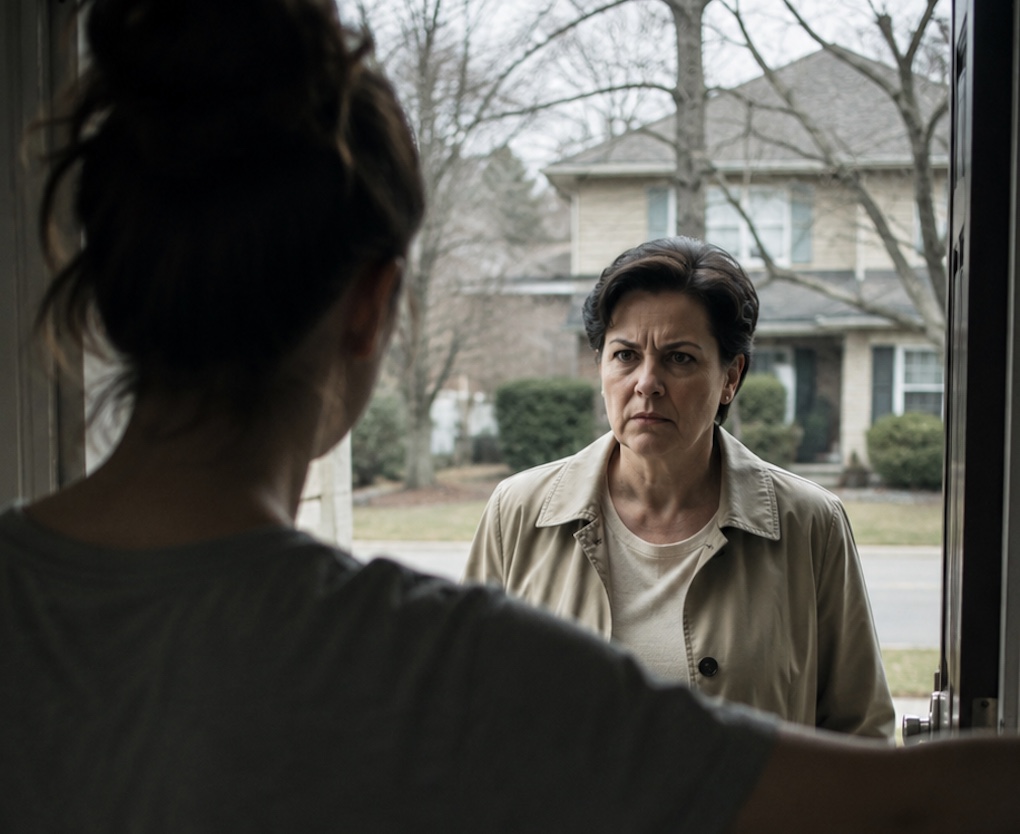
Nina Pavlovna was standing there.
My mother-in-law.
With two large suitcases and the expression of a person who had just done everyone an enormous favor.
“Well, hello, Sasha,” she said in that special tone of hers, where condescension, exhaustion, and mild reproach somehow all fit at once — as if I should have opened the door before she even rang the bell. “Here I am. Artyom is away for a long time, so I thought I should come and help.”
She had already stepped over the threshold while I was still processing what was happening.
Nina Pavlovna was a large woman, confident in herself and in the correctness of every decision she made. She never asked permission. She simply presented people with facts. That was how she had raised Artyom, how she spoke to her daughter-in-law, and apparently how she had lived her entire life — and life had never given her a single reason to doubt that approach.
“Nina Pavlovna, you didn’t warn me…” I began.
“What is there to warn about?” she said, already inspecting the hallway like an auditor. “I’m not a stranger. My son is away, you’re alone with the child, and I came to help. It’s perfectly logical.”
Logical. Yes, of course.
I took a deep breath and stepped aside. The suitcases rolled into the apartment as if they had won a victory.
Nina Pavlovna walked down the hallway, glanced into the kitchen, and looked around the living room. I followed her, feeling myself growing tense inside.
“Where would you like to put your things?” I asked, trying to sound neutral. “I can make up the sofa in the living room.”
Nina Pavlovna turned to me with slight surprise, as if I had suggested something absurd.
“The sofa? Sasha, I have a bad back. I haven’t slept on a sofa in twenty years.” She nodded toward our bedroom. “I’ll sleep in the bedroom. There’s a large bed there, I’ll be comfortable. You and Alyonka can stay in the nursery for now. There’s room there too.”
I looked at her.
She looked at me.
There was not a drop of doubt in her eyes that this was an absolutely reasonable and fair suggestion. She had come to help, which meant she had to be comfortable. Perfectly logical, wasn’t it?
“Nina Pavlovna,” I said slowly, “that is our bedroom. Mine and Artyom’s.”
“So what? Artyom isn’t here, and you’re alone. Are you really going to begrudge me a room? I came here for your sake, by the way.”
For my sake. Imagine that.
I did not argue. Not because I agreed, but because I understood that arguing at that moment would lead nowhere. Nina Pavlovna was one of those people who never lost verbal battles — not because they were right, but because they never admitted they were wrong. Those are different things, but the result is the same.
Without a word, I took clean bed linen from the closet and made the bed in the bedroom for my mother-in-law.
She settled in there like a queen who had finally returned to her chambers.
The next morning, what I mentally called “the inspection” began.
Nina Pavlovna got up before me, walked around the kitchen, opened the refrigerator, and shook her head. When I came out, she was sitting at the table drinking tea with the look of someone forced to endure difficult circumstances.
“Sasha, your refrigerator is almost empty,” she informed me instead of saying good morning. “How do you live like this? Is the child not starving?”
“I didn’t have time to go shopping yesterday,” I said, turning on the kettle. “I’ll go today.”
“You need to buy meat in advance. I always kept supplies. And greens — fresh ones, every day. And cottage cheese for the child. You don’t have any cottage cheese. I checked.”
There was cottage cheese. Nina Pavlovna had simply looked in the wrong place.
I stayed silent.
At lunchtime she came into the kitchen while I was making soup.
“Why are you cutting the carrots like that?” she asked, watching me from the doorway.
“Like what?”
“Too big. Carrots should be grated. Or cut finely. A child won’t eat large pieces.”
Alyonka ate carrots any way they came — large, small, and even raw, which she happily gnawed on. But explaining that to Nina Pavlovna was pointless.
Then she discovered that I washed the floors incorrectly. That the curtains were “somehow faded.” That the flower on the windowsill was “obviously drying out because you water it wrong.” That Alyonka’s clothes in the wardrobe were folded “all over the place.”
By that evening, my head hurt. I sat in the nursery reading Alyonka a book, and it was the only place in the apartment Nina Pavlovna had not yet reached with her inspection.
“Mom, is Grandma going to live with us for a long time?” Alyonka asked when I closed the book.
“I don’t know, sweetheart.”
“Is she always this talkative?”
I laughed quietly, so they wouldn’t hear from the living room.
“Go to sleep.”
I endured it. I told myself it wouldn’t be for long. That Nina Pavlovna was an older woman, and maybe in her own way she was trying. That a conflict with my mother-in-law was the last thing Artyom needed when he came home. That I was an adult and knew how to control myself.
I held myself together. For two days. Almost until the end of the third.
On Friday afternoon, Nina Pavlovna was sitting in the living room watching television. I came back from a walk with Alyonka. My daughter’s cheeks were rosy, she was in a wonderful mood, and she was pulling me by the hand, looking forward to lunch.
“Grandma!” Alyonka flew into the living room and rushed toward my mother-in-law with her arms wide open.
Nina Pavlovna smiled and caught her. She hugged her, then pulled back and began to look her over the way people examine a little object brought in for evaluation.
“You’ve grown,” she stated.
Then her gaze stopped on Alyonka’s hair.
That morning I had pinned her hair back with two small clips on the sides, just to keep it out of her face. Ordinary hair clips. Nothing special.
“Oh, Alyona, why did you pin your hair back like that?” Nina Pavlovna said in the tone of someone stating the obvious. “Your ears are visible. Your ears are… well, noticeable. Just like your mother’s. Artyom never had ears like that.” She shook her head. “You should cover them with your hair instead. So they don’t stand out so much.”
A second of silence followed.
Alyonka stood in front of her grandmother and looked up at her. I saw her face change — first confusion, then slow understanding, and then her lips began to tremble.
My daughter did not cry often. She took after Artyom in character — restrained, stubborn, able to hold herself together. But now she was a five-year-old child whose grandmother had just told her that her ears were ugly. That she was just like her mother. That this was a flaw.
Tears rolled down her cheeks silently, without a sound. Alyonka did not sob. She simply stood there and cried, and that was worse than any loud wailing.
Two and a half days of my patience suddenly narrowed into one point, and that point flared up into something very, very clear.
I walked over to Alyonka, stood beside her, and took her hand. My daughter pressed herself against my side.
“Nina Pavlovna,” I said.
My mother-in-law turned to me, looking somewhat surprised. Apparently, she had not expected any reaction — or she had expected my usual silence.
“I want to tell you something.”
“What is it?” she asked, slightly frowning, sensing something in my voice.
“You told my daughter that she has ugly ears,” I said quietly. Very quietly. Perhaps that was why she did not interrupt me. “A five-year-old child. A child who was happy to see you and ran to hug you.”
“I was just—”
“No,” I interrupted. “I haven’t finished.”
Nina Pavlovna fell silent. I think that “no” surprised her more than anything else.
“You came here without warning. You took over our bedroom. For three days, you have been commenting on how I run my household in my own home. I tolerated it. I thought, all right, it won’t last long, maybe she means well. But this—” I nodded toward Alyonka, who was still standing beside me, staring at the floor. “This I will not tolerate.”
Nina Pavlovna opened her mouth.
“No,” I repeated. “I’m speaking.”
Something in my tone stopped her. I did not quite recognize my own voice. It was completely calm. Maybe that was what worked. Not anger. Resolve.
“It is very good that you never unpacked your suitcases,” I said. “Because now you need to take those suitcases and leave.”
The silence in the living room became almost tangible.
Nina Pavlovna stared at me. I stared back. Something flashed in her eyes that I had never seen before — not offense, not anger, but something close to confusion. For a second, she became just an older woman being shown the door, and it might have been pitiful — if there had not been a child with wet cheeks hiding behind my leg.
“Are you serious?” she finally said.
“Absolutely.”
A pause.
“Artyom will hear about this.”
“Yes,” I agreed. “He will. I’ll tell him myself.”
Nina Pavlovna slowly rose from the sofa. She went into the bedroom and came out with her suitcases. I stood in the living room doorway and watched as she gathered the things she had left in the hallway, put on her coat, and took hold of the suitcase handles.
At the door, she turned around.
“You’ll regret this,” she said.
I opened the door.
“Goodbye, Nina Pavlovna.”
She left.
I closed the door, leaned back against it, and shut my eyes. My hands were trembling slightly. Alyonka ran up and hugged my legs.
“Mom, did you send her away?”
“Yes, sweetheart.”
“Because she hurt my feelings?”
I crouched down, hugged her, and pressed my nose into the top of her head.
“Because no one has the right to hurt you. No one, ever. Do you hear me?”
Alyonka nodded. She was silent for a moment. Then she said very seriously:
“My ears are normal.”
“Your ears are beautiful,” I confirmed.
Artyom listened in silence. He did not interrupt. I had always valued his ability to truly listen without taking a defensive position in advance.
When I finished, he stared at one spot for a long time.
“About the ears — did she really say that?” he finally asked.
“As seriously as possible.”
He rubbed his face with his hands and exhaled.
“She didn’t mean it maliciously, you understand. She just… doesn’t know how to be any different. She never did. I grew up with that myself — everything was wrong, everything was not good enough, it had to be this way or that way. I got used to it.” He raised his eyes to me. “But that isn’t an excuse. Not for me, and certainly not for Alyonka.”
“No,” I agreed.
“You did the right thing.”
I looked at him. To be honest, I had not been sure I would hear exactly that. I had expected a more difficult conversation — him defending his mother, reproaching me for being harsh, asking me to understand and forgive. I had been ready for that conversation. But he said something else.
“Really?” I asked.
“Really.” He took my hand. “About the bedroom, about the comments — I might still have argued, said that she’s elderly and simply doesn’t understand. But Alyonka… no. You cannot do that to a child. You just can’t.”
“She said I would regret it.”
Artyom gave a faint smile, but there was no joy in it.
“She always says that. It’s her final argument when she has nothing else to say.” He paused. “I’ll talk to her.”
“I’m not asking you to take my side against your mother.”
“I know. But there are things that should have been discussed a long time ago. I pretended not to notice for too long. That’s my mistake too.”
I said nothing. I sat beside him and looked out the window, where darkness was beginning to fall. In the nursery, Alyonka was quietly talking to herself — building something, commenting on her construction, and occasionally arguing with an imaginary companion.
“Do you know what she said when I put her hair clips back in?” I said quietly.
“What?”
“‘My ears are normal.’”
Artyom laughed. A real laugh. Warm.
“She’s right.”
“That’s what I told her.”
We were silent for a little longer.
“Sasha,” he said. “Thank you.”
“For what?”
“For not staying silent.” He squeezed my hand. “For Alyonka. And for waiting for me and telling me. You could have boiled over and just kept it to yourself.”
“I thought about it,” I admitted.
“But you told me.”
“But I told you.”
Outside, it had grown completely dark. From the nursery, Alyonka called me — there was something that needed to be shown immediately, urgently, because it was the most important thing in the world. I stood up, and Artyom stood up with me.
We both went to see what important thing our daughter had built.
And she really did have beautiful ears.