“Sveta is a saint in our family. For three years she got Mom back on her feet — golden hands, I’m telling you!” Denis slapped the table loudly with his palm, pulling a plate of sliced cold cuts closer. “That deserves a toast. Alina, pass me that dry wine, the one from Magnit.”
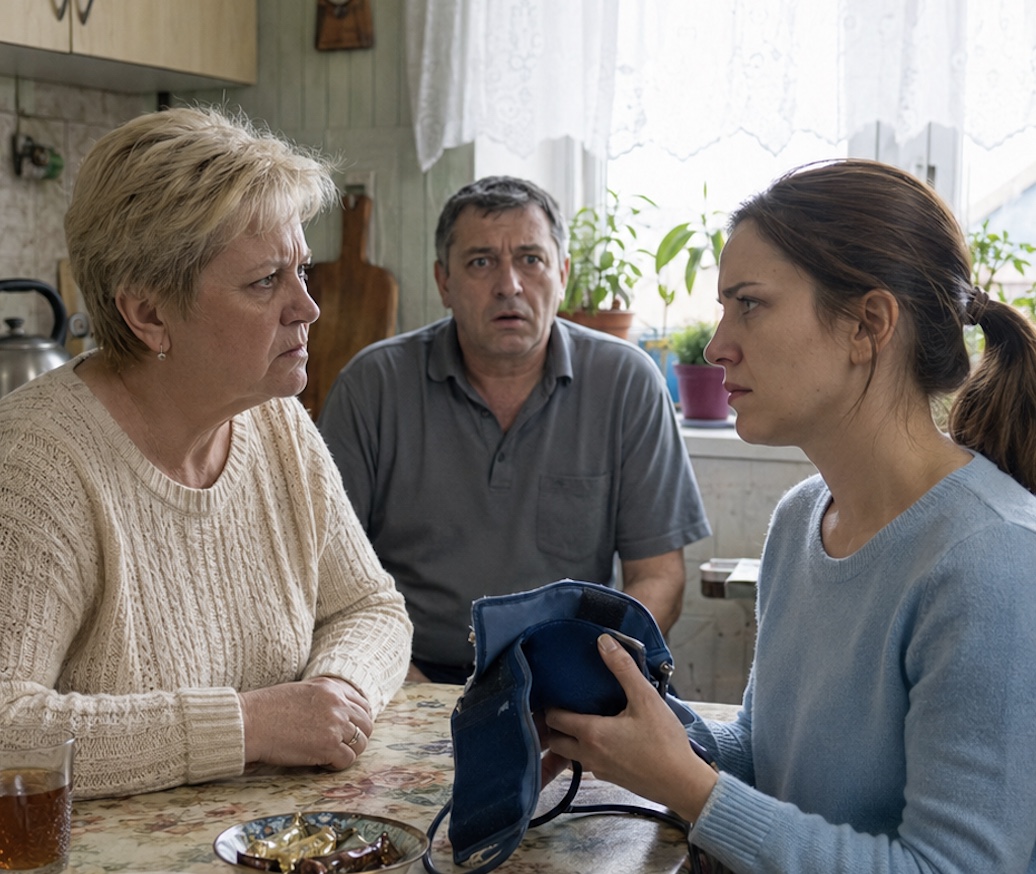
The guests began talking over one another. My mother-in-law, Antonina Pavlovna, sat at the head of the table in a lilac cardigan. She was pale, but already strong again. After the stroke, her face had almost returned to normal, though the left corner of her mouth still twitched slightly whenever she got nervous. Across from her sat her thirty-year-old daughter, Alina, lazily picking grapes off her plate.
I sat at the edge of the table, closer to the kitchen doorway. On the armrest of the chair beside me lay the old blood pressure monitor with its worn, gray Velcro strap. I had brought it from the bedroom an hour earlier, when Antonina Pavlovna complained of ringing in her ears. The cuff still smelled faintly of rubbing alcohol and cheap soap.
“Well, Sveta,” Aunt Lyuba, our neighbor from the stairwell, shook her head as she sipped her tea. “Nursing a person like that back to health… Cooking, turning her over, cleaning the bedpan. Not every daughter-in-law could handle that. You were lucky, Pavlovna.”
Antonina Pavlovna nodded graciously while breaking off a piece of store-bought cake that had cost one hundred and forty rubles. She looked at Alina, then at me.
“Sveta did try, no one can deny that,” my mother-in-law said evenly. “But duty is duty. Denis brought her into this apartment. They’ve lived here for fifteen years. Family is family. But since everyone is here, I want to say something. Now that I’m better, it’s time to put the paperwork in order. I’ve signed a deed of gift. For Alinochka. The apartment will go to her. She’s going to have a baby soon. She needs housing. And Denis is a man. He’ll earn his own.”
The room went instantly silent. Outside the window, I could hear tires hissing over the wet asphalt — an ordinary evening in a residential neighborhood, three minutes on foot from the bus stop.
Denis froze with his fork in his hand. His face slowly turned crimson. He looked at me, then at his sister.
“Mom, what are you talking about?” he asked quietly. “What about us? We’ve been here fifteen years. We did the renovation. We put in the plastic windows — forty-five thousand rubles.”
“You’ll stay here while I’m alive,” Antonina Pavlovna replied calmly, adjusting the collar of her cardigan. “Where would I throw you out to? But Alina will be the owner. That’s fair. She is my own daughter. My blood. And Sveta… Sveta is an understanding woman. She’ll keep helping me. Out of respect. You weren’t caring for me just for square meters, were you, Sveta? We’re family.”
I looked at the blood pressure monitor on the armrest. Inside, everything felt empty and very cold. Over the past three years, I had grown used to that emptiness.
I knew exactly what that care had cost — forty thousand rubles a month for a caregiver I hired during the daytime from my own money, earned through nighttime accounting jobs. Denis thought I ran home during lunch breaks because my office was nearby. He didn’t know about Lida, the caregiver. Nobody knew. I simply kept quiet because it was easier that way. I had created the illusion that everything was manageable.
“You yourself said we were family when we brought her home from the hospital three years ago,” Alina suddenly said, looking at me with clear, innocent eyes. “Sveta, why are you quiet? Mom can’t get upset. Her blood pressure will go up again.”
I stood up and carefully wound the rubber tubes of the blood pressure monitor. The Velcro crackled, drawing everyone’s attention.
“I’ll go wash the dishes,” I said.
My voice sounded surprisingly calm.
In the kitchen, it smelled of tea leaves and old oilcloth. I turned on the hot water and held my hands under the stream. The water burned my fingers, but I barely felt it.
So many days had piled up over those three years that they had all melted into one sticky, shapeless mass.
I remembered the first winter after her stroke. Denis had gone away on a business trip for two weeks, wanting to earn extra money. His warehouse salary was forty-two thousand rubles, half of which went toward loans for his old Korean car.
“Sveta, keep an eye on her,” he told me before leaving for the station. “She’s my mother, after all. There’s no one else but us. Alina’s busy. She’s sorting out her personal life.”
So I kept an eye on her.
I got up at five in the morning and cooked unsalted porridge. Then I ran to my main job at a budget institution, where I worked as a senior accountant and earned thirty-eight thousand rubles. At lunch, I rushed back home to change the sheets. Back then, Antonina Pavlovna still couldn’t speak. She only looked at me with heavy, demanding eyes. If I was ten minutes late, she knocked her cup against the bedside table.
After three months, my hands began to tremble. I would go into the bathroom, press my face into a towel, and howl silently so I wouldn’t frighten her. That was when I understood I couldn’t do it alone.
I found Lida through acquaintances. Lida agreed to come from noon until four for twenty thousand rubles a month. Later, prices rose, and it became thirty. To pay her, I took on bookkeeping for two small companies and prepared their reports at night while Denis slept, turned away toward the wall.
“What are you clicking on that laptop for?” he grumbled half-asleep. “You’re keeping me awake. Go to bed. You have to check on Mom in the morning.”
I would close the laptop and sit in the darkness.
Denis sincerely believed that caring for a bedridden patient was like washing dishes. You came in, fed the person, and left. He never turned her over himself. Not once. He never cleaned bedsores. He simply stepped into her room in the evenings, kissed her dry cheek, and said, “See, Mom? Everything is fine with us. Sveta is managing.”
A month ago, Antonina Pavlovna started walking. First to the toilet, then around the room. Alina immediately began visiting more often. She brought “Rodnye Prostory” chocolates from Pyaterochka when they were on sale, sat in front of the television, and chirped about her problems.
“Mommy, you need a new coat,” Alina would say, sprawling in the armchair. “I saw a nice one on Ozon. Only three and a half thousand. Sveta, do you have anything free on your card? Lend me some until payday.”
And I transferred the money.
From the very money I had set aside for utility meter inspection and new winter boots. My old ones were falling apart, the sole coming loose. I transferred it because Alina smiled so sincerely, so childishly. She had never seen the dirt. She saw a clean mother, a clean room, and a hot meal.
Last Thursday, I went to the clinic to pick up a prescription for free medication. The therapist, an elderly woman with tired eyes, searched for the medical file in the cabinet for a long time.
“Ah, Antonina Pavlovna,” she finally remembered, scribbling with her pen. “Her daughter came by the other day. Asked whether the disability status could be removed if she had improved. Said they were arranging a social services sanatorium voucher for her mother. What a good daughter, so caring. She kept asking about the apartment too — what documents were needed for a deed of gift if the owner had suffered a stroke.”
I said nothing then. I took the papers and went out onto the clinic steps. The wind blew dust from under the wheels of a passing minibus straight into my face. My phone vibrated in my pocket. Denis had sent me a Wildberries link.
“Sveta, order Mom this joint cream. It’s three hundred rubles. You have cashback there, don’t you?”
I opened the app and ordered it.
There were four thousand rubles left on my card until the end of the month.
The guests left by eleven that night. Aunt Lyuba squeezed my elbow sympathetically in the hallway before leaving, but said nothing. She hurried toward the elevator. Alina left by taxi, carrying in her handbag the copies of the documents her mother had signed at the notary that morning.
It turned out they had completed everything a week earlier. Tonight, they had simply informed us after the fact.
Denis sat in the kitchen, smoking out of the open window. We didn’t smoke in the apartment, but that night I didn’t correct him.
“Mom was wrong, of course,” he said dully without looking at me. “About the apartment… It wasn’t decent. I’ll talk to her tomorrow. But Sveta, don’t make any rash decisions. Mom is old now. Her mind isn’t the same after the illness. It’s just some kind of episode. Alina talked her into it, I’m sure. But we still have to take care of her. We can’t just abandon her now. Humanly speaking. Out of respect for her age.”
I washed the cups. The water roared, drowning out his voice.
“Do you hear me, Sveta?” Denis turned around, exhaling smoke toward the ceiling. “Why are you silent again? Sitting there offended like a mouse over grain. Say something at least.”
I turned off the tap. Then I turned to him, drying my hands with a gray waffle towel.
“Denis, tomorrow is Saturday. I’m going to my sister’s place in the countryside for a week. She has problems with the fence at her dacha. She asked me to help.”
Denis frowned, dropping ash onto the windowsill.
“What do you mean, your sister’s? What about Mom? Who’s going to cook for her? She needs fresh soup every day. The doctor said so. And her pills on schedule. I have a twelve-hour shift tomorrow, and on Sunday I have a side job at the car market.”
“You’ll think of something,” I replied. “You’re a man. You’ll earn money for a caregiver if needed. Or Alina can come. The apartment is hers now. Let her care for it. Out of respect for the property.”
Denis stood up. His chair screeched sharply across the linoleum.
“What are you doing, Sveta? Are you serious?” His voice began to rise. “You’d abandon a sick woman over some square meters? I never knew you were like this. You’re kind. You spent three years…”
“Exactly, Denis. Three years.” I placed the towel on the table. “Good night.”
I went into the bedroom and pulled an old sports bag from the wardrobe. I didn’t have many things. A few work blouses, jeans, a house robe.
As I packed, Lida’s business card fell out of my jacket pocket. I turned it over in my fingers, then took out my phone.
“Lidia Nikolaevna, hello. I’m sorry for writing so late. Starting tomorrow, you no longer need to visit Antonina Pavlovna. The contract is over. I’ll transfer the money for the days you worked to your Sber account now.”
The reply came a minute later.
“Alright, Svetlana. Thank you. Call me if anything happens.”
I transferred Lida the last eleven thousand rubles from my savings account. There were forty-two rubles left on my card.
Now everything was honest.
Absolutely honest.
On Saturday morning, I left on the first suburban bus at six-thirty. Denis was still asleep, his nose buried in the pillow, legs tucked under the blanket. I didn’t wake him. I simply placed the keys to Antonina Pavlovna’s apartment on the shoe shelf in the hallway, beside the old blood pressure monitor.
At my sister’s house in the village, it was quiet. The phone signal was weak, and the internet only worked by the veranda window. I muted my phone and placed it in the kitchen cabinet behind a jar of three-year-old raspberry jam.
For the first two days, I simply slept. I woke to roosters crowing, stared at the wooden ceiling, and couldn’t believe I didn’t have to run anywhere. I didn’t have to measure someone else’s blood pressure. I didn’t have to listen to complaints about bland soup.
On Monday evening, I finally took out my phone. The screen was covered with missed calls.
Forty-two from Denis.
Eight from Alina.
And three from an unknown number — probably Antonina Pavlovna herself trying to call from the home phone.
I pressed call on my husband’s number. He answered on the first ring, as if he had been holding the phone in his hand.
“Sveta! Where the hell are you?!” His shout tore through the speaker, breaking into a rasp. “Have you lost your mind? Mom is alone at home! I came back from my shift Saturday evening and found her sitting on the floor in the hallway, crying! Lida didn’t come! Why didn’t you tell Lida you were leaving?”
“I did tell her, Denis. I fired her.”
Silence fell on the other end. It was so deep I could hear the kitchen faucet dripping — the one Denis had promised to fix before New Year’s.
“What do you mean, fired her?” he whispered. “Who hired her?”
“I did. For three years, I paid her thirty thousand a month from my nighttime work. So your mother would be clean, while you thought I was somehow managing everything between reports. The food the caregiver bought came from my money too. You were always busy with loan payments and gas.”
Denis breathed heavily, noisily.
“Sveta… What are you…” For the first time, his voice sounded lost, foolish, almost childlike. “Why didn’t you say anything? We would’ve… Well, Alina could have helped.”
“Alina is the owner now. Call her. Let her come change the diapers. Antonina Pavlovna can walk now, but she gets weak in the evenings. You know that. Soup has to be made. No salt. Mash the potatoes with a fork. Her teeth hurt.”
“Alina can’t!” Denis barked, losing control again. “I called her on Sunday! She came over, stayed two hours, and Mom yelled at her for burning the porridge. Alina cried, threw the keys down, and left! She says the doctor told her not to get nervous because of her pregnancy. She’s leaving for a recreation center with her husband on Saturday. Their vouchers will expire! Sveta, please come back. Mom keeps screaming. She calls me Alina and confuses everything. I don’t know how to wash a bedpan. It makes me gag, Sveta!”
I looked out the window. In the garden, my sister was gathering dry raspberry stems into a pile. We would burn them in the evening.
“Denis, the blood pressure monitor is on the hallway shelf. The Velcro is old, so hold it with your hand when you pump it, otherwise it slips off. Measure her blood pressure three times a day. If it’s above one hundred sixty, give her capoten under the tongue. The pills are in the blue box on the microwave.”
“Sveta, are you insane?!” Denis’s voice trembled now, filled with helpless, filthy anger. “You’re going to kill my mother over an apartment? Choke on those square meters! We’ll sign everything back, do you hear me? I’ll force her! Just come home. I haven’t slept for three days. I didn’t go to work. They’ll mark me absent and fire me!”
“No need to sign anything back, Denis. The apartment belongs to Alina. Everything is fair. You’re family. Blood. And I’m just… an understanding woman. Out of respect.”
I ended the call.
The door to Antonina Pavlovna’s apartment was slightly open. The lock had been sticking for a long time if it was closed from the outside without a key. I entered quietly, without knocking.
It was Friday evening. A week had passed.
The hallway smelled of sour milk and burnt onions. Shoes were piled in a heap. Dark dirty footprints from Denis’s boots stained the floor — apparently, he had run to the pharmacy and hadn’t taken them off. The old blood pressure monitor still lay on the shelf, only now its tubes were twisted into a knot and the rubber bulb was lying separately under the coat rack.
I walked into the kitchen.
On the stove stood an aluminum pot with dried-out remains of vermicelli. Around the sink, dirty plates were piled high, along with at least ten cups ringed with dried tea. On the table lay an opened blister pack of analgin and an empty Prostokvashino kefir bag.
From the bedroom came my mother-in-law’s muffled, irritated voice.
“Denis! Deniska, I’m talking to you! Bring me water! And turn that television down. Your football is splitting my head open! Where did you disappear to, you misery…”
Denis came out of the bathroom. He was wearing old sweatpants with stretched-out knees and a gray T-shirt covered in yellowish stains — baby food or mashed potatoes, by the look of it. His face was gray, covered in stubble, with real black circles under his eyes from lack of sleep. In his hands, he held a plastic basin with a wet rag.
He saw me and froze in the hallway. The rag slipped from his fingers and fell onto the linoleum near the stained baseboard.
“Sveta…” he exhaled quietly, painfully. His lips trembled. “You came.”
I didn’t move. I didn’t put down my bag. I was wearing new jeans bought with the money my sister had given me for helping with the fence, and the same old boots with the loose sole — I still hadn’t fixed them.
“I came to pick up my hair dryer and my winter coat from the storage closet,” I said, looking past his shoulder at the dirty wall. “And my laptop. I need to work. Reports are due. I’m going back to my main job on Monday.”
From the bedroom, Antonina Pavlovna shouted again, louder this time, her voice hoarse and spoiled.
“Denis! Who’s there? Is Alina here? Tell her to come in. My legs need rubbing! Your macaroni is impossible to eat. It’s like glue! Let Alina make proper soup!”
Denis took a step toward me and reached out his hand — dirty, with a broken nail — but he didn’t dare touch my sleeve.
“Sveta… She’s been calling for Alina for three days,” he whispered. In his eyes, dulled by exhaustion, there appeared something terrible and belated: understanding. “And Alina won’t answer the phone. She said her husband is against her visiting a sick woman. She’s due in November. Sveta, I can’t do this anymore. Today I changed her diaper, and I threw up right on the bed. I washed the sheets in the bathtub for three hours. My hands are rubbed raw… Forgive me, Sveta. Please. I didn’t know. I thought it was simple.”
I walked past him into the storage closet. I took out my down coat. It smelled of dust and old newspapers. I stuffed it into my bag on top of my clothes. Then I added the hair dryer.
When I came back into the hallway, Antonina Pavlovna appeared in the bedroom doorway. She held on to the frame. Her lilac cardigan was buttoned crookedly, one button missing its proper hole. She looked at me with her heavy eyes, the left corner of her mouth twitching rapidly.
“Sveta,” she said hoarsely.
For the first time, there was no command in her voice. There was fear. Simple human fear — the fear of an old person abandoned by everyone.
“Sveta, where are you going? What about tea? Slice some bread, there was still some left in the bag… Sit with me.”
I stopped at the threshold. I picked up the blood pressure monitor from the shelf, carefully untangled the twisted tubes, and laid it down neatly.
“Goodbye, Antonina Pavlovna,” I said.
Then I turned the key in the lock.
The door closed with a heavy, dry thud. Inside, someone stirred. Denis shouted something loud and hopeless to his mother, but I was already walking toward the elevator.
My footsteps in my old boots sounded soft, almost silent, against the concrete floor of the stairwell.