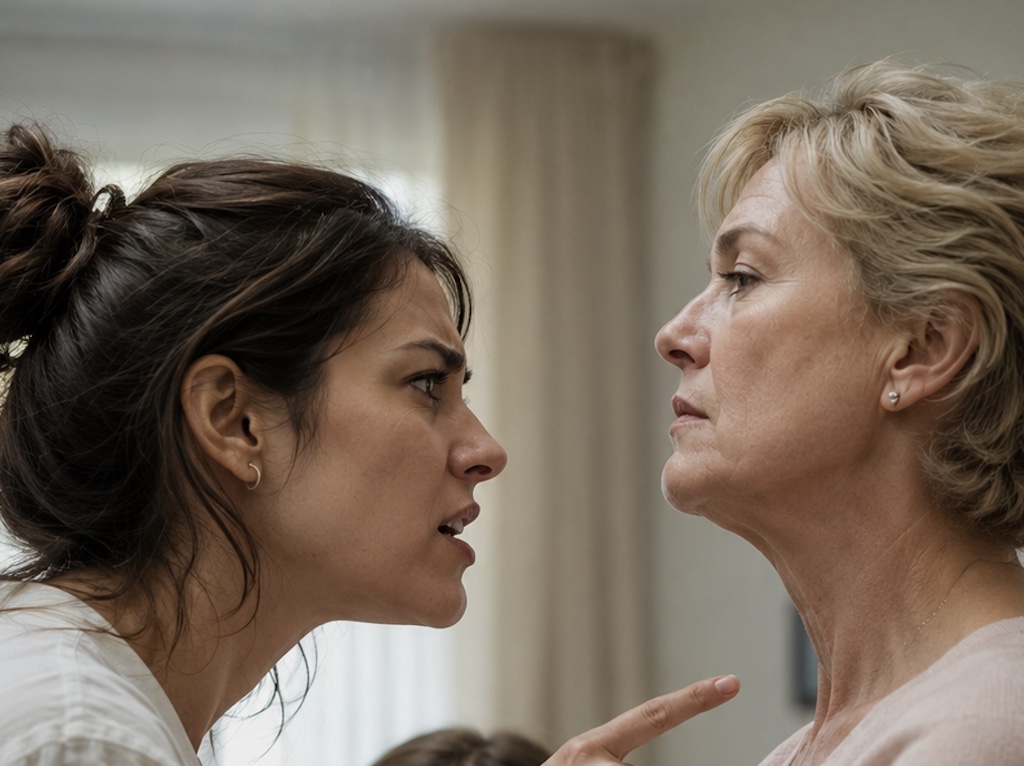
There are things you can never forget. Not because they are beautiful or dear to your heart, but because one day they change something inside you forever — like a crack in a porcelain cup, invisible from the outside, but impossible to erase. For Sveta, that moment came on an ordinary Sunday afternoon, with the smell of warm pancakes in the air and her daughter’s small, frightened voice saying, “Mommy, my mouth is stinging.”
But to understand why that day split everything in two, we have to go back. Much further back.
When Nina Pavlovna first stepped over the threshold of their new apartment with a suitcase and a heavy shopping bag, Sveta smiled sincerely. She stood in the hallway — still smelling of fresh paint and new hopes — and thought: finally, we did it. A large apartment, a spacious kitchen, a separate room for little Nastya with pink floral wallpaper. Her mother-in-law had sold her one-room flat on the outskirts of town, she and Seryozha had added their savings, taken out a mortgage, and moved into this bright three-room apartment overlooking the park.
“Well, here we are. Home,” Nina Pavlovna said, setting down her bag before immediately heading to the kitchen to inspect the cupboards.
Nastya ran after her and grabbed her hand.
“Grandma Nina, Grandma Nina, come see! I have my own room now!”
“Show me, my little treasure,” Nina Pavlovna said, letting herself be pulled away. Over her shoulder, she added, “Sveta, there are pastries in the bag. Take them out for now.”
Sveta took out the pastries. She smiled again — a little more tensely this time.
That was the beginning.
The first few weeks passed in cautious coexistence. Nina Pavlovna cooked in the mornings, helped with Nastya while Sveta was at work, and overall seemed like a reasonable older woman with strong hands and a loud voice. Sveta left for work with a calm heart, knowing her daughter was being looked after.
The first warning sign came quietly, almost unnoticed.
Sveta came home earlier than usual and found Nastya sitting in front of the television — so close to the screen that she was almost touching it, staring blankly, an empty plate from something clearly sweet beside her.
“Nastya, how long have you been watching this?”
“I don’t know,” her daughter shrugged without looking away from the cartoon.
“It’s been on for a while,” Nina Pavlovna said from the kitchen, completely unbothered. “She asked for it. What’s the big deal? Let her watch. She’s not a baby.”
Five years old — not a baby.
Sveta turned off the TV. Nastya burst into tears. In the kitchen, Nina Pavlovna began clattering pots so loudly and expressively that she did not even need to say anything aloud — her displeasure spread through the whole apartment anyway.
“Seryozha,” Sveta said that evening when she and her husband were alone, “your mother let Nastya sit in front of the TV for hours again. We agreed — no more than half an hour a day.”
Seryozha was looking at his phone.
“Well, one time won’t hurt.”
“It’s not one time. It’s every day.”
“Sveta, don’t exaggerate. Mom helps us, she gets tired. What do you want from her? She’s an older woman.”
An older woman. That phrase became something like a protective document in their home. Every time Sveta tried to say something, Seryozha said it in a tone that made it sound as though Nina Pavlovna were not a strong, rosy-cheeked, energetic woman, but a fragile crystal vase that must not be disturbed.
Then it got worse.
Nina Pavlovna discovered that her granddaughter adored her. Truly, completely, with that full-hearted childish devotion that cannot be faked. Nastya squealed and ran to her in the mornings, dragged her over to see drawings, demanded fairy tales, and happily followed her anywhere. And Nina Pavlovna blossomed. She was needed. She was loved. And that feeling intoxicated her more than any wine ever could.
The problem was that Nina Pavlovna’s love had a very specific currency.
“Grandma Nina, I want a candy!”
“Of course, my little treasure. Here, take two.”
“Mommy said I can’t. My teeth hurt.”
“What does your mother know? Just this once won’t hurt.”
Sveta always found out afterward — from the way her daughter became cranky before bedtime, from the way the dentist shook his head at the next appointment and said the cavities were developing faster than they should, from the way Nastya did not grab candy eagerly anymore, but first looked around to see whether her mother was watching. She already knew: Grandma Nina would always give her some.
“Nina Pavlovna,” Sveta would say, trying to keep her voice even, “the doctor said no sweets at night. Nastya already has several problem teeth. This is serious.”
“Oh, you all make such a big deal out of everything,” her mother-in-law waved her off. “Baby teeth fall out anyway. I raised Seryozhenka without listening to all those doctors, and look at him — he grew up healthy.”
“Seryozhenka still goes to the dentist every six months,” Sveta could not help saying.
Nina Pavlovna pressed her lips together and left the kitchen.
That evening, of course, Seryozha was once again looking at his phone.
“Your mother again?”
“Seryozha, she gives our child candy before bed even though the doctor forbade it. This isn’t a whim. It’s about her dental health.”
“Candy isn’t poison.”
“It’s not about candy. It’s about the fact that she deliberately does what we have forbidden. Do you understand? Deliberately. Because that way she becomes the good grandmother, and I become the mean mother.”
At last, Seryozha looked up. He looked at her with that soft tiredness that had recently begun replacing every other expression on his face.
“Sveta. You’re exaggerating.”
The gastroenterologist said the word “gastritis” so calmly, as if he were talking about the weather. Nastya was not even five and a half yet, and she already had an inflamed stomach that required a diet, routine, and a complete ban on greasy, fried, spicy food and fast food.
“No burgers, no pizza, no soda,” the doctor listed, and Sveta nodded while taking a photo of the instructions on her phone.
Nina Pavlovna did not come to that appointment. She said her blood pressure was acting up.
But a week later, Sveta came home and did not find them there. She called her mother-in-law — no answer. She sent a message. An hour later, a reply came with a photo: Nastya, happy, holding an enormous burger, sitting at a plastic table in a brightly lit room with a red-and-yellow logo.
“We spoiled the girl a little!” the caption said. And a heart emoji.
Sveta’s hands began to tremble.
When they returned, she stepped into the hallway and looked at her mother-in-law in silence for a long time. Nina Pavlovna looked back — without remorse, with a faint challenge in her eyes, like a person who had prepared for the conversation in advance and had already decided not to give in.
“Nina Pavlovna. The doctor forbade this kind of food. Nastya has a sick stomach.”
“One burger won’t ruin her stomach.”
“Her stomach is already damaged. That’s why she can’t have it.”
“Oh, please. Nowadays everyone invents problems — stomach issues in five-year-old children. In my day, children didn’t have stomachs, they grew up and didn’t complain.”
“That doesn’t mean illnesses didn’t exist.”
“Don’t be rude,” Nina Pavlovna said very quietly, and walked into her room with dignity.
That night, Nastya cried from stomach pain.
This time, Seryozha did not say, “You’re exaggerating.” He sat beside their daughter, stroked her hair, and stayed silent. Then he went to speak to his mother, and Sveta heard their conversation through the wall — quiet, even, without shouting.
She could not hear the words. Only the intonation. The tone of someone gently explaining. And the tone of someone gently refusing to agree.
The next morning, Nina Pavlovna was deliberately affectionate with Nastya at breakfast and deliberately invisible to Sveta. As if Sveta did not exist at all — she simply moved around the apartment without looking at her, without addressing her directly.
It lasted three days. Then Nina Pavlovna began greeting her normally again, and life rolled on. As if nothing had happened.
As if nothing had changed.
But Sveta felt it — something had shifted. Something very small, like a tiny piece in a clock mechanism that had slipped slightly out of place. The clock was still ticking. But no longer quite correctly.
They had found out about Nastya’s honey allergy by accident, when she was three and a neighbor treated her to a honey cookie. The reaction was quick and unmistakable — redness, swollen lips, tears, an ambulance, an injection, and a long, frightening evening in the emergency room.
Since then, honey had never appeared in their home. Not at all. It was an iron rule, non-negotiable, with no exceptions. Everyone knew it.
Nina Pavlovna knew it too. Sveta had explained it to her several times. Seryozha had explained it. There was even a note on the refrigerator — a list of what Nastya was not allowed to have, and the first item, written in large letters, was: HONEY — ALLERGY.
“Yes, yes, I know,” Nina Pavlovna said every time the subject came up. “I’m not deaf.”
“This is serious,” Sveta said. “Do you understand? This isn’t a runny nose.”
“I understand. I’m not a child.”
But there was always something in her voice — something close to condescension. As if she listened, but did not believe. As if all of it — allergies, gastritis, screen-time limits — was just a collection of modern inventions, another fashionable obsession of anxious young parents.
That Sunday, Seryozha left in the morning to visit a friend. Sveta had errands to run — she needed to stop at several places and planned to be back in about three hours. Nastya stayed with her grandmother.
Before leaving, Sveta stopped in the doorway.
“Nina Pavlovna, I left food in the refrigerator. There’s soup and cutlets. Nastya doesn’t need anything else.”
“All right,” her mother-in-law said without looking up from her knitting.
Sveta left.
She returned earlier than planned. One of her errands had been canceled, and there was almost no traffic. As she rode up in the elevator, she was already thinking that she could lie down with Nastya for a while, read her something, and have a quiet evening.
She smelled it while still in the hallway. A sweet, warm, almost cozy smell — pancakes. Nina Pavlovna was frying pancakes; Sveta could hear the oil sizzling. Nastya was cheerfully telling her something in the kitchen, and it all sounded so homely that for the first few seconds Sveta simply stood there and listened.
Then she walked in.
Nastya was sitting at the table with a pancake on her plate — round, golden, folded into quarters. In front of her stood a small glass dish.
Inside it was honey.
Amber-colored. Thick. Shining.
Nastya had already dipped the pancake into it.
“Mommy, look, Grandma Nina made pancakes with honey!” she said happily. Her voice was a little nasal, her lips looked slightly swollen, and she rubbed her cheek with her palm. “My mouth is stinging a little.”
The world stopped for a second.
“Step away from the table,” Sveta said in a voice she did not recognize as her own. Quiet. Completely calm.
“Sveta, what are you doing?” Nina Pavlovna began. “It’s just one pancake. Honey is natural. It’s not an allergy. That’s all your nonsense—”
“Nastya. Come to me.”
She scooped her daughter into her arms. Nastya felt warm, and Sveta could already see that her cheeks were redder than usual and a reddish line had appeared around her mouth. She grabbed her bag, pulled out her phone, and called an ambulance as she rushed from the kitchen into the hallway, pushing her feet into her shoes with one hand while holding Nastya with the other.
“Sveta, where are you going? Wait,” Nina Pavlovna followed her out, standing in the kitchen doorway with a spatula in her hand. For the first time in all this time, there was something like confusion on her face. “It’s only honey, it’s—”
“Do not leave the apartment,” Sveta said.
The door closed.
The hospital was bright and smelled of medicine and fear. Nastya was given an antihistamine, then they watched her, and then they watched her some more. The reaction was moderate, the doctor said. It could have been worse. It was good they had brought her quickly.
Nastya lay on the examination couch, already calm, almost asleep, with a small needle in the crook of her arm. Sveta sat beside her, holding her hand, and did not cry. She had passed through that stage somewhere on the way there, in the car, while monitoring her daughter’s breathing and answering the dispatcher’s questions. Now inside her there was emptiness and a very deep silence.
The silence after a storm.
Seryozha arrived an hour later. He burst into the room — red-faced, disheveled, phone in hand. He looked at Nastya, who was already sleeping, then at Sveta.
“How is she?”
“She’s fine. It passed.”
“Thank God.” He lowered himself onto the chair beside them and ran a hand over his face. “As soon as Mom called, I came right away…”
“Your mother called you.”
“Well, yes, she said…”
“She knew, Seryozha.” The words came out evenly, one after another, without breaking. “She knew about the allergy. We told her dozens of times. It was written on the refrigerator. She decided it was nonsense. And she gave our child honey.”
Seryozha said nothing.
“It could have been anaphylactic shock. Do you understand? Not just a rash. Anaphylactic shock. In a five-year-old child.”
“Sveta…”
“No.” She looked up at him, and he must have seen something in her eyes, because he stopped. “I stayed silent for a very long time. I stayed silent about the television. I stayed silent about the candy. I stayed silent about the burgers. You told me I was exaggerating, and I thought — maybe I was. Maybe I really was reacting too sharply. Maybe I was unfair to her. I tried very hard to justify her, Seryozha. Very hard.”
He looked at her. Really looked at her — the way he had not looked in a long time.
“I won’t anymore.”
Nastya moved in her sleep and tugged at the blanket. Sveta adjusted it automatically, without taking her eyes off her husband.
“I don’t want to see your mother anywhere near our child again,” she said. “That is all I have to say to you.”
The silence in the hospital room was thick and heavy. Somewhere in the corridor, someone’s footsteps echoed, something metallic clinked, and then silence returned.
Seryozha did not say, “You’re exaggerating.”
He looked at his sleeping daughter, at the needle in her small arm, at the red marks around her mouth that had not fully faded yet. And something happened to his face — slowly, like light changing at sunset — something important and irreversible.
“I understand,” he said at last.
Just that. I understand. No objections, no “but,” no “she’s my mother, she didn’t mean any harm.”
After that came many conversations. Difficult ones. Long ones. The kind that leave you wanting to lie down and not move. Seryozha spoke with his mother. His mother cried, said they did not love her, said they were throwing her out onto the street, said she had given them everything — her apartment, her money, her years — and this was how they repaid her. Seryozha listened. He did not agree. He did not back down.
That, too, was something new.
The decision did not come immediately, but it came. They found a rental apartment for her — small, but nice, in a respectable building with a concierge and not far from the park.
Nina Pavlovna moved out at the end of the month. She packed her things silently, with the air of a person suffering a great injustice. But Sveta noticed that she packed carefully and without rushing.
On moving day, Nastya clung to her grandmother’s neck and sobbed uncontrollably.
“Grandma Nina, don’t go! Grandma Nina, stay!”
Nina Pavlovna held her close, and her face looked guilty and loving at the same time.
“I’m not leaving, my little treasure. I’ll just live separately. I’ll come visit. You’ll come visit me. Everything will be all right.”
Nastya sniffled.
“Do you promise?”
“I promise.”
Sveta stood aside and watched. Something inside her ached — not with malice, not with triumph, but simply with pain. Because she had never wanted this. She had wanted something else — a big, warm family where everyone felt good, where a grandmother helped and loved, where Mom and Dad worked, and everyone gathered for dinner in the evening. A simple, ordinary picture.
It was just that the picture had not worked out.
Nina Pavlovna began coming over on weekends. Seryozha picked her up, brought her over, and then took her back home. At first, everything was careful and awkward — everyone behaved a little more formally than usual, like people who were not entirely sure of the rules of a new game.
But then something began to change.
Nina Pavlovna came over, and they drank tea, and she told Nastya fairy tales — long ones, with different voices and gestures — and Nastya laughed and demanded more. They made dumplings together — slowly, crookedly; Nastya’s dumplings looked like little-eared monsters, and everyone laughed. Nina Pavlovna did not give her candy without asking. She did not turn on the television longer than allowed. Once, she said to Nastya, “If it’s forbidden, then it’s forbidden. Your mother knows best,” and Sveta froze for a second in the next room, unable to believe it.
Small things. Tiny things. But Sveta noticed them.
Honey still never appeared in the house. That rule remained absolute forever.
One evening, when Nastya was already asleep, Seryozha sat beside Sveta on the couch and looked out the window at the city lights. It was quiet. Peaceful.
“I didn’t hear you for a long time,” he said suddenly. “I know that.”
Sveta looked at him.
“I listened, but I didn’t hear. I thought you were exaggerating because it was easier to think that. Because otherwise I would have had to do something, and that’s hard — when it’s your mother.”
“I know it’s hard.”
“I don’t want you to stay silent like that again. If something is wrong, say it right away. I will hear you.”
Sveta was quiet for a moment. Outside, a car passed, brushing a streak of light across the wall.
“All right,” she said finally. “Agreed.”
It was not forgiveness. It was not forgetting. The crack in the porcelain had not disappeared — it was there, and Sveta knew it.
In the children’s room, Nastya breathed softly — alive, healthy, with cheeks slightly pink in her sleep. Tomorrow was Sunday. Grandma Nina would come. They would make dumplings.
Sveta closed her eyes.
After all, family is not a picture stuck to a refrigerator. It is the daily work of agreeing on the rules again and again. Giving way — but not in everything. Loving — but with boundaries.
And sometimes you have to say out loud what you feel so that everything else can finally fall into place.