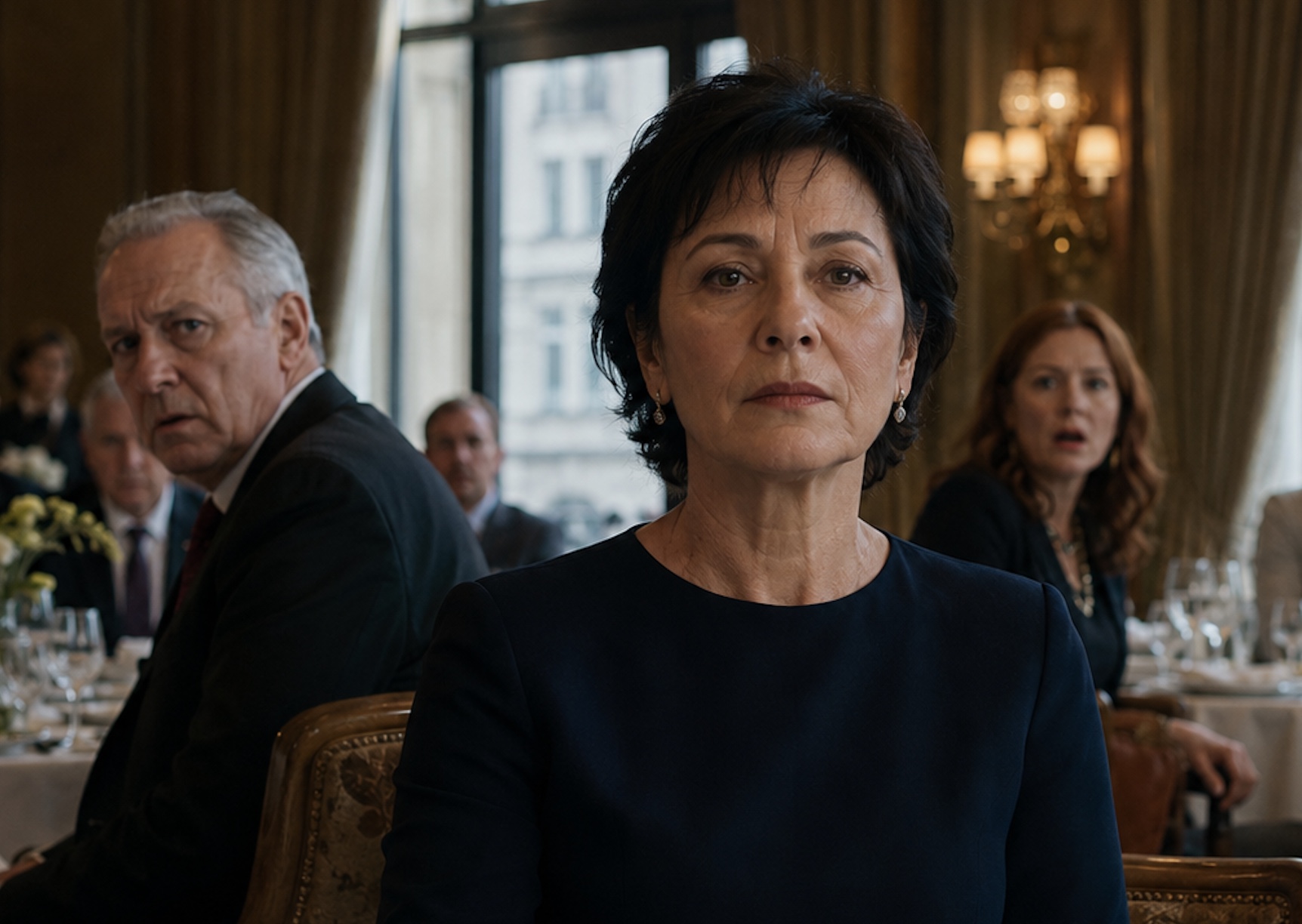
My mother-in-law’s relatives kicked me away from the table. Fifteen minutes later, the restaurant owner personally escorted them outside while I applauded.
“Faina, come early, around eleven. Help in the kitchen a bit — salads and all that. You’re our cook, after all.”
I held the phone and looked out the window. Wet snow was falling behind the glass, and the janitor kept pushing it back and forth with his shovel, pointlessly.
“Zinaida Markovna, the anniversary is in a restaurant. At Beluga. They have their own chefs.”
“So what? A familiar hand is always better, as they say. Besides, you know about these things.”
I said nothing.
I had been saying nothing for eight years.
For eight years, I had looked at her mouth, nodded, and gone off to “help.”
“All right. I’ll be there.”
I hung up and sat down on the small stool in the hallway. My hands were not shaking. My hands had stopped giving me away long ago — twenty-five years at the stove, in hot kitchens, under chefs’ yelling and customers’ demands, had taught me how to keep my face steady and my hands firm.
I am a restaurateur.
Not a “cook woman.”
Twenty-five years in the profession, if you count from my first apron in a student cafeteria. I spent four years as head chef for Arseny Lvovich at Beluga, and before that I ran my own kitchen section at The Golden Rooster for another eight years. Thousands of banquets, weddings, wakes, and anniversaries had passed through my hands. I know how much one minute of idle banquet-hall time costs, and I know what real Russian borscht is supposed to look like — not the kind they show on cooking programs.
Victor’s whole family knew all of this.
They knew it, and still stubbornly called me, “Faya, you’re the one who does the cooking.”
Zinaida Markovna, a retired school administrator, said the word “cook woman” with the particular intonation she probably used at school when saying “cleaning lady.” Regina, a bank manager, introduced me to her friends like this: “This is my brother’s wife. She cooks in some restaurant.” Arthur could barely tell me apart from a waitress.
Victor came out of the room, tying his tie.
“Did Mom call?”
“She did. She wants me there early.”
“Well, go, if she asked. It’ll make her happy.”
“It’ll make her happy,” I repeated.
He didn’t hear it. He never heard anything in that tone. Victor is a mama’s boy at fifty-five. Not because he is cruel. Because it is convenient. Convenient for his mother, convenient for him, convenient for everyone — except me.
And me? What about me?
I’m just the “cook woman.” My job is stressful. I can endure it.
I had endured it for eight years.
Once, when I had nothing better to do, I counted: thirty major family gatherings, with or without a serious occasion. And at every single one, my place was somewhere off to the side, at the end, near the door — “so it’ll be easier to serve.” And I served. I carried salads, sliced pies, washed dishes while Regina told her mother about bank bonuses and Arthur bragged about his new car.
I picked up the box with the dinner set — German porcelain, eighteen pieces, exactly ninety thousand rubles. I had spent a week choosing it, ordered it from Saint Petersburg. I had wanted to give my mother-in-law a real gift. On top of that, Victor and I had contributed to the banquet hall rental — our half was one hundred eighty thousand out of the total three hundred sixty. He did not spare money for his mother’s anniversary, and I did not object. It was not my place to count someone else’s joy.
As I left the apartment, I caught my reflection in the hallway mirror.
A gray strand at my temple that I had stopped dyeing long ago. A dark blue dress, modest, with no low neckline — Zinaida Markovna disliked anything “provocative.” A garnet ring on my right hand — the only thing I had put on for myself.
My face was calm.
Too calm, if you looked closely.
I arrived at Beluga at half past eleven. Two hours in traffic through the wet March city, the box with the dinner set on the back seat, covered with a blanket so it wouldn’t slide around. I drove slowly and thought: I’ll arrive, put down the gift, sit wherever they seat me, eat whatever they serve, and leave.
As usual.
As I had done for all eight years.
The banquet hall was in the far wing. I remembered it from my own shifts. A round table for fifteen people, crystal glasses, white tablecloths, and a small stage in the corner for the musician. Everything was as it should be. Once, I had personally inspected this hall after construction — argued about the ceiling height, fought for stronger ventilation, scolded a supplier over crooked candlesticks.
Now I walked through it as a guest and tried not to look around too much, in case someone from the staff recognized me. I didn’t want to explain to Zinaida how people here knew me.
Zinaida Markovna was seated at the head of the table, wearing a blue dress with a cameo brooch on her chest. Her hair was in its usual bun, her lips painted coral. Regina and Arthur were already hovering around her — my sister-in-law and brother-in-law, two shadows belonging to their mother.
“Ah, Faina,” Zinaida raised an eyebrow. “Finally. You promised to come earlier.”
“Traffic.”
“You always have traffic. Fine, put the gift over there in the corner. We’ll deal with it later. Sit…” She looked around the table as if seeing it for the first time. “Sit over there, at the end. Next to Regina’s children. You can keep an eye on them at the same time.”
Regina gave a little snort and adjusted the cuff of her blazer.
“Yes, Faye, you’re good with children. You’re our household person.”
I placed the box in the corner beside the other gifts. Took off my coat. Walked to my seat — at the very edge, directly opposite the kitchen door. Steam and the clatter of dishes drifted out from there.
Fourteen people at the table.
I was the fifteenth — extra, squeezed in at the side.
Across from me sat Regina’s boys, seven and nine. The older one immediately crawled under the table for a napkin and kicked me in the leg.
“Sorry, Aunt Faya.”
“It’s all right, Grisha.”
I looked around. I lifted a glass of mineral water — the champagne had not yet been served. Around this table sat people I had known for eight years, and who had never known me.
Cousin Aunt Nina and her husband — I had seen her twice. Zinaida’s niece Lyudmila with her daughter — last year she brought cheese “from home” and spent three hours discussing with Regina how unsuitable my hairstyle was. Zinaida’s neighbor from the dacha, the same woman who once called me “the help” to my face and then pretended it was a slip of the tongue.
Thirty gatherings in eight years — and every time, I was “not quite at the table.” Every time, I was seated either with the children, or beside a deaf distant aunt, or simply “wherever there’s room.”
I smiled. I poured drinks. I cut cake. I raised toasts to Zinaida’s health, Regina’s success at the bank, Arthur’s cars. And when Victor asked me at home in the evening, “So, how did you like it with my family?” I answered, “It was nice. I enjoyed it.”
Because that was easier.
Victor sat down beside his mother. He looked at me from across the table, slightly guilty, and shrugged — as if to say, what can I do, Mom arranged the seating. I nodded back — as if to say, it’s fine.
It was not fine.
But that day, for some reason, I noticed the smell from the kitchen for the first time.
It smelled like sturgeon.
Smoked sturgeon.
The very kind I had taught Grisha, the sous-chef, to prepare eight years earlier — and he was still working here, behind that very door. I breathed in the smell deeply, the way one inhales before jumping into cold water. Something inside me reached toward that scent — not even a memory, but something older and more important.
Maybe it was the very same Faina whom, over eight years of marriage, they had called “the cook woman” and almost convinced that this was all she was — just a cook woman, nothing more.
Arthur gave the first toast. About his mother, about the strength of the family, about how she had kept everyone in line with an iron hand. Everyone laughed. Zinaida nodded graciously.
The second toast was Regina’s.
She stood up with her glass, looked around the table, and began in a quiet voice, with that familiar poisonous note I knew by heart.
“I want to drink to real family. To those who share our blood. To those who understand what it means to be Pospelovs. Mom, you gathered all of us here — the real ones.”
Regina paused and slowly, as if by accident, turned her eyes toward my corner.
“All of us who are truly ours.”
A silence fell over the table — the kind in which you can hear a fork tapping in the next room.
Victor lowered his eyes to his plate.
Arthur smirked.
Zinaida put down her fork, turned toward me, and said in an even voice, as if giving instructions in a kitchen:
“Faina, why don’t you move to that table by the window? The family is gathered here, and it’s a little crowded. You can eat there calmly. No one will bother you.”
“That table by the window” was a small two-person table for regular restaurant guests, not even part of our banquet setup.
In other words, they were effectively removing me from the family table into the main dining area.
I slowly placed my napkin beside my cutlery.
I looked at Victor.
He did not raise his eyes.
He did not say a word.
Eight years.
Thirty family gatherings.
A ninety-thousand-ruble dinner set in the corner.
One hundred eighty thousand rubles from our side for this very hall, where apparently there was no chair for me.
Something clicked inside me.
Not loudly.
Quietly — like the lock of a good suitcase.
I stood up.
“All right, Zinaida Markovna. I’ll move.”
“Well, there’s a sensible girl,” she said, already turning back to Regina.
I picked up my purse. Walked around the table. But I did not go to the table by the window. I went straight to the door that led to the kitchen.
Regina said something behind my back. I didn’t catch it.
Victor finally lifted his head.
“Faya, where are you going?”
“Just for a minute.”
I opened the kitchen door as if it were my own.
In a way, it was. I had once accepted this kitchen block from the builders, arranged the stoves myself, chosen the ventilation myself.
Grisha, the former sous-chef and now head chef of Beluga, was standing at the cutting board and saw me first.
“Faina Petrovna! What brings you here?”
“Grisha, is Arseny Lvovich here?”
“He is, in his office. What happened?”
“Please call him. It’s important. Just one minute.”
Grisha wiped his hands and left without a word.
I stood in the middle of the kitchen where I had once spent four years of my life and listened to oil hissing in a pan. It smelled of garlic and rosemary.
Arseny Lvovich appeared half a minute later. Tall, gray-haired, in a dark gray suit — exactly as I remembered him.
“Faina! What are you doing here?” He opened his arms and hugged me. “Why didn’t you warn me you were coming?”
“I’m here for an anniversary. My mother-in-law’s. In the banquet hall.”
He stepped back and looked at me carefully. Arseny had always been able to read faces faster than menus.
“Faya. What happened?”
I told him.
Briefly. Dryly. Without tears — I have never known how to cry at work. About “the cook woman.” About the seat by the kitchen door. About Regina’s toast. About “move to the table by the window.”
Arseny listened silently. When I finished, he stayed silent for another ten seconds.
“Faina,” he said at last, “for four years, you saved this restaurant. Tell me plainly what you want. I’ll do it.”
That was when my hands trembled for the first time that morning. I clasped them together.
“Arseny Lvovich, escort them out. The whole group. Out of my hall. Tell them the banquet has to be stopped for technical reasons. Return the money — I’ll reimburse Victor our one hundred eighty thousand later if necessary. Just escort them out.”
He looked at me for a long second.
“Are you sure? That’s your husband’s mother. Her anniversary.”
“I’m sure.”
“And your husband?”
“My husband stayed silent for eight years while his mother called me a cook woman. Let him stay silent now too.”
Arseny nodded once, shortly.
“Go back to the hall. Sit in your place. Do nothing. I’ll handle it.”
I returned to the hall.
I sat down.
Not at the table by the window — at my previous place, at the edge, opposite the kitchen door.
When Zinaida Markovna saw this, she began drawing in air for an angry remark, but I raised my hand.
“One minute, Zinaida Markovna. Someone will be here shortly.”
“Who will be here?” Regina frowned.
“You’ll see.”
An unpleasant silence settled over the table.
Victor looked at me with growing alarm.
I smiled — calmly, almost gently. Inside, I felt empty and very quiet, like the kitchen at four in the morning before the shift begins.
About ten minutes later, Arseny entered the hall.
Not alone — with the maître d’ and two waiters.
He walked straight to Zinaida, gave a slight bow, and spoke in that perfectly trained voice with which he could settle any scandal with any client.
“Dear Zinaida Markovna, my name is Arseny Lvovich. I am the owner of Beluga. Please accept my personal congratulations on your anniversary, and also my personal apologies. Unfortunately, we are forced to interrupt your banquet. For technical reasons. The full amount for the hall rental and service will be returned to the person who paid within the hour.”
Zinaida Markovna opened her mouth slightly.
“W-what technical reasons? We’ve only just sat down!”
“Allow me not to specify. The restaurant apologizes. You may gather your belongings. We will escort you out.”
“This is outrageous!” Regina jumped to her feet. “I’ll file a complaint! This is arbitrary! We are customers!”
“Of course,” Arseny inclined his head slightly. “You are entitled to complain wherever you like. The phone number for complaints will be provided at reception. And now I must ask you to proceed to the exit.”
Arthur muttered something about getting the money back through court.
Victor sat there as red as meat in marinade, looking from his mother to me.
“Faya,” he said quietly, “is this… is this you?”
I did not answer.
I silently stood up, walked to the corner, picked up my box with the dinner set — the very one worth ninety thousand — and carried it back to my chair.
I placed it beside me.
Mine.
Zinaida Markovna finally understood. She looked from Arseny to me, then back to Arseny.
“You know her?” she asked quietly.
“Faina Petrovna?” Arseny smiled almost imperceptibly. “Of course. She was head chef of this restaurant for four years. The best one, between us. I owe her a great deal.”
Zinaida’s face turned gray.
Not pale — gray, the same color as the old cameo on her chest.
The waiters were already standing behind the chairs, polite but unmistakably firm.
The guests began to rise — first the distant relatives, then the nieces and nephews, then Arthur. Regina hissed something through her teeth. Victor approached his mother and took her by the arm.
I sat and watched as they were all politely led toward the exit. Watched them collect their coats. Watched Arseny personally open the door for them to the street.
I stood up and walked to the banquet hall window. It overlooked the entrance.
There, in the wet March snow, stood Victor’s entire family — fourteen people, without tables, without toasts, without their “real family.”
Zinaida held Victor’s elbow. Regina furiously poked at her phone. Arthur looked around helplessly.
I quietly clapped my hands.
Three times.
Slowly.
Not for them.
For myself.
Arseny returned to the hall.
“Well, Faina. How are you?”
“I’m nothing. I’m empty.”
“Will you have lunch with me? I’ve got fresh langoustines from Murmansk. Remember how you used to cook them?”
I nodded.
We sat down — not at the large round table, but at the small one in the corner, where I used to eat after shifts. Grisha brought us two plates. I took two spoonfuls and put down my fork. I couldn’t swallow another bite.
It was not “good.”
It was empty and light at the same time, as if someone had taken a sack of wet sand off my shoulders, but my shoulders still remembered its weight.
My phone vibrated in my purse.
Victor.
I didn’t answer.
Again.
And again.
Then a message:
“Faya, what have you done? Mom is unwell. Call me back.”
I put the phone away. Arseny understood everything without words and simply poured me more wine.
“Thank you,” I said.
“For nothing, Faya. Eight years ago, when you left me to get married, I thought: she’s going the wrong way. But it wasn’t my business.”
I said nothing.
The dinner set stood by my feet, still in its box.
Heavy.
Mine.
Three weeks have passed.
Victor barely speaks to me. He sleeps on the sofa in the living room, taking a pillow from our bed and a blanket from the guest closet. Sometimes he says “good morning,” sometimes he doesn’t.
The first evening, after we came back from that anniversary, he shouted at me. For the first time in eight years. He shouted that I had “destroyed the family,” that “Mom was humiliated in front of everyone,” that “you can’t treat an elderly person like that.”
I listened silently.
Then I asked only one question:
“Vitya, when your mother seated me with the children by the kitchen door for eight years — was that allowed?”
He did not answer.
He went to the sofa.
He has been sleeping there ever since.
After that day, Zinaida Markovna was taken to the hospital with a blood pressure spike. She spent a week in cardiology and is now back home. They say she tells all her neighbors, all her friends, the whole building, that her “monster daughter-in-law made a scene at the anniversary and disgraced a sick old woman.”
Her version is this: I supposedly “bribed” the restaurant owner to throw the family out. In her version, there is no mention that I had spent four years as head chef of that restaurant.
Regina blocked me in messenger first. Arthur sent one message:
“You are no longer family to us.”
I replied:
“Agreed.”
Since then — silence.
The dinner set is now in my kitchen, in the cabinet. Eighteen pieces, German porcelain, ninety thousand rubles. I use it every day. I drink tea from those cups. I eat porridge from those plates.
Before, I would have saved it — “a gift set, for guests.”
Not anymore.
It is for me.
Because it is mine.
The day after the anniversary, Arseny Lvovich returned all one hundred eighty thousand rubles to our card — honestly, down to the last kopeck. Victor saw the transfer and stayed silent for a long time. Then he asked:
“Did you plan all of this on purpose?”
“No,” I said. “For eight years, I didn’t plan anything. One day, I simply stopped adjusting myself to everyone else.”
Yesterday, Victor stopped in the hallway, looked at me for a long time, and said:
“Do you understand what you did to my mother? She’s seventy-eight.”
“I do,” I said. “And do you understand what she did to me for eight years?”
He did not answer.
He went back to the sofa.
And I went to my room.
For the first time in eight years, I lay down in my own bed alone and slept until morning without waking once. No racing heart at three in the morning. No familiar thought of, “Tomorrow I have to be a good daughter-in-law.”
Nothing.
Arseny Lvovich called yesterday. He offered me a place back at Beluga — not as head chef, but as a partner. He said it was time.
I promised to think about it until the end of the month.
And now tell me honestly, ladies.
Did I go too far that day at Beluga?
Should I have simply stood up, quietly left, and gone home?
Or were eight years of silence already enough for me to answer just once in a way that all fourteen people could finally hear?