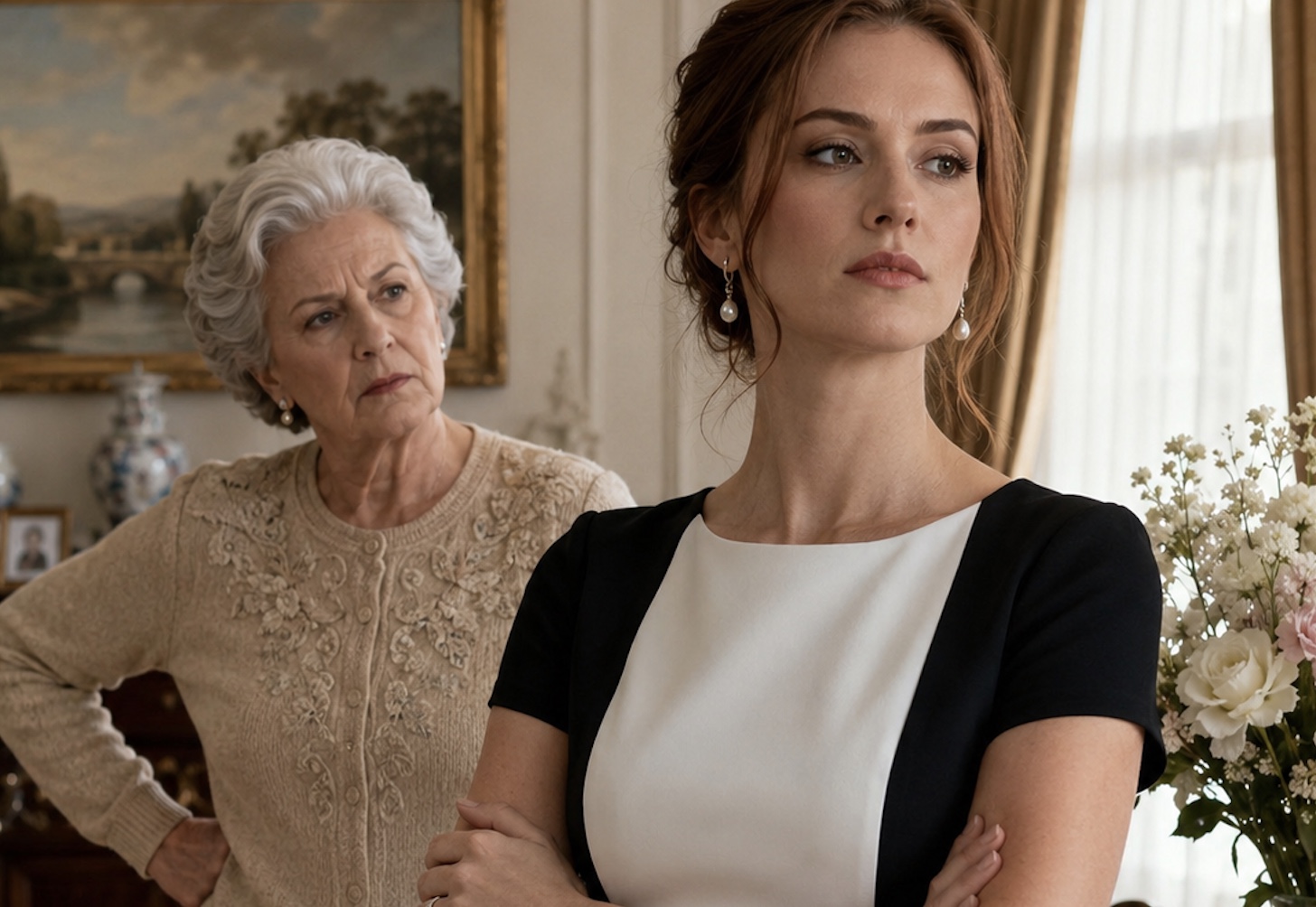
Vera heard the key turn in the lock.
It was a familiar sound: metal scraping, meeting resistance, twisting uselessly. The old key no longer fit. Vera stood in the hallway and counted the seconds until the first knock.
It came eight seconds later.
Not with a fist, but with knuckles — neat, persistent, measured. A rhythm impossible to mistake for anyone else’s. Only Nina Sergeyevna knocked like that. That was how she entered other people’s lives: confidently, without invitation, carrying a bag in her hand and the unshakable belief that she was welcome.
Vera stepped toward the door and slipped the chain into place.
Not abruptly. Not nervously.
Slowly, the way one tightens a scarf on a windy day — leaving just enough space for air. The small metal links settled into the groove with a quiet click.
“Verochka, are you home?” came the voice from behind the door, soft and syrupy. “I brought pastries. Still warm. And some good oranges from Magnolia.”
Vera did not answer at once.
She looked at the chain — those small, almost toy-like links that were now holding back not merely a door, but something far more important.
“Nina Sergeyevna, the lock has been changed,” Vera said evenly, without provocation. “The keys are different now. The old ones don’t work anymore.”
A pause.
Short, but expressive.
The bag rustled outside.
“What do you mean, different? Verochka, what nonsense is this? I came over in the summer to water the flowers. I’ve always had keys. Why would you change them?”
“Because this is our home,” Vera said quietly.
But each word stood firm, like a post driven deep into the ground.
“And we decided the keys should belong only to us.”
“But I’m not a stranger!” the voice behind the door rose slightly, a note of hurt rising from below like water creeping up the steps. “In normal families, people don’t lock their doors against their own. This isn’t some shared apartment.”
Vera leaned her shoulder against the wall.
Her grandmother’s shawl hung from a hook nearby — warm, woolly, still holding the memory of someone else’s old warmth. Above the mirror, a garland left over from last winter blinked faintly. Everything here belonged to the two of them.
Only to them.
“Nina Sergeyevna, I hear you. But I’m not opening the door.”
“Verochka, don’t be childish. Open up. It’s hard for me to stand here with this bag. My legs are aching. I walked all the way from the metro.”
“You could have called ahead. We would have told you we weren’t expecting guests today.”
“What guests? I’m not a guest! I’m part of this family!”
Vera said nothing.
She looked down at her hands. Her fingers rested calmly on the chain, without trembling. She remembered the old country house, the peeling steps, the gate always flung wide open. Her mother had never locked doors and used to say that an open home was a sign of courage and kindness.
Then the neighbors began walking in without asking — with apples, with jars, with advice. And her mother would cry in the kitchen, leaning over the table as if it were a barricade, whispering to her daughter that sometimes doors had to be shut: for the night, for the day, and sometimes forever.
“Verochka, all right,” Nina Sergeyevna said at last. “Let’s say I was wrong. Let’s say I should have called. Open the door. We’ll talk. We’ll have tea.”
“Nina Sergeyevna, I don’t want tea.”
“Then we’ll just talk. Through a door? What kind of conversation is that? The neighbors will hear.”
“Let them hear. I have nothing to hide.”
Vera felt something rising inside her — something she had been forcing down for months, like water pressed into an overfilled bottle. The cork had held through summer. Through autumn. Through winter.
But now, every word Nina Sergeyevna spoke twisted it another quarter turn loose.
“All right,” Vera said, pressing her forehead lightly against the door. “Let’s talk. Through the door. You’re used to being on one side and deciding what happens on the other, aren’t you?”
“What is that supposed to mean?”
“It means that in June you came to ‘water the flowers.’ I came home and found my linen rearranged. My things were not where I’d left them. Kirill’s shirts had been hung by color. The basil, coriander, and turmeric were gone from the kitchen. You threw them away.”
“They were expired!”
“They had been bought a week before your visit, Nina Sergeyevna. The date was on every jar.”
“Well, then I made a mistake. Goodness, they were only spices.”
“In July, you watered my violets with tea. They burned. All four of them.”
“Tea is fertilizer! My grandmother always did that!”
“Your grandmother watered her own flowers. In her own house. On her own windowsill.”
There was an irritated huff from behind the door. The bag hit the wall — Nina Sergeyevna must have set it down.
“Verochka, you’re making a mountain out of a molehill. I wanted to help. I always want to help.”
“In August, you rearranged the shelves in the refrigerator. Dairy on top, meat on the bottom. I spent half an hour looking for the butter. And on the table, you left a note: ‘Dinner should be before seven, Kirill has had gastritis since university.’ Kirill is thirty-two, Nina Sergeyevna. He does not have gastritis. He has a wife, and she cooks dinner when he comes home.”
“I was only taking care of him!”
“No. You come into someone else’s home and behave as if it is an extension of your own kitchen. You don’t ask. You don’t wait. You don’t check. You enter, rearrange, throw things away, leave notes — and then you leave, convinced you’ve done a good deed.”
Vera spoke calmly, without raising her voice. Each word came out like a breath she had been holding for months.
And when the last one left her lips, she felt as though the real version of herself — the one that had been knocking from inside for so long — had finally stepped in.
“You ungrateful girl,” Nina Sergeyevna hissed. “Everything was done for you!”
“If it were for us, a phone call would have been enough,” Vera replied. “If it were for us, you could have respected someone else’s home.”
Silence lasted about fifteen seconds.
Then came a blow.
Not with knuckles this time.
With a foot.
Nina Sergeyevna kicked the door, and the impact rolled through the hallway like a drumbeat.
“Open this door! Open it right now! What am I to you, a beggar? I’m supposed to knock at my own son’s home?”
Vera did not flinch.
She stood with her palm against the chain and felt the vibration of each strike — but she did not move.
“Open up, I said! I’ll break the door down! Open, you little wretch!”
Nina Sergeyevna’s voice scattered across the stairwell, catching on the walls, the railings, the neighbors’ doors. Someone upstairs went quiet. Down below, a lock clicked — then immediately closed again.
“I’m calling Kirill right now!” her mother-in-law shouted. “He’ll put you in your place fast enough! You think you’re the mistress here? You think because your daddy gave you an apartment, you can keep your husband’s mother out?”
Vera slowly turned around.
At the far end of the hallway, on the sofa, Kirill was sitting motionless, his phone resting on his knee, his eyes fixed on the floor.
His face was hard — not from indifference, but from that particular tension people carry when they are about to do something they have feared for years.
The phone rang.
The screen lit up: Mother.
Kirill stared at it without raising his hand. The ringing trembled in the silence of the apartment, mixing with the dull blows against the door.
Vera said nothing.
She simply stood and looked at her husband.
Not reproachfully.
Not as an ultimatum.
She looked at him the way people look when they have already made their own decision — and are waiting to see whether the other person will make his.
Kirill’s childhood room rose in his memory: narrow, six square meters, with a sagging couch and a shelf where the books stood arranged by height because Nina Sergeyevna had ordered it so. He remembered how she checked his schoolbag until ninth grade. How she stood behind him while he did his homework. How after the wedding she demanded that the newlyweds move in with her — “into Kiryusha’s little room, the sofa is wide enough.”
But Vera’s father had given them an apartment.
It was not just a gift.
It was a key.
A key to a door behind which one could finally breathe.
Kirill remembered signing the documents, his hands damp, his heart pounding not from joy, but from the fear that his mother would discover he was happy. That he was escaping.
The phone stopped ringing.
Then immediately rang again.
“Open up, you wretch!” came the voice from behind the door. “Kirill! Kirill, if you’re in there, answer me! I know you’re home! I know!”
Kirill drew in air.
Not a sigh — a deliberate, deep intake, like someone preparing to jump.
And he answered.
“Kiryusha!” Nina Sergeyevna’s voice burst through the speaker like wind through a cracked window. “Finally! Listen to what’s happening here — your wife changed the lock, she won’t let me in, she has the door on the chain! Can you imagine? I’m standing on the landing like some beggar! With pastries!”
Kirill was silent.
Vera saw him tighten his grip around the phone. Not from anger — from effort. Like a man holding the wheel while turning against the current.
“Kiryusha, do you hear me?”
“I hear you.”
“Then tell her! Tell her to open the door! What kind of disgrace is this? I came with good intentions, and she gives me a chain!”
“Vera changed the lock with my consent.”
Silence.
“What?”
“We changed it together. We decided together. Only the two of us have keys.”
“Kiryusha, what… what are you saying? Did she turn you against me? Did she fill your head with this?”
“No one filled my head with anything. I called the locksmith myself. I chose the lock myself. I threw away the old keys myself so you couldn’t use them anymore.”
“Kirill!”
“And the fact that Vera isn’t opening the door — that is with my consent too.”
The voice behind the door trembled.
Not with tears.
With something else.
With the collision against a reality that did not fit into the world she had built over thirty years.
“You… you’re closing the door on your own mother?”
“I am closing the door on a person who enters without asking, takes over someone else’s home, and doesn’t think she needs permission to come.”
“I am not a stranger!”
“Then don’t behave like one. Strangers at least ring the intercom.”
Vera stepped closer to Kirill.
She did not sit beside him. She stood behind him and placed her hand on his shoulder. He did not turn around, but his shoulder relaxed slightly beneath her palm.
“Kirill, you are making a mistake,” Nina Sergeyevna’s voice became quiet, insinuating, like silk scraping over stone. “I am the only person who truly loves you. She is an outsider. She will leave. I will remain.”
“No. You will not remain,” Kirill said slowly.
Each word cost him effort, but he did not stop.
“Because you will not remain in our home. Not the way you used to. If you want to see us, call. Arrange it. Ask whether it’s convenient. Like normal adults do.”
“She taught you to talk to me like this!”
“No. You taught me. For years. With every visit without warning. With every note on the table. With every jar you threw away. I only kept silent because I was afraid. And now — I’m not afraid.”
“Is that your final word?”
“It is not my final word. It is my first. The first in thirty-two years.”
Behind the door came a sound — dry and short, like a branch snapping.
Nina Sergeyevna had hung up.
Or dropped the phone.
There was some rustling, the sound of the bag being picked up, then heavy footsteps descending the stairs.
Kirill lowered the phone and looked at his wife.
His eyes were tired, but there was something new in them — something Vera had never seen before.
Not relief.
Not victory.
Peace.
The peace of a man who had stopped fearing his own voice.
“Are you all right?” Vera asked.
“No,” Kirill answered honestly. “But I’m here. And the door is closed.”
Vera leaned down and kissed his temple.
He closed his eyes.
The chain on the door swayed slightly in the draft — small, thin, almost toy-like.
But it held.
Nina Sergeyevna went down the stairs without waiting for the elevator. The bag struck against her leg. She passed the trash bins near the entrance, stopped, looked at the bag — and flung it into the container with all her strength.
A jar clinked dully against the bottom.
Pastries, oranges, cucumbers — everything flew down into the darkness of the bin, into dampness and stench. Nina Sergeyevna wiped her hands on her coat and walked toward the metro.
Her back was straight, her chin lifted. Her beige hat had slipped slightly to one side, but she did not adjust it.
In the train, she sat by the window and took out her phone.
She called Kirill.
Long rings.
Rejected.
She called again.
Rejected.
She called Vera.
“The subscriber is unavailable.”
She put the phone back into her bag and sat staring into the black glass of the tunnel, where her own face was reflected back at her — stubborn, no longer young, with that almost Roman nose protruding beneath her hat like the prow of a ship sailing against the wind.
She climbed the stairs to her own building.
Out of habit, she reached into her bag for her keys. Her fingers found the bunch — heavy, with a horseshoe keychain Kirill had given her five years earlier for New Year’s. She inserted the key into the lock.
Turned it.
The key did not move.
Nina Sergeyevna frowned.
She pulled it out, put it in again, pushed the door with her shoulder.
The lock would not give.
She stepped back and looked at the door as if it had personally betrayed her.
Then she took out her phone and called her husband, Boris.
He answered after the third ring.
“Boris, my lock is jammed. Are you home?”
“No,” Boris said calmly, almost weightlessly. “I’m not home.”
“Then come here! My door won’t open!”
“It opens. With a new key. One you don’t have.”
Nina Sergeyevna froze.
The hand holding the phone slowly lowered.
“What?”
“I changed the lock. This morning. While you were visiting Kirill with your pastries.”
“Boris, have you lost your mind?”
“I moved to the dacha. For good. I took my things yesterday while you were at the hairdresser. Your new key is with Tamara next door. One key. The only one. Just the way you like it — no spares.”
“Boris!”
“Thirty-four years, Nina. For thirty-four years, I was obedient, as you liked to say. You decided what I ate, when I went to bed, whom I called, whom I was allowed to be friends with. You sent me away to the dacha because I was ‘underfoot.’ You turned our son into a management project. You pushed into his home, his refrigerator, his marriage. And today I heard him answer you. For the first time in his life. And I thought — if he can do it, then maybe I’m not hopeless either.”
“You… you’re taking revenge on me?”
“No, Nina. I’m resting from you. Forever. The divorce papers will come by mail. The apartment is yours. The dacha is mine. That’s fair. You always said the dacha was ‘for failures and pensioners.’ Well, I’m a pensioner. It suits me.”
“Boris, wait! Wait, let’s talk!”
“The key is with Tamara. Apartment three. Good night, Nina.”
Beeps.
Short, even, indifferent.
Nina Sergeyevna stood before her own closed door.
The keys in her hand gleamed — useless, dead, like the teeth of someone else’s comb. The horseshoe keychain swayed and jingled faintly.
She knocked on Tamara’s door.
Tamara did not open immediately. When she did, she looked at Nina Sergeyevna with cautious sympathy and silently handed her a key — one single new key, its teeth sharp and fresh.
Nina Sergeyevna entered her apartment.
Took off her shoes.
Walked into the room.
Boris was gone.
No slippers. No newspapers. No glasses on the nightstand. No mug with “Best Grandpa” written on it, though they had no grandchildren.
He had even taken the wall clock.
Flowers stood on the windowsills — dozens of pots packed closely together like spectators in a theater. Ficus plants, geraniums, violets, some climbing things, creeping things, bushy things. Nina Sergeyevna cared for them with the same obsessive precision with which she had cared for other people’s lives — repotting, feeding, turning them toward the light.
Flowers did not object.
Flowers did not change locks.
She sat down at the table.
The apartment was quiet.
No cat.
No dog.
No husband.
No son.
Only flowers that did not know how to say no.
Only flowers that would never put a chain on the door.
On the table lay a note.
Boris had written in large, steady handwriting — the same handwriting with which he had once signed their wedding papers.
“For thirty-four years, you watered everyone around you with tea. But people are not violets, Nina. They do not grow from it. They burn.”
Nina Sergeyevna turned the note over.
On the back, he had added:
“P.S. I put a chain on the door too. From the inside. You’ll like it — you’ve always loved having everything under control.”
She stood up, walked to the front door, and looked.
A new chain gleamed there — thin, small, with toy-like links.
Exactly like the one on Kirill and Vera’s door.
Only there was no one to lock it against.
There was no one left to come.
Nina Sergeyevna stood in her hallway — alone, among her flowers and her rules — and could not understand how it had happened.
After all, everything had been done for them.
Everything.
For them.
She was certain Vera was to blame. Vera had changed the lock. Vera’s father had bought the apartment. Vera controlled Kirill like a puppet. Vera was the reason Boris had run away.
It was all the daughter-in-law’s fault — insolent, ungrateful, a stranger.
But the door was closed.
And behind it, there was no one.
THE END