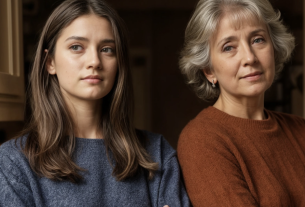
“You could have at least pretended to be interested when my father was talking about how they got the apartment order. After all, it’s part of the family history — a family you were allowed to become part of.”
Vadim stood by the window, theatrically staring out at the nighttime avenue as if he were surveying his estate. The click of the lock after the last guest had left still seemed to hang in the air, and the silence in the apartment had already stretched tight, like a violin string. The dining table was cluttered with the remains of the feast — crystal glasses with unfinished wine, plates with dried cheese, crumbs from a baguette — a mess that irritated Vadim deeply, though of course he had no intention of cleaning it up himself.
Ekaterina silently began gathering the dirty dishes. Her movements were precise, mechanical, stripped of all fuss. The clink of a fork falling onto a porcelain plate sounded like a gunshot in the silence. She did not lift her head, continuing to stack the plates methodically.
“I’ve heard that story forty times, Vadim,” she said, her voice flat and dry, like an autumn leaf. “About the influential grandfather, the call from the ministry, how your grandmother cried with happiness when she saw these ceilings. I can recite it word for word, including your father’s intonation on the line, ‘And then they handed us the keys.’”
“That is called respect for tradition!” Vadim snapped around, red blotches spreading across his face, the way they always did after one glass of cognac too many. He walked over to the table and ran a finger along the polished surface, checking whether the guests had left scratches. “You live in this home, Katya. You walk on this parquet. You sleep inside these walls. Don’t you think you’ve gotten used to taking all of this for granted a little too quickly?”
He swept his arm around the room as though presenting exhibits in a museum: heavy velvet curtains, an oak sideboard filled with family silver, the molding on the high ceiling that had witnessed the leaders of the previous century. To Vadim, none of it was merely interior décor. It was an extension of himself — his skin, his rank, his status.
Ekaterina froze for a second with a full tray in her hands. She looked at her husband, and there was neither fear nor guilt in her eyes, only an endless, leaden exhaustion.
“I live here because I’m your wife, Vadim. Not because I won the lottery for the right to breathe the same air as your antiques. And by the way, that parquet was restored last year with my money. Or is that part of the ‘tradition’ too — forgetting who pays to maintain the museum?”
Vadim snorted and poured himself more cognac. The liquid splashed into the glass, a few drops falling onto the tablecloth. He winced, but made no move to wipe them away.
“There you go again. Money, bills, receipts… You really are petty, Katya. That’s your provincial nature speaking. You measure life in numbers because you have no foundation. No roots.”
He came right up to her, forcing her to take a step back so she would not drop the tray. He smelled of expensive cologne — the one she had given him for their anniversary — and alcohol.
“Understand one simple thing,” he said in a lecturing tone, stretching out his words like a teacher explaining a lesson to a slow student. “Your career, your bonuses, your endless meetings — all of that is foam. Here today, gone tomorrow. But this,” he stomped his foot on the floor, “this is eternal. This is central Moscow. This is status you cannot buy with any bonus. You can become the director of the entire universe for all I care, but without me, without this apartment, you’ll still be that girl with one suitcase at the train station.”
Ekaterina slowly exhaled through her nose. She remembered that suitcase. And she remembered the station. But she also remembered how, seven years ago, this same “owner of factories and steamships” had borrowed money from her for a taxi because his father had blocked his card after yet another stunt.
“I am not a girl from the station, Vadim. I am the head of the logistics department at a major international company,” she said quietly, looking straight at the bridge of his nose. “And I earn five times more than you. Maybe it’s time you stopped playing lord of the manor? The guests are gone. The performance is over.”
“Five times more?” Vadim threw his head back and laughed. It was an unpleasant, barking laugh. “Even if it were ten times more! Do you think that makes you my equal? Do you think money washes away the smell of the cheap sleeper train? My father was right today when he said, ‘Our Katyusha is hardworking, sharp-toothed, like all newcomers.’ That wasn’t a compliment, darling. That was a diagnosis. People like you gnaw at the earth because you have nothing. I, on the other hand, have something.”
He returned to the window, turning his back on her with deliberate arrogance. His figure in a house robe looked almost comical against the pompous curtains, but Vadim did not notice. He felt like a king graciously allowing the servants to clear the table after the banquet.
“Clean this up,” he tossed over his shoulder. “And air the room out. Those salads of yours made it stuffy. And don’t rattle the dishes — your fussing gives me a headache.”
Ekaterina stood motionless for several seconds. She looked at his hunched back, at the thinning hair on the back of his head, and something clicked inside her. There was no anger. No hurt. Only the feeling that she was looking at an old, dusty suitcase with no handle — something that should have been thrown away long ago, but that she had kept dragging along, afraid to admit to herself that there was nothing inside.
She turned and went to the kitchen. The dishes clinked softly as she lowered them into the sink. Ekaterina turned on the water, and the sound of the stream drowned out the muttering of the television, which Vadim had already switched on in the living room. She did not start washing the plates. She simply stood there, watching the water disappear down the drain, carrying away scraps of food and the last grains of her patience. In her head, clear and cold as a winter morning, a puzzle began to assemble itself — one whose pieces had been lying under her feet for years.
Vadim would not stop. Her silent presence in the kitchen was not enough for him. He needed complete, unconditional recognition of his superiority. He followed her, shuffling across the tiles in soft house slippers, and leaned his shoulder against the doorframe, watching as Ekaterina loaded the dishwasher. His posture carried the lazy grace of a well-fed predator playing with its prey before swallowing it.
“You keep trying to prove you’re worth something, Katya,” he said, his voice thick with drunken philosophy. “Running around, rushing, bringing home your bonuses like a dog brings back a stick. ‘Look, master, I’m a good girl.’ But you forget one simple thing: breeding isn’t something you acquire in an office. It’s in the blood.”
Ekaterina froze with a glass in her hand. The crystal gave a delicate ring as it touched the edge of the sink. She slowly set it on the drying rack and straightened, not bothering to wipe her wet hands.
“Breeding?” she repeated, looking at him the way one looks at mold creeping through expensive wallpaper. “Vadim, you haven’t been able to fix the bathroom faucet for three years. You live off the money I transfer into our joint account, and you call that ‘breeding’? Your mother said today that you’re still ‘finding yourself.’ At forty, Vadim?”
“Don’t you dare bring my mother into this!” he jerked, spilling the last of his cognac on the floor. “She sees things for what they are. She sees that you are a foreign element. You’re an outsider, Katya. A provincial climber. You don’t like that word? Does it hurt your ears? But it’s the truth. You came to my city, into my apartment, with your cheap diploma and the ambitions of a small-town upstart.”
He stepped farther into the kitchen, right into the little puddle of cognac. His face twisted with superiority mixed with an old, festering resentment toward her success.
“You think your money makes you a Muscovite?” he laughed, and the sound was like metal scraping. “You can cover yourself in brands from head to toe, but inside you’ll always be that girl in a cheap Chinese down jacket, shivering on the platform. You are a guest here. An eternal guest. And every ruble you spend on this apartment is nothing more than the price of admission. Rent, Katya. You pay for the right to breathe history.”
Ekaterina silently took a kitchen towel and began drying her hands slowly, finger by finger. Her calmness infuriated him more than shouting ever could.
“Let’s calculate it, Vadim,” she said, her voice turning icy, stripped of emotion. “Since we’ve started talking arithmetic. The groceries in that refrigerator are mine. The clothes on your back were bought by me. The renovation you love bragging about to friends was paid for with my card. The cleaning service, utilities, internet — even that cognac you’re drinking — all of it was paid for by me. Your ‘history’ is expensive, and I am the one maintaining it. What do you contribute? Besides your endless whining about the greatness of your ancestors?”
Vadim turned crimson. Facts always knocked the ground out from under him, but he immediately found refuge in his twisted logic.
“You’re throwing food in my face?” he spat the words with contempt. “How low. How… peasant-like. Counting pieces of bread? I gave you the most important thing — status! I gave you a surname! I gave you residence in the center of Moscow! Without me, you’d be living in some rented hole in Mytishchi and riding the commuter train with migrant workers!”
He came right up to her, looming over her, trying to crush her physically now that he had run out of arguments. The smell of alcohol mixed with the scent of expensive fabric softener.
“You should be kissing this floor you walk on!” he hissed in her face. “Every morning, you should wake up and thank God and me for pulling you out of the dirt. And you dare wave receipts at me? Your receipts are garbage compared with the square meters in this building! Walls, Katya, stand for centuries. Your career could collapse tomorrow. And where would you go then? Back to your miserable backwater?”
Ekaterina looked at him, and something finally went out in her eyes. The last spark of pity for this man — a feeling she had mistaken for love or attachment — vanished, leaving behind a clean, sterile emptiness.
“I’m not throwing food in your face, Vadim. I’m stating a fact: you are a dependent. You feed off your family’s past and my present. You call me a provincial nobody, but it is this ‘nobody’ who provides the standard of living you are used to and cannot afford yourself.”
“Shut up!” he roared, slamming his fist onto the countertop. “You have no right to speak to me like that in my house! You are nothing! A freeloader! You’re here only because I allowed you to be here! I made you! I cleaned you up!”
His shout echoed through the apartment, bouncing off the high ceilings. Vadim breathed heavily, his chest rising and falling beneath his silk shirt. He felt like a victor who had put an insolent servant back in her place. He was sure she would now lower her eyes, as usual, apologize, go cry in the bedroom, and he would pour himself another drink and enjoy the silence.
But Ekaterina did not lower her eyes. She carefully hung the towel back on its hook, smoothed an imaginary crease from her blouse, and looked at him as if seeing him for the first time. There was no fear in her gaze. No submission. Only cold calculation and a decision already made.
“So I’m a freeloader?” she asked softly. “So you cleaned me up? Good, Vadim. Very good. I’m glad we’re finally calling things by their proper names.”
She turned and left the kitchen. Vadim, who had expected hysteria or excuses, was thrown off for a second, but then immediately smirked smugly. He decided she had gone to pack a bag to scare him with the idea of leaving, as she had done a couple of times early in their marriage.
“Go on, go!” he shouted after her, feeling a surge of drunken power. “Cry in the bathroom! Maybe your brain will fall back into place! Just don’t run the water too long — the meters are ticking!”
He did not know she had not gone to the bathroom. She went to the hallway, where her work bag lay on the console table.
“Well? Finished crying?” Vadim did not even turn his head when he heard her footsteps. He was certain she had returned repentant, like a beaten dog with nowhere else to go. He refilled his glass, admiring the way the amber liquid played in the light of the expensive chandelier. “I hope you’ve realized who the master of this house is, and who is merely a temporary passenger?”
Ekaterina came to the table. In her hands, she held not a dust cloth or a tear-soaked handkerchief, but a thick blue folder with documents. She placed it on the polished tabletop. The sound was dull and heavy, as if a brick rather than a stack of papers had landed there.
“Look at me, Vadim,” she said. Her voice was frighteningly calm, without a single hysterical note, and that instantly put him on alert.
He reluctantly tore his eyes away from his reflection in the dark window and turned. Ekaterina stood straight, hands clasped in front of her. There were no tears in her eyes. No pleading. There was steel there — cold, rational steel sharp enough to cut.
“What is this?” he nodded toward the folder, twisting his lips into a sneer. “An expense report? Or did you write an explanation for why you dare open your mouth at your benefactors?”
“They’re documents, Vadim. Read them.”
He reached lazily for the folder, making it clear with every movement how little he cared. He opened the first page. His eyebrows climbed upward, and the smirk began slowly sliding off his face, replaced by genuine confusion.
“A purchase agreement?” He lifted his cloudy eyes to her. “What nonsense is this? Did you decide to buy your parents a country house in that wilderness of yours?”
“No. Look at the address.”
Vadim lowered his eyes to the page again. Moscow. A good district — not the center, of course, not his precious “golden mile,” but a very respectable business-class area. A new residential complex he had heard about in passing. The price…
He blinked, trying to focus on the numbers. The amount was substantial. Very substantial.
“Where did you get that kind of money?” he rasped, feeling an unpleasant chill stir inside him. “Have you been stealing from me?”
“There’s nothing to steal from you, Vadim, except dust and self-importance,” she cut him off. “These are my savings from the last five years. Plus a mortgage, approved for me in one day, because unlike you, I have an excellent credit history and an official salary.”
Vadim flung the folder away as if it were infected. The papers scattered across the table like a fan, one sheet gliding down to the floor.
“A mortgage!” he burst out laughing, but the laughter came out cracked and hysterical. “You willingly put a yoke around your neck? Sold yourself to a bank for thirty years? God, how pathetic. Instead of living like a queen in the historic center, you chose a concrete box in a credit ghetto?”
“You call me a penniless stray you ‘picked up’?! I’m not a mongrel, Vadim! I earn more than you, and still you keep throwing this apartment in my face! I’ve had enough! I’m taking out a mortgage and moving out today! Go find yourself another ‘homeless girl’ willing to tolerate your arrogance!”
She took a set of keys from her pocket. New, shiny keys with a keychain from the developer. They landed on the table beside his cognac glass with a bright metallic jingle. The sound resembled coins tossed to a beggar.
“You… you wouldn’t dare,” Vadim turned pale. Suddenly, the full horror of the situation began dawning on him. Not that she was leaving — to hell with her, there were plenty of women. But that comfort was leaving with her. The full refrigerator was leaving. The paid internet was leaving. Cleanliness was leaving. Money for gas and entertainment was leaving. “You can’t just leave! We’re a family!”
“Family?” Ekaterina gave a bitter smile. “Family is when people build something together. I was a convenient service for you. A free maid with an ATM function. Today, in front of everyone, you called me a homeless woman you took in. Well, Vadim, that homeless woman just bought an apartment worth more than you’ve earned in your entire life.”
“Who needs you there?” he screamed, jumping up from the chair. The chair toppled over with a crash. “In your concrete kennel! You’ll come crawling back in a month when you realize what it means to pay bills on your own! You’ll die there from loneliness!”
“I’ve been paying the bills for five years. For both of us,” she reminded him in an icy tone. “How you’re going to pay utilities for this enormous apartment on the salary of a junior assistant — that’s the real question. Your father will help, of course. But for how long?”
Vadim was choking on rage. His world — that cozy little world built on someone else’s back — was collapsing before his eyes. He was used to seeing himself as a benefactor granting shelter to an orphan. It turned out the orphan had grown up long ago and bought her own castle, even if it came with a mortgage. It was not simply betrayal. It was humiliation of his masculine pride, a strike at the most painful place — his status.
“Get out!” he shrieked, spraying spit. “Go on! Get into your mortgage pit! I don’t want your spirit here in five minutes!”
“Don’t shout,” Ekaterina said calmly, bending down to pick up the fallen page of the contract and neatly placing it back in the folder. “I’m leaving anyway. I started packing my things a week ago. They’re already boxed and waiting in the dressing room. The movers will be here in half an hour.”
“You… you planned this behind my back?” Vadim sank onto the edge of the table, staring at her with superstitious horror. “While I slept, while I ate your food, you… you rat! You calculating, cold creature!”
“I’m simply a woman who wants a home of her own, Vadim. A home where she won’t be called a freeloader. Where no one will throw a piece of bread in her face. Where the walls may not be so ‘historic,’ but they will be mine. And where the air won’t be soaked in your snobbery.”
She pressed the folder to her chest like a shield.
“By the way, I’ll leave the keys to your apartment on the console table in the hallway. Don’t forget to lock the door after I leave. The locks here are old and unreliable. Like everything else in your life.”
Ekaterina turned and headed to the bedroom, where her boxes were waiting. Vadim remained standing in the middle of the living room. He looked at the overturned chair, the scattered crumbs, the cognac stain on the tablecloth. Around him was his precious apartment, his inheritance, his pride. But for some reason, for the first time in his life, the high ceilings seemed less like the arches of a palace and more like the lid of a coffin. The silence that followed her words pressed on his ears more heavily than any scream. He reached for the bottle, but his hand trembled, and the neck knocked dully against the rim of the glass.
A sharp, demanding ring at the door cut through the thick, electric silence of the apartment, making Vadim flinch. He stood in the middle of the living room, still clutching his glass as if it were the scepter of his shaken power. Ekaterina did not even turn at the sound — she knew who it was. She calmly pressed the intercom button, letting strangers into their — now only his — sanctuary.
Heavy boots thudded in the hallway. Two sturdy men in stained overalls bearing the logo of a moving company entered the apartment, instantly filling the space with the smell of tobacco, cheap coffee, and the street. To Vadim, it was desecration. Barbarians had burst into his temple, where people were supposed to walk on the parquet only in soft felt slippers.
“Careful!” he squealed when one of the movers brushed his shoulder against the doorframe. “That is oak, it’s a hundred years old! Do you even understand where you are?”
“Relax, old man, we’re not hauling firewood,” the older mover muttered without looking at him, then gave Ekaterina a questioning nod. “Ma’am, are these going out?”
Vadim nearly choked with outrage. Old man. He, a hereditary intellectual, had been called an old man in his own home.
“Yes, guys. Start with the boxes in the hallway, then the electronics from the living room,” Ekaterina instructed them with the same businesslike calm she used to run her logistics department. “And be careful with the plasma TV. Its box is on the balcony.”
Vadim watched as his familiar world was taken apart piece by piece. First, the boxes with her clothes disappeared. Then the movers headed toward the television — the huge screen Ekaterina had bought six months earlier to replace the old bulky relic his father had liked so much.
“You’re taking the television too?” Vadim stepped forward, trying to block the movers’ path. “You’re leaving me in an empty apartment? That’s petty, Katya! It’s just… low-class!”
Ekaterina paused, adjusting the strap of her bag on her shoulder. She looked composed, distant, and frighteningly calm.
“I’m taking what belongs to me, Vadim. The television, the coffee machine, the robot vacuum, the orthopedic mattress. Everything I bought to make this crypt fit for living. You still have your antique furniture, your molded ceilings, and your complete collection of Lenin’s works. Enjoy the spirituality.”
“You’re stripping me bare!” his voice rose into a shrill pitch as he felt the ground disappear beneath him. It was not about the television. It was about the fact that warmth was leaving the apartment along with those things. Life was leaving. Only cold walls and the dust of centuries remained. “You mercenary bitch! I always knew you were only waiting for the moment to grab your share!”
“If I wanted to grab something, I would have filed for division of property,” she replied coldly, nodding for the movers to pass. “By law, half the value of the renovation done during our marriage belongs to me. But I’m not touching your walls. I’m leaving you your precious plaster. Live with it. Talk to it. Maybe it will answer.”
The movers carried out the last boxes. The apartment emptied rapidly, turning into an echoing, uncomfortable space. On the wallpaper, where the paintings Ekaterina had bought used to hang, pale rectangles remained — like scars left by sunlight. On the floor, where a soft rug had once lain, the worn old parquet now showed through, a flaw that had been hidden before.
Vadim paced the room, not knowing what to do with his hands. He wanted to hit something, smash something, stop this nightmare, but he understood that any physical action would make him look pathetic. He was master of the situation only in words. In reality, he was a small man inside a huge old apartment that had suddenly become too large for him.
“Fine, go!” he shouted when Ekaterina was already standing in the doorway. “Go to your concrete box! We’ll see how you howl there in a week! You are nothing without my surname! An empty space!”
Ekaterina slowly turned around. In the light from the stairwell, her face looked as if it had been carved from marble. She took a set of keys from her pocket — the very keys he had given her seven years ago with such ceremony, as if handing over the keys to the city. She did not throw them. She carefully placed them on the console table beside the mirror. Metal rang softly against wood — the sound of a period being placed at the end of an entire era.
“I was never an empty space, Vadim,” she said quietly. “I was the foundation holding up your house of cards. And now the foundation is gone. Be careful your ceiling doesn’t come crashing down on your head. Goodbye.”
The door closed. The lock clicked. The sound was final, irreversible, like the strike of a judge’s gavel.
Vadim was left alone.
The silence descended instantly — thick, cottony, ringing in his ears. He had expected to feel relief, the triumph of a victor who had expelled an invader. Instead, he felt a draft. Cold air seeped through the cracks of the old windows Ekaterina had planned to replace next month.
He went into the kitchen. It was spotless and empty. The coffee machine that filled the house every morning with the scent of life was gone. The bright towels were gone. On the table, only crumbs from the evening’s feast remained, along with the sticky stain from spilled cognac.
Vadim sat down on a stool — hard, wooden, “historic.” He looked around his kingdom. The ceiling molding he had been so proud of seemed dirty and cracked in the half-darkness. The majestic oak sideboard looked like a coffin standing upright. Without his wife’s things, without her movement, without her scent, the apartment had instantly aged by fifty years.
“Bitch,” he whispered into the emptiness, but the word brought no relief. It struck the tile and came back to him as a pathetic echo.
He reached for the bottle, but it was empty. He got up to look for more alcohol and suddenly noticed his reflection in the dark window glass. Staring back at him was not an aristocrat, not a master of life, but an aging, rumpled man in a stale shirt, standing in the middle of a museum of decaying domestic grandeur.
Vadim walked to the window and pressed his forehead against the cold glass. Down in the courtyard, the headlights of the moving truck came on. He watched Ekaterina leave the building, watched her move quickly, almost lightly, toward the truck without once looking back at the third-floor windows. She was leaving for her mortgaged “kennel,” for her new life full of debts and problems — but entirely her own.
And he remained here.
In his fortress.
In his pride.
In his complete, absolute, ringing emptiness.
He slowly slid down the wall onto the floor, onto that very “precious” parquet, and covered his face with his hands. There were no tears. Only dry, throat-scratching anger and the realization that tonight he had not lost his wife.
He had lost himself.
And the walls he loved so much remained silent, indifferent, with no intention of comforting him.