— Perfect!
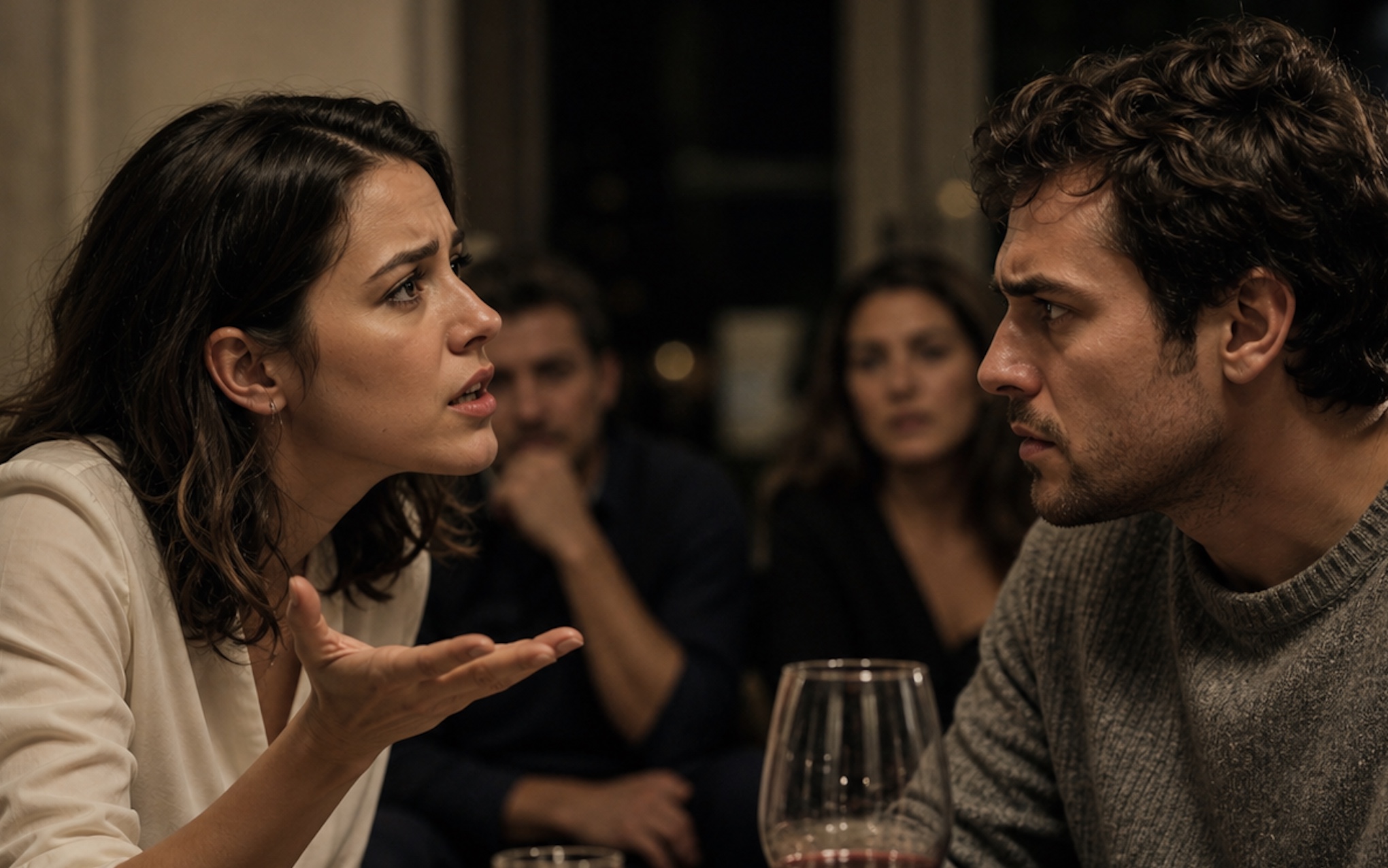
The evening began like a flawless picture from a glossy magazine about the lives of the city’s wealthy elite. Crystal shimmered on the table, thick velvety Bordeaux swayed in the glasses, and the smell of roasted duck with apples mingled with the expensive perfume of the guests. But beneath that polished surface, like rot under parquet flooring, a heavy, suffocating conflict had been growing for a long time.
Artyom sat at the head of the table, lounging in his chair with the air of an overfed patrician. His face, slightly puffy from regular drinking and a comfortable life, gleamed in the warm light of the designer chandelier. He twirled the stem of his wine glass, watching the wine leave oily “tears” on the glass, and continued telling yet another story with obvious pleasure.
“No, just imagine the cultural shock,” he said, his loud, self-assured voice rising above the quiet clinking of cutlery. “I take her to Café Pushkin for the first time, and she stares at the menu like it’s ancient Sumerian cuneiform. Eyes as wide as coins, hands trembling. I tell her, ‘Nastya, order the beef stroganoff,’ and she whispers, ‘Tyom, do they have navy-style pasta here? I’m scared of all these names.’”
The guests — Oleg, Artyom’s old school friend, and his wife Marina — smiled politely, but the smiles were strained. Marina looked down at her plate, delicately picking at a piece of arugula with her fork. She was embarrassed, but she did not dare interrupt the host, who had just been boasting about a new multimillion-ruble contract.
Nastya sat at the opposite end of the table. Her back was unnaturally straight, as if a steel rod had been tied to her spine. She wore an elegant dark-blue dress — one Artyom had chosen himself, claiming she had “the taste of a peasant woman let loose at a marketplace.” She silently cut her meat. The knife scraped against the porcelain a little louder than it should have, but no one noticed except her.
“Tyom, why say things like that?” Oleg tried weakly, sensing the atmosphere around the table growing thicker. “Nastya is beautiful, she runs a business, keeps the house together. Why keep dragging up the past? It’s been five years.”
“What business, Oleg?” Artyom snorted, almost spilling his wine. “You mean that little online shop I bought for her so she wouldn’t climb the walls from boredom? That’s not a business, it’s an expensive toy. I still check her expenses, by the way. Old habit. People from beyond the Ring Road have that mindset: grab the fattest piece and hide it in a sock. The genetic memory of poverty. No manicure can scrub that out.”
He winked at Nastya, as if inviting her to laugh along at her own worthlessness. There was no malice in his eyes — only the limitless, impenetrable arrogance of a man convinced that he had bought the right to humiliate her together with the wedding ring.
Nastya slowly set down her fork. Inside her, where resentment and the fear of losing this comfortable, well-fed world had once lived, there was now a cold, ringing emptiness spreading wider and wider. She looked at her husband and no longer saw the man she had once loved. She saw only a vulgar boor dressed in branded clothes.
“Artyom, please change the subject,” she said quietly.
Her voice was calm, but something in it sent a chill down Marina’s spine.
“Oh, look, someone’s offended!” Artyom threw up his hands, turning to the guests as if they were spectators at a circus. “You see? The moment you remind her of her roots, the queen mother appears. Nastya, sweetheart, you keep forgetting whom you owe for the fact that you’re sitting on an Italian chair right now instead of a stool in a cowshed.”
He leaned forward, his face twisting into a drunken smirk.
“In front of our friends, you joked that if I behaved badly, you’d send me back to my village…” Nastya began, repeating his favorite phrase, the one she had heard hundreds of times.
“I didn’t just joke — I warned you!” Artyom cut her off, slamming his palm on the table. The glasses rang pitifully. “Do you like hearing me say it? Do you? I can see you blushing. It’s good for you, darling. Keeps you from forgetting: a Moscow registration is a privilege, not a birthright. If you start frying steaks badly, I’ll revoke your visa to the beautiful life. Deport you back to your historical homeland — to chickens and an outhouse.”
Silence fell.
It was heavy and sticky, like spilled syrup. Oleg looked away. Marina nervously adjusted her napkin. Artyom, satisfied with the effect he had produced, leaned back in his chair and tapped his fork against his empty plate.
“Speaking of steaks, the duck is a bit dry. Pour me some sauce. Come on, look after your provider. Earn your rent, so to speak.”
Nastya slowly stood up.
Her movements were smooth, almost mechanical. She picked up a large oval serving dish from the table. On it, in a pool of thick, greasy, dark burgundy berry sauce, lay a half-eaten piece of duck. The sauce was still warm and smelled of spices.
She walked over to her husband.
Artyom, still smirking, spread his legs lazily, expecting another serving. He was absolutely certain of his own impunity. In his version of the world, objects did not rebel against their owners.
“You want sauce?” Nastya asked, looking straight at the bridge of his nose. “You want me to be grateful for every bite?”
“Naturally,” he chuckled. “And hurry up before it gets cold.”
At that moment, something clicked in Nastya’s eyes.
The last fuse burned out.
She did not scream. She did not cry. She simply turned the heavy ceramic dish upside down directly over her husband’s lap.
The sound was wet and disgusting.
Greasy, sticky sauce mixed with pieces of meat and fat collapsed onto Artyom’s pale designer trousers. Splashes flew outward, landing on the tablecloth, his shirt, even his face. A dark stain instantly began spreading across the expensive fabric, soaking in and ruining it beyond repair.
For a second, Artyom was speechless. He stared at his knees, at the spreading mess, unable to believe what had happened. His mouth opened, but no sound came out. The guests froze, afraid even to breathe.
This was not merely a breach of etiquette.
It was a declaration of war.
“Enjoy your meal,” Nastya said in an icy voice.
She carefully placed the empty dish on the table, right on top of the clean cutlery, and wiped her hands on a snow-white cloth napkin.
“I hope it’s juicy enough now.”
Oleg and Marina disappeared from the apartment so quickly it was as if a fire alarm had gone off in the living room. No one said goodbye, no one thanked them for dinner, no one promised to call. All that could be heard was the hurried rustle of coats in the hallway and the dry click of the lock, cutting the spouses off from the outside world.
Artyom remained standing in the middle of the room, ridiculous and pathetic in his designer trousers, now resembling a butcher’s uniform. The thick sauce cooled slowly, turning into a sticky, dragging crust that tightened over the fabric and his skin. The smell of duck fat and berries, so appetizing ten minutes earlier, now made him nauseous.
He slowly ran his palm over his shirt, smearing the stain even more, then looked at his fingers with an expression of profound disgust.
“Do you have any idea what you’ve done?” he asked quietly.
But there was more threat in that tone than in any shout.
“That was a business meeting, Nastya. Oleg isn’t just a friend, he’s my partner. And you turned it into a circus.”
He stepped toward her, but slipped on a piece of meat lying on the parquet floor. That robbed him of what little dignity he had left, and because of that, his anger flared up like a white-hot flame. Artyom kicked the piece of duck with the toe of his expensive shoe, sending it under the sofa.
“Clean it up,” he commanded, pointing at the floor. “Right now. On your knees. And pray the dry cleaner can remove this, otherwise I’ll deduct the cost of the suit from your allowance. Then you’ll go to the phone, call Marina, and apologize until they agree to come back.”
Nastya stood by the window with her back to him. She looked at the evening lights of Moscow, at the endless stream of cars, at the city he loved to call his own — the city where he had assigned her the place of a dependent guest.
Her reflection in the glass no longer showed a beaten-down provincial girl. It showed a woman who had just dropped a sack of stones from her shoulders.
“I’m not cleaning anything, Artyom,” she said, turning around.
Her face was calm, almost relaxed, as if they were discussing the weather.
“And I’m not calling anyone. The performance is over. There will be no intermission. The buffet is closed.”
“What?” Artyom was genuinely stunned.
He had expected tears, begging, the usual mumbling about nerves and hormones. But the person standing before him now looked like a stranger.
“I think you’ve forgotten who you’re talking to. Or did the sauce go to your head? You live in my apartment, eat my food, and wear the clothes I picked for you. You’re a project I invested in. And a project doesn’t get a voice.”
Nastya slowly approached the table, picked up her glass with the unfinished wine, and took a sip.
The ordinariness of the gesture was so defiant that Artyom was taken aback.
“In front of our friends, you joked that if I behaved badly, I’d be sent back to my village. You enjoy watching me blush and justify myself, don’t you? You get drunk on the fact that I don’t have Moscow registration. I will not let you wipe your feet on me anymore. I filed for divorce, and my suitcases are already packed. Live alone with your arrogance.”
She said it to her husband without a tremor, without a trace of doubt.
“What the hell are you talking about?”
“I’m sick to death of your ‘nobility.’ It smells rotten.”
Artyom froze.
He even stopped trying to wipe the stain from his trousers. The words “divorce” and “suitcases” reached him with difficulty, forcing their way through the thick armor of his self-confidence. Then he began to laugh — quietly at first, then louder, until the laughter turned into an ugly, crow-like sound.
“Divorce?” he repeated, wiping tears of laughter from his eyes. “Are you serious? Nastya, have you lost your mind? Where will you go? The train station? A shelter? You have nothing. You’re a zero without a line beside it. You won’t even be able to buy a ticket to your backwater dump, because all the cards are tied to my account. I’ll block them right now while you’re putting on your shoes.”
He pulled out his phone, unlocked the screen with theatrical slowness, and began poking at the banking app, leaving greasy sauce marks on the glass.
“There,” he announced triumphantly, showing her the screen. “Your limit is gone. Balance: zero. Welcome to real life, darling. What was it you said? ‘My suitcases are packed’? And what did you put in them? My things? The gifts I gave you?”
Artyom stepped close to her. He smelled of cold food and expensive alcohol — the smell of a celebration decaying.
“You think I’ll let you take even one thread bought with my money?” he hissed in her face. “You came here with one backpack that held nothing but ambition and spare underwear. That’s exactly how you’ll leave. Everything else is an asset. My asset.”
“You’re pathetic, Artyom,” Nastya said, looking at him with pity mixed with revulsion, the way one looks at a crushed insect. “You think the world spins around your bank account. Block the cards. Take everything. I don’t care. I’ve earned enough to stay in a hotel until I find an apartment. Your ‘little online shop’ brings in more money than you ever imagined, because you were too busy admiring yourself to notice.”
That hit him below the belt.
Artyom knew about the shop, but he had never looked into the details. He considered it a woman’s whim, a loss-making hobby. The thought that she might have her own money, hidden from his control, drove him into a rage.
“Oh, so that’s how it is?” He grabbed her by the elbow. His fingers dug painfully into her skin. “So you were squirreling money away? Stealing from your husband while I fed you? I knew it. You can take the girl out of the village, but not the village out of the girl. Fine. Let’s go look at your suitcases. We’ll conduct a customs inspection.”
He yanked her arm, dragging her toward the bedroom.
Nastya did not resist.
She knew that there, in the room where they had slept for five years, the final act of this drama would unfold. And she was ready for it.
“Let go. You’ll stain me,” she said coldly, pulling out of his grip. “I can walk by myself. I have nothing to hide. But you should see what’s really in those suitcases. Maybe then you’ll understand what you’re actually worth.”
Artyom released her arm, wiping his palm in disgust against his trouser leg.
“Go,” he ordered. “And pray I don’t find anything extra. Otherwise you’ll fly out of here naked, just like the day I picked you up.”
They walked down the hallway.
Nastya went first, straight-backed and unbreakable. Behind her, leaving greasy footprints on the parquet, Artyom shuffled along, preparing for the most humiliating inventory of his life.
The bedroom smelled of lavender and fabric softener — the smell of sterile, expensive comfort that now felt like mockery. In the center of the room, on a fluffy carpet the color of melted milk, stood two suitcases. Ordinary plastic ones, bought by Nastya on sale three years earlier. They looked like foreign objects in that interior, like railway-station drifters that had slipped into a palace.
Artyom rushed into the room first. The stain on his trousers had already begun to dry, pulling the fabric into a stiff crust, but he seemed to have stopped noticing it. His gaze was fixed on the luggage. His eyes burned with the feverish glow of a man searching for evidence of the crime of the century.
“Well, come on, open them!” he barked, kicking the nearest suitcase. The plastic answered with a dull thud. “Or should I dump all this trash out myself? I’m sure you’ve hidden half my jewelry in there.”
Nastya entered after him.
She was in no hurry. There was a frightening smoothness in her movements now, like a predator that had already cornered its prey and was simply watching its final struggle. Silently, she walked to the bed and sat on the edge, folding her hands in her lap.
“Open them yourself, Artyom. If you’re so eager to dig through women’s underwear, I won’t stop you. You always did have strange tastes.”
Artyom, breathing heavily with anger, tore at the zipper. It jammed. He yanked harder, ripping the fabric with a crack. The lid fell open, and like a deranged customs officer, he began throwing the contents onto the floor.
“What’s this?” He pulled out a silk blouse, holding it between two fingers as if it disgusted him. “Max Mara? My gift for International Women’s Day. You’ll do without it.”
The blouse flew into the corner, onto an armchair.
“Jeans…” He narrowed his eyes, inspecting the label. “Ah, these are yours. From the market. Take them. Walk around like a scarecrow. And this?” He pulled out a lace lingerie set. “I bought this too. In Milan. Remember? You whined that it was expensive. Then don’t wear it. I’ll save it for the next one — someone with a normal figure.”
Clothes flew in every direction.
Sweaters, T-shirts, tights. Artyom sorted them with manic precision: designer items in one pile, “cheap junk” in another. He reveled in the process, feeling as if he were regaining control of the situation. Every item he confiscated was a small victory for him, proof that without him Nastya was nobody.
“Are you done with your inventory?” Nastya asked when the suitcase was half empty.
She did not even look at the pile of clothes he had “confiscated.”
“No, I’m not done!” Artyom straightened, breathing hard. His face shone with sweat. “I want to make sure you crawl out of here naked and barefoot. So you feel every kopeck I spent on you. You thought all this was yours? You were wrong, darling. It’s props. And you’re just an actress whose contract has expired.”
Nastya slowly rose.
She walked to the pile of “her” things — cheap, simple pieces bought with the money she had managed to save from groceries. She picked up an old gray hoodie.
“You are pathetic, Artyom,” she said quietly. “You’re standing here covered in duck fat, sorting through my underwear, and you think you’re the master of life. But in reality, you’re empty.”
Artyom froze. The hand holding an expensive scarf hung in midair.
“What did you just say?” he asked, lowering his voice.
“I told the truth,” Nastya said, looking straight into his eyes. Her gaze burned through him. “You spent years rubbing my face in where I came from. ‘Village girl,’ ‘outsider,’ ‘trash.’ But do you know the difference between us? I’m real. I know how to work, how to survive, how to build something from nothing. And you?”
She took a step toward him, and Artyom, unexpectedly even to himself, stepped back, landing on the discarded blouse.
“This apartment?” Nastya gestured around the room. “Your father bought it. The car? A gift from your mother when you graduated from university — barely, by the way. Your position at the bank? A fiction. You show up around lunchtime, drink coffee, and pretend to solve problems while the real work is done by people you despise. You’re a parasite, Artyom. You grew up in a golden pot, but you never grew roots.”
“Shut up!” he shrieked. “Who the hell are you? I dragged you out of the dirt!”
“You didn’t drag me out of anything,” she cut in sharply. “You bought me like a beautiful piece of furniture. You needed a silent doll beside you so you could feel important. Because you can’t handle an equal woman. You’re afraid of strong women. You’re afraid someone will see that the emperor has no clothes. And that he’s impotent in every sense of the word.”
Artyom turned crimson.
It was a blow below the belt, a blow to the sorest place — to his male ego, which he polished so carefully with expensive cars and the humiliation of his wife.
“You’re lying…” he hissed, clenching his fists.
“Am I?” Nastya gave a short laugh, and that laugh was more terrifying than any insult. “Artyom, even in bed you don’t make love — you assert yourself. You don’t need a woman. You need a mirror to reflect your greatness. But the mirror has cracked. Look at yourself. You’re standing in the middle of scattered rags, covered in stains, trying to take a scarf away from me. This is your level. This is your ceiling.”
She bent down, picked up her jeans from the floor, and threw them back into the suitcase. Then she grabbed the Max Mara blouse and flung it into Artyom’s face. The silk slid softly along his cheek, but he jerked as if she had struck him with a whip.
“Choke on your brands,” Nastya said. “Keep them. Wear them yourself. Sleep in them if you want. Because no one else will warm you anymore. Your parents won’t live forever, Artyom. And when their money runs out, you’ll be left alone with a world that will devour you. I’ll survive. I always have.”
Artyom stood there, breathing heavily.
Inside his head, accustomed to flattery and obedience, something short-circuited. He wanted to hit her, to destroy her, but some part of his mind understood: she was right. And that understanding flooded him with a wave of black, suffocating hatred.
“You’ll regret this,” he croaked. “You’ll crawl back to me on your knees when you’re starving under a fence.”
“I won’t crawl back,” Nastya said, zipping the suitcase shut.
The sound was sharp and final.
“I’d rather chew dirt than spend one more minute breathing the same air as you.”
She straightened, took the suitcase handle, and looked at her husband one last time.
There was no love in that look. No hatred either. Only disgust — the kind one feels when seeing a cockroach crawl out of a crack.
“Goodbye, Muscovite,” she said, and rolled the suitcase toward the bedroom door.
The wheels rustled softly over the carpet, leaving two straight tracks behind — the traces of her departure from his life.
Artyom remained standing among the scattered clothes.
He felt something dark and destructive boiling inside him. He needed the last word. One final action that would prove he was still in control. He could not let her leave like this — with her head held high.
He caught up with her in the hallway.
He blocked the path to the heavy front door, spreading his arms like a goalkeeper trying to stop the decisive shot. His chest rose and fell heavily, his face was blotched purple, and sweat had appeared on his forehead, mixing with hair product. He no longer looked like a successful city manager. He looked like a cornered animal having a piece of meat taken away from him.
“Stop!” he roared, spitting as he spoke. “Where do you think you’re going? You think I’ll let you leave with my things?”
Nastya stopped.
Her hand tightened around the suitcase handle until her knuckles turned white, but her face remained frighteningly calm. That calm enraged Artyom more than any screaming could have. He was used to hysteria, to women’s tears feeding his ego. But this icy contempt knocked the ground out from under him.
“Move, Artyom,” she said quietly. “Don’t make a scene. The clowns have already left.”
“No, you listen to me!” He stepped toward her, grabbing the lapel of her beige trench coat. “This coat. I bought it in GUM. Take it off. Right now.”
Nastya looked at his trembling fingers clutching the expensive fabric, then raised her eyes to his face, twisted with anger and greed.
“Are you serious?” Genuine surprise slipped into her voice. “You want me to undress right here?”
“I want you to leave the way you came — as nobody,” he hissed. “Take off the coat. Take off the boots. All of it is mine. You have no right to carry it over the threshold.”
Nastya slowly exhaled.
She let go of the suitcase, and it struck the parquet with a dull thud. With slow, measured movements, she unbuttoned the trench coat. She removed it, folded it neatly, and instead of handing it to her husband, simply opened her fingers.
The coat collapsed in a soft heap at his feet.
Then she bent down and unzipped her tall leather boots. One after another, they flew into the corner, knocking a shoehorn off its stand. Nastya was left in socks and the simple home clothes she had been wearing underneath. She opened the side pocket of her suitcase, took out an old pair of worn sneakers, and silently put them on.
“Happy now?” she asked, straightening. “Does the balance sheet match?”
Artyom looked at her with a triumphant smirk.
He thought he had won. He had humiliated her, stripped her down, forced her to obey.
“Now you look like your real self,” he said through his teeth. “Like the little filthy stray I picked up. Keys on the console. Then get out to your rat hole.”
Nastya took out the keys.
The metallic jingle cut through the air. She placed them on the lacquered console, directly on top of the pile of unpaid utility bills he had always used to reproach her.
“Of course, Artyom. I’ll leave. But first, I want to leave you something to remember me by. So you don’t get lonely in your solitude.”
She suddenly turned and walked quickly back into the living room.
Artyom, not expecting the move, froze for a second before rushing after her.
“Hey! Where are you going? I said get out!”
He burst into the room and saw Nastya standing by the dining table.
There, among the remains of the ruined dinner, still stood an opened bottle of collectible red wine — the one he had been saving for a special occasion. The Château Margaux whose price exceeded her parents’ monthly salary.
Nastya grabbed the bottle by the neck.
The dark liquid swayed inside.
“Don’t you dare!” Artyom screamed, realizing something irreversible was about to happen. “Put it down! That costs more than you do!”
Nastya did not even turn her head.
She walked straight toward his pride and joy — the enormous light-beige Italian leather sofa standing in the center of the room on a fluffy handmade rug. It was his comfort zone, his throne, the place where he would not even allow anyone to sit with a cup of coffee.
“You were so afraid I would ruin your life, Artyom,” she said, stopping right in front of the sofa. “That I would stain your perfect Moscow picture with my provincial presence.”
She turned the bottle upside down.
A thick ruby stream spilled onto the flawless beige leather with a gurgle. The wine spread, sank into the seams, and flowed down onto the snow-white rug, turning it into a dirty, blood-red mess.
Artyom howled.
It was not a shout — it was the howl of a wounded animal. He lunged toward her, but slipped on the parquet, still greasy from the duck sauce, and crashed to his knees a couple of meters away.
Nastya did not stop.
Methodically, she poured wine over the sofa, the cushions, the armrests, until the bottle was empty. Then she tossed the empty glass bottle onto the middle of the ruined rug.
But even that did not feel like enough.
She returned to the table, picked up the salad bowl filled with leftover arugula and balsamic vinegar, which she had used as a place to toss her napkin, and walked over to his favorite armchair — the very chair where he loved to sit with a cigar and speak grandly about the fate of the world.
“And this is dessert,” she said.
Then she dumped the greasy green mass directly onto the seat.
Artyom stood on all fours, watching his apartment die.
He was shaking. He could not believe that this quiet, obedient woman was capable of such vandalism.
“You… you monster…” he croaked, raising his eyes to her, full of tears of helpless rage. “I’ll sue you. I’ll destroy you.”
Nastya walked up to him.
She stopped so close that the toes of her old sneakers nearly touched his hands.
“No, Artyom. You won’t do anything. Because you’ll be too ashamed to tell anyone how your ‘village’ wife turned your palace into a pigsty in five minutes. You’ll keep quiet and scrub it yourself, crawling across the floor — just like you’re crawling now.”
With visible disgust, she stepped over his hand as if stepping over a pile of trash.
“Live alone with your arrogance,” she repeated the phrase that had started it all, but now the words sounded like a sentence. “And try to clean yourself up. Though I doubt you’ll manage. Dirt isn’t on the outside, Artyom. Yours is inside.”
Nastya turned and walked into the hallway.
The sound of the suitcase wheels knocking across the parquet was like hammer blows driving nails into the coffin of their marriage.
Artyom remained sitting on the floor among stains of wine, grease, and scattered food. Chaos surrounded him, perfectly reflecting what was left of his soul. He heard the front door slam. The lock clicked.
Silence settled over the apartment, broken only by the hum of the refrigerator and his own heavy, uneven breathing.
He looked at his reflection in the door of the wine cabinet: red-faced, sweaty, smeared with sauce, kneeling in the middle of the wreckage.
A king in exile, ruling over ruins.
And for the first time in his life, there was no one left to blame but himself.