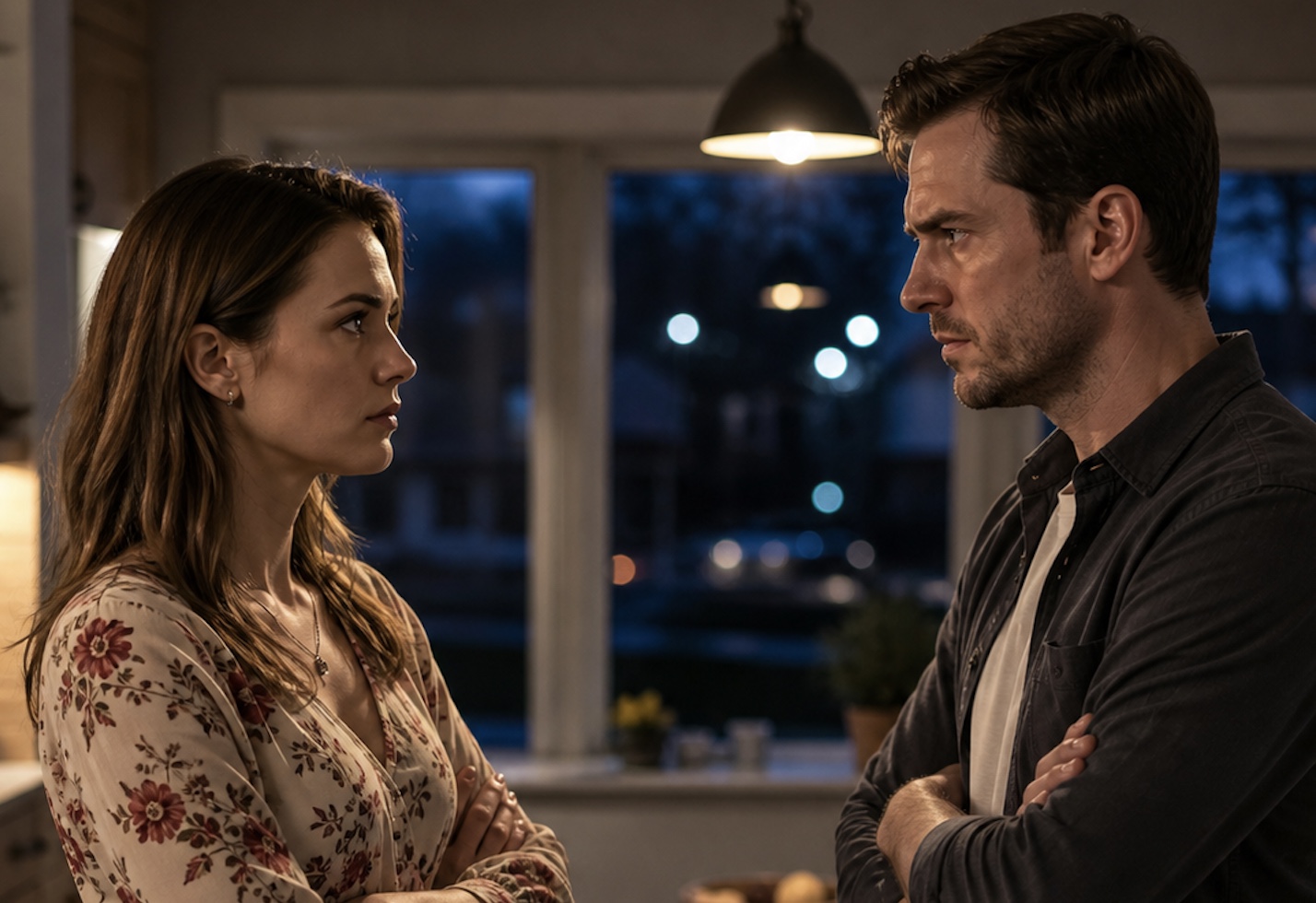
“Don’t try to scare me with divorce, Lena,” Stanislav smirked, not even lifting his eyes from his plate. “You’re not the kind of woman who leaves. You’re the kind who gets upset first, then still sets the table.”
Elena stood by the sideboard with a salad bowl in her hands, staring at the back of his head. A tiny drop of rain glistened near the collar of his pale shirt. He had come home late, as always, without warning, wearing the same expression he always wore — the face of a man who believed no one had the right to question him. The kitchen smelled of roasted chicken, dill, and strong tea. Outside the window, early October twilight was thickening; wet trails ran down the glass, and car headlights slid across the puddles in the courtyard below.
Nadezhda Arkadyevna, sitting by the window, coughed softly into her fist and added in an almost sympathetic tone:
“Stas is right. Loud words don’t hold a family together. A smart woman doesn’t throw things like that around.”
Elena carefully placed the salad bowl on the table. The spoon inside clinked against the glass, and that small sound suddenly seemed louder than both their voices.
“I’m not trying to scare anyone,” she said.
Only then did Stanislav raise his head. There was no concern on his face. Only that familiar, bored confidence, as if he already knew the entire conversation down to the last comma.
“Of course,” he muttered. “You just enjoy a little drama at the end of the day.”
Nadezhda Arkadyevna shook her head as if they were speaking about a spoiled little girl, not a woman who had spent ten years in that house.
“Lenochka, sit down already. Everything will get cold.”
Elena sat. Her hands were cold, even though the apartment was warm. The spacious kitchen, which she had loved so much in the first years, now felt cramped. White cabinets, a dark countertop, a little vase with dried flowers near the microwave, the steady yellow light above the table. Everything familiar. Everything arranged by her. And somehow, none of it had brought warmth for a very long time.
Stanislav ate calmly, with that same expression that had recently made something rise in her — not even anger anymore, but exhaustion. As if he had long ago moved her out of the category of living human beings and into the category of reliable household conveniences. Refrigerator. Clean shirts. Hot dinner. Silence after his late arrivals.
“Mom, pass the bread,” he said.
Nadezhda Arkadyevna immediately pushed the basket toward him.
“Thanks.”
Suddenly Elena caught herself thinking something absurd: the two of them had been speaking more easily to each other for a long time than he ever spoke to her. As if, in that kitchen, there existed a small male alliance, and she was simply the eternal background service.
“You’re late,” she said quietly.
Stanislav cut a piece of chicken.
“I was working.”
“Until half past nine?”
“What surprises you? People work.”
He did not even look at her. He simply tossed the phrase out the way one brushes crumbs from a table.
Elena lowered her eyes to her plate. She no longer wanted to eat. Over the past few months, she had learned that tone too well. It was not openly rude. It was not even raised. But it always carried the same message: you are asking the wrong thing. You are being petty. You are bothering a person whose life is more important than your questions.
Sofya sat at the edge of the table, barely lifting her head. She had come for the weekend to prepare for an academic competition and, at the same time, to get a change of scenery. Sixteen years old, long bangs, thin wrists, her phone beside her plate. Usually, she chatted easily. That evening, she was silent.
Elena noticed it, but said nothing.
Stanislav leaned back in his chair, pushed his plate away, and picked up his glass of compote.
“And by the way, Lena. I have a meeting on Saturday. Don’t wait for me for dinner.”
“Again?”
He smirked.
“Are you seriously asking that?”
“Yes.”
“Then I’ll answer seriously. Yes, again. Work, people, obligations. That’s the adult world, in case you forgot.”
Nadezhda Arkadyevna gently stepped in:
“A man’s whole life cannot revolve around the home.”
Elena slowly lifted her head. Stanislav was drinking his compote, not even trying to hide the irritated pleasure he took in his mother’s support. And suddenly Elena understood it clearly: in their family, everything had long been built on the assumption that her patience was endless. It was not even appreciated. It was simply taken for granted. Like electricity in the socket.
“And a woman’s life can, apparently?” she asked.
Nadezhda Arkadyevna looked at her carefully.
“A woman has the wisdom not to rock the boat.”
Stanislav gave a short snort.
“See? Even Mom understands.”
And at that very moment, something inside Elena became very quiet. No flare of anger. No tears. No beautiful inner speech. Just silence. The kind of silence after which something never returns to its old place.
She did not argue anymore. She ate two spoonfuls of salad, cleared the table, turned on the dishwasher, and asked Sofya if she wanted tea. Everything as usual. Only now, without the hope that if she endured a little longer, the man across from her might one day notice how much of this life rested on her shoulders.
Later, when Nadezhda Arkadyevna had gone to the guest room, Stanislav stood in the bathroom shaving in front of the mirror while Elena folded towels into the cupboard. He spoke to her through his reflection:
“And don’t put on that sour face tomorrow morning. I’m tired of these hints.”
Elena looked at his back.
“What aren’t you tired of?”
He ran the razor along his cheek.
“Normal life. Without women’s performances.”
She did not answer. And that, it seemed, surprised him more than any scandal would have.
That night, Elena did not sleep for a long time. Stanislav lay beside her, breathing evenly. Once, he turned over in annoyance, muttered something, and fell asleep again. Elena stared at the ceiling and tried to remember exactly when everything had become like this.
Probably not in one day.
Not when he first came home later than he had promised.
Not when he forgot her birthday for the first time and then bought his way out of it with expensive roses.
Not when he started answering briefly and looking at his phone during dinner.
It had begun earlier. The moment she had once decided not to argue so as “not to make things worse.” Then another time. Then another. And at some point, her silence stopped being an act of love. It became a comfortable environment for his superiority.
In the morning, she went to the flower salon earlier than usual.
The flower shop was the only place where the world still obeyed a logic she understood. There, everything depended on hands, taste, and rhythm. White chrysanthemums stood by the window in dense round clusters. Burgundy dahlias darkened on the shelves. In the refrigerated room, it smelled of leaves, water, and cool air. The girls were already receiving a delivery; cellophane rustled on the floor, and a courier brought in an armful of eucalyptus.
Elena put on her apron, checked the day’s orders, listened to a regular customer complain that a bouquet was “too romantic,” adjusted the price tags, and worked as usual. But inside, she kept counting something. Not money, not dates. Years. Years in which she had justified the same thing under different names.
At lunchtime, Marina came in.
They had been friends since school. Then, for a while, adult life had pulled them apart, but in recent years they had grown close again. Marina worked as a notary and spoke as if everything in her head had long ago been sorted into folders.
“You look grayer than that dusty display window,” she said instead of greeting her. “What’s going on?”
At first, Elena waved it off. But five minutes later, she was already telling her about yesterday’s dinner. About that smirk. About “you’re not the kind.” About Nadezhda Arkadyevna and her quiet little stabs. About Stanislav’s endless late arrivals. About the feeling that no one had taken her seriously for a very long time.
Marina listened without interrupting. Then she adjusted the strap of her bag on her shoulder and asked:
“Do you believe yourself when you say you’re still trying to save the family?”
Elena lowered her eyes.
“I’m not trying to save the family. I think I’m trying not to admit that I’ve been saving it alone for years.”
Marina nodded.
“There. That’s more honest.”
“What should I do?”
“Don’t fall apart. Don’t threaten him. Prepare.”
Elena gave a faint, involuntary smile.
“You say that as if I’m getting ready for surgery.”
“In a way, you are. Gather documents. See what is registered in whose name. Check the accounts. And most importantly, don’t tell him anything until you understand for yourself what you’ve decided.”
“And if I still haven’t decided?”
Marina looked at her very calmly.
“Then keep living the way you are. Just don’t call it endurance for the sake of love. Call things by their proper names.”
That evening, Stanislav came home in a good mood. He even brought a box of pastries.
“Look, your favorites. Pistachio.”
He kissed her temple in such an ordinary way, as if yesterday’s humiliation at the table had never happened.
Elena stood by the sink and suddenly understood with painful clarity: this was what everything had been built on. These swings. The fact that after coldness, he sometimes gave her a tiny affectionate crumb. And once, she had rejoiced over it as proof that not everything was lost.
Now there was no joy.
“Thank you,” she said.
“What’s with you?” he tossed his keys onto the cabinet. “Offended again?”
“No.”
“Then what?”
Elena turned to him.
“Nothing. I’m just tired.”
He shrugged.
“From what? It’s not like you work construction.”
And he went off to change.
She stood for a long time, looking after him. Not because of the rudeness. The phrase was not even especially rude. It was revealing. The person she had lived with for ten years truly did not understand what could exhaust a woman who carried the house, the work, his moods, and still pretended everything was fine.
Two days later, Sofya stayed at their place after school. She sat in the living room with her laptop, pretending to write an essay, while Elena sorted through utility bills. Stanislav came home earlier than usual, tossed his phone onto the sofa, and went to take a shower.
The screen lit up.
Sofya noticed it first. She had not meant to. Her eyes simply caught it. Then again. And again.
The message on the screen read: “I miss you. Wednesday, like we agreed? Just without your late-night stories about meetings.”
Sofya turned so pale that Elena saw it immediately.
“What happened?”
The girl quickly turned away.
“Nothing.”
“Sonia.”
“Aunt Lena, I didn’t mean to.”
Elena slowly approached. The phone lay face-up, and the message had already faded from the screen. But the name remained. “Irina Tire Service.” Too ridiculous to be true. Too convenient not to be a lie.
Elena’s hands did not even tremble. That surprised her.
“You saw it?” she asked quietly.
Sofya nodded, nearly crying.
“I didn’t want to. Really.”
Elena sat down beside her.
“It’s all right. This isn’t your fault.”
But inside, nothing was all right anymore. In that exact minute, the last pieces of the old structure of self-deception collapsed. He was not simply growing colder. He was not simply asserting himself. He was living a double life, absolutely certain that at home he would still be waited for, fed, and never confronted with the truth.
Stanislav came out of the shower, picked up his phone, glanced quickly at the screen, and calmly went into the kitchen.
Elena watched him go and thought not even about betrayal. She thought about the scale of his certainty. About how long he had been convinced that his lie was convenient, and therefore safe.
The next day, she took half a day off and went to Marina.
The notary office smelled of paper, coffee, and the damp autumn smell from visitors’ coats. A printer hummed quietly in the reception area. Marina led her into her office, closed the door, and immediately understood from Elena’s face that this was no longer about doubts.
“What happened?”
Elena told her. Briefly. Without tears. About the message. About “Irina Tire Service.” About that ridiculous and disgusting vulgarity. About the fact that she no longer wanted to be the woman beside whom it was convenient to lie.
Marina did not gasp. She did not start comforting her.
“Do you still want to wait until he decides to have an ‘honest conversation’ with you?”
“No.”
“Then we act.”
They sat there for almost two hours. Marina explained the procedure, the documents, the timelines. What should be photographed. What copies should be made. What to do with her money. How to behave at home before filing. Calmly, without sudden moves. Elena listened and felt a framework forming inside her instead of panic. Not joy. But support.
“The most important thing,” Marina said at the end, “is not to speak too soon. People like Stanislav don’t lose their footing because they lose love. They lose it when control of the script is taken away from them.”
Elena nodded.
“He always thought he knew my role.”
“Then stop playing it.”
After leaving the office, she went into the coffee shop on the ground floor of their building. Kirill was wiping the counter. The place smelled of cinnamon, ground coffee, and something warm, something homely. He had been their neighbor for several years. He greeted her calmly, sometimes carried heavy boxes upstairs for her if he saw she was alone.
“The usual?” he asked.
Elena suddenly realized she could not remember what her “usual” was. She had been living on autopilot for so long.
“Cappuccino. No syrup.”
Kirill looked at her attentively.
“You look like today was one day too many.”
She gave a small smile.
“Something like that.”
He did not ask any questions. He simply pushed the cup toward her and added a little cookie on a plate.
“Sit by the window. It’s quieter there.”
That was exactly what she had always been grateful to him for: he never forced his way into someone’s soul. He simply knew when to create a place where a person could breathe.
Filing the petition took less time than the fear she had built around it.
An ordinary office. An ordinary folder. An ordinary woman behind a desk who did not even look up when accepting the papers. And because of that ordinariness, Elena’s legs nearly gave way for a second. Was that really it? No thunder? No permission from above? You simply bring the documents, state your surname, sign your name — and life begins moving in another direction.
When she stepped outside, the October air seemed icy. The wind dragged yellow leaves along the asphalt. People hurried toward bus stops. Over the new district hung the early bluish darkness. Elena stood near the entrance and looked at her fingers. They were trembling.
But not from doubt.
During those days, Stanislav behaved with particular confidence. As if he sensed that she was hurting and took it as another personal victory. He could come home late and toss out:
“What’s with that face again? Did the world collapse?”
At dinner, he could say:
“You have a talent for creating tension out of thin air.”
He could call someone in front of her, laugh deliberately brightly, and then go out onto the balcony, leaving the door not quite closed.
Nadezhda Arkadyevna did not lag behind either. One day she came by “for tea,” stayed exactly forty minutes, and in that time managed to say:
“You cannot keep a man on a short leash if you don’t want him to start breaking free.”
“I’m not keeping anyone,” Elena replied.
“That’s what everyone says. And then they act surprised.”
“At what?”
Her mother-in-law picked up a slice of lemon from the saucer.
“At the fact that a man looks for a place where he can breathe more easily.”
Elena looked at her carefully. The woman did not look away. Not a shadow of embarrassment. So she knew. Or suspected. Or maybe she simply considered it the natural extension of their family philosophy: a wife must endure, and a man has the right to “break free.”
That was the first time Elena felt truly sick — not from pain, but from the disgust of clarity.
From that day on, she stopped justifying him even in her own mind.
She no longer tried to find explanations for him. She no longer wondered whether he was tired or confused. She no longer went over where she herself had been “too cold” or “too silent.” Suddenly, that old female habit of looking first for her own guilt released her.
She simply began preparing for the conversation.
She copied documents while he was not home. She moved her money into a separate account. She gathered contracts, certificates, insurance papers into a separate folder. She called the salon and warned her assistant that she might need a flexible schedule in the coming weeks.
One evening, Kirill met her downstairs carrying a heavy box of vases for the flower shop.
“Let me carry that.”
“No, it’s fine. I can do it.”
He narrowed his eyes slightly.
“You can. But it’s easier with two.”
She handed him the box. Then, almost in a whisper, she asked:
“Kirill, have you ever realized that the person beside you has long been a stranger, and you’re still covering them with a blanket out of habit?”
He was silent for a moment, choosing his words.
“Yes. It’s an unpleasant moment.”
“Because it’s too late?”
“Because at that moment, you’re no longer choosing between people. You’re choosing between truth and comfort.”
Elena remembered that too.
The day she decided to say it came on its own. Without special planning. Everything simply aligned.
Stanislav came home early. For the first time in a long while. No flowers, no good mood. Irritated. He threw his jacket onto the armchair as he walked in, went into the kitchen, and poured himself water.
“What’s for dinner?”
“Fish and potatoes,” Elena said.
“Fine.”
As if that was how it should be. As if there was not an entire dead zone lying between them that he stubbornly continued to mistake for comfort.
She set the table. Without rushing. Without shaking hands. In the kitchen, only the overhead light and the lamp above the stove were on. The room reflected in the window; beyond the glass, October dusk was already turning blue. Somewhere in the radiator, water tapped softly. Everything was so ordinary that it became frightening.
Stanislav ate in silence, scrolling through the news on his phone. Then he set it aside and said:
“Mom’s coming on Saturday. Make something normal. None of your diet experiments.”
Elena looked at him.
“All right.”
He did not even notice that her voice was missing its usual tone.
“And another thing,” he added. “Let’s do without the sour faces. I’m tired of walking around this house like it’s a minefield.”
And that was when she understood: there was nothing left to wait for. No special moment. No beautiful final point. No last piece of evidence. Everything had already happened. Everything had already been decided inside her.
She placed her fork on the edge of her plate.
“I filed for divorce, Stas.”
Stanislav did not understand right away. She could see it on his face. For another second, he stared past her, as if the words had not yet fit themselves into reality. Then he sharply lifted his head.
“What?”
Elena repeated evenly, without pressure:
“I filed for divorce.”
And that was when he turned pale.
Not slightly. Not theatrically. He turned pale the way people do when the floor is suddenly knocked out from under them. As if everything that held up his certainty had ceased to exist in a single sentence.
“Have you lost your mind?” he forced out.
“No.”
“When?”
“That doesn’t matter anymore.”
“No, it matters!” He jumped to his feet. The chair scraped against the tile. “When did you do it?”
“A few days ago.”
He stared at her as if seeing her for the first time. Not the woman who cried and waited for explanations. Not the familiar wife with a hot dinner. A stranger. Someone who had stopped obeying his logic.
“You didn’t even talk to me,” he said hoarsely.
Elena shook her head almost imperceptibly.
“I talked to you for years. You simply heard only what was convenient for you.”
He ran a hand over his face.
“What is this about? A couple of arguments? Because I come home late? You’ve completely—”
“Don’t,” she interrupted quietly. “Don’t pretend you don’t understand.”
“What am I supposed to understand?”
She looked straight at him. For the first time, she felt no fear of that gaze.
“That I am no longer living beside a person. I am living beside a convenient lie. Beside a man who was certain he could come home late, lie, humiliate me with that cold tone, and I would still stay. Because I would be too afraid to leave. Because we have a home. Because it has been ten years. Because I’m ‘not the kind.’ You believed that, didn’t you?”
He was silent.
“Didn’t you?” she repeated.
“I didn’t think you would go this far,” he hissed.
Elena almost smiled.
“There. You didn’t think. Because you put me long ago into the category of things that don’t go anywhere.”
He recoiled as if struck.
“Stop with this dramatic nonsense.”
“It isn’t nonsense. It’s finally words without fear.”
Stanislav took a step toward her.
“Who put this into your head? Marina? Or maybe that neighbor downstairs who’s always hovering around you?”
Elena was not even surprised. Of course. If a woman suddenly made a decision, then someone must have “wound her up.” She could not possibly have reached it herself.
“No one put anything into my head. I simply stopped smoothing things over.”
He gave a short, bitter laugh.
“Wonderful. Just wonderful. And the house? Everything we built?”
“I built it. You used it.”
He opened his mouth to object, but at that moment, the lock clicked in the hallway. Nadezhda Arkadyevna entered without ringing the bell, as she always did.
“Stas, I forgot something at your place…” she began, then stopped when she saw their faces. “What happened?”
Stanislav turned to his mother with the look of a man seeking reinforcements.
“She filed for divorce.”
At first, Nadezhda Arkadyevna’s face did not change. Then she slowly removed her gloves.
“Lenochka, what foolishness is this?”
Elena looked at her tiredly.
“It isn’t foolishness.”
“Then what? An offense? A female tantrum?”
“No. A decision.”
Nadezhda Arkadyevna walked into the kitchen without asking, as if by habit she had the right to take part in everything.
“Decisions in a family are not made in the heat of emotion.”
“I did not make it in the heat of emotion.”
“Then that is even stranger,” she said coldly. “You are a grown woman. You should understand that men are different. You don’t destroy a marriage just because your husband doesn’t coo over you.”
Elena closed her eyes for a brief second. There it was — their entire philosophy gathered into one sentence. If he doesn’t hit you, it’s already a blessing. If he hasn’t left completely, endure it. If he doesn’t shout every day, appreciate it. Everything else a woman is expected to swallow in silence.
“This isn’t about affection,” she said. “It’s about the fact that your son has spent years behaving as if I’m not a person, but an insurance policy against his consequences.”
“Strong words,” Nadezhda Arkadyevna said through her teeth.
“But accurate.”
Stanislav slammed his palm onto the table.
“Enough! You’re talking as if I’m some kind of criminal!”
Elena flinched, but she did not raise her voice.
“You’re not a criminal. You simply lived too long believing I would endure everything. And you lost the boundary between marriage and permissiveness.”
Suddenly he sank back into the chair. His face had turned gray.
“You can’t just cross everything out like this.”
“I can.”
“Ten years?”
“Yes.”
Nadezhda Arkadyevna leaned forward.
“Have you thought about what people will say?”
And then Elena realized she no longer even felt irritated. Only tired astonishment. Everything was collapsing, and for this woman, other people’s opinions still mattered most.
“Did you ever think about how I lived through those ten years?” she asked quietly. “Or did no one care as long as I stayed silent and set the table?”
Her mother-in-law pressed her lips together.
“All wives endure.”
“No,” Elena said. “Not all. Some just take longer to stop.”
Then everything became completely quiet.
Stanislav stared at the table. Not at her. And Elena suddenly saw very clearly: he had not gone pale because he was losing the woman he loved. He had gone pale because, for the first time, he had lost control of the story. He was no longer the one deciding when to talk, when to lie, when to come back, when to make peace, when she would cry, when she would forgive. It was over. The script had slipped out of his hands.
And that turned out to be the most unbearable thing for him.
“You’ll regret this,” he said at last.
Elena shook her head.
“I already have. Enough.”
He lifted his eyes.
“You think out there you’re going to start some happy new life?”
“No. I think out there I’m going to start my own life. That’s enough.”
Nadezhda Arkadyevna stood abruptly.
“God, how theatrical. It’s so easy to inflate yourselves these days.”
Elena stood too.
“And it is so easy for you to accept it when another person’s life is convenient for your son.”
Her mother-in-law turned pale at such directness.
“You are an ungrateful woman.”
“Perhaps. But an honest one.”
Elena left the kitchen first. She went into the bedroom, took out the folder she had prepared in advance, and placed it in her bag. Then she returned to the hallway, put on her coat, and took her keys.
Stanislav got up.
“Where are you going?”
“To Marina’s. For a couple of days.”
“What for?”
Elena was already fastening her boots.
“Because I am not obligated to spend the night in the same apartment as a man who only needed me in the moments when I was convenient.”
He stepped closer.
“Lena…”
And for the first time, there was no irritation in his voice. There was confusion. Real confusion. Late. Pitiful.
She looked up at him.
“No. It’s simple. I’m no longer participating in this arrangement.”
He froze. As if only now realizing that he could neither persuade her, nor mock her, nor press her into submission.
Downstairs, near the entrance, the air smelled of wet asphalt and smoke from someone’s cigarette. The October cold scratched her throat. Elena stood under the awning while calling a taxi, and then she noticed the light in the coffee shop window. Kirill was just closing the blinds.
He saw her and came outside.
“Are you all right?”
Elena looked at him and nodded.
“Yes. I am now.”
He did not ask anything unnecessary. He only glanced at her bag, then at her face, and said softly:
“If the taxi takes long, sit inside. It’s warm.”
For the first time that day, she smiled genuinely.
“Thank you.”
Inside the coffee shop, it smelled of coffee, pastries, and the clean floor after evening mopping. Kirill placed a cup of hot tea in front of her.
“On the house,” he said.
Elena wrapped her hands around the cup and sat by the window while the reflections of passing cars trembled on the glass. Inside, she felt strangely calm. Not light. Not joyful. Calm in the way a person feels after a long, severe illness, when the fever has finally broken and the body is still weak, but the main thing has already happened.
Marina met her without unnecessary words. She opened the door, moved a bag of documents aside from the cabinet, and simply said:
“Come in. I made up the bed in the study.”
Elena took off her coat, set down her bag, and suddenly began to cry. No sobbing, no performance. She cried simply because she had kept her face too steady all day.
Marina hugged her tightly.
“That’s it. You’ve already done the hardest part.”
“I’m scared,” Elena whispered.
“Of course. It would be strange if you weren’t.”
“What if I really destroyed everything?”
Marina pulled back and looked into her face.
“No. You simply stopped being the mortar that held everything together. And when that kind of mortar disappears, you can finally see what was actually built.”
That night, Elena barely slept. She heard the clock ticking in the next room, the rare hiss of a car passing outside, Marina getting up once to drink water. But inside her, there was no longer that old torn pain. There was something else. As if she had carried a huge, чужой heavy wardrobe on her back for many years and had suddenly set it down on the ground. Her back still ached. Her hands still trembled. But the weight was no longer on her.
In the morning, a message arrived from Sofya: “Aunt Lena, you were so strong yesterday. I thought he would twist everything around again. But you didn’t let him.”
Elena read it three times.
Then she went to the window. A low gray sky hung over the city. People crossed the courtyard, wrapping themselves in their jackets. Near the bus stop, a boy in a blue hat held a bouquet of chrysanthemums wrapped in rustling paper. An ordinary autumn morning. Nothing grand. No music. No beautiful ending.
And yet, for the first time in many months, she breathed as if the air around her belonged to her.
Not because happiness was guaranteed ahead.
But because behind her, there was no longer the convenient lie that had held her in place for years.