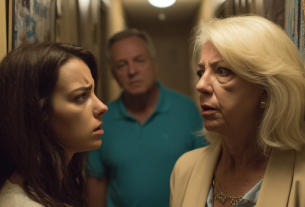
“Vlad, tell me I misheard you. Tell me this is a joke, some stupid prank, and that we’re just going to sit down and have dinner together now. Or maybe we’ll go for a walk along the embankment and watch the sunset gild the cathedral spires. Say something—anything—that will undo what you just said,” Irina pleaded quietly, almost in a whisper, clutching a linen napkin in her hands.
Her voice did not tremble, but there was such fragile hope in it, as though she were holding an antique porcelain cup in her palms, one that could crumble into dust at any moment.
Vladislav, who in his work as a land surveyor was used to dealing with firm measurements, coordinates, and terrain, now looked uncertain. He shifted from one foot to the other in the middle of their spacious living room with its high molded ceiling, guiltily avoiding her eyes.
“Ira, why are you starting already?” he muttered, still not looking at his wife. “Aunt Zina called. They’re already in town, at the train station. I can’t just tell them no. They’re family. They’re only here for a couple of days, just passing through. They’ll do some shopping, spend the night, and leave.”
Irina exhaled slowly. The softness in her gaze began to give way to endless patience—the kind restorers have when they carefully remove layers of later dirt from a masterpiece, hoping to uncover the original beneath.
“Vlad,” she said, stepping closer and placing her palm against his chest. “‘Passing through’ was last time. And the time before that. And a month ago, when your Uncle Borya decided our apartment was the perfect base for sampling every kind of draft alcohol in the neighborhood. We agreed on this. You promised.”
“Well, I promised,” Vlad grimaced. “But they’re already here. What am I supposed to do, leave them out on the street? Ira, be human. Aunt Zina knitted socks for me when I was a kid.”
Irina walked over to the window. Behind the heavy curtains, the sounds of the historic city center could be faintly heard. This apartment, inherited from her grandfather, who had once been an influential Party official, was not just a place to live. It was her private museum, her temple of silence and art. These walls remembered serious conversations, the scent of old books, and the quiet ticking of the grandfather clock. Irina, an art historian by education and calling, had spent years creating an atmosphere of refined comfort here. She had cut off her own relatives firmly and without compromise five years earlier, when she realized they treated her home like a free hostel in the city center.
And then Vlad had appeared. Reliable, grounded, understandable. He measured the land; she studied beauty. It had seemed like the perfect union—until the “extra baggage” appeared in the form of his numerous, loud, and utterly shameless relatives.
“All right,” Irina said, and there was still a faint warmth of hope in her voice, though the foundation of her patience had already cracked. “All right, Vlad. But only two days. And you will explain the rules to them yourself. No smoking on the balcony. Shoes off in the hallway. And please, Vlad, make sure they don’t touch the porcelain collection. That is not soupware. It’s eighteenth century.”
“Of course, of course!” Vlad brightened, sensing that the storm had passed. “You’re gold, Ira! I’ll explain everything. They’ll understand.”
Irina gave a faint smile. She wanted to believe him. She truly wanted to believe that her kindness and civility would not be mistaken for weakness.
An hour later, the hallway filled with noise, stomping, and the smell of tobacco mixed with some kind of pastry. Aunt Zina, a heavyset woman with brightly painted lips and a permanent wave, burst into the apartment like a tank in a parade. Behind her came Uncle Borya, grunting as he dragged plaid bags, and after them slipped Svetka, a twenty-year-old niece with a sour face and a smartphone seemingly glued to her hand.
“Oh, finally!” Aunt Zina boomed, kicking off her shoes without even trying to place them neatly—one flew toward the bench, the other remained in the middle of the rug. “We thought we’d get lost in these labyrinths of yours. And what an entrance hall you’ve got, dark as a crypt! Irka, hi! Why the sour face? Rotting away over your books again?”
“Good evening, Zinaida Petrovna,” Irina nodded politely. “Boris Ignatyevich, Sveta, please come in. But please, don’t put the bags on the parquet. The wheels are dirty. It would be better to leave them on the mat.”
“Oh, come on, don’t be so delicate. You can wipe it up!” Zina waved her off, marching straight into the living room in socks, one of which had a treacherous hole. “Vladik, my dear nephew! Come here and let me kiss you! You’ve withered away with that little wife of yours—nothing but skin and bones!”
Irina froze. A dull irritation began rising inside her, mixed with disappointment. She looked at Vlad. Instead of correcting his aunt, he obediently offered his cheek for a kiss and smiled ingratiatingly.
“Oh, come on, Aunt Zina, I eat just fine. Irina cooks well.”
“We know what that cooking is like,” Uncle Borya snorted, dropping onto the new sofa Irina had bought especially for guests. The sofa gave a pitiful creak. “Grass and those things, what are they called… croutons. A real man needs meat! Hey, hostess, we’ve got rotisserie chicken in the bag and homemade lard. Come on, set the table. We’re starving after the road!”
The word “chicken” scraped against Irina’s ear like a false note. She inhaled slowly, remembering her breathing exercises.
“I’ll set something up,” she said dryly.
The evening turned into torture.
Zinaida Petrovna talked nonstop, interrupting everyone and everything. Sveta watched videos loudly on her phone without headphones, and the sounds of idiotic jokes mixed with Uncle Borya’s chewing.
“So I told her, listen, you old hag, don’t you start lecturing me!” Zina declared, spraying saliva and waving a fork skewered with a piece of an antique delicacy—Irina’s patience. “We’re simple people. We don’t give a damn about all your etiquette. The main thing is for a person to have a soul, not be rotten inside, right? Irka, why aren’t you eating? Too good for our food, are you?”
“I’m not hungry,” Irina replied, watching greasy chicken sauce drip onto the linen tablecloth. The very tablecloth she had embroidered by hand for six months.
“Your loss. Skinny as a dried fish,” the aunt concluded. “A man needs something to grab onto. Our Svetka already has a fiancé, a proper guy, drives a BMW—not like yours, running around fields with a stick.”
Vlad blushed and stared down at his plate.
“Vlad is a good specialist,” Irina said firmly, feeling anger boil inside her. “And his profession is respectable.”
“Oh, stop it!” Uncle Borya waved a hand. “A land measurer is a land measurer. Does he make any money, at least? Or are you supporting him with your grandfather’s inheritance? Speaking of which, this place is fancy. Your granddad must have stolen plenty from the people to grab a palace like this, eh?”
To insult her home, her grandfather’s memory, while sitting at her table and eating her bread—that was beyond the line. She waited for Vlad to stand up, slam his fist on the table, say something. Anything.
Vlad lifted his eyes, looked at his uncle, gave a nervous little laugh, and said:
“Come on, Uncle Borya, don’t say that. Grandpa was just a man of principle.”
Irina rose from the table. The chair did not even scrape—she moved silently, like a shadow.
“I’m tired. I’ll make up the bed for you in the living room. Vlad, help me clear the table.”
“Sure thing,” Uncle Borya belched. “You go ahead, hostess, we’ll manage here. Vlad, bring out the bottle. I’ve got some tincture with me, on cedar nuts. You’ll love it!”
Irina went into the bedroom and shut the door tightly. But even through the solid oak, she could hear laughter, clinking glasses, and shouts of “To us!” Her disappointment in her husband was bitter as wormwood. He had not protected her. Once again, he had turned into that little boy whose Aunt Zina had knitted socks and who had been taught that family was sacred, even when that family wiped its feet on your life.
The next day, the nightmare continued. In the morning, Irina found hair in the bathroom sink, a stranger’s grimy towel on the dryer, and a puddle of water on the floor. In the kitchen, dirty dishes were piled high, caked with dried grease.
“Can you imagine?” she complained over the phone to her friend Larisa, locked inside her study. “They didn’t even think to clean up after themselves. And Vlad… Vlad simply went to work and said, ‘Don’t bother them, they’re resting.’”
“Ira, you’re an idiot,” Larisa said mercilessly. Larisa, the owner of a small but successful contemporary art gallery, had a personality like reinforced steel. “You let them climb onto your neck. Your kindness isn’t a virtue anymore—it’s an invitation to violence. Wait for me. I’m coming.”
Larisa arrived an hour later. At that very moment, Aunt Zina was inspecting Irina’s refrigerator, while Sveta, feet thrown onto the coffee table, was painting her nails with a sharp-smelling polish.
“Good afternoon,” Larisa said loudly as she entered the living room. She did not take off her shoes, walking straight to the sofa in her designer ankle boots.
Zinaida Petrovna nearly choked on a piece of sausage.
“And who exactly are you supposed to be? We didn’t invite any guests.”
“I, as it happens, am an invited guest,” Larisa replied in an icy tone, sweeping the aunt with a look that could have curdled milk in her stomach. “But who are you, turning an elite apartment into a train-station dump?”
“What, you got a mouth on you?” Uncle Borya rose from his den. “Vlad! Where’s that little wimp? Some harpies are attacking us here!”
Vlad had just returned from work early, supposedly “to help,” though in reality to take part in the next feast. He entered the room and froze.
Larisa spun toward him sharply.
“Vladislav,” her voice was low and calm, but it carried the threat level of nuclear war. “Explain to me why Irina, one of the most refined people I know, must tolerate this circus in her own home. Why are your relatives behaving like pigs in an orange grove?”
“Hey, listen!” Sveta squeaked.
“Shut your mouth, sweetheart, before I make you scrub that nail polish off with your tongue,” Larisa barked without even turning toward her. “Vlad! Are you a man or jelly? Your wife is crying in her study. And these… these creatures are eating her food and soiling her soul. You have five minutes. FIVE MINUTES to explain basic rules of civilized living to them. Or to throw them out. Otherwise, I will create such a scandal that you’ll forget what a theodolite and a leveling instrument are called.”
Vlad turned pale. He was afraid of Larisa. Everyone who had ever been caught under the steamroller of her arguments was afraid of her.
“Aunt Zina… Uncle Borya…” Vlad mumbled. “Well, really… let’s be a bit quieter. Ira gets tired. And… maybe the dishes should be washed.”
“What?!” Zinaida exploded. “You little brat, are you going to give orders to your mother’s sister? I put you on the potty when you were small! We came to you with open hearts, and now you sic your friends on us? You henpecked fool! You rag!”
“GET OUT!” Larisa suddenly thundered. “Now! Pack your junk! The tour is over!”
A grave silence fell over the room. The relatives, who were used to charging forward through sheer nerve but were cowardly in the face of real force, went quiet.
“All right, all right, why are you yelling?” Uncle Borya grumbled, realizing the balance of power was not in their favor. “Everyone’s so nervous here. Zin, pack up. We’ll go to Valerka’s. He may live in a dorm, but at least he’s a normal person, without all these… airs.”
Twenty minutes later, the apartment was empty. Vlad sat on the sofa. Larisa victoriously drank a glass of water.
“I don’t want to see their spirits here again, understood?” she threw at Vlad, winked at Irina, and left.
Irina felt relief. She walked over to her husband, wanting to hug him.
“Thank you for not interfering when Lara shouted,” she said quietly. “I… I needed that.”
Vlad looked up at her, his eyes full of resentment.
“She humiliated my family, Ira. And she humiliated me.”
“They humiliated me for two days, Vlad. And you too. You simply don’t notice it.”
Vlad said nothing. The evening passed in tense silence. Then, closer to night, the doorbell rang.
Vlad went to open it. Irina stiffened.
She heard Aunt Zina’s voice.
“Vladik, forgive us. We got heated. Valerka isn’t home, and we’ve got nowhere to go. Let us spend the night. We’ll be quiet as mice. We can’t sleep at the train station, can we? We’re blood, after all!”
Irina froze in the hallway, waiting for her husband’s answer. She remembered Larisa’s dressing-down. She remembered his promises.
“Well… come in,” she heard Vlad say. “Just be quiet, all right? Ira’s asleep.”
She understood then: he was incurable. For now.
Silently, she returned to the bedroom, took her handbag and car keys, and while the relatives rustled their bags in the hallway, slipped out through the second door leading to the back staircase—a feature of the old floor plan.
She drove to a hotel.
For twenty-four hours, Irina did not answer her phone. It kept lighting up with Vlad’s name, but she looked at it indifferently while sipping tea in her hotel room. Her anger had burned itself out.
The next evening, she returned.
The apartment was empty. Silent. But it was not the noble silence Irina loved. It was the silence after a raid.
Candy wrappers lay scattered on the floor. The sofa was smeared with something greasy. In the bathroom hung the heavy smell of cheap cologne.
The relatives had left, but their belongings remained in the corner of the hallway—a sure sign they planned to return.
Vlad sat in the kitchen, staring into an empty cup. When he saw his wife, he jumped up.
“Ira! God, where were you? I was going out of my mind!”
Irina walked past him, opened the window, and let in fresh air. Then she turned and looked at her husband. Her gaze was calm and frighteningly detached.
“Are you my husband? Are you sure? If you are, then from this second on, none of your relatives will ever set foot in this apartment again,” Irina said coldly.
Vlad began his usual song.
“Irish, come on, they’re… it’s Aunt Zina, her blood pressure… they’ll be back tonight…”
“No,” the word fell like a guillotine. “I am not asking you, Vlad. I am setting a condition. Either we solve this problem once and for all, my way, or tomorrow morning we file for divorce. I am serious. The apartment is mine. You are registered here, but I will not live with a traveling circus. Choose.”
Vlad swallowed. He had never seen Irina like this. There was no pleading in her eyes. He realized he had gone too far. He loved her, loved this home, loved their life. And the prospect of returning to his mother horrified him.
“I… I want to solve the problem,” he said quietly. “Forgive me. I’m weak. I don’t know how to say no to them. They pressure me with pity, with ‘family.’ Help me, Ira. I’ll do whatever you say.”
Irina tilted her head slightly.
“Whatever I say?”
“Whatever.”
“Excellent,” Irina smiled. “Then get ready. We’re going visiting.”
“Where?” Vlad stared at her.
“To Aunt Zina’s. For the weekend.”
“But… they live across the river, in the private sector… There’s hardly any space, and they’re supposed to come back here themselves…”
“Exactly. We’re going to them. Right now. Call Zinaida Petrovna. Tell her we have decided to pay a return courtesy visit. And that we’ll be staying with them for a while.”
“She won’t be happy,” Vlad muttered.
“That, my dear, is no longer our problem. Let’s go.”
Aunt Zina’s house in the Zarechny district was a pitiful sight: a sagging fence, a cluttered yard where chickens scratched through a heap of trash, and a house that had long needed repairs.
When Irina and Vlad’s white crossover stopped at the gate, Aunt Zina was just coming out onto the porch in a robe, probably about to call her nephew and find out when she could return to her “base.”
Seeing the guests, her jaw dropped.
“Vladik? Irka? What are you doing here? Did something happen?”
Irina stepped out of the car, beaming with hospitality. She wore a stylish travel suit and held an enormous suitcase.
“Zinaida Petrovna! My dear!” Irina spread her arms, copying the aunt’s intonation. “We’ve come to see you! We missed you so much we couldn’t stand it! You visit us all the time, and we sinners have never once visited our beloved auntie. So we decided to correct that! Vlad took time off, and I have the weekend free. We’ll stay with you for a couple of days. Maybe three. Or a week!”
Zinaida Petrovna turned pale beneath her layer of powder.
“But how… we haven’t cleaned… and there’s no room… Svetka is in her room, and Borya and I sleep in the hall…”
“Oh, don’t fuss!” Vlad cheerfully added, looking at his wife and receiving an approving nod. His role was simple: be the mirror. “We’re simple people! Wherever we fall, we’ll sleep! We don’t give a damn about your etiquette! The main thing is soul!”
Irina firmly picked up her suitcase and, unceremoniously pushing the stunned hostess aside, entered the house.
Inside, it smelled of age, dust, and fried lard.
“Oh, what authenticity!” Irina exclaimed, looking around the junk-filled hallway. “Real rustic charm! Vlad, bring the bags!”
Uncle Borya, sitting in front of the television, choked on his beer. Svetka peered out of her room, eyes bulging.
“So, where is our room?” Irina asked, kicking off her shoes in the middle of the corridor, exactly as Zina had done. “Oh, this bedroom is perfect! Sveta, move over. We’ll put our things here.”
“This is my room!” Sveta shrieked.
“Well, we’re family!” Irina replied with a sweet smile. “Cramped, but not offended. We’ll sleep on your bed—it looks wider. You can stay on a folding bed with your parents for now. You’re not made of sugar. You won’t fall apart.”
With that, Irina entered Svetlana’s room, tossed her bag onto the bed, and began opening wardrobes.
“All right, what do we have here? Oh, not enough hangers. Sveta, clear a couple of shelves for us. We need to unpack.”
Sveta was speechless at such audacity. She looked at her mother for protection, but Zinaida Petrovna herself was in a state of shock.
Thus began a performance directed by Irina with devilish precision.
The evening became a mirror image of what had happened in Irina’s apartment, only adjusted for the poverty of the setting.
Irina demanded dinner.
“Aunt Zina, we’re starving after the road!” she declared, sitting down at the sticky kitchen table. “What do you have? Yesterday’s soup? No, that won’t do. Vlad, did you hear? Auntie said their cellar is bursting. Bring out the pickles, the jam, open the canned stew! Where’s the lard? Set the table!”
Zinaida Petrovna, with gritted teeth, went digging into her stores. She had been saving those supplies for herself, not for gluttonous guests—exactly the kind of guest she herself had been in someone else’s home.
“Delicious!” Vlad praised, devouring a jar of marinated mushrooms Zina had been saving for New Year’s. “Irka, dig in!”
Irina ate little, but she created plenty of noise and mess. She crumbled bread onto the floor. She loudly discussed the flaws of the interior.
“Zinaida Petrovna, who hangs wallpaper like this? It’s ancient. And the color… like a hospital ward. It all needs to be stripped. Vlad, maybe we should help our relatives? Start right now?”
“NO NEED!” Zina shrieked.
Then Irina went to the bathroom. The house had one combined bathroom with an old water heater. Irina locked herself inside for an hour and a half.
She used up all the hot water. She emptied all of Sveta’s expensive shampoo—pouring it straight into the sink, but leaving the bottle empty.
Uncle Borya stomped outside the door, swearing, while Irina serenely sang arias and splashed in the water.
“Ira! I’m going to burst!” Uncle Borya yelled.
“Boris Ignatyevich, have some patience! A lady is making herself presentable!” Irina called from behind the door. “Hygiene culture comes first!”
When she finally emerged, flushed and pleased, there was not a drop of warm water left in the boiler, and Uncle Borya had already run into the bushes in the garden, cursing everything under the sun.
At night, Irina and Vlad occupied Sveta’s room. They talked loudly, laughed, and played music on their phone. Sveta, squeezed onto a folding bed in the walk-through room with her parents, listened to her father’s snoring on one side and the guests’ laughter on the other.
Sunday morning began early. At six, Irina turned on the lights throughout the whole house.
“Rise and shine! The sun is up!” she proclaimed. “The early bird gets the worm! Aunt Zina, where’s the coffee? And not this instant substitute of yours—proper coffee. None? Well then, run to the store. We’ll wait.”
Zinaida Petrovna, sleep-deprived and with bags under her eyes, looked at her nephew and his wife with open hatred. But she could say nothing—after all, she herself had always insisted, “A guest deserves the best,” and “Family is sacred.” Irina had brilliantly used her own weapon against her.
All day, Irina “managed the household.” She rearranged the figurines on the dresser—“It’s better feng shui this way.” She criticized the garden—“Everything is overgrown, what a disgrace.” She ate almost all the cutlets that had been cooked for the week.
By Sunday evening, the hosts looked like shipwreck survivors. They sat in the kitchen, silent and crushed.
Vlad and Irina began packing.
“Well, thank you for the shelter!” Irina said cheerfully, zipping up the suitcase. “We had such a lovely time. So family-like! So warm!”
Zinaida Petrovna looked hopefully at the door.
“Go on, children, go on. You have work tomorrow.”
“Yes, work won’t run away like a wolf,” Irina sighed, already standing on the porch. “But you know what? We liked it here so much! Fresh air, nature… The city is so stuffy, so noisy. But here—it’s paradise! We’ll probably come again next Friday. Straight in the evening. And we’ll invite Svetka’s fiancé too, so we can get acquainted and do some barbecue. What do you think?”
Aunt Zina’s face took on an ashen-gray tint. Uncle Borya clutched his heart. Sveta dropped her phone.
“Oh…” Zina croaked. “But we… we’re leaving! Next weekend! To the dacha… no, to a sanatorium! For a month!”
“Really?” Irina pretended to be disappointed. “What a pity. No matter. Then in a month. Or maybe we’ll drop by during the week? Vlad has a flexible schedule.”
“No!” Zina blurted. “I mean… we’ll call you ourselves. When we get back. Don’t come. We’ll have repairs. Major repairs. For about two years.”
Irina looked straight into her eyes. Her gaze was hard and penetrating.
“Well, as you wish, Zinaida Petrovna. Repairs are a good thing. The main thing is not to drag them out. And we are always happy to help… with our presence. Goodbye!”
Irina and Vlad got into the car. As soon as they drove away, Vlad exhaled and burst out laughing. He laughed until tears came, slapping the steering wheel with his palms.
“Did you see Uncle Borya’s face when you mentioned next Friday? He almost swallowed his cigarette! Ira, you’re a genius! An evil genius, but a genius!”
Irina smiled, leaning back in her seat.
“Just a mirror, darling. Sometimes people need to see their own reflection before they understand how ugly they look.”
The effect of the visit exceeded all expectations. Word of mouth worked faster than the internet.
That very evening, Irina received a call from her mother-in-law—Vlad’s mother, a quiet woman who lived in another region.
“Irochka, hello,” she began cautiously. “Zina called… she was crying. She said you visited them. She said you… ahem… behaved very actively. Ira, what did you do to them? Zina said her blood pressure is two hundred and that she’s afraid you’ll move in with her. She asked me to tell you… that they will never set foot in your place again, as long as you leave them alone.”
Irina winked at Vlad, who was sitting beside her and listening on speakerphone.
“Oh, come on, Mom,” Irina replied sweetly. “We simply showed family affection. We’re one family, aren’t we? But if Aunt Zina wants peace, of course we’ll understand. The most important thing is that she takes care of her health.”
“Yes, yes, she is taking care of it,” her mother-in-law hurried to assure her. “She told everyone in the family that you… well, that you have your own quirks and that it’s better not to bother you. In short, Ira, Zina said that having you as guests is ‘worse than the Tatar yoke.’ Forgive me for being so direct.”
“I’ll survive,” Irina chuckled. “Give her my regards. And tell her we are always ready to pay a return visit if they ever decide to visit us again. Favor for favor.”
A month passed. Perfect silence reigned in Irina and Vlad’s apartment. The antique clock steadily counted the time, the porcelain shone with cleanliness, and only the owners sat on the new sofa.
Not a single relative, not even the most distant third cousin from some forgotten village, tried to invite themselves to stay. The legend of how “intelligent Irka” and “henpecked Vlad” had morally and physically devastated Aunt Zina’s house grew more terrifying with every retelling and was passed around in whispers. People said Irina ate for three, occupied the bathroom for half a day, and forced the hosts to sleep on the floor. Fear of a return visit proved stronger than the thirst for free lodging.
One evening, Vlad approached his wife, put his arms around her shoulders, and said:
“You know, I never thought I’d say this, but I’m happy my relatives think we’re insane, rude people.”
Irina put her book aside and looked at her husband with love—love in which there was no longer disappointment, only respect for the fact that he had finally managed to stand on her side.
“That wasn’t rudeness, Vlad. It was the art of defending boundaries. And I think we created our own little masterpiece.”