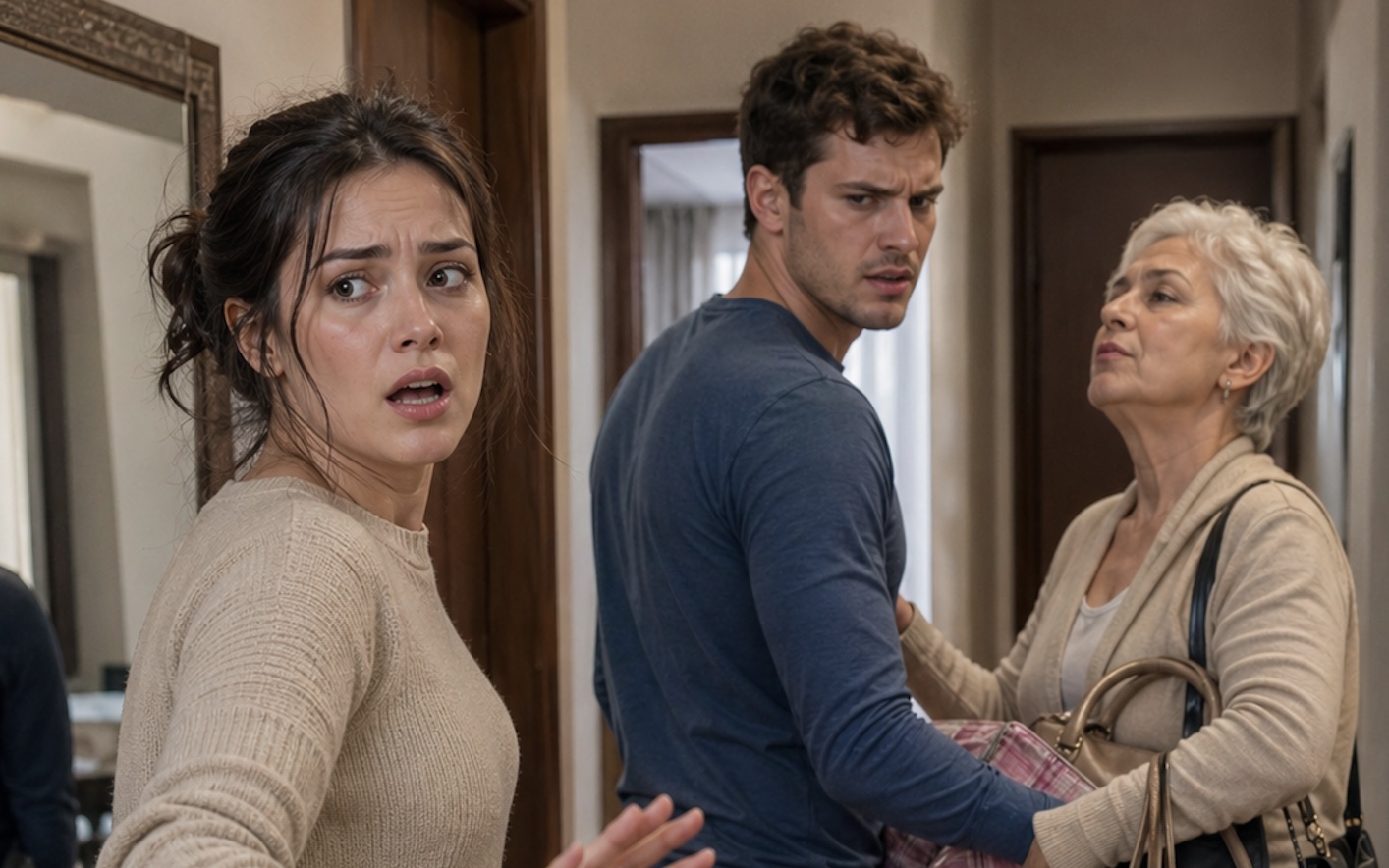
I had always believed that the worst things in marriage were infidelity, money problems, or serious illness. Dima and I used to read articles about relationship crises, laugh at divorce statistics, and feel certain our marriage was a fortress no one could storm. I did not know then that fortresses do not always fall under a battering ram. Sometimes they crumble from a thin, relentless scraping sound that drills into your mind day after day. In my case, it was my mother-in-law.
Lyudmila Petrovna was not just a mother-in-law. She was “Mother,” with a capital M. She called herself that, and beside her, Dima — my strong, confident husband — turned into a confused teenage boy. She called him forty times a day. She commented on my photos on social media: “You should lose some weight, dear. Dima likes small breasts.” She showed up without warning because, as she put it, “I’m his mother. I have the right to see what my son is being fed.”
We were living in a rented apartment, saving up for a place of our own. Dima always tried to calm me down. “You have to understand, she raised me alone. I owe her. Just cut her some slack — it’s her age, her personality. She doesn’t mean harm.” So I did. I clenched my teeth when she called my house robe “a cheap rag.” I swallowed my hurt because I loved Dima. I believed our love was armor, and her moods were only minor scratches on the surface.
That Friday was my day off. I had begged for it after piling up extra hours at work, hoping to finally take care of myself — get my hair done, buy a new dress, and simply enjoy being alone in silence. I had cooked dinner too, because Dima had promised to come home early and we planned to watch a movie together.
I was in the bathroom, putting on a face mask, when the doorbell rang. Not the soft melody of the intercom, but three sharp, commanding bursts.
I threw on my robe and went to open the door.
Lyudmila Petrovna was standing there. She had two huge rolling bags stuffed with jars of pickles and homemade preserves, looking as though she were preparing for a long expedition.
“Oh, you’re home,” she said instead of hello, sweeping her eyes over me — my face covered in green clay, my worn robe. “What a sight.”
Without thinking, I stepped aside and let her in. One thought kept pounding in my head: Not today. Please, not today. I tried to steady myself.
“Hello, Lyudmila Petrovna. You should have warned us. I… I have plans today. I’m leaving in an hour.”
She did not even look at me. She was already taking off her shoes and unloading the bags into the hallway.
“Plans?” she repeated in a sugary voice. “Well, well. I came to see my boy. I’m staying for a while. Someone needs to keep an eye on him while you go wandering around with your little ‘plans.’”
I flinched. Not from the cold, but from the word wandering. And from the way she said my boy, as if I were the outsider in that apartment, a temporary guest in someone else’s life.
“I think Dima would like to know you’ve come,” I said evenly, forcing myself not to raise my voice. “Maybe you shouldn’t make decisions for him.”
She turned around slowly. Her eyes narrowed. Every trace of sweetness vanished from her face as if it had been washed away. Standing before me was no tired older woman. She looked like a predator guarding her territory.
“Don’t bark at me,” she snapped, taking a step closer. Her voice carried so much contempt that it took my breath away. “I came to see my son, not you. This is his apartment, by the way. I paid for it. I gave the money. You’re the guest here.”
That hit below the belt. Yes, we rented the apartment together, but she had paid the deposit for the first and last month — “a wedding gift,” as she had called it at the time. For two years, that “gift” had hung over my head like a guillotine, dragged out as her ultimate weapon in every argument.
At that moment, the lock clicked behind her. Dima came in. Earlier than usual. The second he saw his mother, his face lit up with that same smile he always gave her — warm, happy, but somehow helpless.
“Mom! We weren’t expecting you!” he exclaimed, brushing past me as if I were invisible. He hugged her and kissed her cheek. “Why didn’t you call?”
“I wanted to surprise you,” Lyudmila Petrovna sang, throwing me a triumphant glance. “But your wife didn’t exactly welcome me. She was rude. Almost threw me out.”
I opened my mouth to object, but Dima turned on me so sharply that I froze. The softness vanished from his face. He looked cold, almost like a stranger.
“What happened?” he asked in the tone of an investigator.
“Nothing happened,” I said, feeling a hot wave rise inside me. “I only said it would be nice if people warned us before showing up.”
“She’s my mother,” he cut in. “She can come whenever she wants. Or have you forgotten who helped us with the deposit?”
Lyudmila Petrovna nodded with satisfaction, adjusted her hair, and then, as if I had ceased to exist, addressed her son.
“Dimochka, help me bring in the rest of the bags. There are two more in the car, and a bag of groceries. I’m staying with you for a couple of weeks. You’ve both gotten so thin. I’ll feed you properly.”
She marched into the kitchen. And then Dima did the one thing that became the final straw.
He came up to me, placed his hands on my shoulders, and gently but firmly moved me aside, pressing me toward the wall of the hallway. He did not hit me. No. He simply pushed me out of the way, like a chair that was blocking the passage, so there would be room for his mother’s bags.
“Move,” he said shortly, and rushed off to carry in her things.
I stood there against the wall. My face burned beneath the mask, my robe hung open, and I watched him — my man, my protector — darting back and forth with eager devotion, hauling in endless bags, jars, and packages while his mother shouted instructions from the kitchen: “That goes in the fridge. Put that in the pantry. The rest on the top shelf!”
Something inside me went still.
All the hurt, all the humiliations, all the “cut her some slack” and “she doesn’t mean it” collapsed into one small, cold, crystal-clear point. And in that moment I understood: I did not want this life. I did not want to be a guest in my own home. I did not want a man who pushed me aside the second his mother crossed the threshold.
I walked into the bathroom, washed off the face mask, brushed my hair, and changed into jeans and a sweater. I moved in complete silence, as if in a dream. Dima and his mother did not even notice me. They were clattering pots around the kitchen, talking about rearranging the couch, laughing about some story they shared.
I stepped back into the hallway.
Two of Lyudmila Petrovna’s bags were still standing by the kitchen doorway, not yet carried inside. I picked up one. Then the other. I opened the front door and placed them outside on the landing.
“What are you doing?” I heard Dima’s voice behind me.
I did not answer.
I walked back inside. Lyudmila Petrovna came out of the kitchen with a dish towel in her hand, watching me with confusion that was quickly turning into fury.
I went to the shoe cabinet, picked up Dima’s dress shoes, his sneakers, and Lyudmila Petrovna’s boots — the pair she had taken off fifteen minutes earlier. Calmly, methodically, I carried them outside and set them next to the bags.
“Have you lost your mind?” Dima barked, grabbing my elbow.
I looked at his hand. Then I looked into his eyes. There must have been something in my face he had never seen before, because his grip loosened at once.
“Take your hand off me,” I said quietly. “Or the next thing I’ll be throwing out is your hand.”
He stepped back.
I went into the room, grabbed his gym bag from the corner, and started stuffing in whatever of his things were lying around — his laptop, charger, sweater, jeans. I worked fast, without shouting, without tears. Lyudmila Petrovna stood in the doorway trying to keep her dignity, but her lips were trembling.
“She should be locked up,” she hissed. “Dima, do you see this? She’s insane!”
“I’ll pack your things separately, Lyudmila Petrovna,” I replied without raising my voice. “Don’t worry.”
“Dima!” she screeched.
But Dima said nothing. He was staring at me, and for the first time in his eyes I saw not indulgence, but fear. He understood that something irreversible was happening.
I walked into the hallway, opened the front door, grabbed his bag, and threw it out onto the landing. It landed with a dull thud beside the shoes.
“You… you’re throwing me out?” Dima managed.
“I’m making room,” I answered. “For the people who are actually welcome here. The two of you.”
I went back for his mother’s bags. Lyudmila Petrovna tried to step in my way, but I moved around her without even slowing down. I carried out her bags next. Then her shopping carts.
“How dare you!” she shrieked, rushing after me onto the landing. “I’ll have you know—this apartment—”
“I’ve been paying for this apartment myself for a long time,” I cut her off. “Starting today, officially. Your ‘gift’ will be paid back in full within a month. I’ll send you the receipt.”
Then I turned to Dima, who was standing in the doorway, pale and stunned.
“You have three minutes to decide,” I said. “Either you step back inside, close this door, and we begin a conversation about what our marriage is going to look like without your mother as the third partner. Or you pick up her bags, help her downstairs, and I’ll send you a message later telling you when you can collect the rest of your things while I’m not here.”
“But how… she’s my mother…” he began.
Normal mothers do not invade your life like this.
“One minute already gone,” I said, folding my arms across my chest.
Lyudmila Petrovna grabbed his sleeve.
“Come on, Dima. Leave her. She’s hysterical. Let her cool down. I’ll call her mother right now and make her set this girl straight. I’ll teach her a lesson.”
Dima looked at me. Then at his mother. Then at the pile of bags in the hallway. I could see the battle raging inside him. The habit of obeying his mother was wrestling with the realization that if he stepped out onto that landing now, there would be no way back.
“Dima, I told you, come!” his mother snapped, yanking his arm.
He took a step.
Toward her.
“You do realize what you’re doing?” he asked me from the doorway, still hoping, I suppose, for some last flicker of regret.
“Yes,” I said. “I’m doing what you should have done two years ago.”
He walked out. I stepped back inside and reached for the handle.
“Irina!” he shouted just as the door was almost shut. There was panic in his voice now.
“When you decide who your wife is supposed to be in your life,” I said through the narrow gap, “then we can talk. But not before a week from now. Right now, help your mother with her bags. Carefully. She is, after all, an older woman.”
I shut the door. Locked the bolt. Leaned my back against the cold surface and closed my eyes.
The hallway smelled of his cologne and her jars of pickles.
The kitchen had gone silent. At first there was noise outside the door — Lyudmila Petrovna’s wailing, her outraged cries of “Who does she think she is?” Then the elevator doors opened and closed. And after that, silence.
I walked into the kitchen, turned off the light, removed the jar of jam they had already opened, and washed the dishes. Then I picked up my phone and blocked both numbers — my husband’s and my mother-in-law’s. That was it.
I did not cry.
What I felt was a strange, almost frightening lightness, as though I had spent years carrying a backpack full of stones and had finally dropped it. Ahead of me there was uncertainty. Loneliness. Embarrassment in front of my parents. Rent I would now have to manage alone. But all of that felt manageable, understandable. Unlike a life where your husband pushes you aside to carry in his mother’s bags, and your mother-in-law tells you not to bark inside your own home.
I made myself a cup of tea and sat by the window. Outside, the streetlights were beginning to glow. I looked at them and thought that maybe I had just lost my family.
And yet, for some reason, it felt more like I had finally found myself.
And that was worth every single bag I left outside that door.