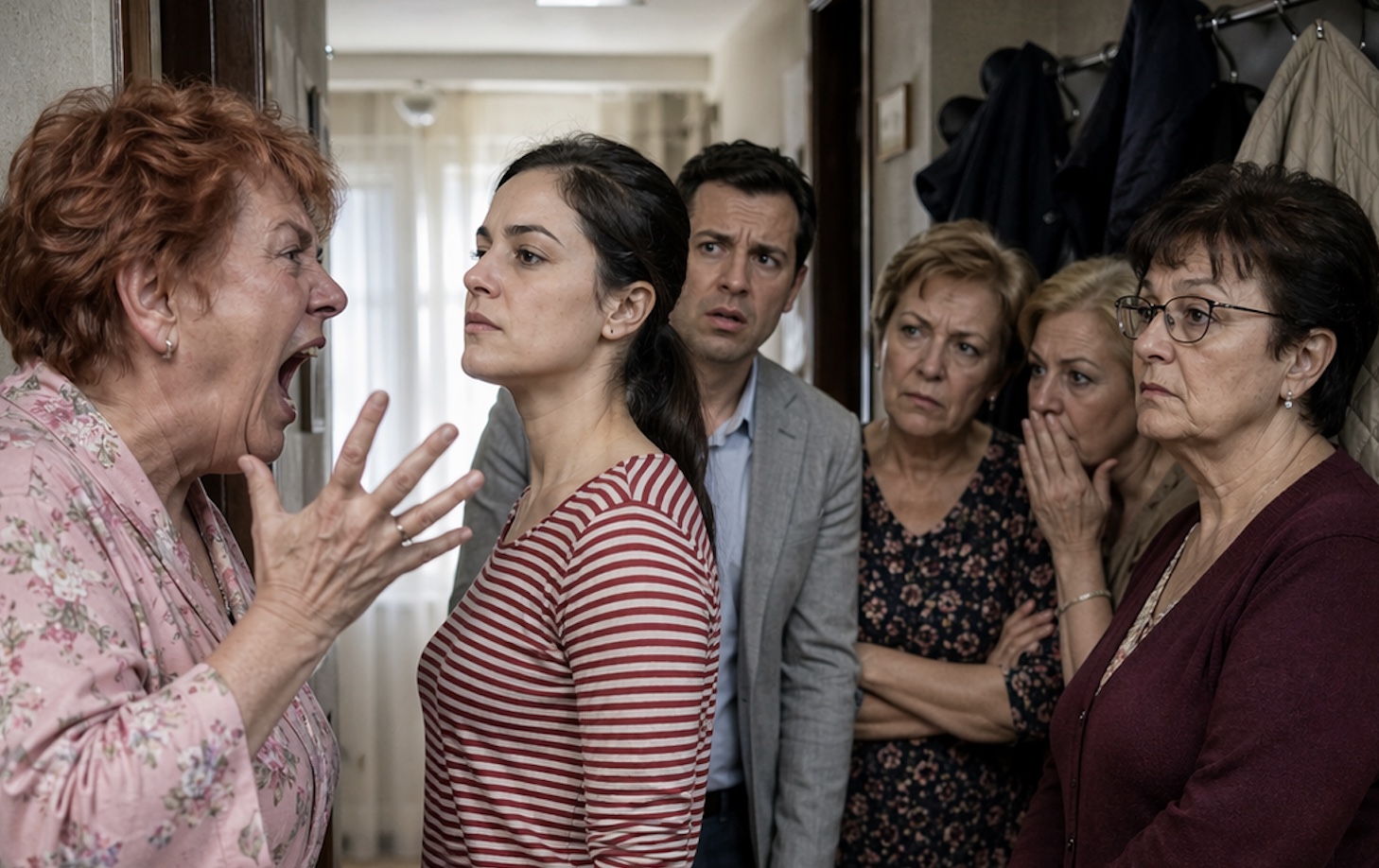
“Are you actually going to clean the stairwell, or is that none of your concern too?”
Magdalena Semyonovna stood in the doorway like a monument in her rose-print robe, a mug of coffee in hand, looking at Tanya as if she had dragged something filthy in from the street.
Tanya was just taking off her coat. She hung it on the hook in silence. Set her bag on the floor without a word.
“I’m talking to you,” her mother-in-law snapped.
“Good evening, Magdalena Semyonovna.”
“What’s so good about it?” the woman scoffed. “Imagine that. In my own home, and no one can even keep things clean.”
It was their usual opening act. Every evening the same performance, only with slightly different props. One day the floors had been washed wrong, another day the curtains were wrong, another Tanya was “muttering into her phone” instead of making dinner. At times like that, Oleg usually vanished—retreated into the bedroom, put on his headphones, and pretended he heard nothing. A true master of survival.
Tanya went into the kitchen and set the kettle on. Beyond the window the city roared on—cars passing, voices rising from the courtyard, distant laughter. Life carried on somewhere out there behind the glass, while inside these cramped twenty square meters, its own little family chronicle kept unfolding.
She and Oleg had met three years earlier, by accident, the way these things usually happen. He had been fixing a bicycle right there on the sidewalk, and she had tripped over the pump. Awkwardness, laughter, exchanged numbers. Eight months later—they were married. A modest wedding in a café, twenty guests at most.
At that wedding Magdalena Semyonovna had worn the expression of someone attending a funeral. From the very beginning she had decided the bride was all wrong. Wrong background, wrong connections, wrong manners. A girl from Tula, no apartment, no car, working as some kind of manager in a random little office—what was that supposed to be?
What no one in Oleg’s family knew was that three years earlier Tanya had quietly, without any announcements, started a real-estate channel online. She never spoke about it. Not because she was hiding it—she simply did not want to explain. It would have taken too long, and there was no one in that house who cared enough to listen.
“Oleg!” her mother-in-law shouted from the hallway. “Oleg, come here!”
He stepped out, disheveled, in a T-shirt, phone still in his hand. Handsome, honestly. Tanya still noticed that sometimes—in passing, the way you notice something familiar that somehow remains beautiful.
“What, Mom?”
“Talk to your wife. She’s on her phone again all evening.”
“I put the kettle on,” Tanya said evenly.
“The kettle!” Magdalena Semyonovna threw up her hands. “A great achievement. And what about dinner? What about keeping order?”
Oleg looked at Tanya. Tanya looked at Oleg. Something invisible passed between them—that same fatigue that builds up not from big dramatic fights, but from endless, grinding little frictions.
“I’ll make dinner now,” Tanya said.
And she did. Quietly, quickly, without comment. Set the table. Called everyone in. Magdalena Semyonovna ate and complained to the neighbor, Kira—who had stopped by “for five minutes” and stayed for an hour—about how difficult life was when your daughter-in-law had “her mind on all the wrong things.”
Kira nodded sympathetically. She always nodded. It was her way of existing inside other people’s dramas without ever truly investing herself in them.
After dinner Tanya went into the bedroom, supposedly to sleep. Instead, she opened her laptop.
A message glowed on the screen. She read it for the fourth time, just to make sure she hadn’t imagined it.
A major Moscow real-estate agency was offering her a contract. Not just offering it—they wanted her to start on the first day of the next month. The amount was listed at the bottom of the email, and every time Tanya reached that line, she paused.
Three million rubles a year. Plus a percentage of every deal.
She had been running her channel for three years. Filming videos right here in this bedroom while everyone else slept. Explaining, in plain language, how to choose an apartment, how not to get tricked by agents, how to read a contract properly. No glamour, no fake polish—just honest, useful information. Her audience had grown slowly, then quickly, then explosively. One and a half million subscribers. It had happened almost without her noticing, while Magdalena Semyonovna was still telling the neighbors her daughter-in-law “didn’t do anything real.”
Tanya shut the laptop and stared at the ceiling.
Should she call Aunt Vera? She was always the first person Tanya wanted to tell when something important happened. Vera was her mother’s sister, lived across town, worked in a library, and knew how to listen in a way very few people did.
Tanya picked up the phone.
“Vera, are you awake?”
“I am. I’m reading. What happened?”
“Nothing happened. I just wanted to tell you—they offered me a job.”
A pause.
“A good one?”
“A very good one.”
Aunt Vera was silent for a second. “Did you sign?”
“This morning.”
“Good girl,” Vera said simply. “You’re a smart girl, Tanya.”
The next day went on as usual. Early that morning Magdalena Semyonovna ran into Grandma Zoya in the building entrance—the same woman from the third floor whom everyone feared just a little more than necessary. Zoya was tiny, wiry, sharp-eyed, and had a habit of speaking plainly—sometimes too plainly.
“Magdalena,” she said, holding the elevator door, “I heard you yelling at your daughter-in-law yesterday. The whole building heard you.”
“That’s none of your business,” Magdalena Semyonovna snapped.
“It is my business,” Zoya replied calmly. “I’ve lived here forty years. And neighbor to neighbor, I’ll tell you this: that girl of yours is a good one. You’d do well to be more careful with her.”
Magdalena Semyonovna stepped into the elevator and hit the button for her floor with the expression of someone delivering the final word in an argument. Zoya remained downstairs—small, in a coat too light for the weather—watching the doors slide shut.
She knew something Magdalena did not. Zoya knew a lot, in fact. Quiet people usually do.
And while all that was happening, Tanya was already on her way to a meeting. Her first official meeting with her new employer. In her bag was a printed copy of the contract, music filled her ears, and in her mind there was a calm, almost unsettling clarity.
Everything was only just beginning.
The meeting went better than Tanya had expected.
The agency’s office was in a business center on Tverskaya Street—glass front, reception desk with fresh flowers, people in expensive jackets. Tanya stepped in wearing her gray coat and caught the receptionist giving her a quick, appraising, professional look. She had learned to ignore looks like that about two years ago.
The head of the department—Sergey Borisovich, around fifty, with the manners of a man who no longer needed to prove anything to anyone—stood to greet her and shook her hand. Not condescendingly. Properly. As an equal.
“We’ve been watching your work for a long time,” he said once they were seated. “Since you had around three hundred thousand followers. We were waiting for you to grow.”
“Why didn’t you write sooner?”
“We wanted to make sure it wasn’t luck,” he said with a smile. “It wasn’t.”
They talked for an hour. Tanya listened, clarified points, occasionally disagreed—calmly, professionally. Sergey Borisovich listened with that rare expression people wear when they realize they’ve finally found what they were looking for. At the end of the meeting he said:
“We’re very glad you agreed.”
Tanya stepped outside, stopped, and tilted her face upward. Somewhere above, pigeons were crying out. The city hummed with its ordinary, indifferent noise. She took out her phone and sent Aunt Vera three words: Everything went well. Heading home.
At home, a surprise was waiting.
Magdalena Semyonovna stood in the hallway—again in her rose robe, but this time with a phone in her hand and the face of someone who had just uncovered a state secret.
“Oh, you’re back,” she said instead of hello. “Where were you?”
“Taking care of something.”
“What kind of something?” her mother-in-law asked in a tone that suggested Tanya could not possibly have anything of importance in her life.
Tanya took off her coat, hung it up, and went into the kitchen. Magdalena followed behind, of course. That too was part of the ritual, like morning coffee or evening television.
“I was at Kira’s,” her mother-in-law announced, sitting down. “We talked. She says a proper woman should stay home when her husband is going through a hard period at work.”
“Oleg is going through a hard period?” Tanya turned.
“He’s tired.”
“I know he’s tired. I’m tired too.”
“You?” Magdalena raised her voice slightly. “And what exactly are you tired from? Sitting on your phone?”
Tanya poured herself some water and drank it. She said nothing.
Silence was always the right move—she knew that from experience. Magdalena Semyonovna did not know how to argue with silence. Silence enraged her more than words ever could, and when she got angry enough, she started saying too much. Apparently today was a special day.
“Listen,” her mother-in-law said, suddenly switching to a falsely warm tone—always worse than open irritation. “I was thinking. Maybe you should get a normal job. Oleg could ask his boss—there’s an opening in accounting.”
“In accounting?”
“Well, why not? Stable, close to home. Better than doing… whatever it is you do.”
Tanya looked at her. Thought for a second. Then simply said:
“I’ll think about it,” and left the kitchen.
That evening Aunt Vera came over.
Tanya had not invited her—Vera had messaged first: I’ll be in your neighborhood. Can I stop by? Tanya had replied: Come. It might not have been the smartest idea to bring her aunt into a house where Magdalena Semyonovna was in one of her moods, but Tanya suddenly felt the need for a real person beside her.
Vera came in carrying a cake—a simple one from the local bakery—and at once became the one point of calm that apartment was so desperately missing. She was short, wore glasses, had cropped hair, and spoke a little more slowly than everyone else. She had worked in a library for twenty years, and somewhere along the way had developed a powerful immunity to human noise.
Magdalena Semyonovna came out to meet her—with a smile that never reached her eyes.
“This is Tanya’s aunt,” Oleg said, appearing from the room. “Vera Nikolaevna.”
“Such a pleasure,” said her mother-in-law in a tone that meant precisely the opposite.
They sat down for tea. Conversation moved cautiously, as if over thin ice—first the weather, then the city, and then Magdalena Semyonovna, unable to restrain herself, asked:
“So tell me, Vera Nikolaevna, what do you think—a young woman should build a career, or should she focus on her family?”
Vera looked at her over the rim of her glasses. Calmly. Without hurry.
“I think,” she said, “that an intelligent woman can manage both. Provided no one gets in her way.”
Magdalena Semyonovna opened her mouth and then shut it again. Oleg stared into his cup. Tanya felt something warm bloom inside her chest.
Aunt Vera left at nine. Tanya went out to walk her to the elevator.
“Stay strong,” Vera said quietly while the doors were still open. “You know what you’re doing.”
“I do,” Tanya answered.
“Will you tell Oleg about the contract?”
“I will. Soon.”
Vera nodded—no extra words, no advice. Just nodded. The elevator carried her down.
The next morning everything started earlier than usual.
Tanya had not even finished her coffee when the intercom buzzed in the hallway. Magdalena was already up—she always rose at six, as if specifically to supervise everything that happened in the apartment from the first minute of the day.
“Who now?” she muttered, pressing the button.
“It’s Kira,” came the voice from the intercom. “Magdalena, I just need a minute. I need to talk to you.”
Kira did not come alone. With her was a woman Tanya had never seen before—around sixty, in an expensive coat, wearing that particular expression people have when they are used to entering other people’s homes as if they own them.
“This is Lyudmila Arkadyevna,” Kira announced. “She’s a real-estate agent, an old acquaintance. Magdalena, you said you were thinking about exchanging the apartment?”
Tanya, standing in the kitchen doorway with a mug in her hand, slowly turned around.
Magdalena Semyonovna flushed slightly—not from embarrassment. More from the fact that a plan she had apparently been nursing quietly and carefully had just become visible before she was ready.
“Well, we were only talking…” she began.
“About exchanging the apartment?” Tanya asked evenly.
“This is my apartment,” Magdalena Semyonovna said, and there was something new in her voice. Something hard. “I’m registered here. I’m the mistress of this home.”
“Mom,” Oleg said, coming out of the room, obviously having heard, “what’s going on?”
“Nothing special,” Lyudmila Arkadyevna said with a polished smile. “We’re just looking at options. The market is interesting right now—you could separate households very profitably.”
Tanya set her mug on the shelf. Looked at Oleg. He was looking at his mother with that same bewildered expression she had seen on his face before. Too many times.
“Oleg,” she said quietly, “we need to talk. Tonight. Alone.”
He nodded. Magdalena had already started talking about “her rights” and “what’s best for everyone,” Kira was chiming in, and Lyudmila Arkadyevna was pulling printed papers from her bag.
Tanya went back into the kitchen, finished her coffee, and picked up her phone.
There was a notification from the agency—the first work email. They were expecting her on Monday.
Outside, the city roared. Somewhere below, the front door of the building slammed and voices rose. Life kept moving the way it always does—loud, messy, never asking anyone’s permission.
Tanya slipped the phone into her pocket and thought that her conversation with Oleg was long overdue. Some things simply cannot be postponed forever.
That evening Oleg came home at half past seven.
Tanya heard him lingering in the hallway—taking off his shoes, hanging up his coat, staying there longer than usual. As if putting off the moment. She sat in the kitchen and waited. Magdalena Semyonovna had already shut herself in her room for an hour; after the morning visit from Kira and the realtor, she had been moving through the apartment like a person with plenty to say but not yet ready to say it.
“Tea?” Tanya asked when Oleg finally came in.
“Sure.”
He sat opposite her. Rubbed his face with both hands—a gesture she knew well. He did that when he was tired not physically, but somewhere deeper.
“Mom called me at work today,” he said.
“I know.”
“Tanya…”
“Wait,” she said. She got up, poured the tea, set a cup in front of him, and sat back down. “I want to tell you something. I should have told you a long time ago, but I kept putting it off.”
Oleg raised his eyes to hers.
And she told him everything. From the very beginning. How, three years ago, she had started the channel simply because she wanted to talk about something she actually understood. How she filmed at night, in that very room, while he slept. How the audience had grown slowly, then suddenly, then to the point where it was obvious this was no longer just a hobby. How the email from Moscow had arrived two weeks earlier. How she had signed the contract.
Oleg listened in silence. He did not interrupt. Only once—when she named the amount—his expression changed.
“Three million?” he repeated quietly.
“A year. Plus a percentage.”
He stared into his cup for a long time.
“Why didn’t you tell me?”
Tanya answered honestly:
“Because I didn’t know how you would react. And because in this house it’s hard to speak about anything that belongs to you without it becoming a group discussion.”
Oleg understood exactly what she meant. He always did. That had always been both the best and the hardest thing about him.
“Mom doesn’t know?”
“No.”
He fell silent again. Then, unexpectedly softly, in a voice different from his usual one, he said:
“I’m happy for you. Really.”
Tanya looked at him. He did not look away.
Magdalena Semyonovna found out the next day.
Not from Tanya. Not from Oleg. From Grandma Zoya. They met on the staircase, and there was something in Zoya’s gaze that made Magdalena ask first:
“Why are you looking at me like that, Zoya?”
“Oh, nothing,” Zoya replied. “Just wondering whether you know what your daughter-in-law actually does.”
“I know. She sits on her phone.”
“One and a half million people watch her,” Zoya said simply. “My granddaughter told me—she’s famous online.”
Magdalena Semyonovna opened her mouth.
“She signed a contract worth three million,” Zoya added, pressing the elevator button. “So you’d better be careful, Magdalena. Very careful with people like that.”
The elevator arrived. Zoya left. Magdalena remained standing there on the stairs by herself.
What happened next Tanya later remembered with a strange, almost cinematic sensation—as if she had been watching it from somewhere slightly outside herself.
Her mother-in-law stormed into the apartment, marched into the kitchen where Tanya was working on her laptop, and stopped in the doorway.
“Is it true?” she demanded.
Tanya looked up.
“What exactly?”
“The money. The contract. Zoya said…”
“It’s true,” Tanya answered calmly.
Magdalena Semyonovna stared at her for a long second. Something complicated was happening in her face—several emotions battling for space, none willing to surrender to the others. Confusion. Irritation. And something else Tanya did not identify right away. Then she did. It was envy. Pure, unfiltered, almost childish envy.
“And you stayed quiet,” her mother-in-law said at last.
“I did.”
“Why?”
Tanya closed her laptop. Got to her feet. Looked directly at Magdalena Semyonovna—not aggressively, but without the usual caution.
“Because in this house,” she said, “everything I do becomes a reason for criticism. I kept silent to protect what I was building. Not from you exactly—from the noise.”
For perhaps the first time in three years, Magdalena Semyonovna had no answer.
That evening Tanya called Aunt Vera.
“Well?” Vera asked immediately.
“Well, Oleg knows. My mother-in-law knows. Everyone survived.”
Vera laughed softly, in her quiet way.
“Have you looked at apartments?”
“I’m looking,” Tanya said. “There’s a good area near the metro. New building.”
“Just for you or for you and Oleg?”
Tanya was quiet for a second.
“For me and Oleg. We had a long talk yesterday. A real one—no headphones, no mother behind the wall. He said he had wanted to move out for a long time, he just didn’t know how to bring it up.”
“So you were both waiting,” Vera observed.
“Looks like it.”
Two weeks later they were viewing an apartment in the north of the city. Eighth floor, wide windows, a park view. The realtor—a young woman with a businesslike tablet—unlocked the door and stepped aside to let them in.
Oleg entered first. Stopped in the middle of the empty room and looked around.
“It’s bright,” he said.
“It is,” Tanya agreed.
They looked at each other. There was something new in that glance—or perhaps something old that had simply been missing for a long time. That lightness that had disappeared in the first months of married life inside Magdalena Semyonovna’s apartment had not been destroyed after all. It had just been waiting for the right moment.
“Should we take it?” Oleg asked.
“We should,” Tanya said.
When Magdalena Semyonovna found out they were moving, she did not speak to anyone for three days. Then she called Kira to tell her all about it. Then she went to Zoya’s apartment—why, no one knew. She just went. Zoya gave her tea and said nothing unnecessary. It was probably the best conversation they had ever had.
On moving day, Oleg carried boxes in silence—steady, methodical, no wasted words. At the elevator, just before he went down again, his mother caught his hand—quickly, almost discreetly.
“You’ll call?” she asked.
“I’ll call, Mom.”
She nodded and let go.
On their first evening in the new place they sat on the floor—the furniture had not arrived yet—and ate pizza straight from the box. The city glowed outside the windows. Tanya looked at the lights and thought that three years was a long time, but sometimes that is exactly how long it takes to understand something simple: life does not simply begin on its own. You begin it. On some ordinary day, without fanfare, you just decide—and that is the beginning.
Oleg said,
“We need to buy a proper table.”
“We do,” she agreed.
“And one more thing—you’re going to show me your channel?”
Tanya looked at him.
“You’re serious?”
“Completely. Three years, and I never watched even once. That probably wasn’t right.”
She opened her phone, found the latest video, and handed it to him.
Oleg watched in silence. Then he said,
“You explain things really well.”
“I know,” Tanya answered simply.
Outside, the city hummed on—alive, indifferent, and beautiful. And it was, perhaps, the best evening they had had in three years.