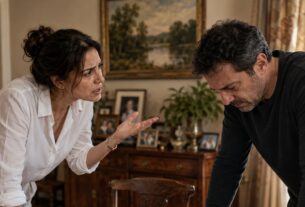
Do without a gift, old woman!” Valera didn’t even look up from his crossword, rolling a pencil around in his mouth. “The ridge beam at the dacha has rotted through, roofing slate has tripled in price, and she’s thinking about restaurants. Fifty isn’t a hundred — you’ll survive without it. You’re not the Queen of England.”
Larisa froze with the heavy cast-iron ladle in her hand, feeling the stifling, sticky heat coming off the stove. A greasy drop slipped from the scoop and splattered onto the perfectly scrubbed enamel, but she didn’t even reach for a rag.
“Valera, but it’s a milestone…” Her voice was hoarse, as if she hadn’t spoken for a long time. “We’ve been saving for five years for this. I wanted shoes, a proper dress, not this robe.”
“You’ll get over it,” her husband snapped, viciously filling in a five-letter word. “Shoes, she says. Planning to lie in your coffin in them? You haven’t even worn out your old skates yet, and now suddenly you’re some fashionista. That’s enough, Larka, stop whining, you’re making my head swell. Better go make some compote from dried fruit. I’m craving something sour enough to make my cheekbones ache.”
The old Saratov refrigerator began buzzing aggressively in the kitchen, as if trying to drown out the squalor of their life. That sound had been the soundtrack to her thirty years of married life — strained, rattling, and endless.
Larisa looked at her husband’s hunched back under his washed-out undershirt, through which the gray hair on his shoulder blades showed through. She looked at the enormous pot of soup she scrubbed to a shine every morning until her fingers hurt.
There was no click inside her, no ringing sound — just the heavy cable holding up the elevator of her patience snapping silently. The cabin plunged down the shaft, gathering terrifying speed, and suddenly the fall made Larisa feel light.
“Compote?” she repeated in a strange, unfamiliar voice that held none of her usual obedience.
“Yeah, and less sugar, my sugar’s spiking,” Valera muttered without turning around.
With two fingers, Larisa carefully set the ladle right on the tablecloth, watching the greasy stain spread across the little flower pattern. She walked into the hallway, took off her apron, dropped it on the floor, put on her raincoat over her house clothes, grabbed her passport, and silently headed for the door.
“Where do you think you’re going? What about the compote?” came his shout from behind her.
“To get sugar,” she threw over her shoulder, slamming the door so hard Valera’s cap fell off the rack.
The bank was cool and smelled of money and air conditioning. Her husband’s words — “Do without a gift” — kept spinning in her head like a scratched record while she sat across from a young teller with fake eyelashes.
“You’re withdrawing the entire amount?” the girl asked, eyes widening. “Larisa Petrovna, you’ll lose six months of interest, that’s not выгодно!”
“Withdraw it,” Larisa said firmly, staring at one spot on the wall. “Every last kopeck. Sweep up the coins too. And convert it into dollars for me. Right now.”
“And the reason for the early closure? We have a box for that on the form.”
“My roof has gone off,” Larisa said with a smile so wide and eerie that the guard by the door stopped chewing gum and tensed up. “It needs a major overhaul. The foundation cracked — we have to save the structure urgently.”
Four hours later she was already sitting in the airport waiting area, clutching a one-way ticket to Antalya in her sweaty palm. In her handbag lay a thick stack of cash — the very money Valera had planned to use to reroof the dacha, buy a motor cultivator, and maybe new winter tires for his “baby.”
She was wearing old jeans, worn moccasins, and the ringing sensation of complete madness. Her phone vibrated nonstop in her pocket — the screen flashing “The Boss” (that was how Valera had entered himself in her contacts five years earlier).
She pulled out the phone and looked at fifty missed calls. Then calmly took out the SIM card, snapped it in half, and with vindictive pleasure tossed the pieces into a trash bin.
The plane climbed higher, leaving below the gray, rainy city that looked like the grimy circuit board of an old television. Larisa stared through the window in horror and realized that for the first time in thirty years she had no idea what she would cook for dinner — and that ignorance was more intoxicating than wine.
Turkey greeted her with damp, heavy heat that made her clothes stick to her body instantly. Larisa, who had never traveled farther than her mother-in-law’s dacha, stood lost in the middle of the airport, stunned by the unfamiliar language around her.
She checked into the first three-star hotel she could find, grandly named “Golden Palace,” where music blared in the lobby and the furniture looked old enough to remember Sultan Suleiman. The receptionist, a slick guy with shifty eyes, looked at her as if she were nothing but a wallet with legs.
“I want a room with a sea view,” she demanded, feeling like an imposter.
“Only room with view of neighboring wall and garbage bins, madam,” the young man replied in broken Russian, chewing on a toothpick. “High season, everything full. Take it or leave it.”
“Then give me the garbage-bin view,” Larisa nodded. “It suits me. It’s very symbolic for my current life.”
She threw her bag onto the bed, which creaked pitifully in protest, welcoming its new guest. Then she walked over to the mirror and looked at herself properly for the first time that day.
From the cloudy glass, a tired middle-aged woman stared back at her with a deadened look in her eyes, a hairstyle that screamed “retired vice principal,” and an ashen face.
“Well then, Larka,” she said aloud to her reflection, “we’re going to look for self-love, since things didn’t work out with anyone else. Or at least some adventure for your second set of ninety.”
The first two days passed in a haze of adjustment. Larisa was afraid to leave her room, living on breakfast rolls and Turkish soap operas. But on the third day, her anger at Valera finally outweighed her fear.
She went to a local shop and bought a bright red dress — the kind her husband would have called “slutty” — and a pair of heeled sandals. The saleswoman clucked her tongue and kept saying, “Beautiful,” while Larisa stared in horror at her bare arms and knees.
That evening she went out onto the waterfront feeling like a raw exposed nerve. Life swirled all around her; the air smelled of grilled meat, spices, and sea. Couples walked hand in hand, laughing, living. Larisa felt like a foreign body, a frozen block of pollock dropped into a hot Eastern soup.
She sat down at a wobbly table in an outdoor café, ordered the most expensive wine on the menu — a name she couldn’t even pronounce — and waited. For what? A prince? A sultan? Just someone who wouldn’t ask her to make compote or hand over a screwdriver.
Almost immediately, a man sat down beside her. Balding, with oily little eyes and a massive gold chain tangled in the hair on his chest.
“Lonely, beautiful?” he winked at her like he had a nervous tic. “I’m Serkan. Leather, furs, gold, best goods. I take you to factory, make discount like for sister.”
“I don’t want a fur coat, Serkan,” Larisa sighed, twirling the stem of her glass. “I want respect.”
“Respect also available,” the Turk pivoted instantly. “But first fur coat. Without fur, what respect? Woman without fur will be cold, she gets sick — who will love her?”
Larisa burst out laughing. Loudly, freely, tears running down her face. She hadn’t laughed like that since ten years ago, when Valera had tried to fix the toilet and somehow ended up wearing it on his head.
“Go away, Serkan,” she waved him off, wiping her mascara. “Find some other fools. I already have one fur coat — it lies on the couch solving crosswords.”
She drank her wine and looked out at the dark, heavy sea. The money burned in her pocket, demanding revenge. She needed to spend it on something outrageously useless, something Valera would have called a crime against the family budget.
The next day she went to the most expensive hammam in town. She ordered the “Sultana” package for an insane amount of money. They washed her in foam, scrubbed her with a rough mitt as if stripping away not just skin but her whole previous life, then smeared her with fragrant oils.
After the treatments she stepped outside, warm and soft as a fresh roll — and was nearly knocked over by an old sputtering motor scooter.
“Careful, hanım!” the driver shouted, braking with his feet against the asphalt.
He was an elderly man in a faded cap. He got off the scooter and threw up his hands, staring at the splash of mud on her new dress.
“Forgive me! I’m an old fool, I got distracted by a seagull! It stole my bagel right out of the air!”
Larisa looked at him. Just an ordinary old man — wrinkled, sunburned almost black, hands covered in calluses and fishing-line scars. But his eyes were kind, bright, and mischievous.
“Shame about the bagel,” Larisa said, brushing off her hem.
“The bagel is nothing!” the old man waved it away. “My honor suffered! I, old fisherman Mustafa, was deceived by a stupid bird! Allow me to treat you to tea as an apology. My boat is nearby — there is shade there, and good tea.”
Larisa wanted to refuse. Valera had always drilled it into her: “Don’t talk to strangers, they’ll fleece you, cut out your kidney, and sell you into slavery.” But right now Valera was probably climbing the walls at home, trying to find her secret cash stash in the grain jars.
“I allow it,” she said unexpectedly.
They drank strong, mouth-puckering tea from little glasses, sitting on the edge of his gently rocking boat. Mustafa turned out to be a chatterbox, but his talk wasn’t tiring. He told her about his grandchildren, about fish that had grown cunning, about the wife he had lost five years earlier.
“She liked to boss me around,” Mustafa said with a sad smile, watching his float. “‘Mustafa, don’t go there, Mustafa, put on your cap, you’ll freeze your ears.’ And now no one bosses me anymore. And I don’t even feel like wearing a cap, even if my ears fall off.”
“My husband is alive,” Larisa admitted, gazing at the water. “But sometimes I wish he’d just keep quiet. All he ever says are orders. Feed me, wash this, hand me that, bring this. To him, I’m like your boat motor. As long as it runs and pulls, you don’t notice it. Once it coughs, you kick it and keep going.”
“Bad husband,” Mustafa said gravely, shaking his head. “A woman is not a motor, hanım. A woman is the sea. Today calm, tomorrow storm, day after tomorrow stillness. You must admire her, not kick her, or she will drown you.”
That phrase caught in Larisa’s mind. She rolled it over on her tongue. It sounded beautiful, powerful. And nothing like “old woman.”
She spent a week in Turkey. She didn’t have a torrid romance, didn’t go completely wild. She simply lived for herself. She ate baklava with her hands, licking the sticky sweetness from her fingers instead of rushing to scrub them with laundry soap. She walked through the city at night, unafraid of the dark.
On the fifth day she bought a cheap new smartphone and inserted a local SIM card. Then she opened her messenger — and a flood of messages from Valera came crashing over her.
“Where are you, idiot?”
“Come back, I’ll forgive everything, just return the money!”
“The roof is leaking right onto the bed, we ran out of basins!”
“I reported you to the police, you’re officially missing!”
“Lara, my blood pressure is 200 over 100, I’m dying!”
Larisa read the messages and smiled. No fear, no guilt. Only mild contempt, like for an annoying autumn fly beating itself against a windowpane.
She started a video call.
Valera’s face filled the screen — red, swollen, twisted with fury. In the background she could see the peeling wallpaper of their kitchen and a mountain of dirty dishes.
“You?! Where are you?!” he screamed so hard the speaker crackled with interference. “Where’s the money?! Do you have any idea what roofing felt costs now?!”
Larisa adjusted the strap of her red dress, enjoying the effect. Behind her the surf roared and those same brazen seagulls cried overhead.
“The money, Valera, went to reinforcing the foundation,” she said calmly. “My personal foundation, which had rotted almost completely away.”
“What? Are you drunk? Come home this instant! I’m starving here! I can’t eat store-bought dumplings, they give me heartburn!”
“Then make yourself some compote, Valera. Something sour. Just how you like it. And wash the pot yourself afterward.”
“What compote?! Are you insane? We’re broke! How are we supposed to fix the roof? Autumn is almost here!”
“Sell your boat then. The rubber one you’ve kept in the hallway for three years. And your fancy Japanese fishing rods. And the garage you use for nothing but drinking vodka with Petrovich and whining about life.”
Valera gasped for air like a fish tossed onto hot sand.
“You… you… Do you even understand what you’ve done? You destroyed the family, you stupid old fool!”
“There is no family, Valera,” Larisa said, taking a sip of her cocktail from a tall glass. “There was a master and there was an unpaid servant. The servant quit. No severance pay, but with good compensation for hazardous working conditions.”
“You found a man over there, didn’t you?” her husband suddenly croaked, squinting. “A Turk?”
“I found myself, Valera. And do you know what? I really like that woman. It turns out she loves to dance, wears red, and absolutely hates cooking borscht.”
She hung up before he could hurl the next round of curses.
Larisa returned home three days later. Tanned, wearing a bright new dress that highlighted rather than hid her figure, and carrying a huge suitcase. The suitcase was stuffed not with souvenirs for the relatives but with beautiful lingerie, spices, and Eastern sweets just for herself.
The key turned in the lock easily, familiarly. The apartment smelled stale, dusty, and faintly sour. In the sink towered an Everest of dirty dishes with dried food crusted onto them. Valera sat in front of the television in nothing but his underwear, surrounded by empty pizza boxes.
When he saw his wife, he jumped up and knocked over a can of beer. He looked pitiful and combative at once, like a half-plucked rooster.
“So you finally showed up!” he shrieked, yanking on his pants. “That’s it, pack your things! You can go live with your mother! I’m not putting up with this debauchery! You’ve humiliated me in front of the neighbors!”
Larisa said nothing. Without taking off her shoes, she walked straight past him into the bedroom. She set the suitcase on the bed. With a loud rip, she unzipped it.
“Are you deaf?” Valera scurried after her, spitting as he spoke. “I said get out! This is my apartment!”
Larisa slowly turned to face him. She took off her dark glasses, revealing a cold, calm gaze. In her eyes shimmered that particular kind of certainty against which all hysterics shatter like waves against cliffs.
“The apartment is ours, Valera. Privatized in both our names ten years ago. Forgotten already? But the dacha is in my name — a gift deed from my father. So if anyone is going to live with his mother, it’ll be you.”
Valera froze, stepping backward. He was used to Larisa apologizing, crying, bustling around, begging forgiveness. This new woman — bronzed from the sun, hardened somehow — frightened him so much his knees trembled.
“How can you… but we… who’s going to cook for you?”
“Listen carefully,” she cut in, never raising her voice. “The washing machine washes by itself if you press the button. Couriers deliver food; the numbers are on the fridge. And I’m buying a robot vacuum. There’s still money left.”
She stepped toward him, and Valera instinctively flattened himself against the doorframe.
“I am no longer your cook, your laundress, or your ATM. If you want to live with me under the same roof, learn to be a neighbor. A polite, quiet, invisible neighbor.”
“And… and the money?” Valera asked pitifully, all his bravado draining away. “For the roof? It’s leaking right onto your pillow.”
“You’ll fix the roof yourself. With your own hands. Remember what they’re for. Or you can sleep hugging a bucket. I don’t care. From now on I’m only going to the dacha to sunbathe and drink wine in a chaise lounge. And God help you if you ask me to weed a single bed.”
She pulled an elegant box of Turkish delight from the suitcase, opened it, and popped a rose-scented cube into her mouth, closing her eyes in pleasure.
“Help yourself, Valera. It’s your gift for my юбилей. There won’t be another.”
Valera stood there staring blankly at the sugar-dusted sweets. He understood that the old life — comfortable and familiar as a pair of threadbare slippers — was over forever. And no glue in the world could stick it back together.
Larisa stepped onto the balcony and flung open the windows they had sealed for winter. The noise of the city rushed into the stuffy apartment along with fresh evening air and car horns. She inhaled deeply, straightening her shoulders.
The air was different. Not Turkish, of course — it had a trace of gasoline in it — but it no longer smelled of hopelessness and sour soup.
Down in the courtyard, someone laughed loudly. Larisa smiled to herself. She knew tomorrow would be a difficult day: dividing up shelf space in the refrigerator, shouting matches over electricity bills, silent guerrilla warfare over the TV remote.
But that would be tomorrow. Today she was a queen returning from exile, carrying out a coup and seizing the throne. It didn’t matter that the queen’s feet hurt a little after the flight, or that her roots needed touching up. Those were trifles.
The important thing was that she would never again economize on shoes — or on herself.
Valera sat in the kitchen googling “how to fix a roof cheaply with your own hands,” periodically glancing toward the closed bedroom door. From inside came cheerful Turkish music.
Larisa was dancing.