Angelina Borisovna raised her son on her own. She had never married—not because she was one of those women who rejected family life on principle or had stopped believing in love. Life had simply unfolded in such a way that too many things were postponed for “later,” and that later kept being pushed farther and farther away. She learned early on that if you wanted to achieve something, if you did not want to depend on anyone, you had to sacrifice something. Most often, that something was your personal life.
First came her studies, then work: at first modest and straightforward, then increasingly demanding, serious, and responsible. One department gave way to another, the tasks became more difficult, and management’s trust in her only grew. Promotions followed one after another, and Angelina Borisovna took pride in every new milestone, every small sign that she was doing everything right. Only once, when she was nearing forty, did she suddenly stop and look around. To her surprise, she realized there was almost no one left beside her. Her peers had long since built families and raised children, while younger men looked at her differently—with cautious respect, as a superior, as someone “above” them, but not as a woman they imagined building a life with.
She never complained. She was used to relying entirely on herself. She had an apartment, a stable job, and a salary that, while not luxurious, was enough to live on. And Angelina Borisovna had one tradition she never broke—once a year, she treated herself to a trip to a seaside resort. Not for noisy fun or thrilling adventures, but as if it were a reward she gave herself—for endurance, for years of hard work, for knowing how to carry herself with dignity.
Her favorite place had become Lazarevskoye. It had everything she needed: warm sea water, sunshine, unhurried walks along the promenade, narrow streets with air unlike anywhere else. She had come there three years in a row, always staying in the same place, and even choosing the same café each time—a small, cozy one with wicker chairs and large windows overlooking the waterfront.
That evening had seemed no different from the others. She was dining alone, sitting by the window, slowly stirring her tea and watching the tanned, cheerful, bustling vacationers. Then she noticed someone standing across from her. A man shifted awkwardly from one foot to the other, as though uncertain whether he should approach.
“Excuse me, is this seat taken?” he finally asked.
He was no longer young, but neat and well kept, dressed carefully, with a kind face. Angelina Borisovna nodded.
“No, of course.”
He sat down, thanked her, and ordered dinner. Conversation began surprisingly easily—without strain, without obligation—as though they had known each other for years. His name was Viktor, and he turned out to be from Siberia. He told her that he had recently suffered through a severe case of bronchitis and had been slow to recover, so his wife had practically insisted that he go to the sea to breathe the salt air and regain his strength. He himself had not really wanted to go, but he had given in. Angelina Borisovna told him she was from central Russia and that she came here almost every year. They spoke about work, about little things, shared funny and awkward stories from their lives, and laughed together.
The next day he sat with her again. Then they began taking evening walks, sitting for hours on benches by the sea, listening to the waves and talking about everything under the sun. Sometimes Viktor would gently take her hand, and every time he did, Angelina Borisovna felt her heart stop for a second.
She barely noticed how deeply she had become attached to him. Not in some girlish, careless way, but deeply, quietly, as a grown woman does. She knew he had a wife. She understood that all of it was temporary, improper, impossible. And still, every evening she caught herself waiting for him. What began between them was the most ordinary resort romance—quiet, slightly awkward, yet astonishingly warm.
Viktor did not hide his feelings. He told her how easy it was to be with her, how long it had been since he had felt such peace. Sometimes he would fall silent, gazing at the sea as if struggling with himself. Angelina Borisovna understood everything and never asked unnecessary questions. She knew how to stay silent when words could ruin everything.
Their parting was the hardest moment of all. On the day of departure, they sat in that same café where everything had begun and stayed silent for a long time, unable to find words that suited goodbye.
“I could…” Viktor began, then stopped. He took a deep breath and finally said, “I could leave my family. I could come to you.”
Angelina Borisovna stared into her cup for a long time, as though searching for the answer there. Then she slowly shook her head.
“No,” she said softly. “That would be wrong. I could never be happy if my happiness came at the cost of another woman’s pain.”
He understood, and he did not insist. They embraced tightly, for a long time, like people who knew that from this moment on, each would go his own way and their roads would never cross again. She did not give him her contact information—not out of resentment, nor pride, but because she knew it was the right thing to do. She did not want to drag that romance behind her like an anchor.
When she returned home, Angelina Borisovna took a long time to recover. Everything around her seemed unchanged—the same apartment, the same morning routine, the same job—and yet inside, something had shifted, as though the support beneath her had quietly moved. She tried to live as before: waking to the alarm, going to the office, dealing with work matters, staying late. Sometimes she caught herself scanning crowds for a familiar silhouette or listening too carefully to strangers’ voices, and each time she would stop herself. No. Everything had stayed there, by the sea.
One day Angelina Borisovna felt that something strange was happening to her. At first it was slight weakness, then sudden drowsiness, irritability, and an unusual sensitivity to smells. She brushed it off, blaming exhaustion, age, nerves. But the uneasy feeling did not go away. When she finally went to see a doctor, she did so without any real expectations, simply to settle the matter and calm herself. Later, sitting in the hallway and clutching her handbag, she did not immediately grasp what she had been told. Pregnant. The word sounded quiet, ordinary, but inside her something glowed to life. Her happiness knew no bounds. A child. The child of the man she loved. A gift from fate—unexpected, impossible, something she had never dared even dream of. She decided at once that Viktor would never know. Not out of hurt, not out of pride, but because that was the right thing. He had his own life, his own family, his own responsibilities.
The pregnancy was calm and uneventful. Angelina Borisovna became more attentive to herself, learned to listen to every signal her body gave her. She rested more, worked less late into the evening, allowed herself small indulgences—an afternoon nap, long walks. Sometimes she would place a hand on her belly and speak softly to the baby, as though he already understood everything. The delivery went smoothly. Anton was born strong and healthy, and the first time they placed her son in her arms, her heart clenched: he looked far too much like his father. The same eyes, the same lips, even the same expressions.
Anton grew up to be a calm, agreeable child. He learned independence early, rarely threw tantrums, and easily found common ground both with children his own age and with adults. He did well in school without strain, as though learning came naturally to him. Angelina Borisovna tried to give him everything she could: care, a sense of stability, confidence in tomorrow. She still worked hard, but now she knew for whom. No matter how tired she was, she always found time for her son.
Sometimes Anton would ask about his father. Angelina Borisovna never lied. She believed that truth, spoken calmly and at the right time, hurt less.
“Your father has another family,” she answered honestly. “He doesn’t know about you.”
The years passed. Anton grew up almost without her noticing. By the time he finished school, he was a confident, self-possessed young man. Sometimes Angelina Borisovna would look at him and think she had somehow missed the moment it all happened. It seemed only yesterday he had been tripping over his shoelaces and dragging a backpack nearly bigger than himself, and now he sat at the table, calmly drinking tea and speaking as though everything had already been decided.
“Mom, I’m going to apply to a university in Tomsk.”
She did not even grasp his words at first.
“Where?”
“In Tomsk. It’s a student city. I’ve already chosen,” Anton replied just as calmly.
It felt as though someone had splashed cold water over her. She could not understand where this desire had come from. She had hidden everything about his father so carefully. She had never named the city, never mentioned Siberia, never shared a single detail. But, as it turned out, Anton had long been reading articles and forums, studying university rankings. He said he had always been drawn to small cities, real winters, biting frost. “Must be genetics,” she thought bitterly then.
She tried to persuade him otherwise. She spoke of the distance, the expense, how hard it would be for him alone. She warned him about dorm life, daily routines, an unfamiliar city. She gave all the reasonable arguments that had always worked before. But for the first time in his life, Anton would not bend.
“Mom, I’ve already decided,” he said firmly.
She saw him off at the train station with a heavy heart, waving for a long time until the car disappeared from sight. He was admitted on his first try. He called, overjoyed and excited, speaking quickly and stumbling over his words. Angelina Borisovna cried right there into the phone, laughing through tears and repeating that she was proud of him.
The first year flew by. Anton called regularly, telling her about his classes, the dormitory, his new friends, sharing his impressions. Then one day, almost casually, he said:
“Mom, I’ve fallen in love with this city. After graduation, I’ll probably stay here.”
That was when she became truly frightened. It was one thing to let her son go for a few years, to accept the distance, to live from call to call. It was entirely different to suddenly understand that he might never return. That he might stay where he felt at home, where his adult life had begun. It was as if Angelina Borisovna had lost her inner balance. During the day she held herself together—worked, smiled at colleagues, pretended everything was under control. But in the evenings she wandered restlessly around the apartment, unable to settle. She caught herself counting the days until his next call, rereading old messages, checking the weather in that very city as though it might somehow bring her closer to him. Sometimes she fell asleep with her phone in her hand, afraid of missing his звонок.
She tried for a long time to convince herself that this was normal. Children grow up and leave. She had no right to keep him near simply because of her own fear. But the anxiety would not leave. It only grew, making it hard to breathe. And then, without letting herself think it through any longer, Angelina Borisovna made a decision she had never expected from herself.
“Anton,” she said over the phone, trying to keep her voice steady. “What if… what if I moved there too? Since you’ve already decided…”
There was a pause on the other end. She braced herself for a polite refusal, a joke, or a cautious “Mom, don’t.” Instead, Anton suddenly laughed—lightly, sincerely.
“Really? Mom, that would be wonderful!”
She sold her apartment quickly. In the new city, Angelina Borisovna managed to buy a small two-bedroom apartment and a studio “for the future.” Finding work proved more difficult. A position turned up eventually, but it was nowhere near as good as the one she had left behind. The salary was lower, the workload heavier, but that no longer mattered the way it once had. Her priorities had changed long ago. The main thing was that her son was nearby. Everything else could be endured.
Little by little, they settled in. They bought furniture, hung curtains, and got used to the new rhythm of life. To the long winters, the sharp wind, the early dusk. Angelina Borisovna learned to dress more warmly, stopped being afraid of the cold, and even found something cozy in it. There was only one thing she tried not to think about.
Sometimes, walking down the street, she caught herself studying men’s faces. Tall figures, familiar eyes, a certain way of walking. Her heart would begin to beat faster, and she would immediately stop herself.
“Nonsense,” she whispered. “So many years have passed.”
She feared that meeting. She feared imagining what would happen if Anton accidentally ran into his father. What would happen if he learned the truth not from her, but on his own. She feared questions she had been spared for so many years. Or maybe it was not fear at all. Maybe somewhere deep inside there was a hidden, nearly forgotten wish—to see him once more. Just to look at him. To make sure he was real, that all of it had truly happened.
Whatever it was, life has a habit of bringing about exactly what you think about too much, even when you keep trying to chase those thoughts away.
Anton graduated from university without trouble. He defended his thesis confidently, and his professors spoke highly of him. Almost immediately after graduation, he was offered a job. The university had agreements with several private companies, and the best graduates were recommended directly. That was how Anton ended up in a respected firm well known throughout the city.
On his very first evening back from work, he came home unusually excited, his eyes shining.
“Mom,” he began from the doorway, not even taking off his coat, “you won’t believe what happened today.”
Angelina Borisovna grew tense. In all the years she had known him, her son rarely looked so stirred up.
“What happened?”
“They spent the whole day asking me questions,” Anton said with a grin. “They wanted to know if I was our CEO’s son.”
She froze, as though time had suddenly stopped.
“Why?..”
“They say I look a lot like him. And my patronymic is Viktorovich. His first name is Viktor too. Can you imagine? Funny coincidence, right?”
Angelina Borisovna slowly sat down on a chair. Her heart beat evenly, without panic, but somewhere deep inside, something trembled with an old, forgotten pain.
“Anton,” she said at last, “your father really was from this city.”
Her son lifted his head and looked at her carefully.
“You knew?”
“Yes. But he never told me where he worked or what he did. And I never asked his last name. I didn’t want to. I didn’t want the temptation to search for him.”
Anton did not reply. He only nodded. It was obvious he needed time to take it all in. And Angelina Borisovna sat across from him, understanding that what she had feared for so many years had finally begun to catch up with them.
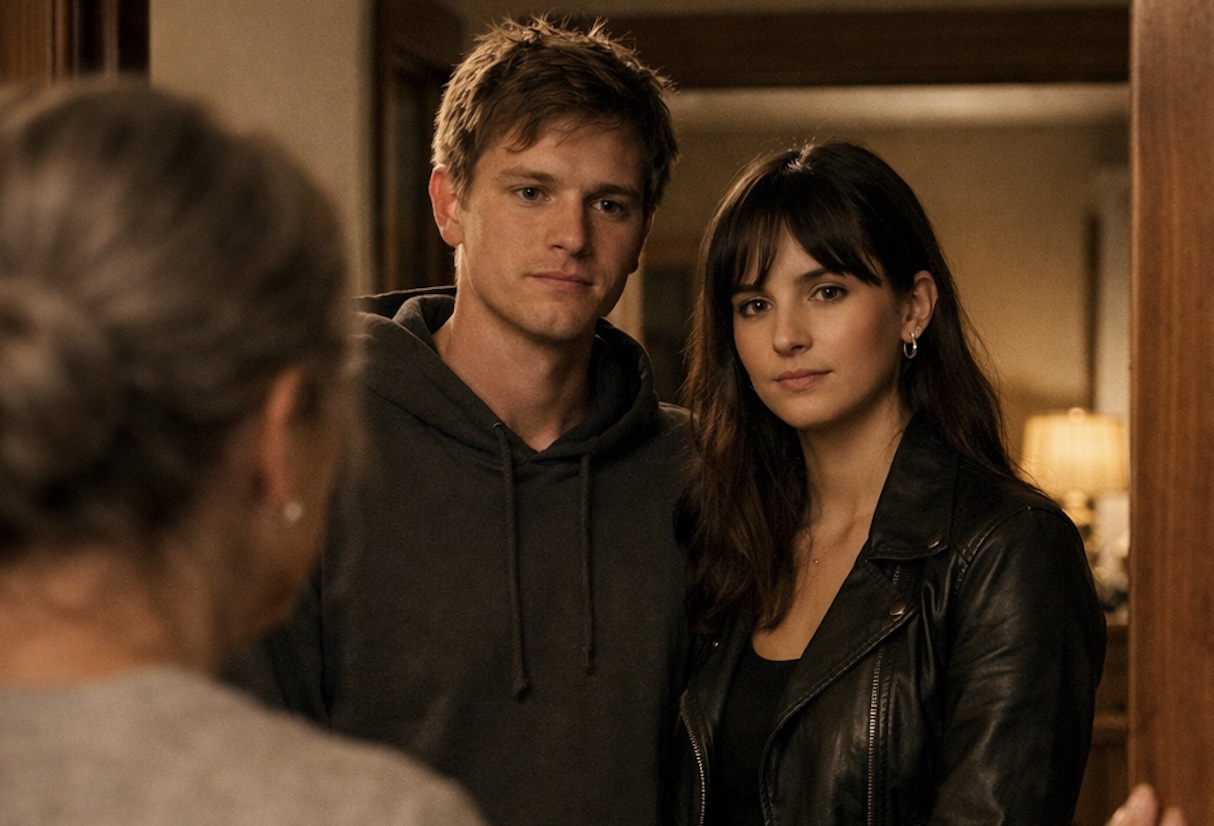
Only a few days passed before, late one evening, the doorbell rang. Angelina Borisovna had just been setting the table—placing the dishes, absentmindedly straightening the napkins, glancing at the clock. Anton was due home any minute, and the apartment already smelled of dinner. She wiped her hands on a towel and went to the door without any sense of alarm. She opened it—and there was Anton on the threshold. But he was not alone.
Beside him stood a man. Tall, gray at the temples, with that very familiar gaze she recognized at once. Viktor.
She looked at him and suddenly realized, with surprise, that she was not afraid. Her hands did not shake. Her breathing did not falter. There was no lump in her throat. Only a strange, almost peaceful feeling of completion—as though a long-awaited final point had finally been placed. Anton cleared his throat awkwardly, glanced at her, then at the man beside him, and without saying a word went into the kitchen. As if instinctively, he understood that they needed this moment—to be alone. For the first few minutes, neither of them spoke. Too much stood between them, and this meeting had lived for too long only in imagination.
Viktor was the first to break the silence. He said that when he returned from the resort back then, he immediately sensed that something at home had changed. His wife had become different—distant, wary. Then it turned out that one of the “well-wishers,” as he put it with a bitter smile, had also been vacationing in Lazarevskoye and had sent her photographs. Pictures of him embracing Angelina.
“She didn’t throw me out,” Viktor said quietly. “But living there became… unbearable.”
There were constant reproaches, cold silence, and looks in which all trust had disappeared. He endured it. At first because he knew he was guilty, later for the sake of his son, who had still been very young at the time.
“I promised myself I would keep the family together,” he admitted. “I thought time would smooth everything over. I thought she would see how hard I was trying… how sorry I was. But no.”
He fell silent, ran a hand across his face as though wiping away exhaustion, and after a pause continued: seven years earlier, his wife herself had confessed that she had long had another man. She said it calmly, almost indifferently. She admitted that she had never truly forgiven his betrayal and that she had stayed with him only because it was convenient: he provided for her, asked no questions, offered stability.
“That’s when I left,” Viktor said simply. “And for the first time in many years, I felt relief.”
He admitted that for a long time he had blamed himself. He had tried to be proper, accommodating, to make amends. Then one day he realized that all those years he had been needed not as a person, but as a source of comfort. And that was when he began remembering Angelina more and more often—the resort, their conversations, that feeling of peace and warmth that had once seemed like an impossible luxury.
“I wanted to find you,” he said at last, lifting his eyes to hers. “I wanted to very badly. But you never even told me your last name. I looked… and got nowhere.”
When people at work directly asked him whether the young man hired there was his son, he brushed it off at first and thought nothing of it. But the resemblance was too strong. The same look, the same way of carrying himself, even the same intonation. He approached Anton carefully, as though afraid of the answer. He asked questions gently, without pressure. And when he heard his mother’s name and learned where they had moved from, everything suddenly fit together. He asked Anton to show him a photograph of Angelina to be sure, and then he himself asked if he might come visit.
Angelina Borisovna listened and felt something inside her slowly release. All that remained in her soul was a quiet, gentle sadness for the years that might have been different—and gratitude that the truth had finally found its way back to them.
Three years have passed since then. Angelina is happy with the man she loves—truly happy, without hesitation or second thoughts. They made their relationship official, without grand celebrations, but with the feeling that everything had finally fallen into place. Anton married a year ago. He and his wife are now expecting a baby, and Angelina Borisovna, smiling, sorts through tiny little clothes she buys with special tenderness.
Whatever people may say, there is room for fairy tales in real life. The important thing is to believe and to wait patiently, no matter how long it takes. She and Viktor dreamed of each other in silence, each in their own way. And fate, as it turned out, had been quietly gathering all the necessary pieces this whole time, so that one day it could fit them together into one complete picture.