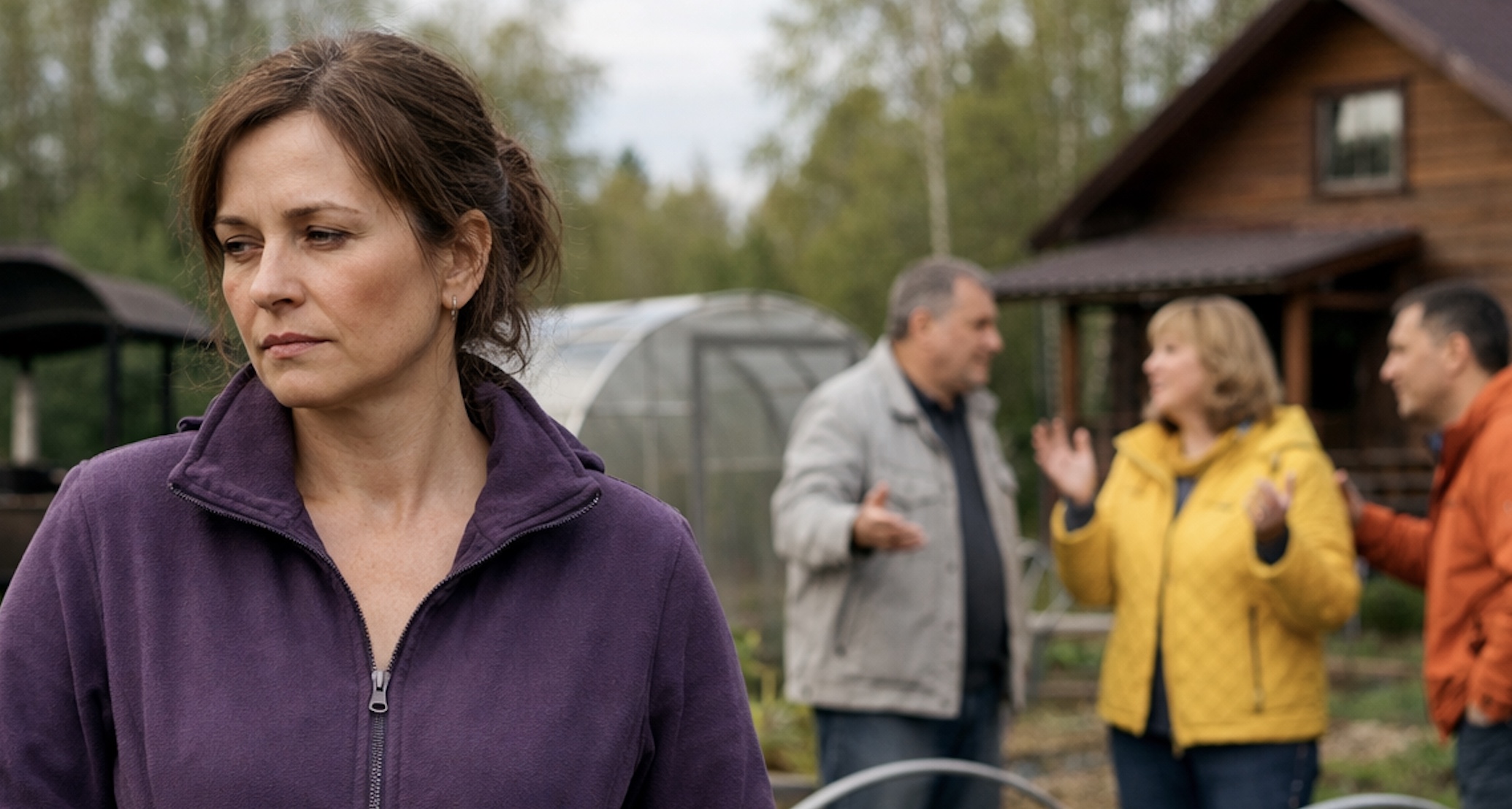
Marina stood in the doorway wearing one sock, the other dangling from her hand, and watched as Kostya loaded a folding grill and three bags of seedlings into his Duster.
“We’ll pick up Mom and Dad on the way,” he said without turning around. “And Larisa and Vovka will come by around lunchtime. I already sent them the coordinates.”
“Larisa who?”
“My sister. Did you forget? I told you.”
He hadn’t told her. Marina knew that for certain. She would have remembered if the plan had involved five extra people showing up at someone else’s dacha.
But she said nothing. She pulled on the second sock and went to pack.
She and Kostya had been together for four months. Not married, not engaged, but somehow they had already slipped into that everyday kind of “we.” He had moved a winter jacket and a multicooker into her apartment. She had gotten used to hearing someone in the bathroom at night, noisily gargling. She was forty-three, he was forty-seven, and for both of them it was easier not to explain to acquaintances why they were alone.
The dacha was partly her own fault.
Back in March, while they were talking about the May holidays, she had casually said:
“I’ve got a dacha. Well, technically it’s my aunt’s. Huge plot, bathhouse, five minutes from the river.”
But what she actually said was, “I have a dacha.”
Not “my aunt does.”
Not “maybe we can ask to go.”
She said it as if the key was already in her pocket and they could leave the next day.
Kostya grabbed onto the idea immediately.
“Oh! Then let’s spend all the May holidays there. Barbecue, bathhouse, perfect.”
Marina nodded. Then she called Aunt Zoya.
Aunt Zoya was a story all her own. Sixty-one years old, former supply manager at a construction company, with a character like a cast-iron skillet: heavy, hard, and built to last forever. She had inherited the dacha from her mother and spent twenty years pouring money, labor, and stubbornness into it. The plot was twenty acres. The house was solid log timber with a terrace. The bathhouse was her personal pride and joy. She had chosen the stove herself and even ordered the stones from Karelia.
She let Marina come there. Not because she was especially kind, but because Marina was the only relative who never asked for money and never complained about life. She came, brought groceries, washed the floors, and didn’t put her hands on things that weren’t hers. Zoya valued that, in her own way.
“Are you coming for the holidays?” Marina asked on the phone.
“No. I’m going to a spa resort. Key’s under the porch, you know where. Just keep the place in order.”
“I’ll come with… someone. A man.”
“Come, then. Just make sure the bathhouse is aired out properly before you leave.”
Not a word about five other people. Because Marina herself said nothing about five other people.
Kostya’s parents got into the car on the way out of Podolsk. His father, Gennady Petrovich, a broad, heavy man in a camouflage jacket, started talking about seedlings before he had even properly sat down.
“I brought cherry tomatoes, cucumbers, peppers. What’s the soil like there, black earth?”
Marina turned around from the front seat.
“It’s not my land. It’s my aunt’s. We’re just going there to отдыхать.”
“Well, why let good soil sit empty?” Gennady Petrovich said evenly, as though it were obvious. “If there’s space, we’ll plant. In autumn we’ll come back and harvest.”
Kostya’s mother, Tamara Yuryevna, small, dry-faced, with sharp watchful eyes, sat in the back seat examining her nails. She said nothing. But Marina could feel it anyway: they had already sized her up, filed her into some internal category, turned her into a line item in their plans.
During the drive, more details came out. Kostya’s sister Larisa and her husband Vovka were bringing a collapsible greenhouse frame. And seven currant saplings.
“Are they planning to move in or something?” Marina asked, trying to keep her voice level.
“No, they’ll plant a few things and leave. It’s fine,” Kostya said, slapping the steering wheel. “What’s with you, Marina? You should be happy. People are helping.”
Helping whom, exactly, he did not say. Marina didn’t ask. She was already thinking about how she would explain to Aunt Zoya that seven currant bushes had been stuck into her soil without permission.
They arrived around two in the afternoon. The property greeted them with silence and order. Zoya had left three days earlier. Everything was tidy, the paths swept clean, the bathhouse locked with a latch.
Gennady Petrovich stepped out of the car, looked around, and whistled.
“Well, would you look at that. This is practically an estate. And the bathhouse is a separate building? Impressive.” He turned to Kostya. “Listen, you could add a second floor here. A mansard roof. This place would be incredible.”
Marina opened her mouth. Closed it. Opened it again.
“This is someone else’s dacha. You can’t add anything here.”
“Well, you can always talk it over,” Tamara Yuryevna said in a calm voice, as if suggesting more tea. “You’re her niece, not some outsider. You’ll talk to your aunt, she’ll understand.”
Around four, Larisa and Vovka arrived. Larisa, large, loud, carrying a practical shoulder bag, stepped onto the property and immediately began circling it like an appraiser.
“What was planted here before? Could we make beds here? Is there a compost pit?”
Marina sat on the porch and watched five people begin to settle into someone else’s space as if it belonged to them. They set up the grill by the fence. Vovka dragged the greenhouse frame to the sunny southern side and started assembling it. Gennady Petrovich marked out three rows for tomatoes with little stakes.
No one asked. Not once. Not a single “is this okay?”
“Kostya,” Marina said, grabbing his sleeve while he was dragging a shovel out of the shed. “Do you understand that we are guests here?”
“Oh, come on, Marina. Who is this hurting? We’ll come back in autumn, take the harvest, make your aunt some jam. Everybody wins.”
“My aunt didn’t ask for jam. She asked me to air out the bathhouse.”
“And we will. Why are you getting worked up?”
He walked off to dig. Marina stayed on the porch.
She was the only person there who really understood that none of this was theirs. But she couldn’t make herself speak sharply enough, clearly enough, finally enough. Because she had helped create this mess. She had said, “I have a dacha.” She had brought Kostya. She had failed to say on the phone: I’m bringing one person, quietly, and that’s all.
By evening there were three garden beds, half a greenhouse, and seven skinny currant stems planted in the earth. Larisa was already discussing with Tamara Yuryevna what curtains would look good on the terrace. Tamara nodded and wrote down measurements.
Marina went inside and lay down on the bed. Through the wall she could hear Gennady Petrovich saying to Kostya:
“Solid setup. If your aunt doesn’t mind, you could come here every weekend. I’d put in a proper permanent greenhouse.”
Aunt Zoya returned the next day at half past nine in the morning.
Marina had no idea she was coming back. Apparently the spa trip had fallen through, or turned out differently than planned. Zoya hadn’t called ahead. She simply drove up in her Niva, got out, slammed the door, and stared at what was happening on her land.
Vovka was finishing the greenhouse. Larisa was hanging laundry on Zoya’s clothesline. Gennady Petrovich was sitting in Zoya’s armchair on the terrace, drinking tea from Zoya’s mug, the one that said: Zoya Grigoryevna, Happy Jubilee! Kostya was chopping wood by the bathhouse.
Aunt Zoya stood there for ten seconds. Then she walked toward the terrace.
“Hello,” she said to Gennady Petrovich.
He half rose, still holding the mug.
“Oh, hello! You must be Zoya, right? Marina’s aunt? You’ve got a fantastic place here. We’re just settling in a bit.”
“I can see that,” Zoya said. “Settling in. Digging beds. Building a greenhouse. Planting currants.”
“Well, no point in letting good land go to waste,” Gennady Petrovich said with a smile.
Zoya did not smile.
Marina came out of the house. She felt sick.
“Aunt Zoya, I didn’t know you’d come back early. And I didn’t plan for there to be this many people. It just… happened.”
“It happened,” Zoya repeated flatly.
She looked over the property. At the greenhouse. At the new beds. At her mug in someone else’s hand. Then she sat down on the bench by the porch and placed her hands on her knees.
“All right, then,” she said in a level, businesslike voice. “Since you came, since you’ve already started digging, since you’ve put your hands on my land, let’s do this properly. My potatoes haven’t been planted. There are six sacks in the shed. The whole field from the bathhouse to the fence, twelve rows. There are shovels. Go ahead.”
Silence.
Gennady Petrovich set down the mug.
“What do you mean, potatoes?”
“Exactly what I said. You all look like hard workers to me. Breaking beds, putting up greenhouses. So go plant the potatoes too. My back isn’t what it used to be. I need help. You’re family,” Zoya said, looking at Marina, “to our Marina. Which means you’re not strangers to me either. Right?”
Kostya walked over, still holding the axe.
“Wait a minute. We came for a barbecue. We came to relax…”
“There will be barbecue. Tonight. After the twelve rows.” Zoya stood up. “And I’ll heat the bathhouse tonight too. For whoever works. Whoever doesn’t can go to the river. Water’s about ten degrees. Very refreshing.”
Larisa came over, wiping her hands on her jeans.
“Hold on, we came as guests. We are not obligated to…”
“You’re guests when you’ve been invited,” Zoya turned to her and said. “Who invited you? Marina? Marina herself is a guest here. My house. My land. My rules. If you don’t like it, the gate is over there.”
No one left.
Maybe they were too embarrassed. Maybe it was the tone Zoya used, the kind people simply do not argue with. Or maybe because the cars were already unloaded and it was two in the afternoon on the first of May, and there was nowhere else to go.
Gennady Petrovich dug. In silence. Heavy, angry, jaw clenched. Vovka dug beside him. Kostya dug. Larisa stood off to the side for a while, until Zoya said:
“And what are you standing there for? There’s a bucket of potatoes. Drop them into the furrows, two per hole, eyes up.”
Larisa dropped them in.
Tamara Yuryevna tried to slip into the house.
“I need to check my blood pressure. I’m not feeling well.”
“The monitor is on the shelf in the bedroom,” Zoya said. “Check it and come back out. There are still four rows left.”
Marina stood on the porch and watched.
On one hand, they deserved it. They had come without permission, spread themselves out across somebody else’s property, made plans for what was not theirs, sat in a stranger’s home, drank from a stranger’s mug. On the other hand, she had brought them there. Not directly, maybe, but because of her, all the same.
Zoya walked up to her.
“You too. Take the rake and smooth out the rows behind them. They’re doing it crooked, devils.”
“Aunt Zoya…”
“Marina. You brought a whole crowd onto my land. I’m not yelling. I’m not throwing anyone out. But everyone works. You first.”
Marina took the rake.
By six in the evening they had planted the entire field. Twelve rows. Six sacks. Everyone’s back ached. Their hands were caked with dirt. Gennady Petrovich sat on an upside-down bucket, breathing heavily. Larisa said nothing, just kept shifting her belongings from one place to another, as if already preparing to leave.
Zoya heated the bathhouse, just as promised. She laid out food on the terrace: boiled potatoes, lard, onions, home-pickled cucumbers. Vovka grilled the meat. They had brought that, at least.
At the table it was quiet. Not the warm quiet of a family meal, but the heavy quiet that comes after humiliation.
“Come back in autumn,” Zoya said, dipping bread into oil. “To dig up the potatoes. We planted them together, so we’ll harvest them together. I’m not greedy. We’ll split them fairly.”
Tamara Yuryevna put down her fork.
“What exactly do you mean by split?”
“Exactly that. You planted them, so you get a share. I get a share. Fair is fair. Just bring your own sacks for the harvest. I don’t have extras.”
Larisa quietly said to her husband:
“Vova, what time are we leaving tomorrow?”
“Early,” Vovka said without raising his head.
In the end, they did not leave the next morning. They left two hours after dinner.
Larisa and Vovka packed first. They did not bother taking apart the greenhouse. They just abandoned it. Larisa even left laundry hanging on the line. Marina had to take it down herself later.
Gennady Petrovich was the last to go. At the gate he turned to Marina.
“This wasn’t right. We thought the dacha was yours. Family property. And instead there’s that commander sitting there making people slave away. You could have warned us.”
“I told you it was my aunt’s.”
“So it’s your aunt’s, so what? She’s still family, not some stranger. You could have handled it properly instead of setting people up.”
Setting people up.
Marina remembered that phrase. Five people had arrived uninvited at someone else’s property, dug up beds, put up a greenhouse, gone into somebody else’s house, drunk from somebody else’s mug, and somehow she was the one who had “set them up.”
Tamara Yuryevna said nothing. She simply got into Larisa’s car and slammed the door. Deliberately. Like placing a final period at the end of a sentence.
Kostya stayed until morning.
That night he lay on the bed staring at the ceiling.
“Marina, try to understand. I brought my parents, my sister. We wanted a normal holiday. And what did we get? Humiliation. My mother, with her bad back, ended up planting potatoes. My father almost collapsed.”
“I told you we couldn’t act like owners here.”
“You said you had a dacha. You invited us. You said there was a bathhouse, land, everything.”
“I never said everything was mine.”
“No, but that’s how you made it sound. What were we supposed to think?”
Marina said nothing.
Because partly he was right. She had made it sound that way. She had not lied outright, but she had not been honest either. She had not said plainly: “It’s my aunt’s place. She’s strict. Nothing can be touched. We can only go quietly, just the two of us.” She had not said it because she wanted to look a certain way. She wanted to be the woman who could say, “I have a dacha.” She wanted Kostya to look at her in a certain light.
Well, he had.
In the morning Kostya loaded the multicooker back into the Duster. Marina stood by the porch.
“You’re serious?”
“Marina, I’m not built for this. I thought we were going to relax, not labor for your aunt.” He paused. “And in general… if this is how you live, under someone else, on someone else’s territory, by someone else’s rules, it’s not for me.”
“I do not live under someone. I was at my aunt’s dacha. With her permission.”
“Well, then stay there. With permission.”
He left.
No slammed door. No dramatic scene. No cruel last words. He simply left. He took the multicooker. Took the winter jacket. Even took the bag of charcoal for the grill.
Zoya had gone to her room the night before and stayed there until morning. After Kostya drove off, she came out onto the terrace with tea in her own freshly washed юбилейная mug and sat in her chair.
“He left?”
“He left.”
“With his things?”
“With his things.”
Zoya took a sip of tea.
“Marina, are you angry with me?”
“I don’t know.”
“Be angry or don’t. But if I hadn’t put them to work, they’d have been back in a week with cement, pouring a foundation for their own shed. I’ve seen people like that. They settle onto someone else’s property quietly and fast. First the beds, then the greenhouse, then ‘we’ll stay here all summer, where else can we go?’ And then you’re left explaining that the dacha is not some shared family estate.”
Marina stayed silent.
She knew Zoya was right. Not entirely, not elegantly, but right. And somehow that made it worse, not better. Kostya was gone. Four months, wasted. Alone again. More explanations for friends. More photos to delete from her phone.
“A man who brings his mother to dig in someone else’s garden and then blames you for it is no man. He’s a tenant looking for a free setup and already moving in.”
Marina did not answer.
She looked out over the field: even rows, freshly turned earth, neat ridges.
Twelve rows of potatoes. Planted by strangers’ hands in someone else’s land. The only thing left behind from those four months.
She picked up the rake leaning against the porch and carried it toward the shed to put it away.
A pair of Larisa’s jeans still hung over the fence. Wet and heavy.
Marina took them down, folded them, and placed them by the gate.
In case anyone came back for them.
But she already knew no one would.