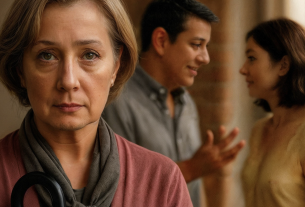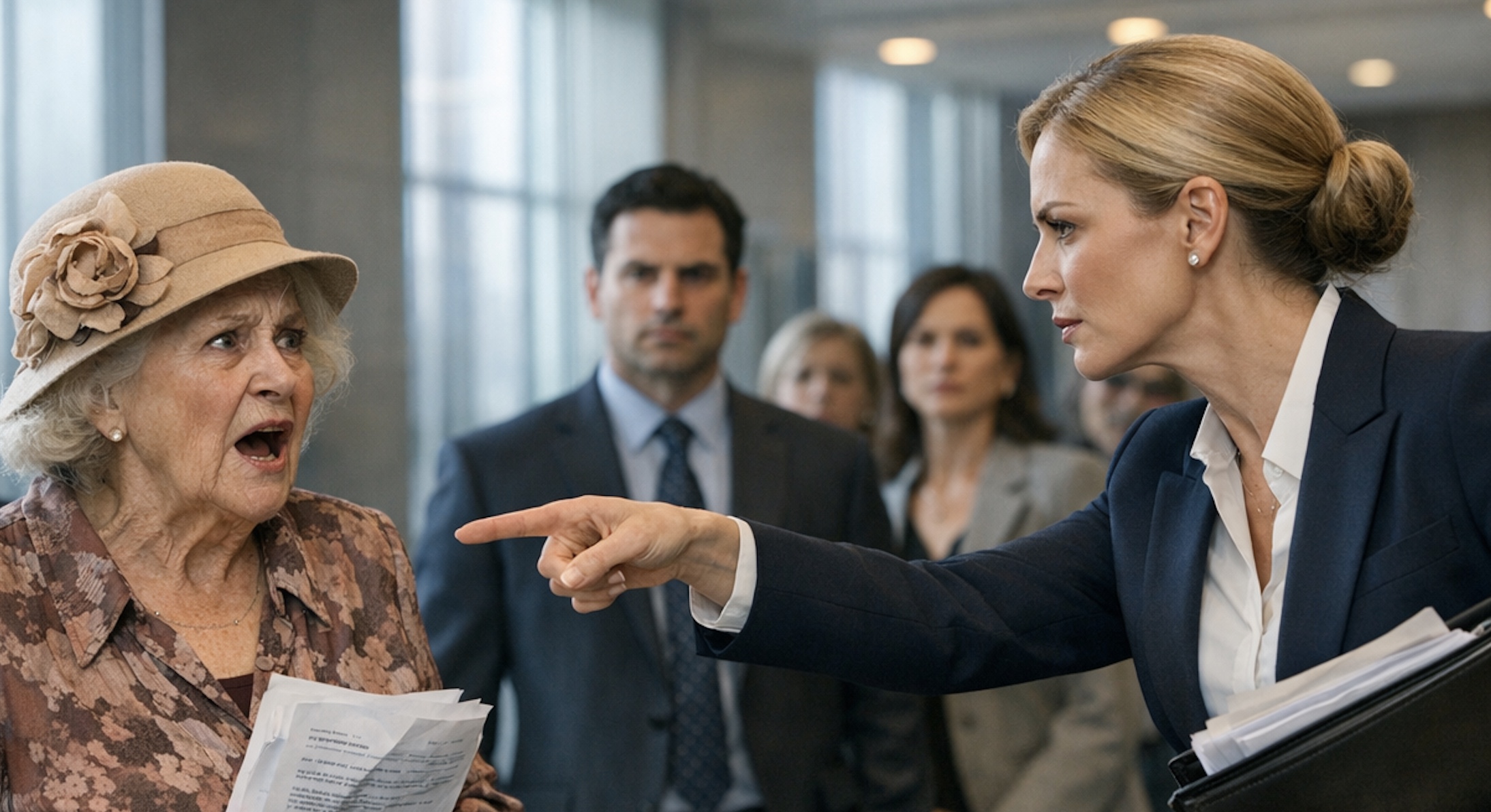
— Your power of attorney is being reviewed, Bella Borisovna. Please have a seat, said Yulia, the bank clerk. Her voice was as even as the horizon over the steppe, though I noticed the slightest tremor in her little finger as she adjusted her name badge.
I stood five meters away, behind a decorative column, staring at the back of my mother-in-law’s head. Today Bella Borisovna was wearing her “battle hat,” the one with the felt flower on the side. She wasn’t sitting—she was reigning over that uncomfortable bank sofa, clutching my handbag in her hands. The very same little evening purse I had assumed was lost after her last visit to our home for “family dumplings.”
Inside that purse, in a hidden pocket sewn beneath the lining, were the keys to my safe-deposit box.
— How much longer is this going to take? Bella Borisovna rose slightly, and the flower on her hat swayed in a threatening way. I have a doctor’s appointment, and your bank moves slower than the post office in a snowstorm.
I could feel a cold drop sliding down my back beneath my blouse. It was not panic. It was the thrill of a hunter who had spent thirty years in a forensic document examination unit and knew one thing for certain: a culprit always leaves traces behind. Even when that culprit sincerely believes she is merely “taking what belongs to the family.”
In box number 412 was something that had nothing to do with Bella Borisovna, or with her son—my husband, Oleg. Inside were documents related to my latest case: a signature analysis in an inheritance dispute involving a major real-estate developer. And there, too, were my mother’s emeralds. The same emeralds my mother-in-law liked to dismiss as “gaudy nonsense,” while looking at them with such hunger that her mouth practically went dry.
She thinks a bank is just a metal cabinet.
I adjusted the old magnifying glass in my pocket. The glass was cold. I knew exactly what was about to happen. Bella Borisovna had not merely stolen the keys—she had brought a power of attorney. The very one she claimed had been “signed by Oleg” while he was in the hospital three months ago with a broken leg.
I approached the desk at the exact moment Yulia reached for the telephone.
— Good afternoon, I said. My voice sounded drier than last year’s leaves. Tamara Ilyinichna Kostrova. I’m the owner of safe-deposit box 412. I would like to clarify the status of access under the power of attorney this lady has just presented.
Bella Borisovna flinched so hard that her bag—my bag—slid from her lap onto the floor. The keys inside gave a bright metallic jingle. I recognized the sound immediately. Thin, high, brass.
— Tomochka? She turned toward me, and for a fraction of a second something childlike and frightened surfaced on her face. Then it was instantly replaced by her usual mask of righteous indignation. What are you doing here? Spying on your husband’s mother? Oleg asked me to collect some papers. He can’t walk!
— Oleg is at home drinking tea and watching football, I said, looking straight into her pupils. They were narrow, like a cat’s in sunlight. And the keys to my deposit box were inside the purse you “accidentally” took last Tuesday.
— I took it to clean it! It was dusty! Bella Borisovna began speaking faster, her voice jumping into a shrill falsetto.
I moved my phone from my left hand to my right. Three times.
Steady. Don’t let her seize control.
Behind the counter, Yulia froze. She was a smart girl. She understood perfectly well that this was no longer just a family quarrel—it was an incident in the making, the kind that could cost her her job.
— Bella Borisovna, I said, taking one step closer. The power of attorney you submitted—was it notarized, or is it a bank form?
— Why does that matter to you? My mother-in-law pressed the bag against her chest. My son signed it! I have every right!
I knew how Oleg signed documents. He was left-handed. He had a distinctive slant and a loop in the capital “O” that could not be replicated unless you understood the mechanics of his wrist. And I knew Oleg had signed nothing for her. He had always stayed out of my deposit-box matters, calling it “your haunted bunker.”
— Yulia, I said, turning to the employee, please call the head of security. And please do not return that document to this woman. I have grounds to believe that the account holder’s signature is… let’s say, less than authentic.
— What exactly are you implying, you snake? Bella Borisovna went pale, then blotchy. You’re suggesting that I… forged it? His own mother?
— I’m saying that for thirty years I identified who wrote what on paper, I replied. And right now I can see that you are extremely nervous. Your right eyelid is twitching.
My mother-in-law instantly covered that eye with her hand.
She always did that when she lied. She hid her face.
At the far end of the hall, a man in a gray suit appeared. Beside him was the person I had summoned in advance, the moment I noticed the purse was missing and realized exactly where Bella Borisovna would go. It was my lawyer, Stanislav. He was carrying a folder containing what we needed to close this matter once and for all.
But before they reached us, Bella Borisovna did something I had not expected. She snatched the power-of-attorney form from the counter—Yulia had not managed to pull it away in time—and tried to tear it apart.
— You won’t prove anything! she hissed.
I caught her by the wrist. My grip was firm—“museum-grade,” as my old mentor used to joke.
— Don’t, I said quietly. That document already belongs to the bank now. And it is evidence.
I watched her fingers, heavy with old rings, digging into the paper. For a moment I almost felt sorry for her. A foolish, arrogant woman who had spent her whole life believing that “family means everything is shared,” including other people’s deposit boxes and other people’s lives. But then I remembered that the box contained case materials on which another person’s fate depended. And the emeralds my mother had carried through the war, sewn into the hem of her dress.
The pity vanished. What remained was nothing but cold professional clarity.
— Stanislav, I called to my lawyer. Would you take a look? It seems our timing was impeccable.
Bella Borisovna collapsed back onto the sofa. The flower on her hat drooped.
— I only wanted to look… she muttered. Surely there must have been something from my late husband left there. You kept everything for yourself.
— The only thing left of your husband there is memory, I cut her off. What’s in the box is my work.
I glanced at my watch. 2:15 p.m. In forty-five minutes, access to the box would be blocked under my request, and no key— even if she had managed to keep them—would help her. But the keys were still in my purse. In her hands.
— Give me the bag, Bella Borisovna, I said.
She said nothing. She was staring at the head of security, who was already standing nearby, listening carefully to Stanislav.
— Tamara Ilyinichna, Stanislav said, opening his folder. I’ve prepared a notice revoking all potential powers of attorney and a statement regarding unauthorized access. But given the circumstances, we may need to file a report concerning attempted theft of the contents.
— Theft? What theft? my mother-in-law screeched. I didn’t take anything!
— You brought keys to a safe-deposit box that does not belong to you, Stanislav said in the most boring tone imaginable, which somehow made him sound all the more terrifying. And you presented a document whose authenticity raises, according to the expert— he nodded at me, very serious doubts.
I could see Bella Borisovna slowly beginning to unzip the purse. Her fingers got tangled in the strap. She was looking at me with such hatred that, if looks could burn paper, the power of attorney would already have turned to ash.
She still does not understand. She still thinks this is just another quarrel between a daughter-in-law and a mother-in-law.
— Toma, she said suddenly in an entirely different voice—low, silky, coaxing. You’re not going to disgrace Oleg, are you? If this gets to the police… people at work won’t understand. A mother who’s a thief, is that what you want?
I looked at her. At her neat manicure. At that ridiculous flower.
— I do feel sorry for Oleg, I said. But you were the one who signed that power of attorney, Bella Borisovna. And that is a criminal offense.
I held out my hand.
— The bag. Now.
Slowly, as if every inch of movement cost her an enormous effort, Bella Borisovna extended the purse toward me. I took it by the strap. Heavy. Inside, the keys shifted against one another. My keys.
— Yulia, I said to the clerk, please record the exact time the property was returned. And have us shown into management’s office. We’ll finish the paperwork there.
Stanislav lightly touched Bella Borisovna’s elbow.
— Come with us, madam. The quieter we settle this now, the less likely it is that your son will have to blush in a police station.
We walked down the bank’s long corridor, carpeted in a runner that swallowed the sound of footsteps. I walked first and could feel my mother-in-law’s stare drilling into my back. It was like a needle driven under a fingernail.
She still thinks she can wriggle free. She thinks I’m bluffing.
The office of the branch manager smelled of expensive coffee and glossy magazines. Behind the desk sat Andrei Viktorovich, a man with the face of someone who made a profession out of listening. He nodded to me like to an old acquaintance. Six months earlier I had performed a forensic analysis for their bank in a counterfeit check case, and the result had saved them from a major lawsuit.
— Tamara Ilyinichna, please sit down, he said, gesturing toward a chair. As I understand it, we have an incident involving the vault area?
Bella Borisovna dropped into a seat and immediately started talking over everyone else.
— Andrei Viktorovich, dear man! It’s all a misunderstanding! I only wanted to help my son! Oleg is ill, he asked me…
— Be quiet, I said softly.
She nearly choked on the air. I used that tone rarely, usually in court, when opposing counsel tried to slip in a fraudulent expert conclusion.
— Andrei Viktorovich, I said, laying the power of attorney on the desk in front of him, look at Oleg Kostrov’s signature. You’ve seen his autograph before, when he opened his account here, haven’t you?
The branch manager pulled the sheet closer. Bella Borisovna squirmed. She started worrying the edge of her cardigan with her fingers.
— What are you all looking at? A signature is a signature! The man was in a cast, his hand was shaking!
I took out my magnifying glass. The same old one, chipped at the edge.
— Look through the lens at the beginning of the capital “K,” I said. See that hesitation mark? That’s called a stop point. Whoever wrote this paused for a moment, comparing it to the original. Oleg writes quickly, in one fluid motion. His handwriting has strong dynamic stability. But this—this is slow imitation.
I spoke calmly, laying out the facts as though placing instruments on an operating table.
— Also, the pressure. Oleg is left-handed. Most of his pressure falls into the lower loop. Here the pressure is even throughout, which is characteristic of a right-handed person trying to copy someone else’s slant. And the most interesting detail: the ink. This was written with a Parker gel pen. Oleg hasn’t used one in three years because he hates how it smudges. But you always keep one in your cabinet, Bella Borisovna. Right next to your favorite desk calendar.
My mother-in-law dug her fingers into the armrests. Her face changed from blotchy to ashen.
— You… you were spying on me on purpose! she breathed out.
— No, I put the magnifying glass back into my pocket. I simply know my work. And I know that you came to our apartment yesterday while I was in the shower and Oleg had fallen asleep in front of the TV. My purse was in the hallway. The keys were inside. You decided that because I work with documents, there must be some kind of “treasure” in that box.
— And isn’t there? Bella Borisovna suddenly straightened up, fury flaring in her eyes again. In three years you never once invited me to see how you live! Always hiding behind your papers! My son lives with a dried-up stick in a skirt! I have every right to know what he’s spending his money on!
— Oleg does not pay for that deposit box, Stanislav interrupted. It is Tamara Ilyinichna’s personal property. Under Article 34 of the Russian Family Code, property acquired before marriage, or received as a gift or inheritance, remains the sole property of the individual spouse. The contents of the box are the Kostrov family archive on the maternal side and work materials protected by legal confidentiality.
Bella Borisovna looked at Stanislav as though he were an insect.
— Don’t wave your laws at me, boy. I’ve lived a whole life.
— A life in which you have just committed document forgery and attempted theft on a particularly large scale, Andrei Viktorovich said, snapping the folder shut. Bella Borisovna, I am required to call the police. Our bank values its reputation. Had you entered the vault using this paper, my employee would have been placed at risk.
I wanted to cover my face with my hands. I was ashamed that this woman was the grandmother of my children. But I sat perfectly still, staring at the chart on the wall.
— Don’t call the police, I said.
Everyone looked at me. Bella Borisovna triumphantly lifted her chin.
— There, you see? She finally came to her senses!
— Not the police, I repeated. We are going to place a full and permanent ban on access to all my accounts and deposit boxes by anyone except me. In person only. No delegation under any power of attorney. Not even a notarized one. Bank Prikamye offers this “special regime” service.
Andrei Viktorovich nodded.
— Yes, that option exists. It is a clause in the agreement. Personal appearance of the owner for every operation, without exception.
— And secondly, I said, turning to my mother-in-law, you are going to write a statement. In it, you will confirm that the purse and keys were returned voluntarily, and that the power of attorney is invalid and is to be destroyed in the presence of witnesses. That will be your protection from prison. And my protection against you ever stepping across the threshold of our home again.
— You’re giving me orders now? My mother-in-law tried to rise. I’ll tell Oleg such things about you…
— Oleg already knows, I said, taking out my phone. I called him the moment I saw you at the counter. He is on his way here now. Would you rather meet him in the doorway holding this statement or with an escort?
Bella Borisovna froze. Her mouth fell open, revealing flawless dentures. She had always prided herself on “keeping her face,” but now that face was slowly collapsing.
— He… he knows? she whispered.
— He knows his mother stole the keys from his wife, I said. And he knows you tried to forge his signature. How do you think that makes him feel? He, who always defended you when I said money kept disappearing from the envelope on the shelf?
Silence settled over the office. We could hear the hum of the air conditioner and, somewhere beyond the wall, the steady grind of a shredder.
Bella Borisovna looked at the sheet of paper Andrei Viktorovich had placed before her. Then at the pen. A bank pen attached to its stand by a chain.
— I didn’t want to steal, she said suddenly, and for the first time there were real tears in her voice. I just wanted… I didn’t want you to keep shutting me out. You live behind walls. Everything is secrets, everything is hidden. I thought that if I knew what was in there, I would become part of your life.
— By stealing keys? I looked down at my hands. My fingers were ice cold despite the heat in the room. Did you really think trust could be gained through a break-in?
She did not answer. She picked up the pen. Her hand was shaking so badly that the chain gave a tiny ringing sound against the marble base. She began to write.
She wrote slowly, hunched over, as if every word of that statement were draining the life force she had always taken such pride in.
Stanislav watched every line carefully.
— Date, full signature, Bella Borisovna. No abbreviations.
When she finished, she shoved the sheet away from herself and turned toward the window. Outside, beyond the glass, Perm went on living its ordinary life: trams rolling by, people hurrying about their business, sunlight flashing in shop windows.
There was a knock at the door.
— Come in, said Andrei Viktorovich.
Oleg entered. He looked pale. The orthopedic boot on his injured leg thudded heavily against the threshold. He looked first at his mother, then at me. There was so much pain in his eyes that for a brief second I wanted to stop all of it. To say this was some kind of mistake, that we had only been testing the security system.
But I said nothing.
— Mom? Oleg walked over to the desk. Did you really do this?
Bella Borisovna did not turn around. She only gripped the chair arms tighter.
— Oleg, I stood up, everything has already been decided. Bella Borisovna is returning the keys and acknowledging that the power of attorney was a mistake. We are closing access to the box permanently.
Oleg looked at the written statement. Read it. His lips trembled.
— Why, Mom? Did you need something? Money? Why couldn’t you just ask?
— Ask her? My mother-in-law suddenly spun around, her eyes blazing with angry tears. She decides everything! She’s the one in charge here! And you… you can’t even see how she keeps you under her heel!
Oleg sighed. The sound was like the crack of old wood.
— Mom, the only thing under my heel right now is an orthopedic boot. And what you tried to steal wasn’t money. You tried to steal our right to live like normal people. Come on. I’ll drive you home.
— I’ll get there myself! She jumped up, straightening her hat. The flower on it hung crooked now, like a damaged wing. I don’t want to see any of you. Any of you!
She yanked open the door and stormed out without looking back. We heard her heels clacking across the tile of the lobby, growing fainter and fainter.
Oleg sat down in the chair she had left. He closed his eyes and pressed his fingers to the bridge of his nose.
— Toma, I’m sorry. I… I never thought she was capable of something like this.
— No one did, Oleg, I said, resting my hand on his shoulder. But I have the keys. Access is closed. It’s over.
— No, he said, opening his eyes. It’s only beginning. We need to change the locks at home, Toma. Today.
We left the office twenty minutes later. Stanislav stayed behind with the security team to oversee the destruction of the forged power of attorney and the amendments to my contract. The bank was cooperating fully—the incident was too serious for them to risk hiding behind procedure.
The main hall was almost empty now. The workday was drawing to a close. Yulia behind the counter watched us with a look that mixed horror and curiosity.
She would remember this for a long time. A scene straight out of a cheap television drama, only real.
Oleg and I walked slowly toward the exit. He leaned heavily on the cane I had bought him two weeks earlier. Every metallic tap against the tile echoed in my temples.
— How are you? he asked when we stepped out onto the front steps.
At that time of year, the air in Perm smells of river coolness and dusty asphalt.
— Like after a long trial, I answered. When you realize the signature is forged and the whole case falls apart before your eyes. Only this time it wasn’t a case that fell apart—it was something inside the family.
— Family… Oleg gave a bitter laugh. She called me from the taxi. Said I was an ungrateful son, and that you had turned me against her.
I stopped at the curb.
— And what did you say?
— I said forensic analysis is a science. Facts don’t argue with anyone, Mom. That’s what I told her.
We fell silent. A bus drove past, sending a wave of engine heat over us.
I could feel my fingertips going numb from how tightly I was gripping the strap of my handbag. Inside it were the keys to the safe-deposit box. Heavy. Real.
— Tom, what is actually in 412? Oleg asked suddenly. I’ve never asked before.
— The truth about what people will do for pieces of paper, I said. And my mother’s stones. The ones she promised our daughter on her eighteenth birthday. I just never wanted Bella Borisovna to see them. She would have measured them in carats, not in the years my mother spent in exile, hiding them in bread dough.
Oleg nodded. He knew my family’s story. But perhaps only today did he finally understand why I guarded those relics like a fanatic behind seven locks.
— Let’s go home, he said. I’ll order new locks. And… maybe we should change our phone numbers too? At least for a while.
— Changing phone numbers won’t help, Oleg. What we need to change is our attitude toward boundaries.
We reached the car. Oleg sat down in the passenger seat, awkwardly maneuvering his leg in the orthopedic boot. I got behind the wheel.
Before starting the engine, I opened my bag. Took out the keys. They flashed in the sunlight—cold, indifferent.
They could have become the cause of a massive scandal, lawsuits, even prison time. And yet in the end they were nothing but pieces of metal.
I put them back into the deepest zippered pocket.
— You know, I said, looking into the rear-view mirror, the worst part of this whole story isn’t that she stole them.
— Then what is it?
— It’s that she was absolutely certain I would never notice. She saw me as nothing but a function. A wife who shuffles papers. She forgot that I see right through people—through their handwriting, their pressure, the way they place the final dot at the end of a sentence.
Oleg covered my hand with his. His hand was warm, solid, dependable.
— She never really knew you, Toma. Not truly.
We drove along Komsomolsky Prospekt. The city was getting ready for evening. Lights were appearing in the windows. I watched the road and thought about how tomorrow I would have to return to work—to other people’s signatures, other people’s attempts to cheat fate with pen and paper.
But today… today I had placed my own full stop. The most important one of all.
At home, it was quiet. Even the smell of dumplings left behind by my mother-in-law’s visit seemed to have finally faded. I opened the window and let in the cool evening air.
Oleg was sitting on the sofa, sorting through the old set of apartment keys.
— These can go in the trash tomorrow.
I walked over to the hallway closet. Hung the purse on its hook. Checked that the zipper was closed.
My mother-in-law always used to hang her bag higher than mine. As if making a point of hierarchy. Now her hook stood empty.
— Do you want tea? I asked.
— No sugar, he said. The way you like it.
I went into the kitchen. Took the kettle, filled it with water. It began to murmur softly, then louder and louder, filling the emptiness of the apartment.
I set out two mugs. Blue ones, with hairline cracks around the rim. Our favorites. I placed them on the table.
Something pricked at me from inside the pocket of my blouse. I pulled out the magnifying glass. The old one, chipped at the handle. I held it over the surface of the table. Through the lens I could see the tiniest scratches, specks of dust, the traces of time. All of them real.
I placed the magnifying glass on the shelf beside the cookbook.
Outside the window came the sound of a car pulling up. I froze and listened. No, not a taxi. Just the neighbors.
I turned off the stove. The water stopped roaring.
In the hallway the door lock creaked—Oleg was testing the old mechanism from the inside.
— They’re coming tomorrow at nine in the morning, he called out. They said they’ll install the most secure one they’ve got.
I did not answer. I watched the steam rise from the mugs, slowly disappearing into the dimness of the kitchen.
On the table lay a glove Bella Borisovna had forgotten. Just one. The left one. I picked it up between two fingers like evidence.
She had gone searching for other people’s secrets and found only her own helplessness.
I opened the trash can and loosened my grip. The glove dropped to the bottom.
Then I went back into the room and sat down beside Oleg. We sat there in the dark without turning on the light. All that could be heard was our breathing and the ticking of the wall clock.
— Everything is all right, I said.
And this time I did not add anything for my own benefit.
Because this time it was true.
I reached out and touched his shoulder.
Oleg covered my hand with his.
In the stillness of the apartment, the lock clicked—Oleg had turned it all the way and bolted the door on the second rotation.