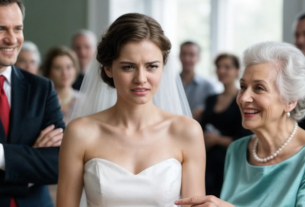
“Get out of my house! And don’t you ever set foot in here again, do you hear me?!” Zinaida Petrovna’s voice tore through the apartment so loudly that the neighbors behind the wall had surely heard every word. “Parasite! Found yourself a cozy little nest here, didn’t you?”
Vera stood in the hallway with a bag in her hand, looking at her mother-in-law the way someone looks at something unpleasant but long expected. Calmly. Almost distantly. Five years in that apartment had taught her many things—above all, that arguing with Zinaida Petrovna was pointless. It was like shouting into a ventilation shaft: the sound disappeared, and nothing ever came back.
“I hear you,” Vera said quietly.
“Oh, she hears me!” Zinaida threw up her hands. “Five years living off everything ready-made! Five years my son fed you, paid for you! And what are you? What are you even worth?”
It was a rhetorical question. Zinaida never waited for answers—she never had. She was the kind of woman who delivered monologues, not conversations, and believed the volume of her voice was proof she was right.
Vera slipped on her coat. Buttoned it carefully—all five buttons, one by one, from the bottom up. Lifted her bag.
“Get out and don’t come back!” Zinaida shouted after her.
The door closed.
The stairwell smelled of cat food and someone’s cooking. Vera stood there for a second, her back against the wall. So that was it. Five years, and that was it.
She didn’t cry. The tears had dried up about a year ago—around the same time Maxim had once again chosen his mother over his wife, shrugged, and delivered his trademark line: “You know what kind of person she is.” Vera did know. She understood many things. That was exactly why she had left.
Outside, she took out her phone and sent a single message to Leonid Sergeyevich, her supervisor from the holding company’s head office. Three words: “I’m ready. Tomorrow.”
The reply came a minute later: “We’ll be waiting at ten.”
The Uralmashstroy plant stood on the northern edge of the city—gray, Soviet-built, with chimneys that smoked year-round. Vera knew that place well. Too well. Her ex-husband Maxim worked there as a mid-level manager, a man with a decent salary and absolutely no desire to change anything in his life. Three years earlier, Vera herself had joined the plant—first as an economist, then as head of the planning and economics department.
Zinaida, naturally, had never considered it serious work. “She just shuffles papers around,” she would say to her neighbor Tamara Borisovna, and Tamara would nod in full agreement.
But Vera’s papers were not ordinary papers. For three years she had been building analytics, writing reports, and sending them upstairs—to the holding company that owned the plant. They had noticed her there. They had valued her work. And now they were calling her in.
That night she spent in a tiny rented studio on Yuzhnaya Street, which she had secretly leased a month earlier, just in case. That “just in case” had arrived sooner than she expected.
The apartment was tiny: a bed, a table, a window overlooking the yard. On the shelf were several books on management accounting and one battered copy of Anna Karenina, which Vera had been trying to finish for nearly three years. She made tea, sat on the bed, and stared at the ceiling.
Was she scared? No. Did it feel strange? Yes. A little like stepping out of a long dark tunnel and squinting into the light, not yet sure what lay ahead.
In the morning she put on a gray business suit—the only one she had brought with her. She fixed her hair, touched up her lipstick, looked at herself in the slightly cloudy bathroom mirror, and gave her reflection a small nod. It was time.
At the central office of Uralprom Holding, Leonid Sergeyevich met her himself—a short, lean man who spoke crisply and never wasted words. He led her into a conference room where two unfamiliar men in suits were already seated.
“Vera Andreyevna,” Leonid Sergeyevich said, “the holding company has decided to replace the leadership at Uralmashstroy. The current director, Gromov, is stepping down for health reasons. Your candidacy has been under consideration for the last six months.”
She said nothing. She listened.
“We would like to offer you the position of plant director.”
One of the men—a large man with a heavy, assessing gaze—leaned forward.
“You do understand how serious this is? The situation there is far from simple. Debt, old alliances, staffing confusion.”
“I understand,” Vera said. “That’s exactly why I spent three years gathering every figure on that plant.”
The man narrowed his eyes slightly. Something about him unsettled her at once—an overcareful politeness that seemed to conceal a very different kind of interest. She remembered his face.
The papers were signed by noon. Her official start date would be a week later.
Maxim found out the same day. Someone from the office called him—rumors traveled fast in a small plant. He messaged Vera: “Is it true?”
She replied: “Yes.”
A long pause followed. Then: “Mom is going to be shocked.”
Vera smiled to herself and set the phone aside. His mother was already in shock—she just didn’t know it yet.
She left the office and walked to the embankment—the same one where she and Maxim had strolled during their first year together, back when everything had seemed possible and Zinaida Petrovna had not yet shown her true face. The river was gray and still. Somewhere beyond the bridge, a tram groaned.
Vera wasn’t thinking about Maxim or her mother-in-law. She was thinking about the large man from the conference room—Vadim Olegovich, as he had been introduced. Something about his manner had been off. He had shown far too much interest in staffing issues. His questions about whom she planned to keep and whom she might remove had been far too precise.
A plant was not just numbers in a spreadsheet. It was people, money, connections. And someone clearly did not want the new director digging in too quickly.
In a week, she would walk through those gates not as an economist, but as the person in charge.
And something interesting would be waiting for her there. She could feel it as clearly as one senses the pressure change before a storm.
Monday morning began with Semyonych, the elderly guard at the gate who had known Vera for three years, staring at her in open amazement.
“Vera Andreyevna… so you’re now…”
“Yes, Semyonych. I am.”
He cleared his throat, adjusted the logbook, and opened the turnstile a little more ceremoniously than usual. It was both funny and touching.
At eight in the morning, the plant yard was already alive: a forklift dragged pallets of sheet metal across the concrete, three workers stood smoking near the second workshop, and somewhere deeper inside, machinery hummed in a steady rhythm. Vera crossed the yard, feeling eyes on her—surprised, appraising, openly skeptical in some cases. A woman. Thirty-two years old. Director.
She saw it all and kept walking.
The director’s office was large and official-looking—a heavy desk from the nineties, filing cabinets stuffed with folders, a portrait of the president on the wall. Gromov, the outgoing predecessor, had left behind three boxes of papers and a note that read: “Good luck. You’ll need it.” Vera read it, placed it in a desk drawer, and asked the secretary, Klavdiya Nikolaevna—a woman in her mid-fifties with the face of someone who had seen everything—to bring her the full list of the management staff.
Klavdiya Nikolaevna did so. And while Vera reviewed the papers, the secretary quietly studied her in return—the way experienced people study a new boss: carefully, patiently, without saying a word.
The first to come into her office was Boris Yevgenyevich Karpov, deputy director for production. He was a broad, heavyset man in his sixties, with a habit of keeping his hands in his pockets and speaking just a little slower than necessary, so the other person had time to feel how important he believed himself to be.
“Vera Andreyevna,” he said, sitting down without being invited, “I’m glad, of course. But you understand—a plant lives by its own rules. It needs someone with real production experience.”
“You have production experience, Boris Yevgenyevich,” Vera answered evenly. “That is exactly why you are staying in your position. For now.”
She said the last two words quietly. But he heard them. His shoulders shifted slightly, and he left politely, though his expression clearly said: we’ll see.
Maxim showed up at nine-thirty. He merely stuck his head into the office—as if by chance, though chance had long stopped existing at that plant.
They had not seen each other in a week. He looked the same as ever: neat, slightly lost, with that permanent dimple in his chin that Vera had once found so charming.
“Am I supposed to congratulate you?” he asked.
“If you want to.”
He was silent for a moment, then rubbed the back of his neck—a gesture Vera knew by heart.
“Mom called yesterday. She… well, she doesn’t know you’re here. I didn’t tell her.”
“She’ll find out,” Vera said. “It’s only a matter of time.”
Maxim nodded and left. Just like that. Five years—and he simply nodded and walked away. Vera watched him go and felt neither pain nor bitterness. Only something like relief. The kind you feel after carrying a heavy bag for too long and finally setting it down.
The real conversation happened after lunch.
Vadim Olegovich arrived without warning—in a black SUV, accompanied by a young man carrying a folder. He introduced himself as “the holding company’s representative for operational matters” and asked for half an hour.
Vera gave him twenty minutes and asked Klavdiya Nikolaevna to bring coffee.
Vadim sat down and glanced around with the ease of a man who had been there before and knew where everything was. That put her on alert.
“Vera Andreyevna,” he began, “it is important to us that the transition period goes as smoothly as possible. There are a number of contracts the plant has maintained for years. Reliable partners. Proven arrangements.”
“Send me the documents. I’ll review them.”
“Of course. I simply want you to understand that these are established relationships. It would be undesirable to change them.”
“That depends on the economics of the contract,” Vera replied. “If it benefits the plant, we’ll keep it. If it doesn’t, we’ll revise it.”
A pause.
Vadim looked at her with the same expression he had worn at that first meeting—as though she were a problem not yet solved, but already being worked on.
“You’re very straightforward,” he said, though it was impossible to tell whether it was praise or a warning.
“I try to be.”
He left. The young man with the folder scurried after him. Vera watched from the window as the SUV rolled through the gate and turned left.
Then she took out her notebook and wrote: “Karpov. Vadim Olegovich. Contracts. Check everything since 2022.”
Klavdiya Nikolaevna stepped into the office at the end of the day—supposedly to collect the coffee cups. But she lingered by the door.
“Vera Andreyevna, may I?”
“Go ahead.”
The secretary hesitated for a second—it was obvious she was weighing her words. Then she made up her mind.
“Karpov called someone after your meeting. I didn’t hear who. But he closed his office door, and he never closes it.”
Vera looked at her carefully. Klavdiya Nikolaevna held the gaze without fuss, calmly.
“Thank you,” Vera said.
The secretary nodded and left.
There it was. Her first ally had appeared on his own—sooner than Vera had expected. That was a good sign.
Outside, darkness was settling in. The plant was growing quiet; the shift was ending, workers were heading home. Vera sat behind Gromov’s desk—her desk now—and thought about the contracts Vadim Olegovich had tried so carefully to shield with phrases like “reliable partners.” They were almost certainly going to tell a very interesting story.
All she needed was the right person to help her unravel it. And she needed to move fast—before the people who stood to lose from her digging too deeply had time to prepare.
The right person appeared on the third day.
His name was Roman Viktorovich Yershov, a financial analyst Vera remembered from old meetings. Quiet, inconspicuous, always with a pencil tucked behind his ear and a habit of looking down at the desk whenever management spoke. Gromov had disliked him for it, considering it disrespectful. Vera, on the other hand, had noticed long ago that Yershov was not looking down out of timidity—he did it because he was thinking. Quickly, and without wasting words.
She called him into her office after the morning planning meeting.
Yershov entered, sat down, placed a folder on his knees—and once again fixed his eyes somewhere below. Then he looked up.
“This is about the contracts, isn’t it?”
Vera paused slightly.
“What makes you say that?”
“Because if it weren’t about the contracts, you would have called Karpov. But you called me.”
Without a word, she handed him the supplier list from the last four years. Yershov took the papers, scanned them—and an expression crossed his face that belonged to someone who had been waiting a long time for exactly this moment.
“I can do a full analysis in a week,” he said.
“You have three days,” Vera replied.
He nodded and left. No unnecessary questions. Vera watched him go, thinking that quiet people made the most dependable allies. In the best possible sense.
On the fifth day, Maxim called.
At that moment Vera was in the workshop, walking the production floor with the shift supervisor, watching, listening, memorizing. Her phone vibrated in the pocket of her coat. She declined the call. He called again a minute later.
She stepped into the corridor.
“What happened?”
“Mom knows,” Maxim said. His voice sounded like someone who had just lived through a minor natural disaster.
“Expected.”
“Ver, she… she’s feeling really bad. Blood pressure.”
Vera closed her eyes for a second. Zinaida Petrovna’s blood pressure always rose at the right moment—whenever she needed to stop something unwanted or redirect someone’s attention. It was a well-practiced instrument, and Maxim fell for it every time, sincerely, without the slightest irony.
“Maxim, I’m the plant director. Not a doctor. If she feels bad, call an ambulance.”
Silence.
“You’ve changed,” he said at last.
“No,” Vera replied. “I’ve just stopped pretending.”
She put the phone away and returned to the workshop.
Yershov brought the materials back in two and a half days—ahead of schedule. He spread the printouts across her desk, slid his laptop forward, and began speaking quietly, clearly, without preamble.
The picture was ugly, though not criminal. Dozens of supplier contracts had been signed without any proper tender process, simply on the basis of “who’s familiar.” Prices were above market, terms were disadvantageous, delivery deadlines were regularly missed. The plant had been overpaying for years simply because nobody wanted to change anything. Karpov covered it all with talk of “trusted partners,” while Gromov never bothered to dig deeper—he had enough other concerns.
The losses were considerable. Just over the last two years alone, the numbers were enough to make any competent economist feel physically ill.
“It’s not a crime,” Yershov said. “It’s just years of negligence.”
“Which needs to be dismantled,” Vera replied. “Contract by contract.”
“Karpov will fight it.”
“I know.” She closed the folder. “Prepare a summary report for the holding company. Officially. With numbers and optimization proposals. I’ll take it there myself.”
Yershov stood up and gathered the papers. At the door, he turned back.
“Vera Andreyevna, Karpov stopped by the workshop managers this morning. One by one. I don’t know what he told them, but afterward two of them declined the meeting you scheduled for Wednesday.”
Vera nodded. Of course. Karpov was rallying his people, building his defense. An old tactic—isolating the new leader, making it seem as though the whole staff was against them.
“Thank you, Roman Viktorovich. We’ll move the meetings to Friday. And invite all the workshop heads at once—for one general meeting.”
She went to the holding company the following morning. Leonid Sergeyevich received her immediately, read the report with care, and turned the pages slowly. Then he set the folder aside and looked out the window for a while at the gray city sky beyond the glass.
“Karpov has been at that plant a long time,” he said at last. “Connections, people, habits.”
“Which is exactly why the plant has been operating at a loss on operating expenses for three years,” Vera replied. “I’m not saying he’s a bad man. But the system he built isn’t helping the plant.”
Leonid Sergeyevich remained silent for another moment.
“What do you propose?”
“A phased review of all contracts. Open tenders. And a new deputy director for production—someone who works for results, not for preserving old arrangements.”
“Who?”
“Yershov. He’s a finance man, but he understands production economics better than many engineers do.”
A pause. Then a slight nod.
“Proceed. You’ll have our support.”
Zinaida Petrovna appeared on Friday.
Vera learned about it from Semyonych—the guard called her on the internal line to say that a woman was standing at the gate demanding to be let through to the director. Personal matter, she said.
Vera went out herself. She did not make her wait.
Her mother-in-law stood by the turnstile in a coat, lips pressed tightly together, wearing the same expression she usually wore when marching into battle. But when she saw Vera coming out of the administrative building in a tailored suit, the director’s badge pinned to her chest, something in that face shifted. Just slightly. Almost imperceptibly.
“Zinaida Petrovna,” Vera said evenly. “Good afternoon.”
“Is it true?” the older woman asked. “That you’re the director here?”
“It is.”
Zinaida said nothing. She stared at her for a long moment, with some new and unfamiliar expression on her face. Calculating something. Perhaps recalling her own words: Get out.
“Does Maxim know?” she asked at last.
“Maxim works in the planning department,” Vera said calmly. “So yes, he does.”
Zinaida opened her mouth, closed it, then opened it again.
“I only wanted to talk,” she said, more quietly than usual. Almost like a normal human being.
“We’ll talk,” Vera said, glancing at her watch. “On Monday. Make an appointment through my secretary.”
Then she turned and walked back into the building without looking back.
That evening she sat in her tiny studio on Yuzhnaya Street. On the table: her laptop, a cup of tea, a notebook full of notes for the coming month. Outside, the city rustled and murmured. Somewhere below, two young people were laughing—loudly, carefree.
Vera looked at her notebook and thought about how, just three weeks earlier, she had been standing in someone else’s hallway with a bag in her hand, listening to someone else’s shouting. And now she had an office, two reliable people at her side, difficult work ahead of her—and the feeling that at last she was standing exactly where she belonged.
Ahead of her were tenders, negotiations, Karpov’s resistance, and who knew what else. All of it would demand strength, time, and a cold head.
She closed the notebook, shut down the laptop, and for the first time in a long while went to bed before midnight.
Tomorrow, it would be the plant again.
And the work waiting for her had only just begun.