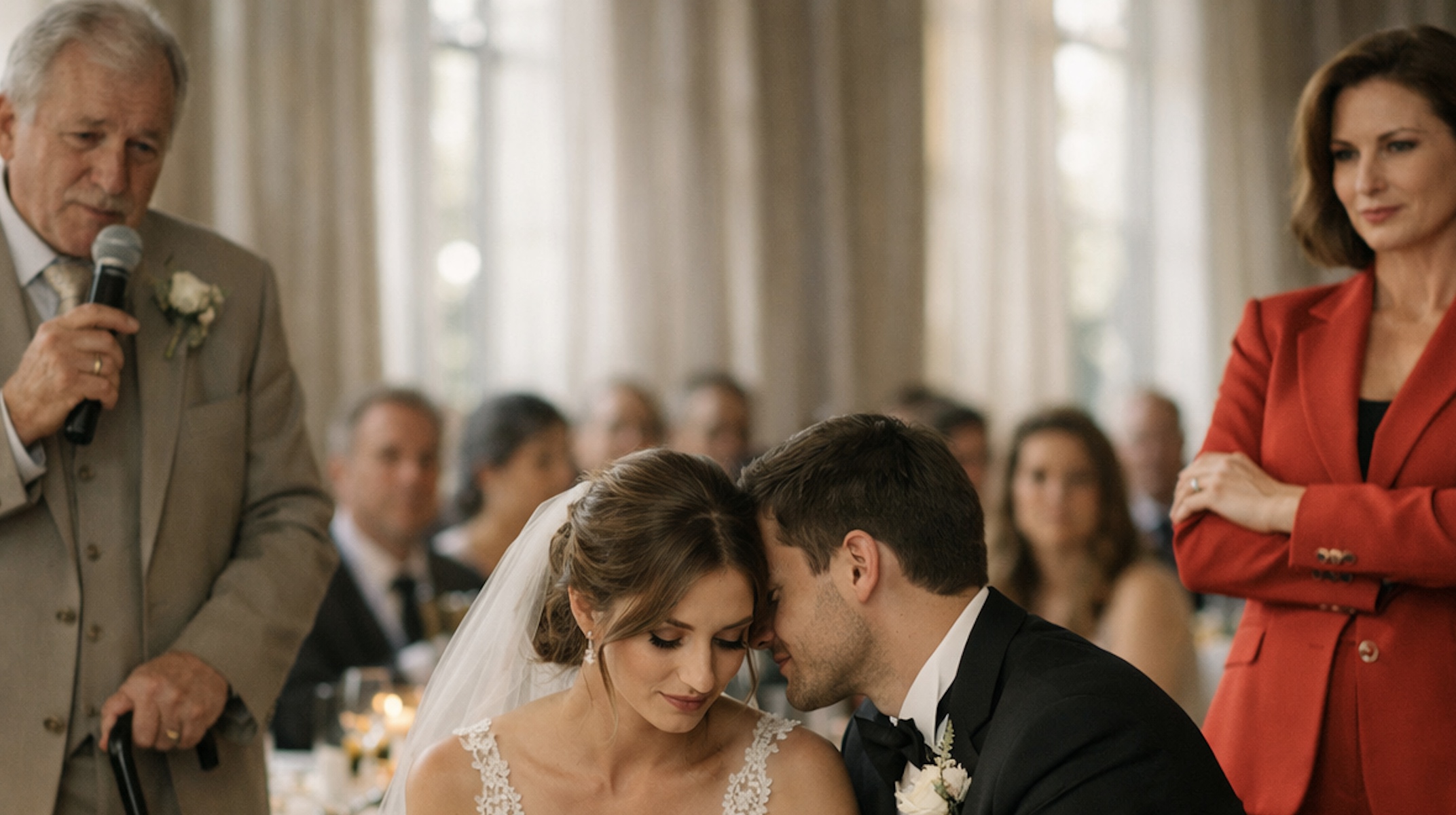
“Denis, my boy, come here,” Margarita Stepanovna said, snatching the microphone straight from the toastmaster’s hands. Olga sat frozen at the table, feeling the tips of her fingers go numb. All evening, her mother-in-law had been looking at her as if she were inspecting damaged goods.
“Denis, my boy, come here,” Margarita Stepanovna repeated, taking the microphone from the host without hesitation.
Olga sat at the table, her fingers tingling with tension. All evening long, her mother-in-law had watched her as though she were judging a flawed purchase. While greeting guests, she had whispered to her friends, “Well, what can you do? The boy fell for some girl from a dormitory.” When the salads were served, she pushed her plate aside and muttered, “I don’t know where this food was ordered from, but I’m not eating that.”
Each time, Denis squeezed Olga’s hand under the table. He said nothing. She understood—he was trying to preserve at least the illusion of a celebration.
“I want to give the newlyweds a present,” his mother announced, pulling a set of keys from her handbag, attached to a shiny designer keychain. “Denis, here. The car is waiting outside. Business class. The papers are made out in your name only.”
She placed the keys in front of her son, then turned dramatically toward the room.
“Only for my son. Because I’m not naïve—I know how young couples live these days. Today it’s love, tomorrow it’s divorce. And let this poor little peasant girl from her rented room remember one thing: the apartment is mine, the car is mine, and she will get absolutely nothing if things fall apart.”
Someone at the groom’s table let out a smug little snort. Olga’s relatives sat there, visibly humiliated.
“Mom, what are you doing?” Denis asked, turning pale.
“What did I say that wasn’t true?” Margarita shot back. “I’m telling the truth. Let her know her place.”
Olga clenched the napkin in her hand until it tore apart. She wanted to stand up and leave. But instead, her father rose.
Vasily Yegorovich stood slowly and made his way toward the stage. Margarita Stepanovna looked down at him with open contempt—she stood on high heels, while he wore simple worn shoes.
“Give me the microphone,” he said quietly.
“What for?” she asked, unwilling to let it go.
“Give it here.”
With a mocking smile, she finally handed it over.
Vasily Yegorovich stood for a moment, looking out across the silent hall. Then he turned to his daughter.
“I’ve spent my whole life working construction,” he began. “I build houses for other people. Twenty-five years ago, I started building one for myself. Out in the country. Brick by brick. Every spare minute I had.”
The room fell completely still.
“I put the roof on with my own hands. Installed the windows myself. I thought it would be for the whole family. But today I realized—it’s time to give it away.”
He reached into his pocket and pulled out an envelope.
“The papers are here. The house is in Olga’s name. Entirely hers. So no one will ever dare say again that my daughter has no roof over her head. Maybe I don’t have a three-million-ruble car. But I know this much—my daughter is honest, hardworking, and достойная. And if someone calls her a peasant, that says nothing about her and everything about the person speaking.”
He handed the microphone back and returned to his seat.
At first, only the bride’s relatives applauded. Then others joined in. Within seconds, the entire hall erupted in applause.
Margarita Stepanovna stood by her table, her face twisted with anger.
Denis looked at his mother. Then at the keys. Slowly, he stood, picked them up, and walked over to her.
“Mom, thank you for the gift. But I won’t accept it.”
He set the keys down in front of her.
“What are you doing?” she hissed. “Do you even understand how much that car costs?”
“I do. But I don’t want to drive a car that came with conditions attached. You didn’t give me a gift. You used it to humiliate my wife. In front of everyone.”
“I was doing it for you!”
“Protecting me from whom? From the woman I love? From her father, who spent twenty-five years building a house? All my life, you taught me that money was what mattered most. But it turns out what matters most is not humiliating other people. And Vasily Yegorovich taught me that in a single evening.”
Then he turned to the guests.
“Thank you to everyone who came. We’re leaving.”
He took Olga’s hand. Her father passed her a handkerchief. Together they walked out of the hall. Outside stood that very car, decorated with a giant red bow. Denis did not even glance at it. Instead, they got into Vasily Yegorovich’s old car, and he drove them to the house.
The house welcomed them with silence. Its windows looked out over a garden. A light was on in the kitchen—Olga’s mother had come by that morning and left a note: Fresh sheets are on the bed. There’s food in the fridge.
Olga walked through the rooms, trailing her hand along the walls. Her father had laid those walls himself. Every weekend for twenty-five years, he had come here. And never once had he told her he was building a home.
“I thought he was just going out to the cottage,” she said to Denis. “But he was saving all this for me.”
She sat down right on the floor in her wedding dress and began to cry. Denis sat beside her and wrapped his arms around her. They stayed like that for a long time.
Two days later, Margarita Stepanovna started calling. Denis did not answer. On the third day, she came in person.
Vasily Yegorovich opened the door. He was helping his son-in-law put up a new fence.
“I need to speak with my son,” she said stiffly.
Denis came out onto the porch wearing work jeans.
“Have you completely lost your mind?” Margarita said without so much as greeting him. “All my acquaintances are talking about how my own son threw a three-million-ruble gift back in my face!”
“Mom, if you came here for an apology, you’re in the wrong place.”
“I came to talk sense into you! You married a girl who has nothing!”
“No, Mom. You’re the one who’s spent your whole life using me. As proof that you were successful. Like a doll you could show off to your friends.”
“How dare you!”
“And how dare you call my wife a poor peasant girl in front of everyone?”
Margarita fell silent. Then she spun around sharply and headed for the gate.
“You’ll regret this! When the money runs out, you’ll come crawling back to me!”
“We won’t crawl anywhere. Because now we know what truly matters. You still don’t.”
She slammed the gate behind her and drove away.
Four months passed. Margarita Stepanovna did not call. Denis left his mother’s company and took a new job. The salary was lower, but for the first time in years, he no longer dreaded waking up and going to work.
On a Saturday morning, someone knocked at the gate. Margarita Stepanovna stood there without heels, wearing a simple sweater and holding a shopping bag.
“What do you want, Mom?”
“I wanted to ask for forgiveness. I baked a pie. May I come in?”
“No.”
“Denis, please… I’ve lost you, and it…”
“You didn’t lose me. You lost control. That’s what’s bothering you.”
Margarita lowered her head.
“No. I really did understand. After you left that wedding, everyone turned away from me. Tamara Lvovna said, ‘You went too far.’ Viktor Semyonovich stopped answering my calls. And now I sit alone in my apartment every evening, with no one left to call.”
At that moment, Olga appeared in the doorway.
“Olga,” Margarita said, taking a step toward her. “Please. Forgive me. I was a fool.”
Olga said nothing.
“You didn’t just say horrible things,” Olga replied at last. “You showed me exactly what you truly thought of me. That I was nobody. That I was unworthy of your son.”
“I was wrong!”
“You weren’t wrong only when you grabbed that microphone. You were wrong your whole life, believing money made you better than everyone else.”
Margarita stood there clutching the bag, and suddenly she looked small and old.
“You’re right. But could you at least let me try to make it right? Give me a chance.”
Olga looked at Denis. He gave a small shrug—as if to say, It’s your decision.
“All right,” Olga said. “You can come by. But this is my home. Here, you are a guest. No lectures, no judgmental looks. If you can manage that, then come.”
Margarita nodded quickly, almost like a schoolgirl.
“I can. Truly.”
She began coming every Saturday. At first, she sat quietly in the kitchen, afraid to say too much. Later she started helping—washing dishes, sorting berries. One day, Olga asked her to hand over a hammer while they were repairing the gate, and Margarita stood beside her holding the tools like an assistant.
By the end of summer, the three of them were sitting together on the porch. Denis was shaving down boards. Olga was peeling apples.
“All my life I believed that if I had enough money, I’d be happy,” Margarita said suddenly. “I worked like a beast. Bought apartments, cars. But it turns out happiness is this—just sitting on a porch like this.”
Olga said nothing. Denis stayed silent too.
“I know you don’t believe me,” Margarita went on. “But I sold that car. I gave the money to an orphanage. Not for show. I just couldn’t bear the sight of it anymore.”
“Mom,” Denis asked, “why did you put on that whole performance in the first place?”
Margarita was quiet for a long time.
“I was afraid of losing you. I thought if you depended on me, you would never leave. But I got the opposite.”
Olga looked at her. For the first time in months, there was no tension in her eyes.
“My father spent his whole life doing hard labor on construction sites,” she said. “His hands are covered in calluses. His back hurts. But he never complained. And while he was building this house, he never told me a word about it. He just kept doing it. Because he loved me.”
Her mother-in-law wiped at her eyes with her sleeve.
“I don’t know how to love like that,” she whispered. “I learned how to take, not how to give.”
“Then learn,” Olga said, holding out a bowl of apples to her. “Peel these. I’m tired.”
Margarita took the bowl. Her hands trembled, but she peeled them anyway. Slowly. Awkwardly.
That evening, after Margarita left, Olga sat down beside Denis. The sun was setting behind the trees.
“Do you regret turning down that car?” she asked.
“Not for a second.”
“You know, at the time I thought it was the end. I thought I would become a laughingstock. But people remembered something else. They remembered my father standing up. They remembered you refusing the car. They remembered us leaving without looking back.”
Denis wrapped an arm around her.
“My father never once told me he loved me,” Olga continued. “Not once. He just worked in silence. And I used to think he was cold. But he simply didn’t know how to speak. He knew how to do. When he stood there with that microphone, that was the first time I truly heard what I meant to him. I could have gone through life never knowing. If not for your mother.”
“So… are you grateful to her?” Denis asked with a faint smile.
“No. But she taught us something, against her own will. She wanted to humiliate us—and lifted us instead. She wanted to bind you to her—and ended up setting you free.”
They sat in silence until darkness fell. Then Olga rose and walked toward the house. At the doorway, she turned back.
“Do you know what I’m afraid of? That one day we’ll forget this porch. Forget how happy we were here just because we were together.”
Denis came up to her and took her hands.
“We won’t forget. We have this house. It will always remind us. Your father poured his life into it. We have no right to forget that.”
They went inside. Night was settling outside, but indoors it was warm and bright. The air smelled of apples and fresh wood. And suddenly Denis understood: real happiness is having a place to return to. And having people waiting for you not because you are wealthy, but simply because you are you.
He looked at his wife, at the house Vasily Yegorovich had built, and realized: they were richer than anyone.
A year later, they had a daughter. Vasily Yegorovich brought a wooden cradle to the hospital, one he had made with his own hands.
“It’ll be good for great-grandchildren someday too,” he said. “It’s sturdy. It’ll last a hundred years.”
Margarita Stepanovna arrived soon after. She sat down beside Olga and looked at her granddaughter for a long time.
“Thank you for giving me a chance,” she said softly. “I’ll try to be a good grandmother.”
Olga did not answer. She simply placed the baby into her arms. Margarita took the little girl, and tears began to roll down her face.
When everyone else had gone, Denis sat beside Olga and looked at their daughter sleeping in the cradle.
“Will we tell her this story when she grows up?” he asked.
“Of course,” Olga said. “She should know that dignity is worth more than any car.”
Olga took his hand.
“I’m glad you made the right choice.”
Outside the hospital windows, the city lights glowed in the dark. Somewhere out there was his mother’s apartment, where she was learning, at last, how to become human. Somewhere out there was the construction site where, tomorrow, Vasily Yegorovich would go back to laying bricks for other people. Somewhere out there stood their house, waiting for them to come home.
And in that moment Denis understood the most important thing of all: wealth is not what sits in a bank account. Wealth is waking up in the morning and knowing who you live for. It is being loved not for your money. It is having people beside you who chose you, not your wallet.
He looked at his sleeping daughter, at his wife, at the cradle made by his father-in-law.
They were richer than anyone in the world.