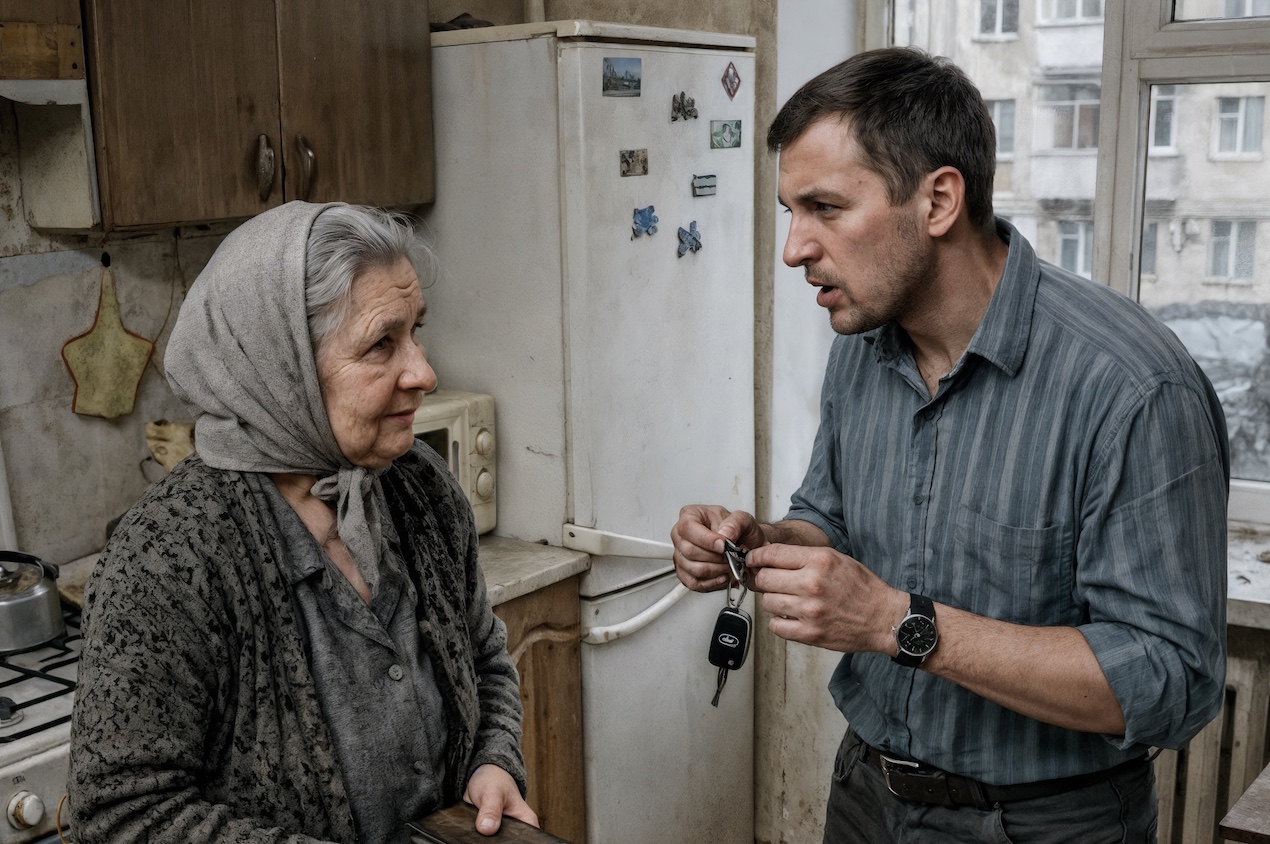
The Kyiv evening dragged in damp and heavy, laced with the smell of exhaust fumes. Galina Petrovna stood by the window of her old Khrushchyovka apartment in Nyvky, clutching an official envelope in both hands. The sheet inside, stamped with the logo of the large logistics company she had given twenty years of her life to, felt impossibly heavy. Redundancy. Staff optimization. Three months’ salary as severance — and that was it. The door had closed behind her for good.
“Mom, give me the money! It’s already the tenth! The bank’s been flooding me with messages! We’ve got a mortgage!” Artyom’s voice shot in from the living room, sharp and impatient.
Galina walked slowly into the kitchen. Artyom was spinning the keys to his new crossover around one finger — the very same car she had been faithfully making loan payments on every month.
“Artyom, sit down. We need to talk,” she said, her voice trembling like a taut string.
“Just skip the lectures, okay?” He didn’t even look up. “Make it quick. I’ve got training in an hour. And my gym membership is running out too, by the way.”
The lock clicked. Khrystyna came in, wrapped in the scent of expensive perfume. She was wearing a brand-new puffer coat. Galina remembered exactly how much it had cost, because she had handed over the money herself.
“Galina Petrovna, you didn’t forget about the fridge, did you?” her daughter-in-law began without so much as a greeting. “I already picked one out. Forty thousand. Ours is completely dead, everything leaked, the food went bad.”
Galina sank onto a stool. The white envelope landed on the table like a border between the life she had known and the one waiting beyond it.
“I lost my job. Starting from the first, I’m unemployed.”
A dead silence fell over the kitchen. A car horn sounded faintly outside. Artyom recovered first.
“You’re serious?” He grabbed his head, and the keys clattered to the floor. “Mom, do you even understand what this means? We have a mortgage! Our child goes to private daycare — that’s ten thousand a month! Did you do this on purpose?”
“On purpose?” Galina shot to her feet, the stool scraping beneath her. “They laid me off! I worked there for twenty years! They cut staff!”
“Then you should’ve found a way to stay,” Khrystyna said coldly, never lifting her eyes from her phone. “Other people kept their jobs. That means you must’ve done something wrong.”
Something inside Galina tightened. Not from hurt — from the sheer absurdity of it.
“I’m fifty-four. They hired young people for twenty thousand. I was making fifty. It’s simple math.”
“Wonderful,” Khrystyna said, throwing up her hands. “So how are we supposed to live now? We’ll have to start cutting back. And first of all, you need to. No cafés. No social outings.”
“What cafés?” Galina gasped. “I haven’t gone anywhere in three years! The last time was at your birthday party! And I paid for everyone!”
“Here we go again,” Artyom muttered, pulling out his phone. “I’m calling Dad. He needs to know what you’ve done.”
“Your father?” Galina let out a strained laugh. “He’s been in Poland for five years with his new family! He didn’t pay child support when you were a kid! And now you think he’ll suddenly care? I carried everything alone!”
The front door opened again. Marina stepped in with two backpacks and her teenage children.
“Hi, Mom! We’re going to stay here for a couple of weeks, okay?” she said, already walking inside. “A pipe burst at our place. The apartment got flooded. The repairs will take at least a month.”
Artyom and Khrystyna exchanged a glance. There was annoyance in it… and relief too.
“Marina, maybe not right now…” Artyom started.
“Then when?” Marina brushed him off. “Mom, you don’t mind, do you? You’ve got plenty of room.” She had already begun moving around the kitchen like she owned it.
“I have no job,” Galina repeated quietly.
“You’ll find something,” Marina said with a shrug. “At your age, health is what matters. Work… well, you could always get a job as a cashier.”
“Exactly!” Khrystyna brightened. “That’s actually a great idea. Twenty thousand or so.”
“Twenty thousand…” Galina repeated slowly. “That wouldn’t even cover your car payment, Artyom.”
“So what are we supposed to do?” he snapped. “We’ve got a mortgage! A child! You’re our mother, aren’t you? You have to help!”
Galina sat back down. Her fingers smoothed the envelope automatically.
“They gave me severance. Three salaries. One hundred fifty thousand.”
The silence changed. It was no longer stunned. It was hungry.
“Well, Mom,” Artyom said at once, his tone softening as he sat beside her, “that means everything’s fine. Kristina and I can take thirty-eight for the fridge, fifteen for the bank—”
“And we need money for repairs,” Marina cut in. “At least forty thousand.”
“And my mother needs medicine,” Khrystyna added. “Five thousand.”
Galina looked at her own hands. When had all of this started? When was the first time she had said, I’ll manage?
“I don’t have that money,” she said quietly.
“What do you mean, you don’t have it?” Artyom jerked his hand back. “You just said you did!”
Galina raised her eyes to him.
“I have debts. Three microloans. One hundred thirty thousand. More with the interest.”
Marina froze.
“Mom… you took out loans? Why?”
“For you,” Galina answered calmly. “For your renovation. For Artyom’s car. For Khrystyna’s holiday. For Grandma’s surgery.”
“We never asked you to do that!” Khrystyna shot back.
“Yes, you did,” Galina said. “Every day. For twenty years.”
Marina stayed anyway. Her children took the living room. She and her husband moved into the bedroom. Galina ended up on an old folding armchair in the kitchen.
At night she couldn’t sleep. She counted. Remembered. Twenty years — work, children, loans, helping, sacrificing. And this was the result: she was lying on a kitchen chair while, beyond the wall, her son-in-law snored without ever wondering whether she had enough money to buy bread.
The next morning her friend Svetlana came by. She took one look around and understood everything.
“Galya, come on,” she said firmly.
Outside in the yard, she lit a cigarette and asked bluntly, “How much longer are you going to live like this? What are you, an ATM? You’re fifty-four, and you look seventy.”
“They’re my children…”
“Children?” Svetlana cut her off sharply. “Children are the ones who ask how you’re feeling. Not the ones who demand money. They’re over thirty! They aren’t children — they’re parasites.”
Galina said nothing.
“Have you ever once heard the word thank you?”
There was no answer.
Her phone rang. Artyom.
“Mom, where are you? We need money urgently! It’s the last day!”
“I don’t have any money.”
“Then take out a loan! Just for a month!”
Galina looked at Svetlana… and for the first time, she really thought about it.
“I’ll think about it,” she said softly.
Soon after, she found work as a sales assistant in a household goods store. Eighteen thousand. Long hours. Hard work.
“Good for you, Mom,” Marina said. “At least now you can buy groceries.”
“Eighteen?” Marina’s husband sneered. “That’s basically nothing.”
Galina worked herself to exhaustion. She came home late, drained. No one was waiting for her there — only fresh demands.
When her first paycheck came in, she sat down to figure out how to divide it… and then the phone rang again.
“Mom, send money.”
“I barely have enough for myself…”
“We have a mortgage! You’re our mother, aren’t you?”
Khrystyna’s voice cut in from somewhere nearby:
“If you just give us ten every month, eight will be enough for you. You live alone.”
And at that moment, something finally broke inside her for good.
“All right,” Galina said evenly. “I’ll transfer it tomorrow.”
She ended the call… and texted Svetlana:
“Sveta, I need a realtor. I want to sell the apartment.”
The next day she was already meeting with an agent.
“We’ll sell it fast,” he assured her.
That evening she came home and said quietly:
“Marina, it’s time for you to find somewhere else to live.”
“What do you mean?”
“I’m selling the apartment.”
“Have you lost your mind? This is our home!”
“No,” Galina said. “It’s mine.”
Her son-in-law rushed out of the room.
“And where are we supposed to go?”
“To your own apartment. The repairs there are finished. I checked.”
Marina went pale.
The phone rang again. Artyom.
“What do you think you’re doing? What about the mortgage?”
“There won’t be any money. I’m paying off my debts and leaving.”
“Leaving where?”
“To Poltava. To my sister.”
“You’re abandoning us?”
Galina looked at the screen calmly.
“I raised you. My duty is done.”
She hung up.
Marina burst into tears.
“Mommy, we love you…”
“Love me?” Galina asked. “When was the last time any of you asked how I was?”
No one answered.
The apartment sold in ten days. Galina paid off her debts, gave each of her children twenty thousand “to get by for a while,” and blocked their numbers.
She sat on the Kyiv–Poltava train, looking out at the snow-covered fields. Her mother slept beside her. In her bag lay a new coat — and a ticket to a different life.
Artyom texted her from someone else’s number: “You’ll regret this.”
Marina sent her a long voice message. Galina didn’t even listen to it all the way through.
For the first time in twenty years, she took a deep breath.
She was no longer a wallet.
She was a human being again.
What do you think — did she do the right thing? Was it selfishness, or the only way to save herself? And should parents keep helping their adult children if it costs them their own life?