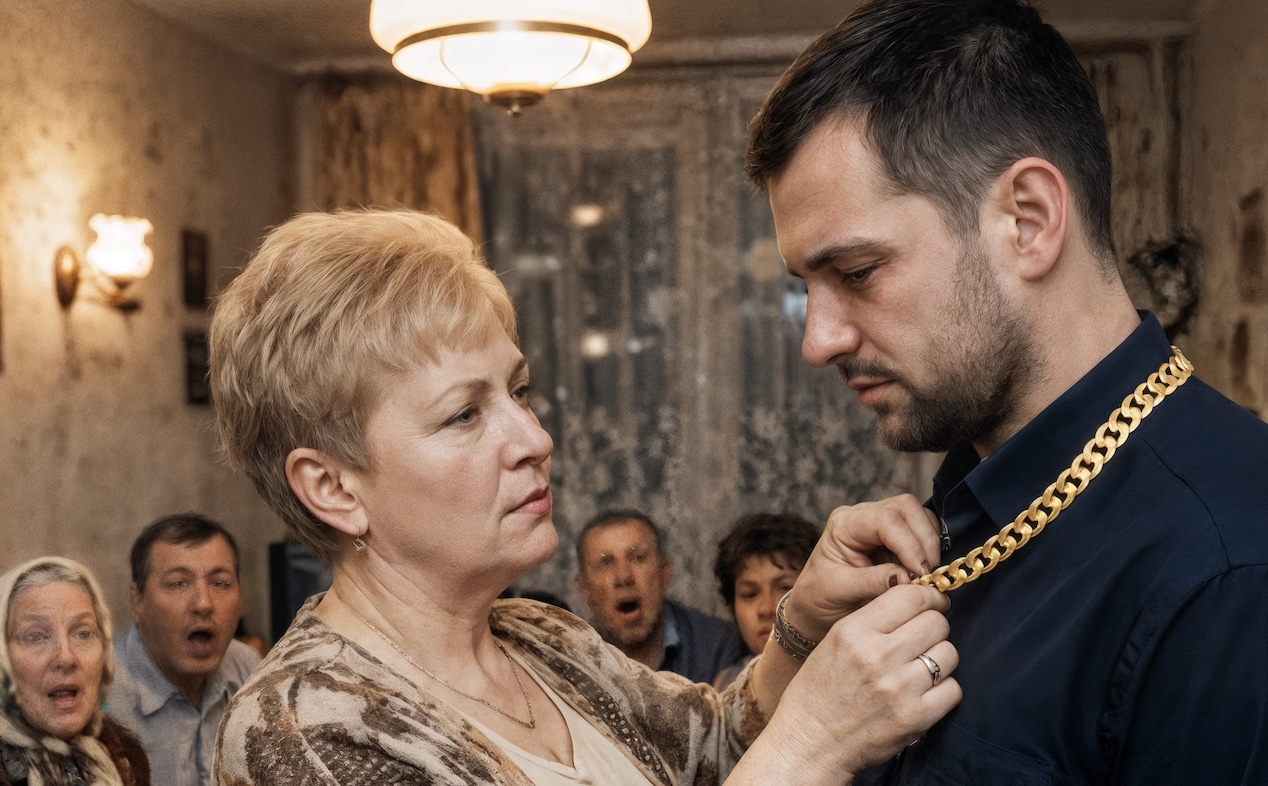
“Son, this apartment doesn’t belong to you, so we decided to give you a present you can simply sling over your shoulder and walk away with if things ever go wrong,” my daughter’s mother-in-law said with a frosty smile as she clasped a heavy gold chain around my son-in-law’s neck.
“And a robot vacuum is useful too. Let it collect the dust while you’re, so to speak, only temporarily settled here,” her husband added, casting a mocking glance at the large box Stepan and I had just placed beside the sofa.
I felt everything inside me start to boil, and even Stepan froze at such shamelessness. Ten years. Dmitry had been living in the apartment we had furnished with our own hands for ten full years, and to them it was still somehow “temporary.”
“What exactly are you implying, Maria Ivanovna?” I asked, struggling to keep my composure.
“Nothing at all, Lyubochka. I’m simply calling things what they are,” she said with a dismissive wave, as though brushing away an annoying fly. “You understand perfectly well who the real owner is here, and who just came into a ready-made life.”
I looked at our Tanya, but she was standing there staring at the floor. My son-in-law, on the other hand, had straightened up and was stroking that chain with such affection, as if it meant more to him than all the comfort we had spent years creating in that home.
A week passed after the anniversary celebration, yet that scene would not leave my mind. Stepan and I were not outsiders. We had always wanted only the best for our children. When Tanya married Dmitry, we did not doubt him for a minute.
Stepan had inherited a two-bedroom apartment from his parents in a good neighborhood near the park. The rooms were separate and bright, and the windows faced west. We renovated it properly, making sure it would last for years.
Stepan personally checked every tile in the bathroom, every electrical outlet, making sure everything was done perfectly. We moved the best furniture in and told the children, live here, just keep the place in good order. We registered Tanya there immediately, and later the grandchildren as well.
But we never rushed to register Dmitry. Not because we distrusted him, but because life is unpredictable. We decided it was safer to keep everything in Stepan’s name.
Who could have guessed that this would become the cause of constant complaints? In all these years he had not done even the simplest repair.
Recently Tanya came to us in tears, her eyes red and her hands trembling. She sat down in the kitchen, turning a mug of tea in her hands.
“Mom, Dad, please do something. I can’t live like this anymore,” she sobbed. “Dmitry says he’ll leave if you don’t register him there.”
“My dear, what is that even supposed to mean?” Stepan said, taking off his glasses in disbelief. “What else does he want?”
“He wants guarantees, Dad. His relatives keep filling his head with ideas. And the bathroom tiles have started falling off. Three of them, right above the faucet. And the wallpaper in the children’s room… you’ve seen what the kids did to it.”
“Then let Dmitry take some glue and fix it,” I burst out. “It’s half an hour of work. Is a grown man really incapable of doing something that simple?”
“He won’t do it, Mom!” Tanya exclaimed. “He says the apartment belongs to Dad, so Dad should be the one dealing with repairs.”
I just sank into my chair. So living there and enjoying everything the apartment offered was perfectly fine, but the moment something needed fixing, it was suddenly “not his responsibility.”
Stepan and I have two children. Our older son, Roman, is completely different. He and his wife Oksana earned their own house.
Of course, Stepan helped them with advice and sometimes with practical support. But Roman always said, “Dad, just point me in the right direction, and I’ll handle the rest.” But here…
Tanya had always been gentle and sensitive. She met Dmitry back in university. On the surface he seemed decent enough: he didn’t drink, he didn’t fool around. But his stubborn pride was like a splinter that never stopped hurting.
Yesterday she came again, this time with the younger child.
“Dad, please at least come and glue the tiles back on. It’s scary to shower now. Dmitry said that since it’s your apartment, you should be the one fixing it.”
“Listen, Tatyana,” Stepan said, rising to his feet. “Your husband is a grown man. Does he really not understand that it was his own children who drew all over the wallpaper?”
“He says it’s a matter of principle,” Tanya replied, covering her face with her hands. “If you don’t register him, he’ll find another place to live. And he’ll take me and the children with him… or maybe he won’t.”
She said those last words almost in a whisper, and silence filled the house. By then it was no longer just stubbornness. It was outright blackmail.
I could not help remembering that gold chain around his neck, heavy and gleaming. It seemed to have become some kind of symbol for him… maybe even an anchor.
Stepan is a soft-hearted man, quick to forgive. I could see he was already starting to waver. He loves his grandchildren more than anything in the world.
“Maybe we really should register him,” he said quietly that evening. “Would it hurt us so much to give in on a formality?”
“And are you sure that after that he’ll suddenly start taking care of the repairs?” I answered. “Or will he decide that now he’s the one in charge?”
We were never against our son-in-law. When the wedding happened, we paid for everything ourselves. And now his parents had money for gold, while he somehow had no desire and no sense of responsibility.
Tanya says we are the ones to blame. That our lack of trust is ruining their family. But where is the line between trust and common sense?
At work Dmitry is a serious, respected man. At home he behaves like a spoiled child—gets offended and waits for his father-in-law to come fix everything.
Yesterday Stepan finally gave in. He took his bag of tools and went over there. He came back late.
“Did you fix it?” I asked.
“I glued the tiles back,” he said with a heavy sigh. “And Dmitry sat in the other room watching television. The only thing he said was, ‘Oh, finally, the owner came to put things in order.’”
I actually shuddered. “The owner came”… that was how he referred to his father-in-law, a man who should be resting by now instead of doing repairs for a grown son-in-law.
And this morning Tanya called again.
“Mom, Dad did a great job, but we still haven’t bought the wallpaper. Dmitry said spending money on wallpaper means investing in real estate, and since the apartment isn’t his, Dad should pay for that too.”
That was the limit. This was no longer mere stubbornness. It was a complete lack of conscience. The robot vacuum was acceptable to him, but wallpaper somehow was not.
Stepan says nothing. I can see he is already prepared to go buy the wallpaper too. But I told him:
“No, Stepan. If we give in now, we will turn Dmitry into a dependent for good. He will never become the true head of a home that way.”
And now I sit here wondering: what matters more—protecting the apartment or protecting our daughter’s family?
On one side are the grandchildren, who need decent living conditions. On the other is a son-in-law who uses our kindness as leverage.
And his mother? Next time she’ll probably bring him a gold ring as well.
What is the right thing to do? Swallow our pride and register him? Or stand firm and hope that at least a drop of responsibility awakens in him?
And what if he really does leave? What if he takes Tanya and the children to a rented apartment? Would she be happy there?
I look at my hands. Stepan and I worked our whole lives, built, saved, denied ourselves. We know the value of every penny. And it hurts us to see such an attitude toward a home.
Because a home is not just an address in a passport. A home is the place where you are willing to glue back the wallpaper your own children have scribbled on.
Stepan says we should be wiser. But I keep wondering whether our wisdom is slowly turning into weakness.
Maybe it is time to speak to my son-in-law plainly, as one adult to another. To sit down and ask him directly, “Dmitry, are you part of this family, or are you simply a guest?”
But Stepan is afraid. Afraid of ruining the relationship for good. Afraid Dmitry will explode and destroy everything.
So this is how we live. The tiles in the bathroom are holding only because Tanya’s father glued them back, and the walls in the children’s room are still covered in the grandchildren’s drawings.
What would you do in a situation like this, to protect the children without losing your own dignity?
Is it worth sharing property with a man who will not even buy wallpaper with his own money? Or is this only the beginning, and one day they will ask us to leave this apartment ourselves?