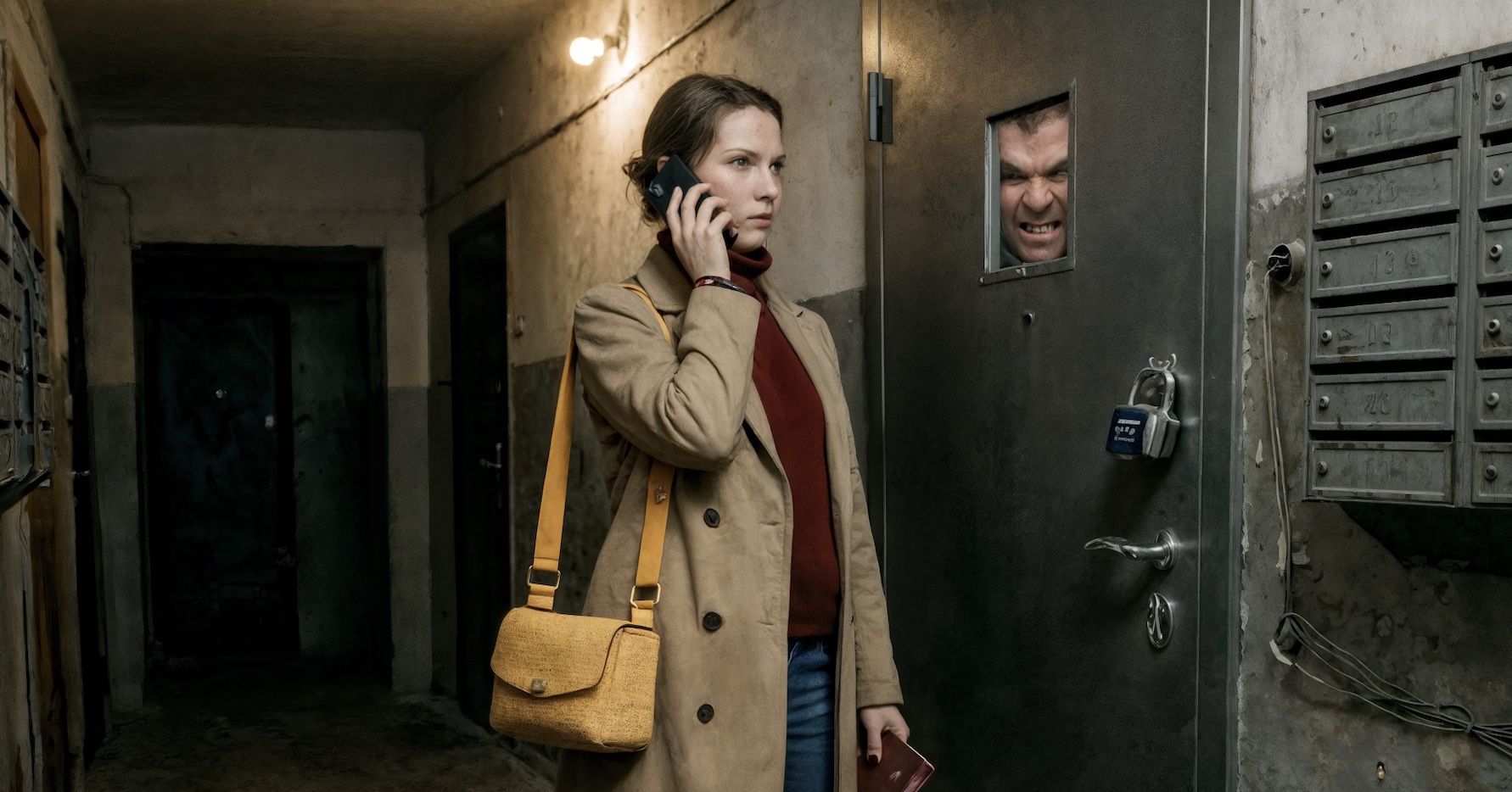
“Get out, Glasha. Go crawling back to your mommy, your girlfriends, nowhere at all!” Denis shoved the last bag onto the stairwell landing. “I changed the locks yesterday while you were wasting away at that factory. And you’re not taking the kids anywhere until you get yourself treated. Off you go, you ‘sick’ woman.”
The door shut behind him. Not with a bang. Quietly, almost routinely. Denis had always known how to close a door with care, even when anger was blotching his neck red. I stood there in a stairwell in Minusinsk, where someone had thoughtfully left a jar of cigarette butts on the windowsill between the second and third floors. At my feet was a blue sack with Tyomka’s pink sneaker sticking out of it, along with my old hair dryer.
Of course. I had been a fool. For five years I had believed that if I stayed quiet enough, invisible enough, my “diagnosis” would somehow go away on its own. I’m a kvass production technologist. I understand fermentation, I know exactly how sugar becomes alcohol and carbon dioxide. But I had no idea how my own mind had turned my life into sour mash, flat and lifeless, with not a single living bubble left in it.
“Mom!” Tyomka pressed his forehead against the peephole from the other side. “Mom, are you there?”
“I’m here, sweetheart,” I said, stepping closer to the door. My hands were trembling in that fine, constant way they had for the last six months. “Daddy’s just joking. Go play with Alinka and your building blocks.”
I crouched down right there on the cold concrete floor. In my hands was a real string shopping bag, the cotton kind I’d bought at a fair last year. Inside were the keys to the lab, two apples, and my passport, which I had started carrying with me for no clear reason, as if I had somehow sensed this ceremonial expulsion was coming.
Depression is not when you cry. It’s when you feel nothing, even while your husband is putting your things outside the door. Denis called it my “spoiled weakness.” My mother-in-law, Rezeda Mukhametovna, echoed him: “In our day women gave birth out in the fields, and you, Glafira, are suffering from too much idleness.”
I looked at my hands. Dry, lined, roughened by endless work with chemical reagents. For five years I had feared this moment. Feared being left alone, feared not coping, feared the children seeing me fall apart. And now it had happened. My belongings were on the floor, the lock had been changed, and inside the apartment was the silence I had spent so long trying to fill with my presence.
Should I have started pounding on the door now? Screaming? Calling the police?
Instead, I took an apple out of the bag. Firm, local, smelling faintly of cellar air and an autumn orchard. I bit into it. Juice splashed onto my coat.
“How stupid,” I said out loud. “God, how unbelievably stupid.”
I remembered the first time, three years earlier, when Denis said I was “not right in the head.” I had dropped a pot of soup and just stood there watching greasy streaks spread across the linoleum. I couldn’t move. It felt as though if I took one single step, I would fall straight into hell. Denis didn’t help me. He simply stepped over the spill and went off to watch television.
“You’re just lazy,” he used to say. And I believed him.
I got up. The bags could stay there. Who needed them? Old jeans, a couple of sweaters, textbooks on microbiology. I picked up my string bag and slung it over my shoulder.
I walked down to the first floor. The stairwell smelled of wet dog and bleach. An ordinary March day. Minusinsk was waiting for spring; the snow had turned gray and porous, like bread with a ruined crumb.
Outside, the air was cold and sharp. I drew it in deeply, until it hurt in my lungs. And then, suddenly, I realized something: I wasn’t dead. Five years of fear, and this was the result. I was standing outside, without keys, with an apple in my bag. And I was not afraid.
It was a strange feeling. As if I had been carrying a heavy sack of grain on my shoulders for years, and it had finally split open. The grain spilled out, and I straightened up. My back hurt, my knees felt weak, but the weight was gone.
I reached the nearest bench by the playground. The playground was empty; only the swings creaked in the wind in that dull, rhythmic way that gets under your skin. I took out my phone.
No, I didn’t call Denis. And I didn’t call my mother either. She would have started in right away with talk of “a woman’s burden” and “endure it for the children.”
I called the bank.
“Good afternoon,” I said, and my voice sounded surprisingly steady. “My name is Glafira Ippolitovna Pustovalova. I am a co-borrower on a mortgage loan. I would like to submit a request to separate the account and withdraw my share. Yes, I understand. No, notification does not require the consent of the other spouse.”
As I spoke, I watched sparrows fighting over a crust of bread near a trash bin. Denis had always assumed I was like kvass in a barrel: he would turn the tap, and I would flow in whichever direction he wanted. But he had forgotten that kvass is a living thing. Push it too far, and it can split the barrel open.
My job at the soft drinks plant had always been my refuge. The weighing station by the grain intake smelled of dust, dry malt, and a little diesel from the trucks. Time stopped there. When you’re checking the wort density, you don’t have to think about why your husband no longer looks at you. You think about Brix degrees and acidity.
A month before the eviction, I had been standing by the scales when Ilyich, our old mechanic, came into the little utility room, wiping his greasy hands on a rag.
“Well then, Ippolitovna, gloomy again?” he asked, lowering himself onto a stool. “Your Denis acting up again?”
“No, Ilyich,” I said, doing my best not to meet his eyes. “Just a headache. Must be the weather.”
“The weather’s in your soul, Glasha. Has been for years,” he said with a sigh. “You’re like that batch of kvass we ruined last July. On the outside, the bottle looked perfect, nice label, everything in place. But inside, the fermentation went wrong. You let it sit too long, girl.”
At the time, I was offended. But sitting on that bench in Minusinsk, I realized he had been right. I had let myself sit too long in that marriage. I had turned into vinegar while telling myself I was preserving tradition.
My depression hadn’t begun all at once. It was like mold on bread: first a tiny spot you think you can cut away, and then suddenly the whole loaf is ruined. At first, I simply stopped wanting to leave the house. Then I stopped tasting food. Denis got angry. He thought I was doing it on purpose to get attention.
“Just look at yourself!” he would shout when I sat in the bathroom for hours staring at the tile. “You’ve got children! You’ve got a job! What more do you want? You’ve become completely spoiled!”
And I couldn’t explain to him that there was a vacuum inside me. That every single movement felt like trying to lift a crane with my bare hands.
One day I went to a doctor. An ordinary district clinic, where the line at the front desk starts forming at seven in the morning and the whole place smells of old coats. The doctor, a tired woman with thick-lensed glasses, listened to my scattered explanation for a long time.
“It’s an illness, dear,” she said, writing out a prescription. “Just as real as gastritis or tonsillitis. Only harder to treat, because people here still think depression comes from idleness.”
I brought the prescription home. Denis tore it into four pieces.
“There will be no chemicals in my house,” he said flatly. “You’ve just let yourself go. Tomorrow you’re joining a gym. Or going to the dacha to dig beds. That’ll cure you fast enough.”
I didn’t go to a gym. I started taking the pills in secret. And what I felt was… not relief exactly. The fear dulled, but it didn’t disappear. It sat deep beneath my ribs, a small cold animal that bit me every time Denis raised his voice.
And now, sitting on that bench, I suddenly felt that the animal had died.
I looked at my phone screen. Three missed calls from Rezeda Mukhametovna. Of course. Here it came. My mother-in-law always appeared when it was time to finish off the victim or make sure the victim didn’t resist too much.
I called her back myself.
“Glafira?” Her voice was full of righteous fury. “Where are you wandering around? Denis said you grabbed your things and disappeared. The children are crying! How could you abandon your family at a time like this?”
“At a time like what, Rezeda Mukhametovna?” I almost smiled. “At the moment when your son threw me out of the apartment and changed the locks?”
“He just lost his temper!” she shouted. “You know how emotional he is. You brought this on yourself with that permanently sour face of yours. Go back right now, apologize, and maybe he’ll let you in.”
“No,” I said.
“What do you mean, no?” she choked out.
“I’m not coming back. And I’m not apologizing. I’ll collect the children tomorrow, with the police and a child welfare representative. I already spoke to the factory’s legal adviser. He explained everything.”
That part was a lie. I hadn’t spoken to any lawyer. But my voice did not shake.
“Who do you think you are?” Rezeda Mukhametovna screeched. “A penniless stray! Without our Denis you’ll die under a fence somewhere!”
“Possibly,” I said. “But it will be my own personal fence. All the best.”
I ended the call. My heart… it was calm. For the first time in years it wasn’t hammering in my throat, wasn’t freezing in panic. It was simply working. Evenly. Rhythmically. Like a pump in the pasteurization shop.
I stood up and started walking toward the bus stop. Bus number 14 went by, packed with people, the windows all steamed over. I didn’t get on. I decided to walk to my mother’s apartment instead. Forty minutes through the old park.
As I walked, I looked at the trees. Bare, defenseless, and yet every bud already held that hidden, stubborn force of spring. Minusinsk is a small town; everyone knows everyone’s business. Tomorrow people at the plant would be whispering: “Did you hear? Pustovalova’s husband threw her out.”
Let them.
Suddenly I thought of my great-grandmother, Glafira, the woman I had been named after. In 1941 she was left alone on a farmstead with five children. And she survived. She raised all of them. If she could see me now, she would probably say, “Glashka, don’t disgrace the name. Get up and keep walking.”
So I did.
The second apple rolled around in my bag. All at once, I felt hungry. Truly hungry, sharply hungry, for the first time in months. I stopped at a small corner shop.
“I’d like a loaf of bread,” I told the shop assistant. “Still warm. And some milk.”
“We just got a fresh delivery,” the woman nodded. “Straight from the dairy.”
I walked out of the store, tore off a piece of the crust, and started eating as I went. The bread tasted unbelievably good. It smelled like an oven, hard work, and freedom.
By the time I reached my mother’s place, dusk was starting to fall. She opened the door, saw me standing there with my bag, and understood at once.
“He threw you out?” she asked quietly.
“He did, Mom.”
“Come in. I’ll put the kettle on.”
We sat in the kitchen. My mother didn’t start lamenting. She simply poured me tea into a large mug with the Olympic bear on it.
“I knew, Glasha,” she said. “Even at your wedding. I saw the way he looked at you. Like you were property. But you were in love…”
“I wasn’t in love, Mom. I was afraid.”
“Afraid of what?”
“That no one would want me with my ‘strangeness.’ Denis was the only one who offered me something that looked like support. I thought that if I stayed behind his back, the illness wouldn’t reach me. But it turned out he was part of the illness.”
I took my passport out of the bag and opened it to the page with the marriage stamp.
“Mom, tomorrow I’m filing for divorce.”
“Then file,” she said, placing her dry hand over mine. “My pension isn’t much, but it’ll stretch for two. And the garden will feed us. We’ll get Tyomka and Alinka too. Where’s he going to go? He only loves them when they’re convenient. But children are noisy, children are real. He won’t handle them alone for long.”
That night I slept without sleeping pills. For the first time in three years. I didn’t dream of dark basements or monsters chasing me. I dreamed of our factory, of enormous vats of kvass, and sunlight glinting in the bubbles.
In the morning I woke to a phone call. Denis.
“Hello,” I answered without softening my voice.
“Glasha,” he said, his voice cracked somehow. “Listen… Tyomka’s acting up, Alinka broke a vase. My mother came over and they had a fight. So… come back. I’ll open the lock. But on one condition: you go to a psychiatrist and check yourself into a clinic. I need a normal wife, not a vegetable.”
I looked out the window. A crow sat on a poplar branch, carefully cleaning its feathers.
“Denis,” I said, “you still don’t understand. I am no longer your wife. Not normal, not a vegetable, not anything of yours. I’m filing the divorce papers today. And I’ve already spoken to the bank. The accounts are frozen pending division of assets.”
Silence fell on the other end of the line. Thick silence, dense enough to slice.
“You… what did you do?” he hissed.
“What I should have done a long time ago. Stop yelling at the children. I’ll be there in two hours. With my cousin and a cargo taxi. Pack their things. And get my bags out of the hallway before you embarrass yourself in front of the neighbors.”
I hung up.
“Good for you,” my mother said from the doorway. “And I made you some pancakes. With wild strawberry jam. Picked the berries myself.”
I ate the pancakes and felt something inside me slowly unfolding. It wasn’t euphoria. It was simply life. Hard, uncertain, full of diagnoses and debts, but mine.
Two hours later I was standing in front of what used to be my door. Denis opened it. He had gone pale; the blotches on his neck were deep burgundy now.
“You’ll regret this,” he said, trying to block the entrance.
But behind me stood my cousin Stepan, a foundry foreman with fists the size of good pumpkins. Denis stepped aside quickly.
“Mom!” the children cried, running to me.
I held them close. They smelled of children’s soap and, oddly enough, of Rezeda Mukhametovna’s pancakes. My mother-in-law sat in an armchair with her lips pressed together, staring at me as if I had risen from the dead.
“Come on, kittens,” I said. “We’re going to Grandma’s. For good.”
It took forty minutes to pack. I didn’t take anything unnecessary. I left him the television, the microwave, all of it. I took only the children’s things, my books, and that same string bag.
As we were leaving, Denis stood on the balcony shouting something after us. I didn’t listen. I was looking up at the sky. It was a piercing, washed-clean spring blue.
In the taxi, Tyomka asked, “Mom, is Dad not going to live with us anymore?”
“No, sweetheart. He isn’t.”
“That’s good,” Alinka said suddenly. “He was always angry. And you were always sad.”
I pulled them both close.
Three months passed.
I still work as a technologist. This season, my kvass was recognized as the best in the region. I take my medication, go to therapy, and am learning how to feel joy again. It doesn’t happen all at once. Sometimes the black dog of depression comes back and lies down by the threshold. But now I know it won’t bite if I don’t hand it power.
The divorce is difficult. Denis fights over every spoon. I don’t care. I rented a small apartment on the outskirts of Minusinsk near the park. It has old flowered wallpaper and a faucet I learned to fix myself.
One evening I was coming home from work. In my bag I had groceries for dinner and a new book. At the entrance to the building I met a neighbor, a young woman pushing a stroller.
A woman in the elevator looked at me and asked, “Are you okay? You’re smiling in such a strange way…”
“Yes,” I said. “For the first time in a very long while, I truly am.”
I walked into the apartment. Tyomka was drawing on the floor. On the sheet of paper were me, him, and Alinka. And above us, taking up nearly the whole page, was a huge sun.
“Look, Mom!” he said, holding up the drawing. “That’s you.”
“Why am I so yellow?”
“Because you’re like the sun. You glow.”
I sat down beside him. My hands no longer shook. I took a pencil and added a tiny string bag to the drawing. My own little basket for a new life.
Yes, maybe I was still a little foolish. But now it was my own conscious, cheerful kind of foolishness. The kind that belongs to someone who has stopped being afraid of the dark because she has learned how to turn on the light herself.
The anger was gone. What remained was a quiet, steady warmth. Life itself had turned out to be the strongest argument of all.