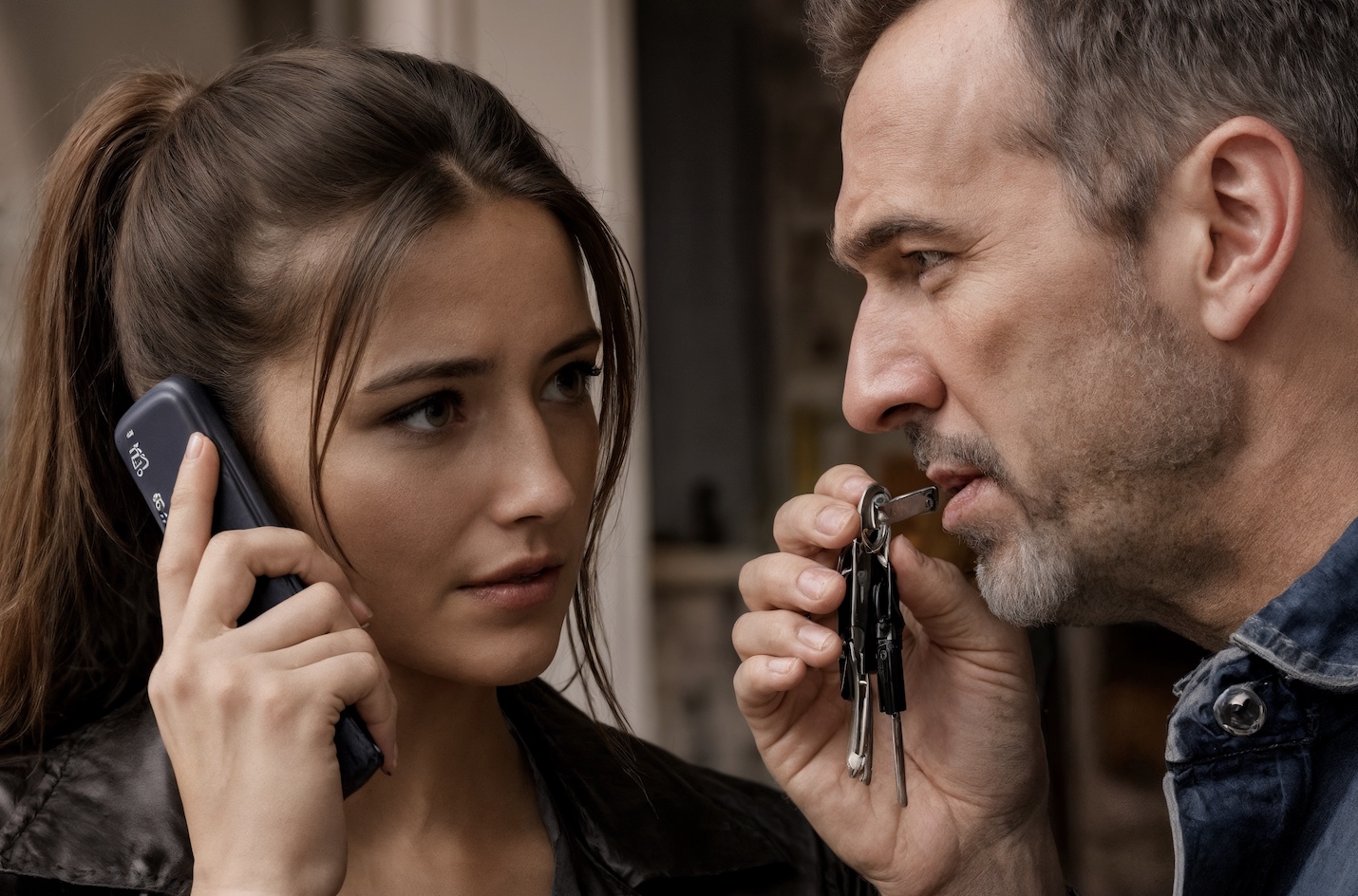
“Sveta, hi. Listen, this may sound odd… did you sell your car?”
Lenka’s voice on the phone sounded casual, but there was a thin edge of barely hidden curiosity in it. Sveta, who had been steadily slicing bell peppers on the cutting board for dinner, froze for a second. The knife with the red plastic handle stopped a hair’s breadth from the glossy yellow skin.
“Why would you think that? Of course not. It’s parked downstairs, taking it easy.”
“Really? That’s strange. I saw it literally five minutes ago outside Egoist. You know, that new club where getting past the door is harder than crossing a border. Your brother-in-law Maxim was piling out of it with some cheerful little crowd. The music was blasting so loudly my whole car was vibrating. I actually thought maybe you’d sold it to him… It was definitely yours. I recognized that fox keychain hanging from the mirror.”
Sveta slowly set the knife down on the board. The sound of metal touching wood was the only sound in the kitchen now besides Lenka’s voice, which suddenly seemed far away, чужая—foreign, unreal.
“I see. Thanks for telling me, Len. I’ll call you back later. Something’s burning here.”
She ended the call without waiting for an answer. Nothing was burning. The smell of fried onions, which a minute ago had felt warm and homely, suddenly turned sharp and suffocating, filling her lungs. Sveta walked to the window. Their third-floor apartment in the old concrete block overlooked the parking lot. The spot where her dark blue sedan stood every morning and every evening was brazenly empty. It looked like a freshly knocked-out tooth in a neat row of parked cars.
She didn’t tidy anything up. She didn’t switch off the hood fan or move the pan from the cooling burner. She simply sat down at the kitchen table and stared at the front door. There was no familiar wave of feminine hurt inside her, no urge to cry. Something else was forming there instead—cold, solid, and heavy. The calm of a surgeon looking at an X-ray and seeing a tumor that has to be removed immediately.
She remembered how Yegor had persuaded her two weeks earlier. He hadn’t demanded it, hadn’t pushed. He had coaxed her—softly, warmly, with his hands on her shoulders and his eyes fixed on hers.
“Sveta, just try to understand. Max is job hunting, running all over the city. Buses are a nightmare—he’s late, he shows up looking disheveled. Let him take your car sometimes, just for interviews. He’s careful, you know that. He’s changed.”
She knew. She knew his “careful” brother all too well. She knew how much he had “changed” the last time they paid off his debt to a microfinance company. And the time before that, when he had “accidentally” broken her laptop trying to install a pirated game. But Yegor had looked at her with that same disarming mix of love and guilt over his hopeless brother, and she gave in. Not because she believed him. Because she was tired of being the only adult in their small family triangle.
The wall clock ticked away with dull indifference. With every second, the cold inside her grew denser, settling somewhere beneath her ribs. At last, after what felt like forever, she heard the familiar scrape of a key in the lock.
Yegor came in, kicking off his shoes with the weary ease of someone returning home in a good mood. He was humming under his breath, already anticipating dinner.
“Hey, kitten. Wow, what smells so good—” He cut himself off when he saw her motionless figure sitting at the table in the dim kitchen. “Sveta? Did something happen? Why are you sitting there in the dark?”
She said nothing. She gave him time to come closer, to feel that the temperature in the apartment had dropped several degrees.
“Your brother had an interview today,” she said in a flat voice stripped of all emotion. It wasn’t a question. It was the opening line of a report.
“Oh, yeah? Good for him. Hope it went well,” Yegor replied lightly, opening the fridge and peering inside.
“It went very well,” she continued in the same detached tone. “The interview took place at the Egoist nightclub. Judging by what I heard, he passed the audition for lead party animal with flying colors, because he was celebrating with his friends while climbing out of my car with music blasting loud enough to shake nearby vehicles.”
Yegor froze with a carton of kefir in his hand. Slowly, he shut the refrigerator door and turned to face her. A flicker of annoyance crossed his face—the look of a man being bothered with nonsense just when he wanted to relax.
“So what? The guy had a little fun. He’s allowed to, isn’t he? Why do you always start right away? Maybe he found a job and decided to unwind. Big deal. He went to a club, not to the moon.”
His words dropped into the kitchen’s silence like a pebble into icy water. No ripple. No splash. They simply disappeared into the cold depth. The phrase he’s allowed to wasn’t just a stupid thing said out of fatigue. It was a worldview. A philosophy. And that was exactly the trigger Sveta had been calmly waiting for.
She rose slowly from the chair. There was no rush in her movements, no visible anger. It was the smooth, measured grace of someone who had moved from waiting to action. She stepped from the shadow of the kitchen into the lit hallway, and for the first time that evening Yegor got a clear look at her face. He didn’t like what he saw. There were no tears there. No hurt. Only cold, focused fury.
“He’s allowed to?” she repeated. Her voice stayed low, but steel had entered it. “To use my car? At my expense? With friends I’ve never even seen? At night? Outside a club where the cover charge costs as much as our groceries for a week? That’s what he’s allowed to do, Yegor?”
Yegor grimaced. He still didn’t understand the scale of the disaster. To him, this was just another episode of her “picking at little things.”
“Sveta, come on. I’ll talk to him. The guy got carried away, it happens. The car isn’t made of sugar, it’s not going to melt. He’ll bring it back tomorrow morning. What’s the problem?”
“The problem,” she said, stepping almost nose to nose with him, “is that tomorrow morning doesn’t work for me.”
She smelled of neither perfume nor dinner. She smelled of danger.
“Give me the keys to my car. Now. And call your useless brother and tell him to return it within the hour. Otherwise, I’m reporting it stolen. And I don’t care that he’s your brother.”
That sentence, spoken without shouting, almost in a whisper, finally pierced his armor of indifference. Yegor’s face changed.
“You… you’re serious? You’d report Max? My own brother? Over some car?”
“Not over the car,” she cut in sharply, looking him straight in the eyes without blinking. “Because your he’s allowed to applies to everything that belongs to me, but not to you. He’s allowed to take my money. He’s allowed to lie to my face. He’s allowed to turn my property into some cheap taxi for his nightlife. And what, in your opinion, am I allowed to do? Smile and swallow it because he’s your brother?”
Yegor hesitated. He looked at her, and in his eyes there was confusion, anger, and genuine incomprehension. He was used to soothing her irritation with hugs, promises, and some tired variation of I’m sorry, I’ll talk to him. But now he was looking at someone else entirely. Instinctively, he slipped a hand into his jacket pocket where his keys were. His fingers closed around the cold metal.
She noticed the movement at once. The corner of her mouth twisted into a smile that held no amusement.
“You still don’t get it?” she hissed, and there was more threat in that whisper than in any scream. “Either you call him now and in one hour my car is back under my window, or I call the police. Your choice. Time starts now.”
She pulled her phone from her jeans pocket, unlocked it, and set it on the entryway table beside her. Like a stopwatch at the beginning of a race. Yegor looked from her to the phone and back to his hands. The air in the hallway had gone thick enough to cut with a knife. This was no longer a family argument. It was a standoff. And with growing horror, he realized she was not bluffing. She would do exactly what she said. Her composure frightened him far more than any hysteria ever could.
His face passed through several stages—bewilderment, outrage, then finally a mask of wounded righteousness settled over it. He took a step back as though her words had physically shoved him. The ultimatum, sharp and merciless, had left him no room to maneuver. So he turned to the only weapon still available to him: attacking her.
“What is wrong with you, Sveta? You’ve become completely… heartless. Is this hunk of metal more important to you than an actual human being? More important than my brother? I always knew you didn’t like my family, but not to this extent… calling the police on your own relative!”
He was speaking loudly now, trying to fill the hallway with himself, to crush her calm beneath the force of his righteous anger. He wanted her to feel petty, selfish, guilty. But his words bounced off her icy self-control like peas against a wall.
“Your family, Yegor? Fine. Let’s talk about your family. Your brother, specifically. This isn’t the first time he’s taken something without asking, is it?”
She still didn’t raise her voice. Her tone remained even, almost academic, as if she were dissecting not their personal crisis but some abstract case study.
“Let’s remember last spring. When your ‘careful’ brother borrowed the neighbor’s drill to ‘help a friend with a renovation.’ And that drill ended up in a pawn shop. Who went to speak to the neighbor and handed him eighteen thousand rubles from the money we’d been saving for vacation? You or me? No, wait—we both went. You apologized, and I counted out the cash. Our cash, Yegor.”
He flinched as though struck. He opened his mouth to protest, but she didn’t let him.
“Or should we talk about your watch? The one your father gave you. The one that vanished from the shelf after Maxim visited. You whispered to me yourself later that it was probably him, but you didn’t want to make a scene. You just swallowed it. Because he’s your brother. He gets to take your things, and you don’t even get to ask where they went.”
Every word she spoke was a precise, deliberate blow to the rawest parts of his conscience. She wasn’t ranting. She was simply laying out the facts, and that calm recital was more frightening than any shouting match. She wasn’t exposing her own cruelty. She was forcing him to face his blindness and weakness.
“So this isn’t about the car, Yegor. It never was. It’s about the endless chain of he’s your brother, which you use like a bandage to cover wounds that are already rotten underneath. He lies—he’s your brother. He steals—he’s your brother. He spits on both of us, on our plans, on our property, on our peace of mind—and you stand there and say, the guy has a right. No. He doesn’t. And you don’t have the right to expect me to pay for his ‘rights’ with my money and my nerves.”
She paused, giving him time to absorb what she had said. He stood there in silence, breathing heavily. Every accusation he had thrown at her had crumbled to dust. He no longer looked righteously indignant. He looked cornered.
“So I’ll ask one more time. Are you calling him? Or should I?”
Yegor breathed hard, staring at her unreadable face. All his arguments, all his usual tricks, had shattered against her calm. He was like a boxer who stepped into the ring only to realize his opponent was a granite wall. Desperate, unable to find words that could break her, he reached for his last, stupidest, most insulting weapon—money.
“Why are you shaking over this damn car like it’s some sacred relic?!” he exploded, his voice cracking into a yell full of helpless rage. “So what if he scratches it? So what if he dents the fender? My God, what a tragedy. I’ll buy you a new one! Two new ones, if you want! Better than this one! Stop counting pennies and panicking over every little thing!”
That was his final mistake. The last drop that filled the cup of her cold patience to the brim.
She didn’t answer.
Instead, something strange happened right in front of him. Her face lost its hard expression for a brief moment, as if she had made some final, irreversible decision. She stepped toward him, and he instinctively recoiled. But she passed by him and went to his jacket hanging on the rack.
“What are you doing?” he asked, bewildered.
She didn’t reply. Her hand slid confidently into his coat pocket and pulled out his key ring. His keys. To their apartment, to his office, to his parents’ house. Hanging from it was a small but weighty keychain—a fox she had once given him. And right beside it, on the same ring, was the spare key to her car. The one she had given him “just in case.”
Yegor watched in silence as she removed that key from the ring. He still didn’t understand. He thought she was simply taking it back so he couldn’t hand it to his brother again. But what she did next was beyond anything he could have imagined.
She gripped the key with both hands. Her thumbs pressed into the plastic head, her index fingers braced against the metal blade. Then, with such force that her knuckles turned white, she began to bend it.
Her face tightened with effort. Sweat beaded on her forehead. The key resisted. It was made of strong alloy, meant to survive years of use, not to be broken in bare hands. Yegor stood there with his mouth open, staring at this silent, furious, utterly insane act—at least insane from his point of view. She leaned into it with the full weight of her body, her shoulders trembling from strain.
Then, at last, with a dry, sharp snap like a bone breaking, the metal blade tore away from the plastic head.
She never looked at him. She simply walked to the kitchen table—the same table where she had meant to serve dinner a few hours earlier—and dropped the two useless halves onto its surface. They clinked and lay still. One was black plastic with buttons. The other was a dull, broken shard of metal.
She straightened, caught her breath, and finally raised her eyes to him.
There was no anger left in them. No fury.
Only emptiness.
Cold, scorched, absolute emptiness.
“Call your brother,” she said quietly and distinctly, separating every word. “Tell him he has nothing left to drive now. And, for that matter, neither do you.”