“Where does it say the air belongs to you? The stairwell is shared space. If I want to smoke, I’ll smoke. If I want to spit, I’ll spit. Learn the law, lady.”
Vika, the twenty-year-old daughter of Elena Sergeyevna’s neighbor Galina, blew a thick stream of sickly sweet vapor straight into Elena’s face. Two boys lounged nearby on the windowsill between the floors, cackling. The concrete floor was littered with cigarette butts, empty energy drink cans, and sunflower seed shells.
Elena Sergeyevna, the chief accountant at a large factory, did not cough or wave her hands the way the teenagers expected. She only adjusted her glasses and looked at the girl with the kind of heavy, appraising stare that made department heads break into a sweat during inventory checks.
“This is a shared area, Viktoria,” she said in an icy tone. “Which means no smoking, no spitting, and no turning it into a pigsty. You have five minutes to clean up this mess. Otherwise, this conversation will go very differently.”
“Oh, I’m so scared,” Vika sneered, deliberately flicking ash onto the floor that the building cleaner had just washed. “Go take your heart drops before your blood pressure spikes. Going to complain to my mom? She’s the one who told me to sit out here so I wouldn’t smoke up the apartment.”
The boys burst into laughter. Elena Sergeyevna’s door slammed shut, cutting off the noise from the landing.
Inside, the hallway smelled of fried potatoes and old wood — warm, familiar scents now overwhelmed by the stink of cheap cigarettes seeping through the keyhole. In the kitchen, hunched over the table, sat Pasha.
Pasha was thirty-two, but because of his early baldness and hunched posture, he looked closer to forty. He was the nephew of Elena’s late husband and had been living with her for ten years. Quiet, timid, and with a mild stutter, he worked in a clock repair shop and was afraid of his own shadow. To the neighbors, he was “the simpleton,” an easy target for mockery.
“L-Lena… are they out there again?” Pasha shrank into himself when he heard the thudding outside the door.
“Eat, Pasha. This is not your concern,” Elena Sergeyevna said curtly, putting more potatoes on his plate. But inside, she was seething.
That evening, she went to Galina’s apartment. The neighbor opened the door in a bathrobe, phone in hand, wearing a face mask.
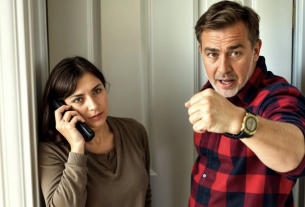
“Galina, your daughter has turned the space outside my door into a hangout. Smoke is drifting into my apartment, and the noise goes on until late. I expect you to do something.”
Galina rolled her eyes without even taking the phone from her ear.
“Oh, Lena, why are you starting this? They’re young. Where are they supposed to go? It’s cold outside. They’re not drug addicts, they’re just hanging out. Try being a little more understanding. You don’t have children of your own, so that’s why you get worked up over things like this. And your Pashka is practically a fool anyway, so what difference does it make to him?”
The blow was low and perfectly aimed. Elena Sergeyevna slowly exhaled.
“So that’s how it is. ‘Young people being young,’ is it? And my Pavel bothers you? Fine, Galina. I hear you.”
She went back home, sat down at her desk, and pulled out a folder of documents. Emotions were for the weak. Strong people had the Civil Code and the administrative offenses code.
For the next week, Elena Sergeyevna stayed quieter than water.
Vika took her silence as surrender and fully occupied the landing. Soon there was an old armchair dragged in from the trash, and music blasted until one in the morning.
The turning point came on Friday.
Pasha was coming home from work carrying a bag of groceries and a small box — an order for a client. As he passed the group on the landing, one of the boys, Vika’s boyfriend nicknamed “Sour,” stuck out a leg.
Pasha tripped. The grocery bag ripped open, and apples rolled across the filthy floor straight into the cigarette butts. The box with the clock mechanism flew into the wall.
“Well, look at that! The ostrich took flight!” Sour howled.
Vika lazily blew out smoke.
“Hey, loser, maybe watch where you’re going. You’re the one ruining the air around here. Pick it up while I’m still being nice.”
Red as a beet, Pasha began gathering the apples with trembling hands. Tears of helplessness filled his eyes. He was used to it. Used to being nobody. Used to getting shoved around while nobody stepped in for him.
Then the door flew open.
Elena Sergeyevna stood in the doorway. In her hands was neither a broom nor a rolling pin, but a smartphone, its camera aimed straight at Sour.
“Petty hooliganism, insults, and property damage,” she said clearly. “I recorded everything. I’m calling the district officer now, and tomorrow I’m taking this evidence to the station.”
“Put the phone away, lady!” the boy lunged, but he did not dare come closer — Elena Sergeyevna’s stare was more frightening than any police officer.
“Pavel, get up,” she ordered without looking at her nephew. “Go inside.”
“B-but the apples…” he stammered.
“Leave them. They’re garbage now. Just like everything else on this landing.”
Once the door closed behind Pasha, Elena Sergeyevna turned to the suddenly quiet Vika.
“Now listen carefully, little girl. Did you think I spent a whole week putting up with this? I was building a file.”
“What file?” Vika scoffed, but her voice shook.
“I contacted the apartment owner. Your mother isn’t the owner, is she? The apartment belongs to your father, who lives in Moscow and still believes his daughter is a diligent medical student, not a foul-mouthed brat gathering drunks in the stairwell.”
The color drained from Vika’s face. Her father was not simply strict — he was a tyrant who supported her and her mother only as long as his daughter behaved perfectly.
“You wouldn’t dare…” she whispered.
“I already did. He received the photos and videos of your little ‘social life’ ten minutes ago. Along with complaints sent to the police and the building management company, plus printed records of the photo and video evidence: times, dates, trash, noise, smoking in the stairwell. Let the proper authorities handle the paperwork now. The district officer will be here in half an hour. And your father said he would arrive tomorrow morning.”
On Saturday morning, the building shook with a deep male voice.
Elena Sergeyevna was drinking tea when the doorbell rang. On the threshold stood a tall, heavyset man in an expensive coat — Vika’s father, Anatoly Borisovich. Beside him stood Galina, tearful and bowed with shame, while Vika herself was nowhere to be seen.
“Elena Sergeyevna?” the man said politely, though with unmistakable authority. “I apologize for the behavior of my daughter and my former wife. The mess on the floor is already being cleaned by the building staff. I will pay for the wall repairs. Vika is being sent to live in a dormitory. I have cut off their financial support.”
Elena nodded, accepting the apology as a matter of course.
“That is fair. But there is one more thing.”
She called for Pasha. He came out of the room with his head drawn into his shoulders, expecting yet another scandal.
“Your… guest insulted my nephew yesterday,” Elena said calmly. “He also damaged his work. Pavel is a remarkable craftsman. He restores clock mechanisms that even specialists in Switzerland refuse to touch.”
Anatoly Borisovich looked at the shrunken Pasha with interest.
“A clockmaker?”
“R-restorer,” Pasha corrected softly, stammering.
“I see…” The man stepped forward, and Pasha instinctively flinched back. But Anatoly Borisovich only held out his broad hand. “I have a collection of Breguet pocket watches. One mechanism stopped a year ago, and three workshops refused to take it. Would you be willing to have a look?”
Pasha raised his eyes. For the first time, someone was looking at him not like he was invisible, not like he was some village fool, but like he was a professional.
“I… I c-can try. I-if the spring is intact.”
“Then it’s settled,” Vika’s father said, firmly shaking Pavel’s thin hand. “Forgive me, brother, for my girl. I failed in raising her properly. Don’t hold it against me. I’ll pay compensation, and I’ll place the order with you.”
When the door closed, Pasha stared at his own hand for a long time. Then he straightened up. For the first time in years, his shoulders were no longer hunched.
“Aunt Lena,” he said firmly, almost without stammering, “I think I’ll go pick up those apples myself. It’s not right for food to go to waste.”
Elena Sergeyevna turned toward the window so he would not see the tears in her eyes.
“Go pick them up, Pasha. And put the kettle on. Today, we celebrate.”
The landing was quiet and spotless. It smelled of bleach and fresh paint. And from Elena Sergeyevna’s apartment drifted the smell of pies, along with Pavel’s calm, confident voice as he explained the workings of a tourbillon to his aunt.
The smoking lounge was gone.
For good.