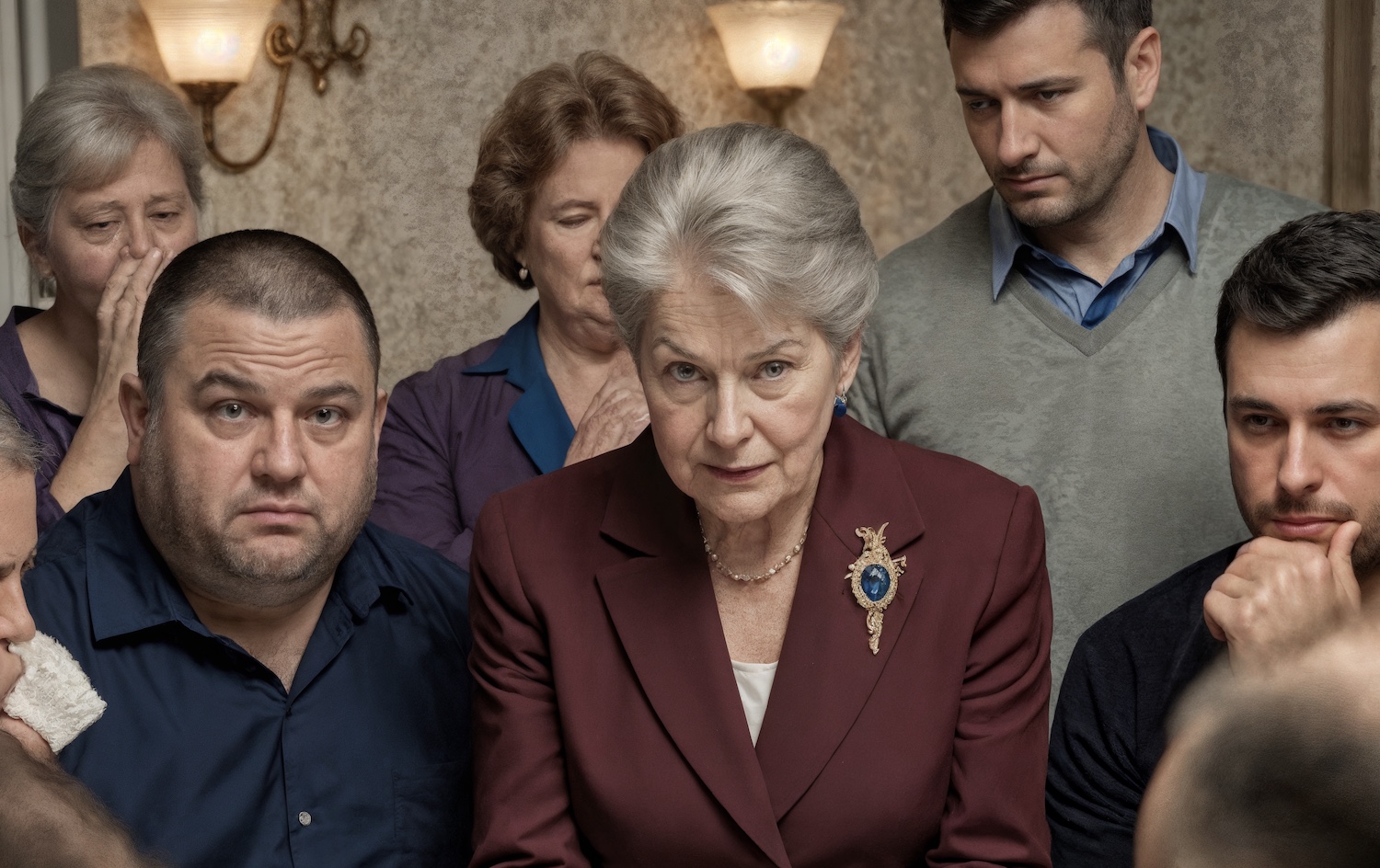
Larisa Petrovna lifted her glass of sparkling wine, and I knew immediately that something was about to go wrong. I could see it in the way she straightened her back, in the narrow, judging look she gave me across the table.
The room went quiet — around fifteen people, all familiar faces: teachers, neighbors, distant relatives. The necklace rested in front of her on a velvet cloth, gold and large topazes flashing under the chandelier. I had spent five years saving for that gift. Five years of giving up vacations, postponing a car, denying myself any kind of decent life. Because this was the necklace she wanted. Vintage. Collectible. The kind she used to admire in old catalogs. A status symbol, as she liked to call it.
She let the silence hang, the way she always did when she wanted every word to hit exactly where it would hurt most.
“Thank you, Dmitry. It’s a lovely gift. But you always believed you could make up for years of your… lack of soul with a piece of gold.”
I went still. It became so silent that I could hear someone awkwardly setting down a fork.
“The real treasure is my nephew, dear Sasha,” she said, nodding toward him. He lowered his eyes, hiding a smug smile. “He values me as a living person, not as a picture in a jewelry catalog. He comes to see me just because he wants to. And you… you visit once a month for two hours, sit there like you can’t wait to escape, and leave at the first opportunity.”
Someone gave a short, nervous laugh. Our neighbor, Aunt Zina, shook her head with sympathy — for my mother, of course, not for me.
I stood up without looking at anyone and stepped out onto the balcony for a smoke. My hands were steady. Inside me there was only emptiness — cold, clear, almost freeing.
The guests left around midnight. Larisa Petrovna left the jewelry box with the necklace on the dresser in the living room — probably planning to admire it again in the morning. I waited until she went to bed, took the box, and slipped quietly out of the apartment.
The calls started two hours later. I didn’t answer. By morning, I was back in my own city, waiting.
She wasted no time. She called my office, and our HR clerk, Valentina Mikhailovna, passed along the message: my mother claimed I was emotionally unstable and had stolen a family heirloom. Then a photo appeared on social media: Larisa Petrovna holding the empty box, looking heartbroken, with the caption: “A mother’s heart cannot be bought with jewels. I pray my son comes to his senses.” Sasha was in the comments supporting her, pitying her, condemning me.
I looked at the screen and thought: she didn’t regret what she had said. She regretted losing control.
Three days later, she ended up in the hospital with a hypertensive crisis. She posted a selfie in a hospital gown with an IV in her arm: “My own family wishes illness on me. But I forgive.”
I went to see her. Not to return the necklace. I went to answer her.
She was lying alone in the room, pale, with that same triumphant gleam in her eyes. She thought I had come to apologize.
“Dmitry, finally. I knew you’d come to your senses. Return the necklace, and we’ll forget this foolishness.”
I sat down beside her bed and looked her straight in the eye.
“I’m not coming back. And I’m not giving the necklace back. Do you know why? Because you never truly wanted it. What you wanted was a stage. A public humiliation. You wanted everyone to see what a terrible son I was and what a suffering mother you were.”
She tried to cut me off, but I continued in a calm voice.
“For five years I lived on bread and pasta so I could buy you that gift. You knew that. And still, in front of everyone, you called me heartless. Then you called Sasha your treasure. The same Sasha who only comes around when he needs money. The same Sasha who calls twice a year, and only to ask for something. But he knows how to flatter you, doesn’t he? I don’t. I just worked and saved for your dream like a fool.”
Larisa Petrovna turned even paler.
“You… you do not speak to me like that! I am your mother!”
“You were my mother. Now you are simply a woman who believes that giving birth to a child gives her the right to humiliate him for the rest of his life. I’m going to sell the necklace. And I’m going to spend that money on myself. For the first time in forty-two years. On my life, not on earning your approval.”
I stood up. She reached for me, trying to grab my sleeve, but I stepped back.
“Dmitry, wait! You can’t just leave like this! I’m in the hospital!”
“You can call Sasha. He’s the real treasure, remember?”
I walked out without turning around. In the hallway, my hands finally began to shake — not from fear, but from relief.
Over the next few weeks, I prepared to leave. I sold my apartment quickly, packed my things, and found a house on the banks of the Volga in a quiet little town where no one knew me.
Larisa Petrovna kept calling from different numbers, sending messages through apps, first furious, then pitiful. I never answered.
Sasha showed up too. He wrote: “Have you completely lost your mind? Your mother nearly died because of you, and you’re acting like the victim. Return the necklace while I’m still asking nicely.” I blocked him, deleted all my social media, and stopped caring what they were saying about me.
I learned about karma by accident, about six months after I moved. A former neighbor called me — the same man who had been sitting at the table during the anniversary dinner.
“Dmitry, did you hear about Sasha?” he asked, his voice full of barely hidden satisfaction. “He borrowed a huge amount of money from your mother, supposedly for some business deal. Promised he’d pay it back in a month.”
Half a year passed — no money, no Sasha. He stopped answering his phone, moved out of his apartment. Your mother is telling everyone she was deceived, that she trusted the wrong person. Funny, isn’t it? She humiliated you in front of everyone and praised him like he was gold. Well, there’s your treasure.”
I listened in silence. I wasn’t happy. I wasn’t gloating. I just accepted the news as a fact.
“She was trying to find your address,” the neighbor added. “She wanted to come and talk to you. But no one told her where you’d gone.”
“Don’t tell her,” I said. “Please.”
He was silent for a moment, then sighed.
“All right. Take care of yourself.”
The house welcomed me with the kind of silence I hadn’t heard in years. I adopted an old greyhound from a shelter named Marshal — no one wanted him because of his age. In the mornings we walked slowly down to the river, enjoying the calm.
At the local community center, they asked me to teach financial literacy classes for pensioners, and I agreed. About ten people came each time. They listened carefully and thanked me without flattery, just with simple human warmth.
One morning, while I was drinking coffee on the porch, a message arrived from an unknown number:
“Dmitry, it’s Mom. I’ll be turning eighty soon. Sasha let me down — he wasn’t the person I believed he was. Maybe I was wrong back then. I would like to see you and talk.”
I read it, finished my coffee, and deleted the message. Not out of anger. Not out of revenge. I simply had no desire to return to a life where love had to be bought, approval had to be begged for, and I was always made to feel indebted.
I had learned to live differently — without guilt, without the need to be perfect for someone who only ever saw me as a tool for their own self-importance.
Marshal came over and rested his head on my knees. I scratched him behind the ear and looked out at the river, at the morning mist drifting above the water.
This was my life now. Mine.
And it was more than enough.
If you want, I can also make it sound even more native and cinematic, like an original English short story rather than a direct translation.