“You can see I’m losing strength, and you can’t even fix my pillow?” Valera’s voice sounded like he was dictating his last will to a notary.
Even though the digital thermometer betrayed him shamelessly: 37.2°C.
I fluffed the pillow without a word. Valera suffered on a grand scale. If a man’s temperature creeps past thirty-seven, the world is required to stop. Birds must fall silent. And the wife must become a soundless shadow with a tray.
“I’m freezing,” he complained, tugging on the thick wool socks I’d knitted for him last November. “Lyuda, is the chicken ready? I need something hot. My body needs support.”
“It’s cooking, Valer. Ten more minutes.”
I pulled the door nearly shut so I wouldn’t disturb my husband’s “strict bed rest.” The kitchen smelled like boiled onion and the never-ending female shift.
That smell had followed me for thirty years: first nursing the kids, then my mother, and now my husband—who could turn any little draft into a universe-level tragedy.
It was 11:00 a.m. on a Saturday. Outside: grey November 2025, wet snow tapping the glass. In weather like this, you want to curl up under a blanket with a book—not strain broth a second time so “the grease won’t float.”
What I found in his pocket
In the hallway, his jacket hung on the rack—an enormous puffy “Alaska” parka he’d bought a month ago. The sleeve was smeared with something white. Chalk? Plaster?
“If he’d look where he leans just once,” I muttered, out of habit.
You know that automatic motion. Before tossing something in the wash, we check the pockets. Not to spy—at fifty-four, hunting for secrets is ridiculous—but so you don’t wash a passport, garage keys, or a forgotten banknote.
I slid my hand into the deep side pocket. My fingers touched a stiff wad of paper.
I pulled it out and smoothed it on my knee.
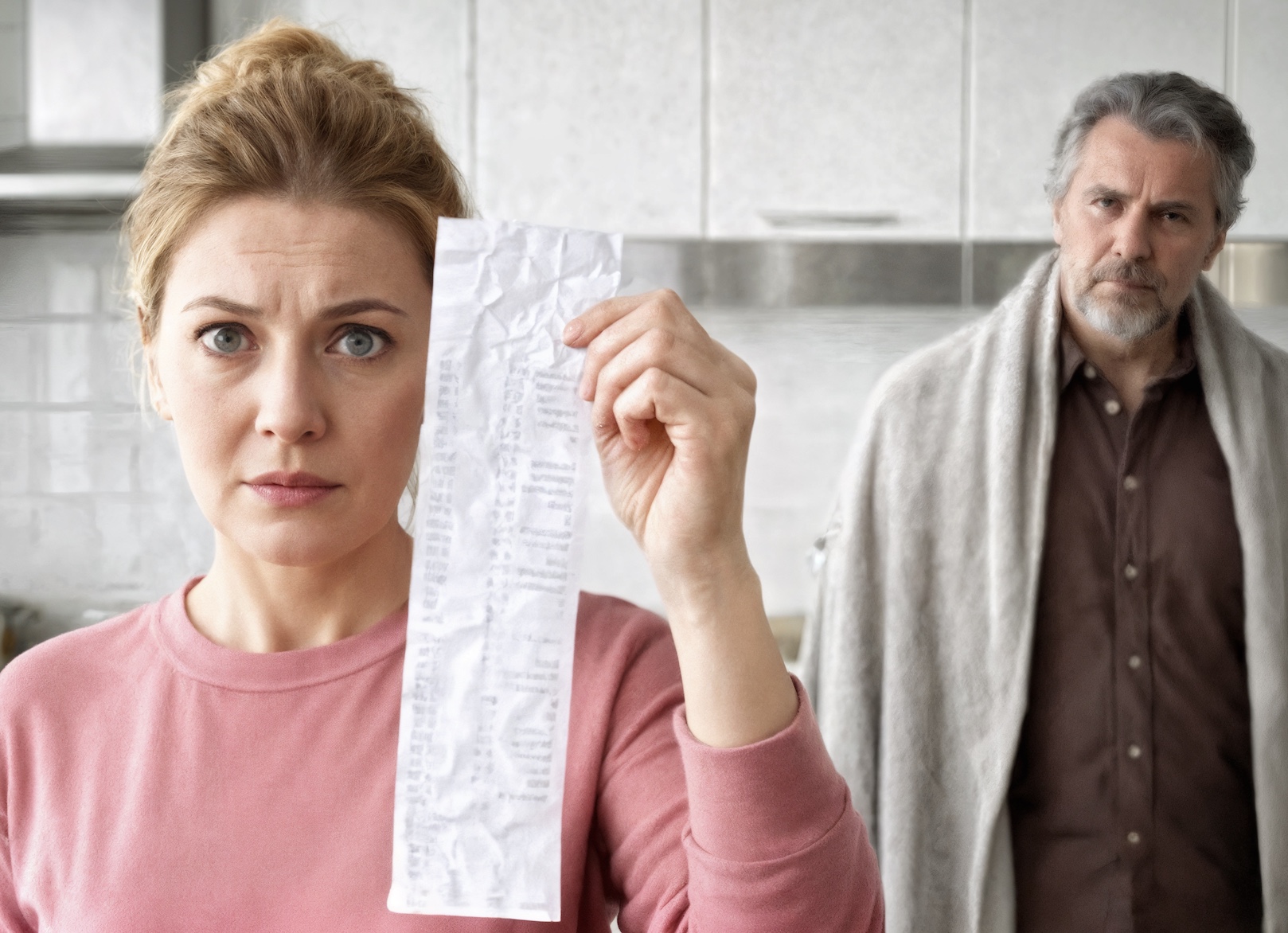
A receipt—long, rolled into a tube, printed on good thermal paper.
“Aqua World Store. Yamaha 9.9 outboard motor…”
My eyes slid down to the total. The numbers danced, assembling themselves into something my brain refused to accept.
128,400 rubles.
I blinked. Maybe my glasses had fogged from the kitchen steam? No. One hundred twenty-eight thousand four hundred. Card payment.
And the date.
I lifted the receipt almost to my face.
15.11.2025. 18:45.
Yesterday.
Yesterday evening—when he came home clutching his chest and whining, “Lyudochka, I’m shaking, I think I caught a cold, I don’t even have the strength to take my boots off.” I’d panicked. I ran for tea with raspberry jam, checked his blood pressure…
And he’d been hauling a thirty-kilo motor an hour before that.
But the worst part wasn’t even the lie. A colder feeling—sharper than November wind—slid down my spine.
I knew that amount.
I’d been saving it for a year and a half.
The smile he stole
Those were my teeth.
My complicated dental work—three units I’d postponed and postponed, chewing on one side, enduring the discomfort because “now isn’t the time,” “let’s fix the car first,” “the dacha roof needs work.”
A week ago I’d withdrawn all my savings and put the cash into a blue envelope in the linen closet. Valera knew. We had agreed: on Monday I’d go to the clinic and pay the deposit.
Slowly, like I was dreaming, I went into the bedroom, opened the closet, pulled out the box of bed linens. The blue envelope was there.
Empty.
“Lyud!” Valera’s voice carried from the living room—whiny and demanding. “How long is this going to take? My throat is dry. You forgot about me?”
I stood in the middle of the bedroom, the empty envelope in one hand and the receipt in the other.
Something inside me tore—but there was no screaming, no crying. Just the feeling of a switch being flipped in my soul.
Click—
and silence.
For thirty years I’d been Convenient Lyuda.
Lyuda who understands.
Lyuda who waits.
Lyuda who chews on one side another year because Valera needs it more—he has fishing, he has stress, he has “men’s brotherhood.”
He didn’t just steal money. He stole my health—and the last of my patience. And there he was now, lying there and acting weak, knowing he’d spent every last ruble on his toy yesterday.
“L-yuuu-da!” his voice grew stronger. “Bring the broth!”
Service unavailable
I went back to the kitchen.
On the stove, the pot bubbled happily: golden broth, clear as a tear, with a sprig of dill—exactly how he liked it. Perfect care for a perfect egoist.
I stepped closer and stared at the chicken leg poking out of the water, lonely as an orphan.
Service temporarily unavailable, flashed through my mind.
I turned off the gas. Grabbed the pot by its hot handles without even looking for potholders—hurt burns stronger than heat—and carried it to the sink.
I didn’t need a strainer.
I tipped the pot, and the golden liquid I’d cooked for two hours gurgled down the drain. The chicken slapped into the wet sink with a dull thud. The boiled carrot and onion followed after it.
I turned on cold water, rinsing away the traces of my work.
“Lyuda, are you coming?” Valera shouted now with irritation. “I’m getting up!”
I dried my hands, took my phone, opened the delivery app.
My finger hovered over “Pizza,” then I changed my mind. No. Not today. No dough.
I chose the most expensive Japanese place in our area. The Imperial Set—eel, salmon, scallops, roe.
Price: 4,800 rubles.
I tapped Place order. Paid with my husband’s credit card—the one linked to my phone “for household expenses.”
A notification appeared: “Your order has been accepted. Courier will arrive in 40 minutes.”
I sat down at the kitchen table, placed the receipt in front of me, and pinned it with a heavy crystal sugar bowl.
“Lyuda!!!”
“I’m coming, Valera,” I said quietly—yet in the empty apartment my voice sounded unexpectedly firm.
I didn’t take a tray.
I didn’t take medicine.
I smoothed my hair, caught my reflection in the dark window—an exhausted woman who’d been kind far too long—and walked into the living room.
The talk he couldn’t dodge
Valera was lying on his back with his arm over his eyes, radiating theatrical suffering. Hearing my steps, he opened one eye, expecting a cup.
“Finally,” he exhaled. “Where’s the broth?”
I came closer, but I didn’t perch obediently on the edge of the couch like usual. Instead I dragged a chair over, set it in front of him, sat down, and placed my hands on my knees.
“There won’t be any broth, Valer.”
He lowered his arm.
“What do you mean? I heard you clattering around. Lyuda, don’t start. I really feel awful. I’m shaking.”
“The broth is in the sewer,” I said calmly. “Along with the chicken.”
Valera sat up slowly, propping himself on his elbow, staring at me. His eyes were honestly confused—as if the wife had overheated at the stove, or simply gotten tired.
“You… poured the food out?” he tested the ground. “Are you serious? I’m sick!”
“You’re not sick, Valera,” I said. “You’re just sneaky.”
I pulled the receipt from my pocket and laid it neatly on the coffee table. The white strip curled like a worm.
Valera stared at it. Then at me. Then back at it.
I could see him scrambling for a story. Healthy color—bright, real—flooded his face, pushing out the “pale suffering” he’d been wearing.
“Ah… that,” he stammered, and his voice suddenly sounded stronger. “Lyud, I wanted to explain.”
“It was a chance! Sergey had a discount, one day only. That motor—Japanese—costs two hundred now, and I got it for one twenty! It’s an investment!”
“An investment?” I repeated. “That envelope held my health, Valera.”
“We’ll fix your teeth!” he waved a hand—and that gesture hurt me more than any words. “You can wait another month or two. What’s the big deal? Not critical. But the motor would be gone. You just don’t understand tech.”
Not critical.
There it was. Our entire marriage in two words. My problems were “you can wait.” His wants were “it’ll be gone.” I can endure. I can manage. I’m Lyuda.
The doorbell rang.
“Who’s that?” he snapped.
“My lunch,” I said, standing up.
A celebration of disobedience
I brought in a big paper bag. The scent of fish, ginger, and soy sauce filled the room, drowning out the smell of medicine and theatrics.
I unpacked the boxes right on the coffee table, nudging his thermometer aside. Split the chopsticks. Click.
“Lyuda, what are you doing?” Valera stared at the pile of food with fear and hungry envy. “You ordered delivery? For one hundred twenty-eight thousand or what?”
“No,” I said. “Only five. From your card.”
I dipped a piece of eel into sauce and ate it. Delicious. Ridiculously delicious. And I didn’t care that chewing wasn’t easy. I enjoyed every bite.
“And me?” Valera swallowed. “I’m hungry too. I haven’t eaten all day.”
“You can’t,” I said, taking another piece. “You’re sick. With a cold, this is harmful. You need broth.”
“Then give me broth!”
“I poured it out. You forgot? Make a new one yourself.”
“Me?!” He nearly choked. “I can barely stand!”
“Valer.” I looked him in the eyes—calmly, without anger. “Yesterday at 18:45 you were strong enough to carry a thirty-kilo motor. You hauled it up to the fourth floor without an elevator. So you can definitely lift a pot of water.”
He opened his mouth to argue, then shut it. The date and time on the receipt destroyed his performance.
“You… you only think about yourself,” he hissed. “I’m doing this for the family. The boat means fish, rest—”
“For your family, Valera,” I said. “The one where there’s only you and your wishes. In my family, today is a day off.”
I turned on an audiobook, put in my earbuds, and kept eating. The Japanese omelet melted in my mouth.
I didn’t hear what he muttered. I only watched him stand up—bright red with outrage. Stand up easily, without groaning.
His strength returned instantly the moment he realized there were no more spectators, and the service was over.
He hovered a moment, watching me eat. Then he spun around and stomped into the kitchen. A minute later I heard pots banging and the refrigerator door slam. He was hunting for dumplings.
A life that finally tastes good
I finished my set—not all of it, but enough to feel the pleasure. I threw out the boxes.
Valera sat in the kitchen over a plate, eating in furious silence. When he saw me, he turned to the window.
“Tomorrow we’ll divide the property,” I said. The words came out as lightly as if I’d suggested tea.
He froze, fork halfway to his mouth.
“Because of the motor? Are you serious? Lyuda, don’t start. I lost my temper. I’ll return the money, I’ll sell something…”
“It’s not because of the motor,” I said. “And it’s not even about the money.”
I stepped closer to the window beside him and watched the wet snow fall.
“It’s because you decided my health is a small thing, and your toy is life itself. I’m tired of being convenient, Valera. I want to be a woman someone thinks about—or at least a woman her own husband doesn’t lie to.”
“Who needs you at fifty-four?” he muttered, but his voice had lost its swagger. What was left was fear—the fear of a man who suddenly realizes his comfort is disappearing.
“Me,” I answered.
I went into the bedroom to pack. Not everything—just what I needed for now. I’d stay with my sister for a while.
And the motor… let it warm him on cold nights. They say Yamaha works flawlessly. Let Yamaha cook his dinner too.
And girls—check pockets before you wash clothes. Sometimes you find more than loose change. Sometimes you find the moment you finally start over. And if you find a receipt instead of a conscience—don’t boil broth.
Order yourself a celebration.
You’ve earned it.
And you—have you ever discovered a purchase your husband hid from you? How did you react—did you forgive it, or did you lay everything out on the table?