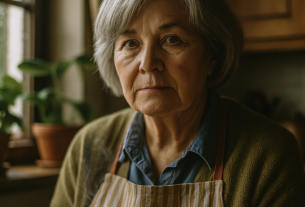
Irina stood by the window, staring at the gray October clouds. Outside the glass, the first yellow leaves slowly spun down from the poplars in the courtyard. The apartment where she had spent her childhood and youth had now become her only refuge. Three years earlier, her mother had signed it over to her as a gift deed, saying simply at the time:
“Let it be yours. So there won’t be any arguments later.”
Back then Irina had brushed it off, unwilling to think about anything bad. Now those words sounded prophetic. Her mother had been gone for two weeks. Cancer had given no chance, though the woman fought to the very end. Irina had spent the last months with her—taking shifts at the hospital, holding her hand when the pain became unbearable.
After the funeral, the home fell empty. Her husband Oleg came twice—helped with the paperwork at the morgue and went to the cemetery to choose a headstone. That was the extent of his involvement. When Irina asked why he wouldn’t stay with her even for one night, he answered shortly:
“I have work. You understand.”
She did understand. Oleg had always been good at finding reasons not to participate in anything that required emotions or effort. They had been married for eight years, and Irina had long since learned not to expect support from her spouse. More often it was formal presence, when propriety demanded it.
Today was the memorial meal. Irina got up early, though she had slept in fragments. All night she replayed her to-do list in her head: order food, set the table, call relatives and her mother’s colleagues. She handled the organization herself, because there was no one else. Oleg promised to come by lunch, and her mother-in-law, Tamara Ivanovna, also confirmed she would be there.
By two in the afternoon, the apartment filled with people. Distant relatives, neighbors, her mother’s coworkers and friends arrived. Everyone spoke in low voices, hugged Irina, offered condolences. She accepted their words of support, trying to hold herself together. Tears choked her, but she wouldn’t let herself fall apart. Not now. Not in front of everyone.
Oleg showed up around three. He walked into the room, nodded to the guests, and sat at the table. Irina noticed he looked tired, but she didn’t ask. This wasn’t the time for выяснения.
The table was set in the large room. Irina arranged plates, laid out cutlery, brought salads and hot dishes from the kitchen. Guests took their seats; someone poured kompot, someone sliced bread. The atmosphere was heavy but restrained. That’s how memorial meals are.
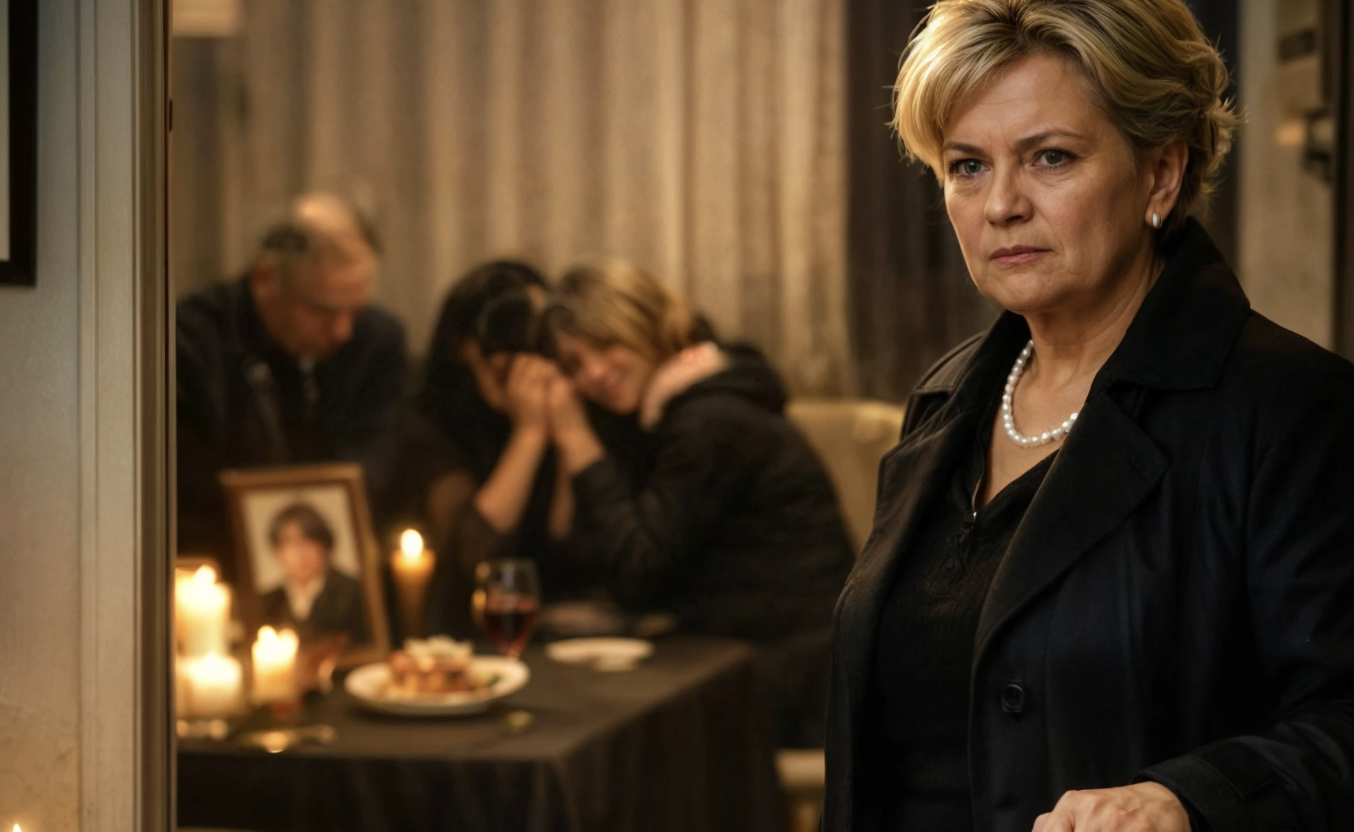
Then the sound of the front door opening came from the entryway. Irina turned, expecting to see someone late. In the doorway appeared Tamara Ivanovna. She wore a dark suit, her hair neatly styled. But in her hands she held not a bag of food or flowers, as was customary, but a large rolling suitcase.
Several people in the room also turned at the sound. The suitcase was so out of place in this setting that everyone fell silent for a moment. Tamara Ivanovna rolled it into the hall, adjusted the collar of her jacket, and said loudly:
“Since your mother is gone, I’ll live here now. There’s enough space.”
Irina froze. Her hand holding the ladle stopped above the pot. Aunt Valya, the neighbor, choked on her kompot. Oleg jerked his head up, but said nothing. Someone gave an awkward little laugh, apparently deciding it was a clumsy attempt to lighten the mood. But Tamara Ivanovna wasn’t smiling.
She took off her shoes, left them by the door, and, ignoring the silence, walked into the room. She dragged the suitcase after her, carefully maneuvering around people. The guests stepped aside, not knowing how to react. She approached the wall where an old chest of drawers stood and placed the suitcase next to it.
“This will be convenient for me,” Tamara Ivanovna said, looking around the room. “We’ll move the bed closer to the window, and we can get rid of that nightstand altogether. It only takes up space.”
Irina blinked, trying to process what was happening. People were sitting around her, having come to honor her mother’s memory. Hot food steamed on the table. In the corner, on a shelf, stood a photo of the deceased in a black frame. And her mother-in-law was talking about rearranging furniture, as if she’d walked into a showroom.
“Tamara Ivanovna,” Irina began quietly, “maybe we can discuss this later? It’s the memorial today.”
Her mother-in-law turned, genuine bewilderment on her face.
“So what? I’m not bothering anyone. I just had a look around. I’m going to live here, so I need to understand how everything’s set up.”
Oleg sat at the table, staring into his plate. Irina shot him a quick look, expecting at least some reaction. But her husband stayed silent. Aunt Valya nervously twisted a napkin. Her mother’s friend Lyudmila Petrovna pressed her lips together and looked away.
Tamara Ivanovna walked up to the table and inspected the dishes with a critical eye.
“I don’t like herring under a fur coat,” she remarked. “You could have made something lighter. Oh well—this will do for the first time.”
Irina squeezed her eyes shut for a second. Inside, everything tightened into a hard knot. She wanted to scream, throw her mother-in-law out, slam the door. But the guests were watching, waiting to see how she would respond. Irina unclenched her fingers, set the ladle back into the pot, and exhaled slowly.
“Please, have a seat, Tamara Ivanovna,” Irina said evenly. “We’re about to begin the remembrance.”
Her mother-in-law nodded and sat on an empty chair beside Oleg. The guests exchanged uncomfortable glances but continued eating. Irina went back to the kitchen, leaned her back against the refrigerator, and closed her eyes. Her hands were shaking. Her heart pounded as if she’d just run a marathon.
What was that? Tamara Ivanovna had always been forceful, but Irina hadn’t expected this. To come to a memorial with a suitcase and announce she was moving in? It went beyond even her idea of shamelessness.
When Irina returned to the room, her mother-in-law was already chatting away with Aunt Valya.
“I’ve been saying for ages that Oleg and Irina should live together,” Tamara Ivanovna declared. “Why maintain two apartments? It’s expensive. And now space has opened up—fate itself decided it.”
Aunt Valya nodded, but her face clearly showed she was shocked. Lyudmila Petrovna set down her fork and stood up.
“Irochka, thank you for the memorial. I should go,” her mother’s friend said, heading to the hallway.
Irina walked her to the door. Lyudmila Petrovna hugged her goodbye and whispered:
“Hold on, dear. Your mother was strong. And you—don’t let anyone hurt you.”
After Lyudmila Petrovna left, other guests began to disperse too. Some cited errands, some said they felt unwell. An hour later, only Irina, Oleg, and Tamara Ivanovna remained in the apartment.
Tamara Ivanovna leaned back in her chair, satisfied.
“Well, now we can talk heart to heart. Oleg, help me carry my suitcase into the room. Irina, you clean up here for now.”
Irina slowly lifted her head. Something inside clicked. Fatigue, grief, the strain of the last weeks—suddenly it all turned into cold anger.
“Tamara Ivanovna,” Irina began quietly but firmly. “Do you understand that this is my apartment?”
Her mother-in-law laughed and waved a hand dismissively.
“Oh, what are you talking about! Yours? Oleg is my son, which means the apartment is ours. A family one. What’s there to divide?”
“The apartment was transferred to me by gift deed three years ago,” Irina replied. “I have all the documents.”
Tamara Ivanovna frowned, clearly not expecting that answer.
“So what? You’re married to Oleg. That means everything is shared.”
“The gift deed was done before the marriage,” Irina clarified. “It’s my property.”
Tamara Ivanovna fell silent, digesting it. Then she turned to Oleg, who had still been sitting there quietly.
“Oleg, are you going to let your wife talk to your mother like that?”
At last her husband raised his eyes. He looked confused, but not eager to intervene.
“Mom, maybe not today? Let’s talk about everything calmly tomorrow.”
“There’s nothing to discuss,” Irina cut in. “Tamara Ivanovna, take your suitcase. You won’t be staying here.”
Her mother-in-law sprang up, face flushing red.
“How dare you?! I’m Oleg’s mother! I have the right!”
“You have the right to visit your son. But not to move into my apartment without asking,” Irina said.
Tamara Ivanovna looked at Oleg, expecting support. He stayed silent, staring at the floor. She turned and went out into the hallway. Irina heard the loud zip of a bag, then the door slammed.
Oleg stood up and walked to the window.
“You shouldn’t have done that,” he said quietly. “Mom wanted to help.”
Irina turned, unable to believe her ears.
“Help? She came to the memorial with a suitcase and announced she was in charge now!”
“She didn’t mean it badly. She just wanted to be closer to us.”
“Oleg,” Irina stepped closer, “do you even understand what happened today?”
He shrugged.
“I do. Mom got carried away. But you could have been gentler.”
Irina stood in the middle of the room where, just an hour earlier, people had sat to see her mother off on her final journey. Uneaten food cooled on the table. A photograph in a black frame stood in the corner. And her husband was defending the woman who had turned the memorial into a circus.
“Leave,” Irina breathed.
“What?” Oleg didn’t understand.
“Leave here. Now.”
Oleg frowned.
“Ira, what are you talking about? Maybe you should calm down?”
“I am calm. I just don’t want to see you. Leave.”
He hesitated, then silently put on his jacket and left. The door closed softly. Irina remained alone. She sat on the couch, hugged her knees, and the tears finally poured out—tears of hurt, exhaustion, helplessness. She cried for a long time, until she had no strength left.
The next morning, Irina woke to the doorbell. Her head split with pain; her eyes were swollen from crying. She looked at the clock—8:30. Who would come so early? The ring was long and insistent. Irina went to the door and peered through the peephole. Oleg and Tamara Ivanovna stood outside. Her mother-in-law was holding the suitcase again.
Irina opened the door, leaving the chain on.
“What do you want?”
“Ira, open up,” Oleg asked. “Let’s talk properly.”
“Talk like this.”
Tamara Ivanovna stepped forward.
“Irochka, I understand it’s hard for you right now. Losing your mother is terrible. But life goes on. We’re family—we have to help each other. Let us in and we’ll talk like civilized people.”
Irina looked at her mother-in-law, at the suitcase, at Oleg. Her husband avoided her gaze, studying the toes of his own boots. Tamara Ivanovna smiled—sweetly, that cloying smile she used when she wanted her way.
“Fine,” Irina nodded. “Come in.”
She removed the chain and opened the door wider. Tamara Ivanovna brightened and stepped into the apartment first. Oleg followed. Her mother-in-law left the suitcase in the hallway and took off her coat.
“Good. Now we’ll have some tea and discuss everything. Irochka, do you have any cookies?”
“I do,” Irina replied and went into the kitchen.
Tamara Ivanovna and Oleg sat down at the table in the room. Her mother-in-law glanced around, apparently assessing what changes could be made. Irina returned with the kettle, poured tea into mugs, and silently placed a plate of cookies in front of them.
“Thank you, dear,” her mother-in-law said, taking her mug and sipping. “See how good it is when we do things properly. I’ll tell you right away—I need to stay here for about two weeks. Maybe three. The workers promised it would be quick, but you know how that goes.”
Irina nodded.
“I understand.”
Tamara Ivanovna relaxed, pleased.
“I won’t take up much space. I’ll take that room where your mother lived. The bed is comfortable, and the wardrobe is big. You’re not sleeping there now, are you?”
“I’m not,” Irina confirmed.
“Perfect. Oleg, later help me move the suitcase in there. And the curtains, Irochka—we’ll need to change them. These are old and faded.”
Irina took a sip of tea, set her mug down, and pulled out her phone. She unlocked the screen, found the number she needed, and dialed.
“Hello, police? Good day. I’d like to report an unauthorized person entering my apartment.”
Tamara Ivanovna froze with a cookie halfway to her mouth. Oleg jerked his head up.
“Ira, what are you doing?” he murmured.
Irina continued speaking calmly into the phone.
“Yes, that’s right. The address is Sadovaya Street, building 12, apartment 8. There are belongings of an outsider in the apartment; please come and document the situation.”
Tamara Ivanovna went pale. The cookie slipped from her hand onto the plate.
“What are you doing?!” she shrieked. “Oleg! Say something!”
Oleg sat there with his mouth open, unable to form a word.
Irina set the phone down on the table.
“The patrol will be here in ten minutes. You have time to take the suitcase and leave on your own.”
“I’m your mother-in-law!” Tamara Ivanovna screamed. “How dare you?!”
“I dare,” Irina answered quietly but firmly. “This is my apartment. The documents are in my name. You entered without my permission, brought your things, and intend to stay without the owner’s consent. That’s a violation.”
“Oleg!” her mother-in-law turned to her son. “Are you going to allow this?!”
Oleg said nothing. He looked from his mother to his wife. His lips moved, but he couldn’t find words.
“Time is passing,” Irina reminded her.
Tamara Ivanovna jumped up and grabbed her coat. Her hands trembled; she couldn’t fasten the buttons. Oleg helped her, then picked up the suitcase. Tamara Ivanovna went to the door and turned back.
“You’ll regret this,” she hissed through clenched teeth.
“Maybe,” Irina agreed.
When the door closed behind them, silence settled over the apartment. Irina walked into the room and went to the window. Down below, in the parking lot, Oleg was helping his mother lift the suitcase into the trunk. Tamara Ivanovna was talking and waving her arms; Oleg nodded, then got into the driver’s seat.
Seven minutes later, the doorbell rang. Irina opened the door. Two police officers stood on the threshold.
“Good evening. You called?”
“Yes,” Irina let them in. “But the situation has been resolved. The person left.”
The older officer glanced around the hallway.
“Are you sure everything is okay?”
“I’m sure. Thank you for coming.”
The officers exchanged a look. The younger one reached for a notepad.
“We’ll record the call-out anyway—for the record. If it happens again, contact us.”
“Alright.”
When the patrol left, Irina locked the door and leaned back against it. Slowly she slid down and sat right on the floor in the hallway, hugging her knees. Everything inside her trembled—from tension, from fear, from relief.
The apartment was silent. Empty and quiet. But now it was her apartment. Her home—the place where her childhood had passed, where her mother had died. There was no place here for outsiders who came with suitcases and demanded residency.
Irina got up and walked into the room. On the table stood her mother’s photograph in a black frame. In the picture, her mother smiled—the same warm smile Irina remembered from childhood.
“Forgive me, Mom,” Irina whispered. “Forgive me that it turned out like this.”
Her mother didn’t answer. But Irina suddenly understood clearly: her mother would be proud of her now. For not giving in. For protecting her home. For not letting herself be trampled.
The next day Oleg called.
“Why did you do that? We’re family.”
“Oleg, family is when boundaries are respected. Your mother came to the memorial with a suitcase and announced she was in charge here. That’s not normal.”
He was silent.
“Maybe you went too far? Mom didn’t mean harm.”
Irina felt something inside snap—finally and irreversibly.
“Oleg, I’m tired. Tired of explaining. Tired of proving things. If you don’t understand what the problem is, then we have nothing to talk about.”
“What are you saying? You mean…”
“Exactly. Come pick up your things. Leave the keys.”
She ended the call. Sat down on the couch and looked out the window. Yellow leaves spun outside the glass. October was ending. Winter lay ahead—cold, snowy. But Irina was no longer afraid.
The home belonged only to her again—and to the memory of her mother, who had signed it over as if she had foreseen her daughter would need that protection. Now Irina knew for sure: she could stand up for herself. Even if she had to do it alone