— I don’t understand why you’re paying strangers when you have an apartment! We tried so hard for you!”
Anna read her mother’s message out loud, as if saying the words might change their meaning. It didn’t. She was sitting at the kitchen table in a rented one-room flat, counting crumpled bills and carefully writing in a worn notebook: “Rent — 25,000, groceries — 8,000, transit pass — 2,500…”
Her phone buzzed again. Anna didn’t even look—she already knew it would be another reminder of her parents’ “generosity.” She tossed the phone to the far end of the table, where it thudded dully against the sugar bowl. Inside her chest rose a familiar wave: a mix of resentment and some long-calcified bitterness that time refused to dissolve.
Anna looked around her kitchen—tiny, with peeling paint on the radiator and an old refrigerator that hummed like a tractor. And yet here, she felt at home. Unlike that other apartment—spacious, renovated, overlooking a park. The apartment her parents had “given” her.
Anna’s mother, Valentina Sergeyevna, always knew what was right. The right way to raise her daughter, the right friends for her to choose, the right plan for her future. Her father, Pyotr Nikolayevich—quiet, easygoing—rarely argued with his wife. In twenty-eight years of marriage he had learned to nod at the right moments and agree with her decisions.
When Anna turned fourteen, her parents announced at the праздничный table:
“We bought an apartment! For you, sweetheart. So you’ll have your own place when you grow up.”
Relatives gasped and praised them. What wonderful parents, what care for their child! Anna hugged them then, moved to tears. It seemed to her she was the happiest girl in the world.
The apartment was in a good neighborhood, close to the метро. Two rooms, bright, with a big kitchen. Her parents renovated it and furnished it—everything in calm beige tones, just the way Valentina Sergeyevna liked.
On the day Anna was accepted to university, her parents staged a little ceremony. She stood in the entryway of that very apartment with a bouquet of white roses, while her mother and father smiled, holding a set of keys tied with a red ribbon.
“This is your home, Anechka!” Valentina Sergeyevna proclaimed. “Now you’re grown up, independent. We’re so proud of you!”
Anna took the keys with trembling hands. She was eighteen, full of hope and plans. The whole world lay at her feet.
Only a few months later, when she needed to arrange temporary registration for the university, Anna found out that the owner listed on the apartment documents was Valentina Sergeyevna. “Of course,” her mother explained. “You’re still so young. We’ll transfer it later, when we need to.” Anna didn’t think much of it. Why would she? They were her parents—her closest people.
The first crack appeared in her second year. Anna realized she had chosen the wrong faculty. Economics bored her; numbers blurred before her eyes, and accounting lectures made her feel miserable. But the elective she’d taken—art history—she attended with shining eyes.
“Mom, I want to transfer to art history,” she said over dinner at her parents’ home.
Valentina Sergeyevna froze.
“What nonsense is this? Art history? And who will you work as—someone in a museum for pennies?”
“But I’m interested in it! I can’t sit over these spreadsheets anymore…”
“You can’t?” her mother’s voice turned icy. “So we paid for your education for nothing? Bought you an apartment for nothing?”
“What does the apartment have to do with it?” Anna asked, bewildered.
Valentina Sergeyevna stood up from the table, cheeks burning with anger.
“It has everything to do with it! You’ll do as we say! If you don’t like it—vacate the apartment, since you won’t take us into account! It’s my home, by the way. I’m the owner!”
The words hit like a slap. Anna stared at her mother and for the first time saw a stranger. Pyotr Nikolayevich ate his cutlet in silence, eyes down on his plate.
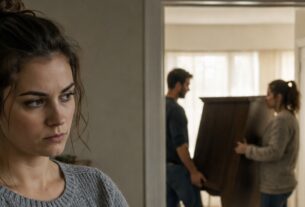
That night Anna couldn’t sleep. She lay in “her” room, in “her” apartment, and felt like a prisoner. Everything around her—curtains her mother had chosen, the sofa her parents had bought, even the bed linens—none of it was hers. It was all a tool of control.
At three in the morning she began packing. Clothes, textbooks, her laptop—shoving everything into a bag. Her hands shook, a lump rose in her throat. She called Katya, a classmate she was friends with.
“Can I stay with you for a few days?” Anna whispered into the phone.
“Of course! What happened?”
“I’ll tell you later.”
As she left, Anna placed the keys on the little table in the entryway. The metal chilled her palm, almost like a burn. She closed the door quietly and went down the stairs. A fine drizzle fell outside. Katya was already waiting in her car by the entrance.
Anna lived at her friend’s for three days. She slept on a fold-out cot in the kitchen, went to classes as if through fog, and didn’t answer her parents’ calls. On the fourth day Valentina Sergeyevna showed up at the university, standing by the classroom entrance—upright, in a строгий suit, her face unreadable.
“We need to talk,” she said—and it wasn’t a question.
They sat in the nearest café. Her mother ordered two coffees and was silent for a long time, stirring sugar.
“Anna, stop acting foolish. Come back home.”
“That isn’t my home,” Anna said softly.
“Don’t start. You’re my daughter. I want what’s best for you. Art history isn’t a profession. What—do you want to live in poverty all your life?”
“I want to do what I love.”
“Love won’t pay the bills. You’ll finish economics, get a real profession, and you can do art as a hobby. I’ll even pay for courses if you want.”
Anna raised her eyes. Valentina Sergeyevna looked tired; shadows sat beneath her eyes.
“Anya, please. Your father and I haven’t slept these days. We’re worried. You’re our only daughter.”
And Anna broke. Not from threats or shouting—from the weariness in her mother’s voice, from those words: “only daughter.” Guilt swallowed her whole. She nodded, gathered her things from Katya, and returned to the apartment with the beige wallpaper.
The next year and a half passed like a haze. Anna dutifully attended economics lectures, took exams, smiled at her parents over Sunday lunches. In the evenings she secretly read books about art, watched documentaries about great painters, and sometimes cried into her pillow from the feeling of being locked in a cage. But she stayed. Obeyed. Because “only daughter,” because “we’re worried,” because it was easier that way.
Three years passed. Anna graduated from the economics faculty. She still lived in her parents’ apartment, worked as an accountant at a small firm, and in the evenings took art history courses—for her soul.
At an exhibition she met Artyom. He was a photographer, shooting for glossy magazines, but dreaming of his own projects. They started talking about composition in photography; then came museum visits together, long walks through the вечерний city, and after six months Anna realized she was in love.
Meeting her parents happened in September. Valentina Sergeyevna prepared a formal dinner—duck with apples, Olivier salad, even baked a cake. Artyom brought flowers and a bottle of good wine.
At the table, conversation wouldn’t flow. With a strained smile Valentina Sergeyevna questioned him about work.
“A photographer, then? And do they pay much for those… photographs?”
“It depends,” Artyom answered calmly. “Sometimes well, sometimes I have to take side jobs.”
“Side jobs,” her mother repeated, and contempt was clearly audible in her voice. “And do you have an apartment?”
“I’m renting for now.”
Anna squeezed Artyom’s hand under the table. He gave a light squeeze back.
After dinner, when Artyom left, her parents called Anna in for a “talk.”
“He’s not right for you,” Valentina Sergeyevna said flatly.
“It’s not you who has to live with him—it’s me!” Anna snapped.
“If you decide to move in with him—you won’t see that apartment,” her mother looked straight into her eyes. “It’s my apartment. I decide who lives there. Some penniless photographer certainly won’t be registered there.”
“But you said it was my home!”
“It’s yours—as long as you live the way we think is right. No one’s holding you. You can wander from rented corner to rented corner.”
Anna stood up from the table. Her chest burned with hurt and anger.
“You know what? I will. At least those corners will be mine.”
She left that same night, taking only the essentials. Artyom met her by the metro, hugged her without asking questions. They went to his place—a tiny studio on the top floor of an old building.
Eight months later, Anna and Artyom broke up—quietly, without scandals. They simply realized they wanted different things from life. Anna moved into another rented place: a one-room flat on the outskirts—the very one where she was now sitting at the kitchen table.
Work drained her, money was always tight, but strangely Anna felt happier than she ever had. She decided for herself what curtains to hang (she bought bright yellow ones on sale), what to cook for dinner (most often pasta with canned тушёнка or cheese), what time to go to bed, and when to invite guests.
That evening she came back after an exhausting day at the office. The annual report, a нервный boss, a broken printer—everything hit at once. Anna boiled pasta, opened a can of тушёнка, sliced a tomato, sat at the table—and suddenly smiled. Simple food, cheap dishes, a view of a gray соседняя wall—but it was all hers. Her choice. Her life.
The phone rang as she was finishing dinner.
“Anechka,” Valentina Sergeyevna’s voice was unusually soft. “Katya told me you and Artyom broke up.”
“Yes, Mom.”
“Well, you see—we told you he wasn’t a match for you. Never mind, come back home, to your apartment. No need to throw money away.”
Anna held the phone and looked at her reflection in the dark window: a tired face, messy hair, but eyes—calm, confident.
“Mom, it isn’t my apartment. It’s yours. Mine will come one day—somehow.”
“Don’t talk nonsense! You earn pennies!”
“I’ll save. For a mortgage. It’ll take a long time, it’ll be hard, but it will be mine alone.”
“Proud thing!” her mother’s familiar anger broke through. “Ungrateful!”
“I’m grateful for your забота, Mom. Truly. But I need to live my own life.”
Anna ended the call. The phone immediately started ringing again, but she muted it. A strange feeling spread in her chest—not anger, not resentment, but a calm acceptance. Yes, her parents wanted what they thought was best. In their way they loved her. But their love suffocated, their забота turned into control.
Her parents didn’t give up for several more months. Valentina Sergeyevna complained to every relative and acquaintance: “Can you imagine, we bought her an apartment and she’s living in rented holes! Too proud!” Pyotr Nikolayevich stayed silent, but sometimes sent Anna money to her card—secretly, without his wife knowing.
Anna stopped reacting to the reproaches. She opened a separate bank account and deposited at least a small amount every month. She took evening side work—helped acquaintances with reports. She studied mortgage programs and went to view new buildings.
“Have you lost your mind?” Katya would say, flipping through brochures with her. “Thirty years paying off a loan!”
“But it’ll be mine,” Anna would answer. “Do you understand? Mine. If I want to hammer a nail in—I will. If I want pink wallpaper—I’ll put it up.”
“Pink wallpaper is too much,” Katya laughed.
“Then maybe yellow. Like my curtains.”
She learned to save without depriving herself—found good вещи in second-hand shops, cooked at home instead of going to cafés, walked when the weather was good. But she didn’t deny herself small joys either—once a month she always went to a theater or exhibition, bought good books, sometimes treated herself to a tasty coffee at her favorite café.
Life slowly improved. She got a small promotion at work, made new friends, and even started seeing a coworker from the соседний department—Misha, a calm, dependable guy who didn’t push advice and respected her decisions.
Four years had passed since that evening in the rented kitchen. Anna stood in the middle of an empty room and couldn’t believe it was really happening. In her hands she held the purchase contract and keys—real keys now, her own keys to her own apartment.
A studio in a new building on the outskirts—only thirty-two square meters. But with big windows, her own bathroom, and a tiny balcony. It smelled of fresh plaster and new frames. Sunlight flooded the empty space, drawing golden squares on the floor.
Anna walked to the kitchen—very small, but hers. She put on the stove the only thing she owned there so far: an old kettle brought from the rented place. She sat on the windowsill, hugged her knees, and looked down at the city. Twelfth floor. A view of the sunset.
Her phone buzzed. A message from her mother: “I saw your photos on social media. What kind of box did you buy? You’re too proud—you could’ve been living in a normal apartment long ago instead of this studio. Come to your senses, it’s not too late.”
Anna read the message twice. Then she smiled and turned off the sound on her phone. The kettle whistled; she took it off the stove and made tea in a cardboard cup—there were no dishes yet.
She returned to the windowsill. Down below the city lit its first lights. Somewhere there, in the center, stood that two-room apartment with beige wallpaper and “proper” furniture. The gift-apartment, the trap-apartment, the illusion-apartment.
And here, in this empty studio with bare walls, Anna felt truly at home for the first time. Tomorrow Misha would come and help assemble IKEA furniture. Katya promised to give her a bright plaid. Next week Anna would hang those very yellow curtains—bring them over from the rented place.
“At last I’m home,” Anna said out loud, and her voice echoed off the empty walls. “In my own home.