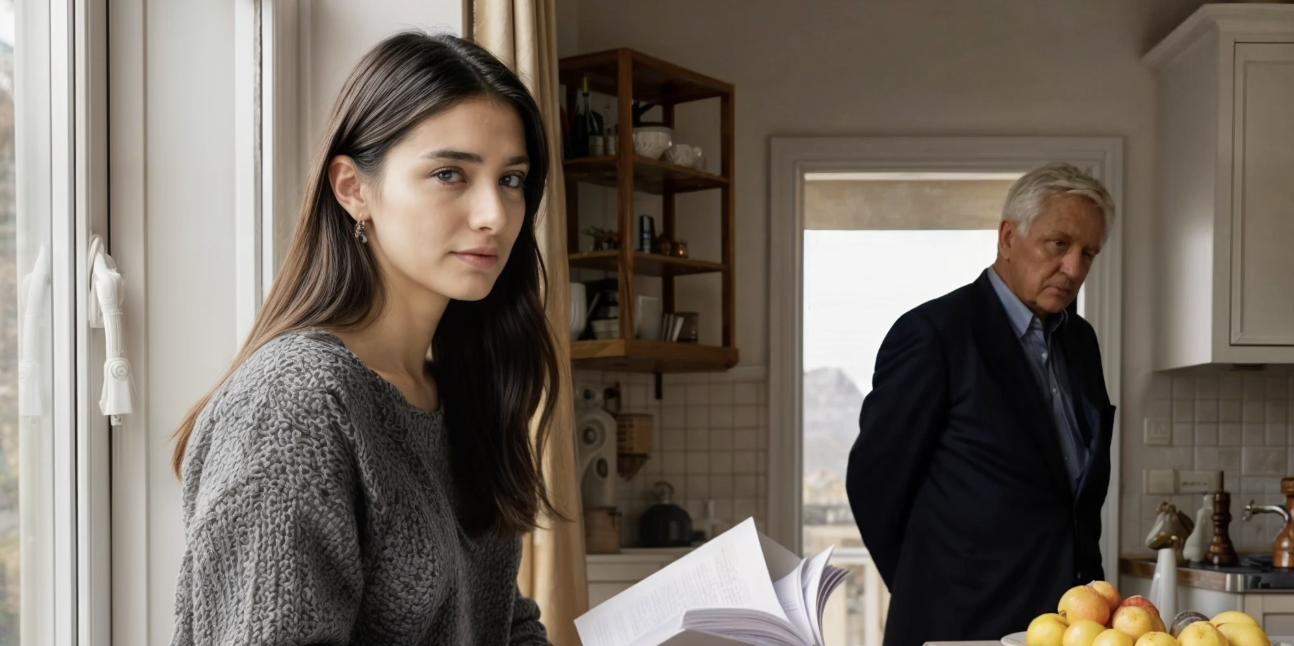
— Are you deliberately trying to make my mother have a heart attack? Nicholas rasped, hurling the remote onto the table as if he were tossing away a red-hot coal that had scorched his palms.
— Don’t be so dramatic, please, Elena replied indifferently, without looking up from the dishes. The water in the sink roiled, foam sliding down the plates like a shroud. Let her at least stop rummaging through my closets.
— She means well for you! Nicholas exploded, blocking the light spilling in from the window. She says your place is a mess, like a dorm. You’re a grown woman—you’ve got a family! And you live… like some seventeen-year-old girl, not a thirty-five-year-old mother.
— Because it’s my apartment, Kolya, Elena cut him off, turning off the tap and fixing her eyes on it. I can keep the tea under the table instead of on the mezzanine, if I want. Because that’s what’s convenient for me.
His shoulders sagged under an invisible weight. He wearily rubbed his forehead, as if trying to wipe away a grimace of hopelessness.
— Here we go again—“mine,” “mine”… Do you even realize you’re not living alone?
— I realize it perfectly well, she said slowly, drying her hands on a towel. Especially when someone barges into the bathroom while I’m washing because “the faucet’s leaking.” Or when some stranger’s jars of sauerkraut appear in the fridge. Or when my documents aren’t where I left them.
She turned around. Her gaze was direct—tired and cold. Icy water seemed to slosh in her eyes.
— Tell me honestly, Kolya. Was it your idea to put the apartment in your name?
Nicholas bit his lip. He fell silent, like someone caught red-handed.
— Mom said it would be “the right thing for the family.” So that if something happens to me, the apartment doesn’t go anywhere.
— Doesn’t go anywhere? Elena twisted her mouth into a crooked smirk. I don’t have brothers or sisters. Legally it’s mine anyway. Even if I jumped off a roof tomorrow—it still wouldn’t become hers. Not your mom’s, Kolya. Sorry.
— She’s just worried. She’s older—she has experience. She cares…
— She’s in debt up to her ears, Elena cut in sharply. And I’ve figured that out already.
Silence fell—heavy, sticky, like tar. Nicholas recoiled and went to the window. He watched dark May leaves, like black sails, thrash in the wind.
— What are you even saying…
— You didn’t know? Or you pretended not to? Elena crossed her arms, forming an invisible barrier. Bailiffs brought a letter. Her microloan is in your name. You’re the guarantor. All neat—on paper. She wanted to do it quietly, dump it on you. But it didn’t work out. Now she needs the apartment. To sell it. Or to mortgage it. My home—to pawn it off! For her debts and her fantasies about “renovations” and “treatment.”
Nicholas hunched over as if he’d taken a punch to the gut.
— She said… helping the family…
— Family? This is her fourth “help.” Remember 2021? The scooter on credit. In your name. You paid for two years like a cursed man.
— I thought she’d changed…
— She has, Elena nodded. For the worse. Now she coats her words in syrup—until you sign a document. And then that’s it, Kolya. You’re in debt. And I’m without an apartment.
He turned around. His gray eyes darkened, grew heavy, as if filled with lead.
— But she’s my mother… You can’t just refuse her.
— And I can’t let myself be betrayed, Elena said quietly. This isn’t a marriage anymore, Kolya. It’s a deal. Where I’m the expendable part.
She went into the room. It smelled of new laminate—alien and cold, like a state-run hotel. The apartment where she’d rearranged furniture after her grandmother’s death was slowly, irreversibly becoming less and less like her home.
Elena sat on the couch. Picked up the remote. A bright TV show flickered on the screen—people laughing, waving spoons around. She saw nothing.
— You really thought I’d agree? Nicholas stood in the doorway like a lost ghost.
— I hoped you were an adult, she said tiredly, not turning around. Not a mama’s boy on a leash.
He slammed a cabinet door so hard the glass trembled.
— Enough! You have no right to humiliate me. You don’t know what it’s like—being stuck between you! You with your complaints, her with her debts!
— You’re wrong. I do know, Elena rose. I’m the bargaining chip, Kolya. You want to spend me in this little play.
— Lena…
— Leave.
— What?
— Go to your mother’s. Spend the night there. Think about where you plan to live. With me—in my apartment. Or with her—in a rental. I have nothing else to say to you.
She walked past him as if past a stranger. He stayed at the threshold—confused and pathetic—staring into the mirror at his crushed reflection lost among someone else’s shoes.
And the door closed behind him softly, gently—like the apartment itself had said: “No. Enough.”
And then, in the quiet, came a muffled voice outside—full of desperation:
— Elena, open up. I know you’re home. Your bathroom light is on.
Margarita Vasilievna hammered the door with her palm—insistent and furious, as if she weren’t knocking but testing the limits of Elena’s patience. In the musty stairwell, the click of heels burst like angry sparks and boomed off the walls, as if the building itself—old and weary—were eavesdropping and sighing along.
— I didn’t give birth to my son so you could boss him around! The apartment must be in the husband’s name! The head of the family!
— Go home, Margarita Vasilievna, Elena’s voice came through the door, icy calm—too calm for the storm behind it. Nikolai and I have discussed everything. The apartment is mine. There’s nothing more to discuss.
— Oh, nothing?! The door shuddered from a furious yank but remained unyielding. Kolya will come back and the three of us will sort it out! You’re nobody here. A mistress isn’t decided by a piece of paper, but by experience and common sense!
— And you have debts, Elena cut in flatly. I’m aware of your financial problems.
A sinister silence fell outside the door. Then—a blow. Dry, distinct—like a seal stamping the end of an argument.
— Know this, her mother-in-law’s voice went hoarse with hatred, you’re nothing here. A little girl who got lucky by accident. This apartment isn’t your achievement. And if we help you keep it, you’ll be grateful. And if I tell Kolya how you behave—he’ll throw you out himself. A husband is support. Not furniture in your bedroom.
The door handle jerked again, but it seemed Margarita Vasilievna’s strength had finally left her.
— Leave, Margarita Vasilievna, Elena said coldly. Or I’ll call the police. Next time there won’t be a warning.
Silence. Only the sound of heels retreating down the stairs like a defeated enemy. In the stale air, a heavy trail of sharp perfume lingered, mixed with the smell of mothballs—like a sinister reminder of a war.
A couple of hours later Nikolai returned. He carried a plastic bag from Pyatyorochka as if nothing had happened—as if he really had only stepped out for milk.
— Did you call my mom? Elena looked up from the couch where she felt trapped.
— She came on her own. I was at her place… she was crying. Said you threw her out, yelled…
— Don’t lie, Elena snapped. I didn’t yell. She was the one pounding on the door. Is that what you want? For her to run things here?
— She’s desperate. Collectors are staking out her windows.
— Then let her pay. What do I have to do with it? This is my grandmother’s apartment. My memory. The only thing I have left. And she’s crawling in here with her debts—and you’re singing along.
— I can’t abandon her, Lena. I’m her son. You want me to choose?
— Yes. I do. Because she chose long ago—money. And who will you choose?**
He fell silent, burning her with his stare. In anger he flung the bag onto the table. A loaf slid out of its wrapper, tea spilled across the oilcloth tablecloth like an omen. Nikolai stepped toward Elena. His face went white; his eyes flared with a hostile fire.
— I’m tired. You’re always making demands. Mom’s an old person. She has blood pressure. And you act like a stranger. You don’t even try to talk to her like a human being!
— I talk to her exactly the way she deserves, Elena said. A manipulator. A predator. You’re her prey. And I’m an extra victim in her show.
— Who are you to decide?! Nikolai grabbed Elena’s arm roughly, squeezing until it hurt. You’re married. You have to consider more than just yourself!
— Let go, her voice sounded quiet, but unbreakably firm.
— You made my mother cry!
— And she drove me to a notary, Elena replied calmly. I was there today. I rewrote my will. If something happens to me, the apartment goes to a fund for women who have suffered violence.
He went so pale it seemed all the blood drained from his face at once.
— You wouldn’t dare…
— Too late. I already did. Let her know: keep playing games—she’ll lose everything. Even the chance to “snatch a little piece.”**
He stepped back as if struck by an invisible blow.
— You… you’re insane…
— No. I finally got well. Cured of naivety. From today on everything will be different. I’m no longer obligated to be a victim. Not even for your mother in her “Magnit” perfume.**
Without another word she slipped into the bathroom, shut the door, and clicked the latch. Nikolai remained rooted in the middle of the kitchen amid the soggy loaf and scattered tea, as if he’d suddenly found himself in an endless line for some phantom justice—having completely forgotten why he’d joined it.
And behind the door, silence settled—heavy, like that bedroom where they would never again fall asleep in each other’s arms.
— Are you serious? Nikolai sat on the very edge of the couch, shoulders slumped, a kind of old-man resignation showing in his face as if life had dumped fifty years on him at once. To a fund? For women? Lena, are you saying that about me?
— About both of us, Kolya, Elena answered evenly, carefully drying the dishes. Violence isn’t only bruises and broken bones. It’s when you can’t breathe in your own home because you’re being methodically strangled with words, reproaches, guilt. When you wake up every morning feeling an unbearable weight. That’s violence too. And I want my apartment to help those who survive it—not your mother, who only pushes women into an even deeper abyss of humiliation.
— I don’t understand… Nikolai got up and went to the window. I’m not a bad person. I just don’t want my mom to die drowning in debt.
— Then sell your car. Or your share of your parents’ house. But why should my apartment become a life ring for her endless debts?
He lowered his head. Silent.
The next day Margarita Vasilievna tried again to force her way in. But now a brand-new sign greeted her on the door:
“NO UNAUTHORIZED ENTRY. VIDEO SURVEILLANCE IN PROGRESS.”
And a cheap camera, winking with a brazen red eye, scared off every uninvited guest. Even the mailman dropped letters into the box warily.
Margarita raged, but she no longer pounded the door—she called Nikolai fourteen times a day.
— What is it, son, are you completely under that… woman’s heel? That… that volunteer burned your brains out?
— She’s not a volunteer, Mom. She’s my wife.
— Not anymore, Elena said quietly from behind him. I filed for divorce. Yesterday.
Nikolai flinched. Margarita fell silent on the other end of the line. Then, like a snake, she spat venom:
— Well then, congratulations. You know how to destroy families. Go on with your camera and sue like all these modern girls. Complainers…
— Better a complainer than your slave, Elena shot back firmly. And yes, I will sue. For everything. For illegal intrusions. For threats. For the way you’ve been teaching your son since infancy that a woman is automatically in debt.
A heavy silence followed. And then, unexpectedly, in a чужой, broken voice:
— You do understand… I’m completely alone now… I have nothing left…
— Not you, Elena answered calmly. Me. But I’m rebuilding now. Myself.
Two weeks passed.
Elena sat on the windowsill. Spring raged outside; the wind chased a light, rustling plastic bag with the “Magnit” logo along the pavement—and it felt like a sinister symbol. On her knees lay a neat folder: the divorce filing, the new will, receipts from the lawyer.
There were no tears left. She had cried them all out earlier. Now her soul held a ringing emptiness—but it was a bright emptiness, like a freshly whitewashed room from which a bulky Soviet wall unit had finally been hauled away. The air vibrated with freedom.
Her phone lit up: a message from her lawyer.
“The hearing is set for May 15. Documents accepted. Good luck, Elena Sergeyevna.”
She gave a faint smile. Luck wouldn’t hurt. But the most important thing was that now it was her life—hers alone. Without other people’s voices. Without other people’s decisions.
The doorbell rang.
Elena tensed and looked through the peephole. A young woman in a baseball cap stood there with a tablet in her hands.
— Hello. We’re conducting a survey among district residents. Would you like to take part in a support program for women going through divorce?
Elena flung the door open.
— Not only will I take part. I want to join the project’s council. I have experience. Bitter—but real.
The woman nodded encouragingly. And Elena, without looking back, stepped forward decisively—as if she were finally coming home. Home—for real.
Epilogue.
A couple of months later Elena случайно heard her former mother-in-law’s surname. On TV they ran a short segment: a пенсионерка had sunk into debt to a bank; neighbors complained about constant shouting and scandals. The camera caught, in the darkness of an entryway, an enraged woman in a housecoat brandishing an old broom at the reporter.
— I recognize you, Margarita Vasilievna, Elena whispered and turned off the television.
She put the kettle on, poured fragrant green tea into her favorite teapot—from a little shop near the notary. Sat on the windowsill. In silence. Without nagging calls. Without suffocating tears. Without endless чужие dramas.
She simply lived