Everything began three years ago, when Artyom brought his fiancée and her mother to meet his parents. Tamara Viktorovna, Artyom’s mother, immediately understood: the girl was a good one. Katya was a student at the teacher-training college—modest, well-mannered, from a “decent family.”
True, when it turned out that this “decent family” meant a single mother from the village of Kozlovka—half an hour from their industrial town—Tamara couldn’t help but frown a little.
“And where is the father?” she asked carefully, pouring tea into her best cups with little roses on them.
“He died when Katyusha was ten,” Zinaida Ivanovna replied, neatly breaking off a piece of pastry. “I raised her alone.”
Zina was about fifty-five, wearing a simple cotton dress and a knitted cardigan. Her hands were working hands—rough and calloused. She spoke quietly, with a village accent. A headscarf sat on her hair, and she never took it off the whole evening. Out of the corner of her eye, Tamara noticed the cheap shoes and the faux-leather handbag.
“I work as a milkmaid at the state farm,” Zina went on. “My Katya is a clever girl—always top of the class. I sold my cow for her, so she could get into college.”
Artyom looked at his fiancée with adoration, while Katya blushed and whispered:
“Mom, please… no need for details.”
Tamara Viktorovna nodded and smiled, but in her head she was thinking: My God, a milkmaid… What if the neighbors find out? What about my coworkers?
She—deputy chief accountant at the district administration—had always been proud of her position. An apartment with a modern renovation, a husband who was a foreman at the factory, a son who’d graduated from a technical institute and worked at the same plant as an engineer. Everything proper, everything respectable.
And now—her in-law, a milkmaid in a headscarf…
They prepared for the wedding thoroughly. The restaurant Mayak—the best in town, and priced accordingly. Tamara tried on three dresses and settled on the burgundy suit she’d bought for her boss’s anniversary. She had her hair styled at a salon and got a manicure.
“And what is Zinaida Ivanovna going to give as a gift?” she asked her son a week before the celebration.
“I don’t know, Mom. Katya says she’s preparing something special.”
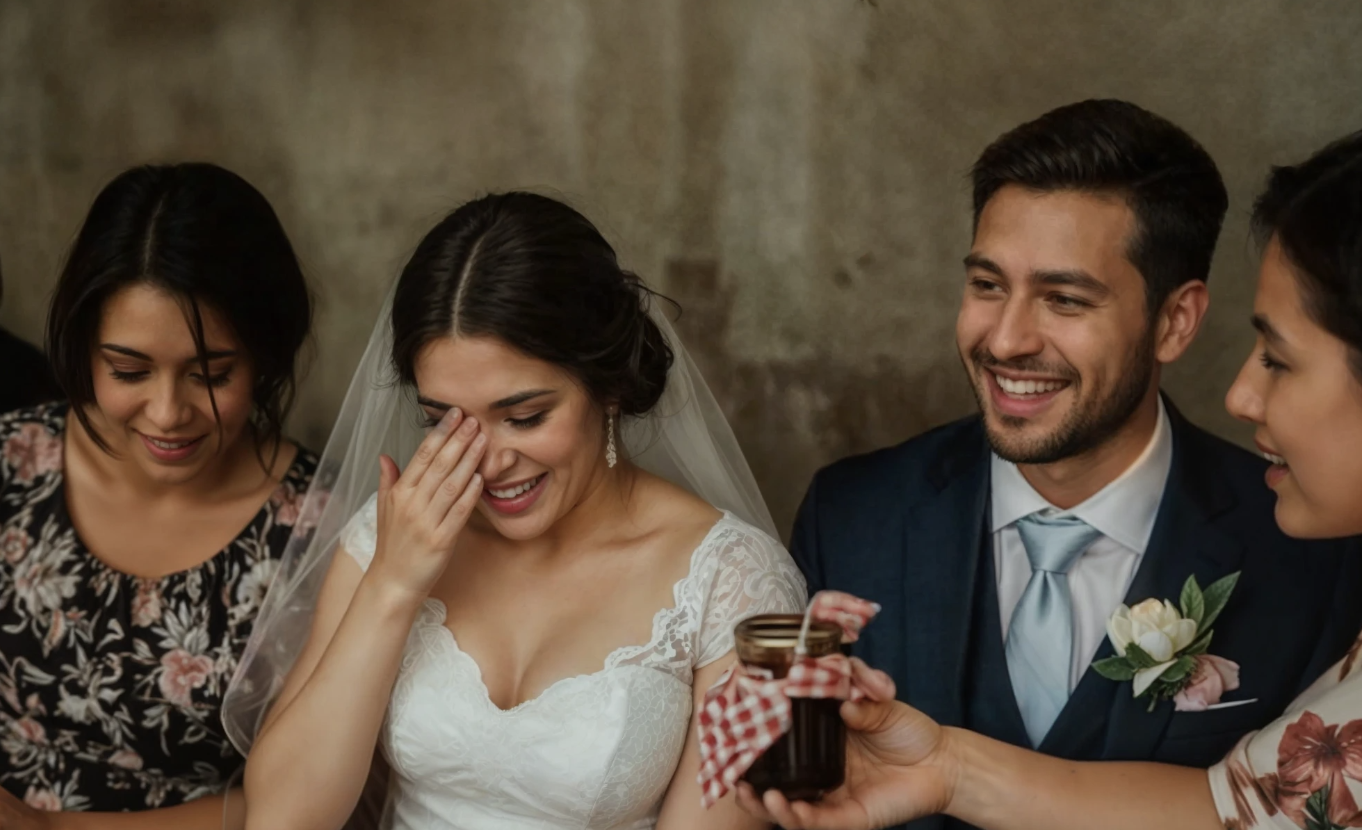
That “something special” turned out to be a homemade tablecloth—snow-white, with embroidered roses—and a three-liter jar of cherry jam.
“I wove the tablecloth myself,” Zina explained proudly to the guests. “On winter evenings. And the jam is from my own garden—cherries as sweet as can be.”
Tamara saw the way her colleagues exchanged looks. Lidiya Semyonovna, head of HR, had given a crystal vase worth eight thousand. The Petrovs from next door—a set of expensive pots. And here it was: a handwoven tablecloth and a jar of jam.
“How… touching,” Valentina Konstantinovna, head of social services, said through clenched teeth.
Zina smiled simply and started talking about her village, about cows, about how well the potatoes had grown that year. The guests listened with polite but condescending smiles. Tamara felt her cheeks burning.
“And in Kozlovka it’s such a blessing in spring!” Zina enthused. “The apple trees bloom, the bees hum. Katyusha used to disappear into the garden all day as a little girl.”
“Mom, come on…” Katya mumbled, embarrassed.
“What’s there to be shy about?” Zina was surprised. “Nature is nature.”
After the wedding, Tamara’s friend Svetlana Borisovna, a local doctor, asked delicately:
“And your in-law… how to put it… she’s very… simple.”
“She’s a good woman,” Tamara replied dryly. “Raised her daughter alone, after all.”
But inside, she was boiling with shame.
After the wedding, Tamara tried not to cross paths with Zina. When Katya gave birth, they celebrated the granddaughter’s birthday at home—quietly. The young couple lived with the mother-in-law then, so Tamara decided who to invite and who not to. They didn’t invite Zina. They celebrated New Year the same way—at home.
“Artyom, so Tamara Viktorovna didn’t invite my mom?” Katya whispered when everyone was already sitting down at the table.
“Mom said there are already too many guests and she won’t have time to cook everything,” Artyom answered, and it was clear he felt awkward.
And Zina called, asked how things were going, how her granddaughter was growing. Tamara answered politely but coldly:
“Everything is fine, Zinaida Ivanovna. Thank you for your concern.”
“Maybe you’ll come visit us? In summer it’s beautiful—apples will ripen.”
“We’ll see how it goes. We have a lot to do.”
Zina didn’t insist, but hurt could be heard in her voice.
Once, she came without warning—on the one-and-a-half-year-old granddaughter’s birthday. She brought a wooden rocking horse made by a local craftsman—and again a jar of jam, raspberry this time.
“Everything is plastic these days,” she explained. “But wood is alive—warm.”
The little girl squealed with delight and climbed onto the horse. But Tamara was in a bad mood—her neighbor, Aunt Sveta, a lover of gossip, was visiting.
“Oh, your in-law is… colorful,” the neighbor said later out in the stairwell. “Like she’s straight out of the last century.”
Tamara said nothing—but decided she wouldn’t allow such “surprises” again.
Then one day Zina called, upset:
“Tamara Viktorovna, we’ve got a situation… They’re going to demolish our village.”
“Demolish it?”
“Yes. They’re planning a logistics center. Everyone is being relocated, houses will be torn down. It’s such a shame—this house is ancestral, I grew up in it…”
Tamara thought to herself: Well, now she’ll be poor for sure. Who’s going to give her an apartment? Old, sick…
“And where will you move?”
“I don’t know yet. They say there will be compensation, but how much—we don’t know. Maybe they’ll give me a little room in a dormitory.”
“Don’t worry, Zinaida Ivanovna. We’ll figure something out.”
Tamara said it automatically—out of politeness—but inside she was already calculating: Just don’t let her latch onto us. The apartment’s small as it is, and now the in-law too…
After that conversation, Zina vanished. She stopped calling, didn’t congratulate them on holidays. Katya grew anxious:
“Artyom, let’s go to Mom. What if something happened?”
“She said she was moving. Probably a lot of hassle.”
“Then why isn’t her phone answering?”
“Maybe she changed her number.”
Tamara soothed them:
“Don’t worry. She probably went to relatives. She has a sister in the region, doesn’t she?”
In truth, Tamara was even glad. The awkward topic of the “milkmaid in-law” was disappearing on its own.
Meanwhile, Artyom and Katya’s problems began. By then they lived in a rented one-room apartment on the outskirts, paying fifteen thousand a month. Katya’s salary as a doctor was twenty-five thousand; Artyom’s as an engineer—thirty. With a child, diapers, food—they barely made ends meet.
“Mom, we wanted to ask about a mortgage,” Artyom began timidly. “Could you help us with the down payment?”
Tamara sighed. Their own finances weren’t great either—two more years on the car loan, plus she dreamed of renovating the kitchen.
“Son, we’d love to, but we don’t have much ourselves. Maybe you can wait a year?”
“Mom, we’re not asking for a gift. We’ll pay it back.”
“Pay it back from what, if you’re barely getting by?”
Katya cried after those conversations. Their daughter was growing, and there was catastrophically little space. Apartment prices rose faster than their wages.
“We should go to my mom,” Katya told her husband. “Maybe she’d advise us.”
They hadn’t seen Zina for over a year. Katya only rarely spoke to her mother on the phone, exchanging routine phrases without details.
On Saturday Tamara and her friend Galya went to the new shopping mall on Vostochnaya—one of the stores had a sale. The center was recently built: big, modern, with a movie theater and a food court.
Parking near the entrance, Tamara noticed a familiar figure out of the corner of her eye. A middle-aged woman in a solid dark-blue coat and fashionable boots was walking up the steps toward the office wing. There was something familiar in her gait, the turn of her head…
“Wait,” Tamara said to her friend. “I thought I…”
The woman turned around, and Tamara gasped. Zina. But what a Zina! Neatly cut and dyed hair, light makeup, an elegant coat clearly not from the market. Instead of a cheap bag—a real leather one.
“Zinaida Ivanovna!” Tamara called out.
Zina turned, her face lighting up with a joyful smile:
“Tamara Viktorovna! What a meeting! How are you? How’s my granddaughter?”
“Fine, fine… And you… you’ve changed so much!”
“Well, life forces you,” Zina laughed. “What are you doing here?”
“Shopping. And you?”
“Business. There’s a real estate office here—I’m consulting.”
Tamara’s throat went dry. A real estate office? Zina?
“Shall we have coffee?” the former milkmaid suggested. “It’s been a long time. I’d love to talk.”
In the café on the third floor, Zina ordered a cappuccino and strudel, paid by card without even looking at the amount. Tamara still couldn’t come to her senses.
“Zinaida Ivanovna, where do you live now? We were so worried…”
“In a new building on Severnaya. Two-bedroom, nice and bright. I bought it last year.”
“You bought it?”
“What are you so surprised about?” Zina stirred her coffee. “When they demolished the house, they gave a decent compensation. Eight million. Can you imagine?”
Tamara’s eyes nearly popped out.
“Eight… million?”
“Yep. The plot was large, plus the house and outbuildings. They calculated it under the new demolition law. At first I didn’t believe it, thought it was a typo. But it turned out to be true.”
Tamara sat with her mouth open. Eight million. For a simple milkmaid.
“And what… what did you do with the money?”
“What do you mean, what?” Zina smiled simply. “I bought an apartment for four million. Put the rest into business. Opened three retail outlets—groceries and household goods. Things are going well. I want to open another one downtown.”
Zina pulled out her phone and showed photos:
“Here are my little stores. This one on Zavodskaya, this one on Molodyozhnaya. I found good workers—people from our village. Honest people. Of course I keep an eye on everything myself, drive around daily.”
In the photos were neat, modern shops with bright signs: Zina’s Groceries.
“But that’s…,” Tamara faltered. “How do you know how to run a business?”
“What’s there to know?” Zina smiled ingenuously. “People want to eat—they buy food. The main thing is good quality and honest prices. And there are consultants; they help.”
She sipped her coffee and added:
“And I kept thinking—why don’t you invite me over? I decided I’d gotten on your nerves. Or you’re embarrassed by some silly old woman.”
“Oh, come on, Zinaida Ivanovna!” Tamara felt herself blushing. “It’s just… we had so much to do.”
“I understand. I have no end of things now too. But I miss the kids. How are Katyusha and Artyom? And my granddaughter?”
That evening Tamara told her husband about the meeting. Nikolai Petrovich whistled.
“Well, I’ll be… And we thought she was poor.”
“Not poor,” Tamara objected. “Just… she was so simple.”
“Sounds like she’s still simple,” he said. “Just with money now.”
The next day Tamara called Zina:
“Zinaida Ivanovna, would you like to come visit? Artyom and Katya will be here. Your granddaughter misses you.”
“With pleasure!” Zina brightened. “I’ll buy gifts.”
Zina arrived in a brand-new Hyundai Solaris with huge bags. For her granddaughter—a ridiculously expensive interactive doll; for Katya—gold earrings; for Artyom—a good tool set; for Tamara and Nikolai—cognac worth five thousand.
“Zinochka, oh my goodness!” Tamara fussed. “Why spend so much?”
“And what else should I spend on?” Zina was surprised. “On my children, on my beloved granddaughter.”
Over dinner the young couple’s housing problems came out. Zina listened and waved her hand:
“Nonsense! Go to the bank tomorrow and apply for a mortgage. I’ll give the down payment.”
“How will you give it?” Artyom blurted out.
“I’ll just give it. Not a loan—a gift from Grandma. You should live in your own home.”
Katya burst into tears of happiness, Artyom didn’t know what to say, and Tamara sat red with shame.
A month later they celebrated a housewarming in a three-room apartment on the seventh floor of a new building. Zina gave them a microwave for thirty thousand and a dishwasher.
“Mom, you spend too much on us,” Katya said timidly.
“Nonsense!” Zina waved it off. “I want to help while I can. Money exists to make your loved ones happy.”
The same relatives from the groom’s side came to the housewarming as had attended the wedding. Now they looked at Zina with completely different eyes. Lidiya Semyonovna asked obsequiously:
“Zinaida Ivanovna, what do you think—should people invest in real estate now?”
Valentina Konstantinovna begged for advice:
“My son wants to start a business too. Would you share your experience?”
The neighbor asked:
“And where are your shops? We’d come to buy from you.”
Tamara watched all this fuss with a bitter smirk. The same people who, three years earlier, had smiled condescendingly at Zina’s stories about the village were now hanging on her every word.
And Zina remained the same—simple, kind, openhearted. She talked about her shops without boasting, shared her plans, asked about news.
“Do you remember,” she laughed, “how at the wedding everyone stared at my tablecloth? Now I buy ready-made ones—no time to weave myself.”
The guests laughed with her, but Zina saw the same calculation in their eyes—just as she’d once seen contempt.
When the guests left and the young couple put the little girl to bed, Zina stayed in the kitchen with Tamara.
“The kids chose a good apartment,” she said, glancing around the kitchen. “Spacious, bright.”
“Thank you so much, Zinaida Ivanovna. We don’t even know how to thank you.”
“What’s there to thank me for? We’re family.”
Zina paused, then added quietly:
“I understood you felt awkward around me. At the wedding, on holidays.”
Tamara felt her cheeks burn.
“Zinaida Ivanovna, what are you saying…”
“Oh, come on—don’t be shy. I really was… how to put it… not from your circle. A milkmaid in a headscarf with a jar of jam. I get it.”
“Did you… weren’t you offended?”
“Offended about what?” Zina was surprised. “People are different. Some judge by clothes, some see you off by your mind. I just waited for you to get to know me better.”
Tamara sat silent, not knowing what to say.
“You know,” Zina continued, “money changes a lot. But not everything. I still love the earth, still get up early, still make jam. I just make it now in a new apartment—in an expensive pot.”
She stood up and hugged Tamara.
“I’m so glad we’re talking again. I used to think—with all your educated friends—I was completely out of place.”
After Zina left, Tamara sat in the kitchen for a long time, thinking. How wrong she had been—judging a person by appearances, by social status. Zina had always been smart, kind, decent—and she stayed that way despite wealth.
But Tamara’s own friends and colleagues showed themselves in a far worse light. The same people who used to wrinkle their noses at village stories now flattered and begged for advice.
Another year passed. Zina really did open a fourth shop—in the very center of town. Business climbed; she even thought about expanding into neighboring districts.
Her granddaughter called her “the rich grandma” and adored her visits—Zina always brought interesting gifts and told funny stories from her new life as a businesswoman.
“Just imagine,” she said at a family dinner, “a supplier comes in—important-looking, in a suit. And I’m standing there in an apron, receiving stock. He asks, ‘Where’s the director?’ I say, ‘That’s me.’ He practically sat down from surprise!”
Artyom and Katya were happy in their apartment. Artyom got a promotion; Katya enrolled in a second degree. Life was getting better.
And Tamara, every time she looked at Zina, thought of the same thing: how important it is not to judge people by first impressions. A person’s true value isn’t in outward polish or social status, but in their soul, their actions, the way they treat those close to them.
Zina remained a simple woman with a kind heart. She just had more opportunities now to show that kindness.
And money… Money only revealed who was who. And not everyone passed that test with dignity