Mom, well, not so abruptly. We need to prepare… yes, I understand we can’t drag it out, but you know Ksyusha. You can’t just swing the axe with her—you have to be careful, gradually…”
Ksenia froze in the hallway, the key still not fully turned in the lock. Dima’s voice—her husband’s—came from the bedroom, muffled and conspiratorial, with those ingratiating intonations he used only when talking to his mother. He was home, though he was supposed to be back a couple of hours later. A nasty chill—nothing to do with the damp cold outside—began to creep slowly from her stomach up to her throat. She silently pulled the door shut without taking the key out and stayed standing on the doormat, turning into pure listening.
“No, she doesn’t know anything. Of course not. I’m not an idiot. I’ve thought it all through. We just need to choose the right moment. Tonight, maybe. I’ll make dinner, pour her some wine… yes, good wine, the kind she likes. I’ll set the mood so she’s relaxed.”
He spoke, and Ksenia stared at the wall in front of her—at the textured wallpaper they’d chosen together a year and a half ago, bickering playfully over the shade. Now the pattern looked like an ugly, lifeless spiderweb. Every sound from the bedroom, every word, pierced her mind like a red-hot needle. The mood. The wine. He was going to anesthetize her before striking.
“What scandal? We’ll talk calmly. She’s a smart woman—she’ll understand… Well, maybe she’ll scream a little, that’s normal. Women always scream. The main thing is that she understands it’s not the end of the world. People get together, people split up—it happens. I’ll tell her everything honestly. That my feelings have cooled off, that I met someone else…”
Ksenia slowly—very slowly—lowered the grocery bag to the floor. The carton of milk inside thudded dully against the parquet. Feelings have cooled off. Met someone else. Those banal, worn-out phrases she’d heard a hundred times in cheap TV dramas were now meant for her. And they weren’t being said by a man ready for an honest conversation, but by a cowardly boy rehearsing his speech with his mommy. He wasn’t repenting. He wasn’t suffering. He was building a strategy.
“About the apartment? Mom, not now. We’ll sort it out. I’m registered here. The main thing is to present it the right way. So there’s no hysterics. Okay, that’s it—bye. I’ll call you later, tell you how it went. Kisses.”
Short beeps. Ksenia didn’t move. She waited. She heard him set the phone on the bedside table, heard his relieved sigh, heard him pacing around the room. He came out of the bedroom whistling some simple tune and froze in the doorway when he saw her. His face went through every stage in a fraction of a second—from carefree ease to panicked horror. The smile slid off, his eyes darted, his hands hung awkwardly at his sides.
“Ksyu… you… have you been here long?” His voice came out pitiful and hoarse.
She looked at him in silence. Not at the husband she’d loved, but at a stranger—someone completely unknown to her. There was no pain in her gaze, no hurt. Only cold, crystal-clear contempt. She didn’t ask who she was. She didn’t ask how long his feelings had been “cool.” All questions were pointless. He’d just answered them himself, consulting his mother.
Ksenia glanced at the wall clock in the living room. Then she looked back at him.
“Finished your consultation?” Her voice was perfectly even, not a tremor in it. “Good. Then listen to me. You have ten minutes. Pack the essentials. Phone, documents, charger. Laptop. Whatever fits in your gym bag. The rest I’ll put out in the common hallway later. You can pick it up anytime.”
Dmitry blinked—his brain refused to process the information. He’d expected tears, screaming, accusations. He’d prepared for the scene he’d already rehearsed. But he wasn’t prepared for this calm, businesslike tone, as if she were giving instructions to a courier.
“Ksyu, you misunderstood everything! Let’s talk! I’ll explain! It’s not what you think!”
He took a step toward her, reaching out, trying to turn on the familiar reconciliation mechanism. But she didn’t even flinch. She simply looked at the clock again.
“Nine minutes.”
Dmitry stared at her as if she’d gone insane. His face was pale, his mouth half-open in a ridiculous attempt to say something—to argue, to justify himself. But the words stuck in his throat. In front of him wasn’t his soft, understanding Ksyusha; it was a stranger with a surgeon’s eyes before a difficult operation—cold, focused, allowing not the slightest weakness. He jerked toward the bedroom, then back again, as if he didn’t know what to grab first. His movements were frantic, panicked.
“Ksyu, wait—this is some mistake… We have to talk this through…”
“Eight minutes.” Her voice stayed just as level. It cut through the air like a scalpel. “Don’t make me call a service to change the locks right now—with you still standing in the hallway.”
That threat, delivered without a hint of anger, hit him harder than any screaming could have. He finally understood this wasn’t a game. Not another fight. This was the end. He darted into the bedroom. Ksenia heard him yank open the closet, heard something crash to the floor, heard the zipper of the gym bag rasping. He wasn’t packing—he was stuffing pieces of his past life into it on pure instinct, like an animal fleeing a burning forest.
Ksenia didn’t move. She stood in the hallway by the front door, cutting off every path—back to negotiation, to dialogue, to his usual manipulations. She was the silent guard of her new space, free of him. Exactly six minutes later he burst out of the bedroom—rumpled, red blotches on his neck. Gym bag in one hand, laptop in the other. He stopped a meter from her, his eyes full of pathetic pleading.
“Ksy…”
She simply took the door handle and opened it. It said more than any words. He swallowed, dropped his gaze, and awkwardly squeezed past her onto the landing. The door clicked shut behind him—quietly, politely.
The apartment sank into silence. But it wasn’t the soothing silence of being alone. It was heavy, viscous, soaked with his smell, his presence, his lies. Ksenia went into the bedroom. Abandoned hangers lay scattered on the floor. The closet door hung open. And the bed… their bed was rumpled.
She looked at it, and a wave of icy disgust rose inside her. Without turning back, she went to the bathroom and pulled on rubber cleaning gloves. Then she returned and, with one sharp, strong motion, ripped the duvet cover, sheet, and pillowcases off the bed. She balled them into a tight knot and threw them into the corner like filthy rags. Then she took a fresh set of linens from the closet—still smelling of factory newness—and began making the bed methodically, with measured precision. Every movement was crisp and mechanical. Smooth the sheet. Fluff the pillows. Thread the duvet.
When she finished, she looked around the room. Cleaner. But not enough. She went to the kitchen. On the table stood his blue mug with half-finished morning coffee. She picked it up with two fingers, carried it to the sink, and put it into the dishwasher. Then she wiped the table, removed his plate from the drying rack. She moved through the apartment like a sanitation worker, methodically destroying every trace of him. She didn’t cry. She didn’t scream. She worked. That mechanical, purposeful activity was the only thing keeping her afloat, not letting her fall into the black void of betrayal.
When the last trace was erased, she felt a strange, ringing emptiness—not only in her soul, but in her stomach. She opened the refrigerator. Empty. The milk she’d bought was still sitting in the bag in the hallway. She needed something else. Bread. Cheese. Something simple. Life, it turned out, didn’t stop. It demanded food.
Ksenia took off the gloves, threw on her jacket, grabbed her bag, and left the apartment. Outside it was gray and damp, but the air felt surprisingly fresh. She walked to the store, looking straight ahead. People hurried past on their errands; cars drove by; somewhere children laughed. This ordinary world felt like scenery for someone else’s play. She bought what she needed, paid, and headed back.
As she neared her building, she saw two figures from a distance. They stood right by the entrance, blocking the way. One was hunched and wretched, shoulders slumped—the unmistakable silhouette of a beaten dog. The other stood rigid, hands clasped behind her back. Her posture radiated unbending, militant resolve. Even from far away, Ksenia felt the aggression rolling off her. Her husband. And his mother. The lull was over. The storm was beginning.
Ksenia walked with an even, measured step, neither speeding up nor slowing down. The grocery bags tugged at her hands, but she carried them as if they weighed nothing. She saw Tamara Igorevna straighten as Ksenia approached, square her shoulders, and assume a fighting stance. Dmitry beside her, on the contrary, seemed to shrink—tucking his head into his shoulders and staring at his boots. He looked like a guilty schoolboy dragged to the principal’s office.
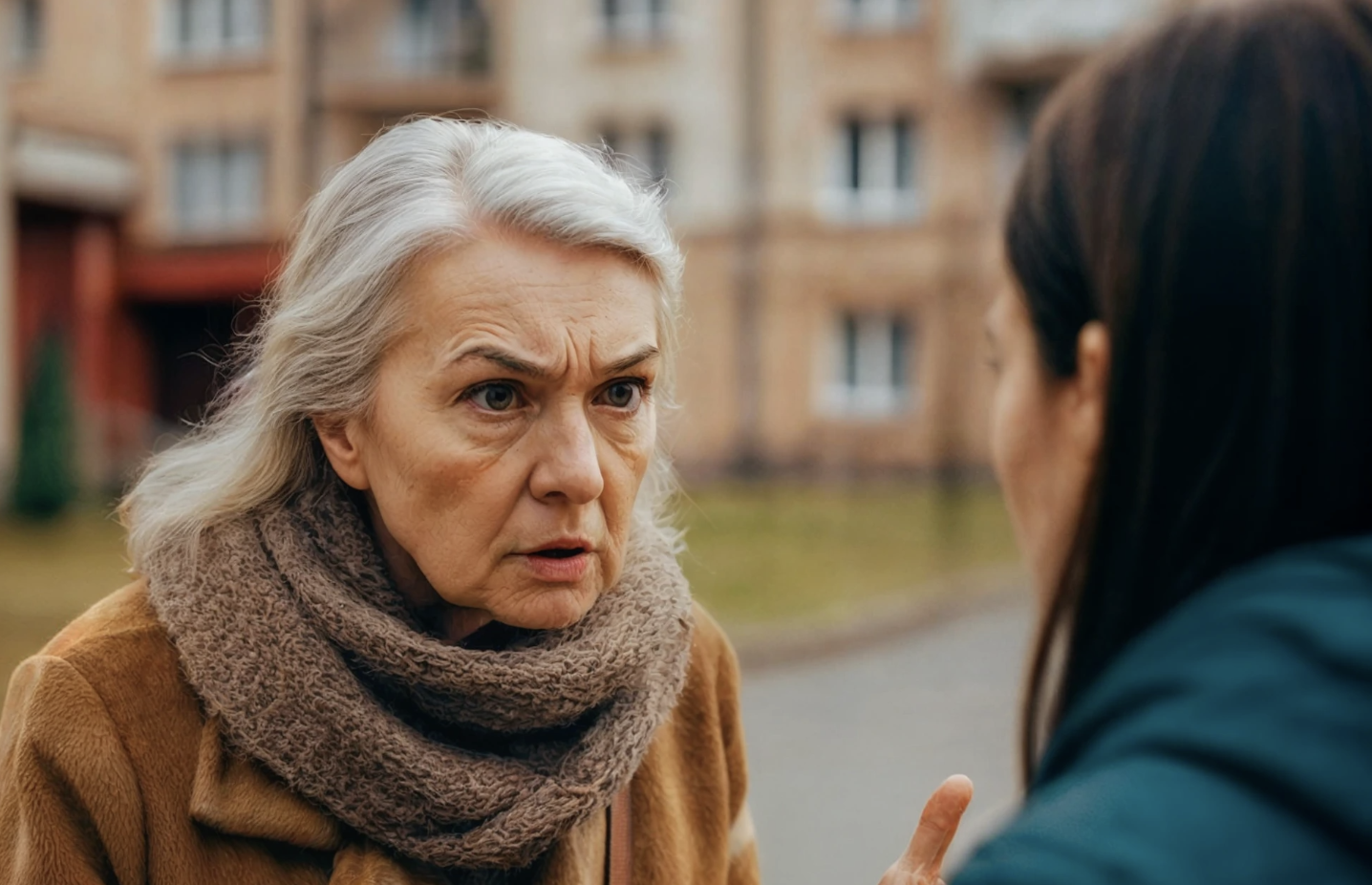
Ksenia reached the steps. Only a few steps remained to the спасительная door, but Tamara Igorevna stepped sharply into her path with surprising speed for her age and build. She planted herself right in front of Ksenia, blocking the entrance. Her face was crimson, her eyes burning with a fanatical, righteous fire.
“So,” she began without preamble, her voice loud—meant to be heard not only by the three of them but by passersby as well. “The games are over. You take your words back right now and let Dima come home. He isn’t going anywhere.”
Ksenia said nothing. She looked not at her mother-in-law but through her, at the scuffed entrance door. Her face remained absolutely still, as if carved from cold marble. That impenetrability—that icy calm—infuriated Tamara Igorevna far more than any shouting would have.
“Are you deaf? I’m talking to you!” she raised her voice another notch, nearly screeching.
“Yes? What is it?”
“You can’t just throw my son out of the house! He’s your husband, which means he’ll stay in your apartment as long as he wants! And after the divorce you’ll sign over half of this apartment to him, regardless of the fact that you bought it!”
She paused to let her words—her ultimatum—land with full force. Dmitry shifted awkwardly behind her but still didn’t lift his eyes. This street theater was staged by his mother; his role was silent scenery, living proof of her “rights.”
“He gave the best years of his life to this family! He worked, he tried! And you—what? You think that because the apartment is in your name you have the right to throw people out on the street? You don’t. That won’t happen. I won’t allow it. My son won’t be homeless because of your whims. You will open the door right now, he will come in, and you will live as you lived until you resolve all property issues in a civilized way. Do you understand me?”
She finished her fiery speech and planted her hands on her hips, waiting for surrender. She was sure she’d won. In her world, maternal authority and brute pressure were forces that could crush any resistance.
Ksenia slowly turned her gaze to her. And there was nothing in that look—no fear, no anger, no hurt. Only deadly exhaustion and cold, endless contempt. She took a step forward.
“Did you hear me?!” Tamara Igorevna shrieked, trying again to block her, thrusting out a hand to grab her by the elbow.
Ksenia didn’t dodge. She simply took that hand in her free palm and moved it aside. No malice. No jerk. She did it with the same calm, detached strength you’d use to shift a chair in the way or move a fallen branch off the path. As if what stood in front of her wasn’t a living person, but an object.
Tamara Igorevna blinked, stunned by that audacity—by that wordless physical humiliation. And Ksenia, ignoring her completely, looked straight at her husband. For the first time she addressed him directly. Her voice was quiet, but against the raw November wind it sounded deafening.
“You brought your mother to win you a place in my bed?”
And without waiting for an answer, she turned away, took her key from her pocket, slid it into the lock, and, opening the heavy metal door, disappeared into the dim stairwell. The click of the door closer sounded like a gunshot, leaving mother and son standing on the gray concrete steps in complete, humiliating silence.
Ksenia entered the apartment and leaned her back against the door she’d just shut. She didn’t turn on the light in the hallway, staying in the half-dark. The silence pressed down—but it was her silence. Her fortress. She slowly lowered the grocery bags to the floor, giving herself a second to even out her breathing. She was sure that was it for today—that they, humiliated and crushed, had slunk off to lick their wounds.
But less than a minute later, there was a scrape in the lock. Metal rasped against metal. A key—the one he hadn’t given back.
The door swung open, and Dmitry appeared on the threshold, shoved forward from behind by his mother. His face was twisted with a mix of fear and desperate determination. Behind him loomed Tamara Igorevna, flushed with fury and triumph. They had forced their way in. Crossed the last line.
“So that’s how it is!” Tamara Igorevna hissed, pushing past and flipping on the hallway light. “You thought you could get rid of us that easily? This is his home too! He’s registered here and he will live here!”
Dmitry, finding a semblance of a voice under his mother’s pressure, bleated, “Ksyusha, we have to talk. You can’t just act rashly like this. I… I was wrong not to tell you myself. Give me a chance to explain everything.”
They stood in her hallway, polluting her air, her calm, her space. Ksenia looked at them, and the cold, calculating fury inside her began to melt into something else—into white-hot liquid steel. She was no longer a victim. She was the judge.
She slowly—very slowly—straightened up. Not a single muscle moved in her face.
“Fine,” she said so quietly they had to fall silent to hear. “You want to talk about what belongs to whom here? Excellent idea. Let’s take a walk.”
Without waiting for their reaction, she turned and went into the living room. Confused, they followed. She stopped in the middle of the room and gestured around with her hand.
“This sofa. I chose the upholstery for three weeks. I drove to the warehouse myself to check the seams. I paid for it with money I’d been saving for vacation. Your contribution? You said gray is practical.”
She moved on, into the kitchen. They trailed after her like an экскурсия.
“This kitchen set. Ordered from my drawings. I designed every drawer myself. The installers put it in while you were fishing with friends. This coffee machine was a work gift for a successful project. You use it every morning.”
Her voice stayed flat, almost lifeless. She wasn’t accusing. She was stating facts. Each fact was like a hammer blow on a nail being driven into the lid of their shared past. She led them into the bedroom. The freshly made bed looked like an altar in a desecrated temple.
“This bed. I paid for the orthopedic mattress because your back hurt. Remember?”
Dmitry said nothing, his face turning a dull gray. Even Tamara Igorevna’s fighting fire dimmed. They hadn’t been ready for such methodical, cold annihilation.
Ksenia went to the closet and flung the doors open. On one side hung her dresses. On the other—his shirts, trousers, jackets. Her gaze settled on a dark-blue suit of expensive wool. His pride. The suit he wore to the most important negotiations to look solid and successful. The suit bought on her credit card.
She took it off the hanger. Jacket and trousers. The fabric was soft and heavy. She turned and, without a word, walked back to the kitchen. They stared after her blankly, not understanding what was happening. She went to the cabinet under the sink and opened the door where the trash bin stood. Inside were morning coffee grounds, eggshells, an empty cheese wrapper. She took the jacket. Carefully—like she was folding it for storage—she folded it in half and began stuffing it into the bin. The expensive fabric touched the wet remains of their breakfast. She pressed down, packing it deeper. Then she took the trousers and did the same. She shoved them into the trash with force but without haste, until they disappeared completely beneath the rest of the garbage.
Then she closed the lid. The quiet plastic click rang through the silence like a verdict.
She turned to them. Dmitry stared at the trash bin in horror, as if she’d just buried something living inside. Tamara Igorevna stood with her mouth open, speechless.
“Trash goes out on Tuesdays,” Ksenia said in her calm, even voice. “Time for you to go.”
And in that moment they both understood. Understood everything. That there was no more “us.” No “shared home.” Nothing left to cling to. She hadn’t just kicked him out. She erased him—turned him into trash that needed to be taken out.
They turned and went to the door. In silence. Dmitry didn’t look back. Tamara Igorevna didn’t yell anymore. They simply left, and Ksenia closed the door behind them and—for the first time all day—slid the inner bolt into place…