We were celebrating our little boy’s first birthday. Guests, presents, laughter. I thought it was the happiest day of my life. But then the door flew open, and she walked in—my mother-in-law. Without even looking at the guests, she jabbed a finger at me and screamed, “That child isn’t my Pavel’s! I’ll expose you for what you are, you tramp!” I froze in horror, bracing for my world to collapse. But instead, my husband stepped up to his mother and quietly said words that turned her triumph into her greatest shame.
The party was in full swing. Our little Timoshka was turning one. The apartment was drowning in balloons, the air smelled of homemade cake, and our closest friends sat around the table. I held my sleepy son in my arms, smiled at my husband, and felt absolutely happy.
It seemed like nothing could ruin this day. I was wrong.
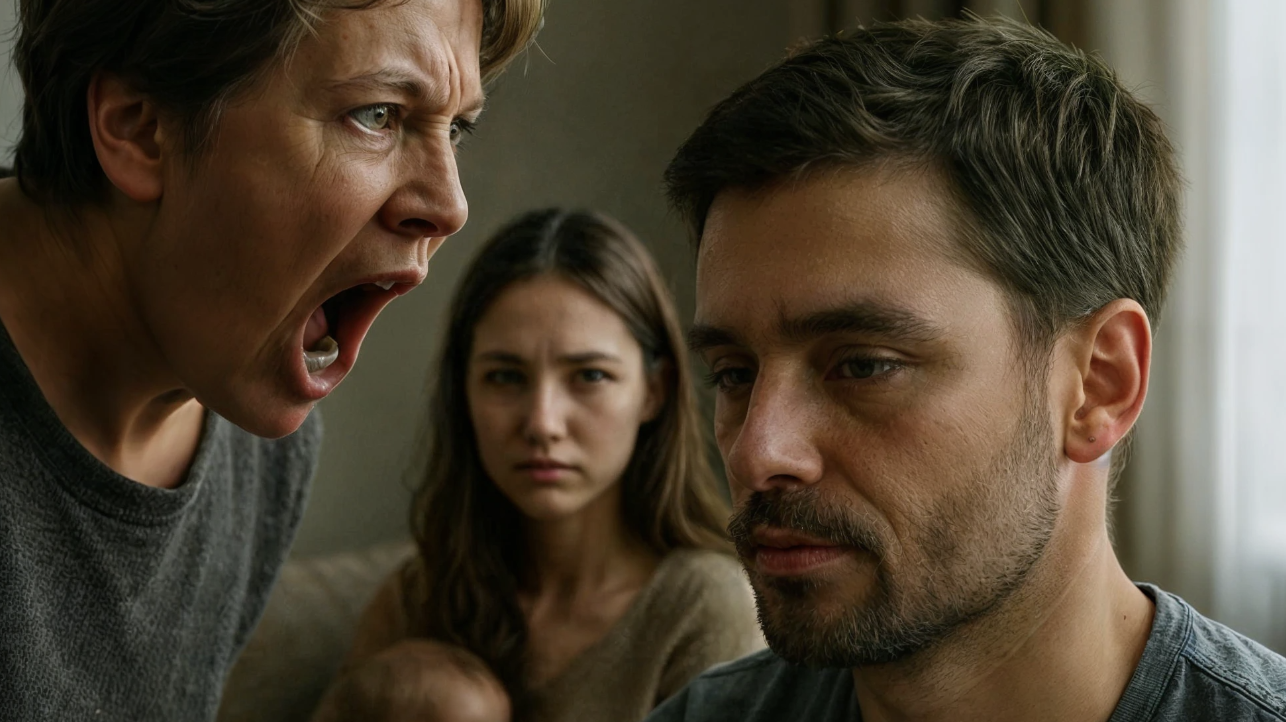
The front door flew open so hard it banged against the wall. Natalia Ivanovna, my mother-in-law, stood in the doorway. Her face was twisted with rage; her eyes burned with icy hatred.
“Well, well! Celebrating, are you?” she hissed, sweeping the guests with a contemptuous stare. “And you—” her finger stabbed in my direction, “—you thought I wouldn’t find out?”
The guests fell silent. The music died. My husband Pavel tensed and rose to his feet.
“Mom, what are you doing here? We agreed…”
“Agreed?” she shrieked. “That’s what you agreed with her, while she was cheating on you!”
I felt the blood drain from my face. Timoshka whimpered in my arms, sensing my fear.
“What are you talking about?” Pavel stepped toward her, trying to push her out.
“The truth!” she shouted, digging in her heels. “I know everything! This child isn’t yours, Pasha! Not yours! She had him with someone else! Look at her—so saintly, and yet…”
Tears burst from my eyes. I pressed my son to my chest, my throat locking up in a painful spasm. A friend rushed to me, trying to calm me down. The guests stared from me to my mother-in-law, unsure how to react. It was shame—public, humiliating shame.
“Mom, leave,” Pavel said, his voice turning to steel.
“I won’t!” she snapped. “Not until everyone knows what kind of snake you’ve taken in! I told you she wasn’t right for you! Not our kind! Now confess—whose baby is it?”
I couldn’t force out a single word; I only shook my head, choking on sobs. I waited for Pavel to turn to me with questions, doubt in his eyes. I waited for our marriage—our happiness—to crack and shatter.
But he didn’t turn to me. He looked straight into his mother’s eyes—calmly, coldly, utterly crushing.
“Mom, you’re right.”
A ringing silence fell over the room. I stared at him, not believing what I’d heard. The guests froze. Natalia Ivanovna’s face spread into a triumphant smile.
“There! You heard him! He admitted it himself!”
“Yes, I admit it,” Pavel continued, his voice flat and lifeless. “This child isn’t mine.”
He paused, letting her triumph swell to its peak. And then he finished her.
“He isn’t mine… because I’m infertile.”
The smile on his mother’s face stiffened, then slowly slid away, replaced by confusion and horror.
“What?..”
“Olya and I spent years in treatment. For nothing. We went through seven circles of hell you never even suspected,” Pavel’s voice began to tremble with restrained pain. “And when the doctors gave their verdict, we made a decision. We used a donor. This child is ours. He is my son more than if my blood ran in his veins. He is Olya’s and my love—and our pain.”
He spoke, and I looked at him and understood I loved him more than life. He sacrificed his pride, exposed our most humiliating secret in front of everyone, just to protect me.
“We wanted to tell you. Later. Someday. But you ruined it all with your cruelty—your blind hatred for my wife,” he stepped to the door and flung it open. “Get out!”
Natalia Ivanovna stood as if struck by lightning. She stared from her son to me, her lips moving soundlessly. She had expected something else entirely—expected her son to throw out his “unfaithful” wife, and instead he stood with me against her.
“Pashenka… son… I didn’t know…”
“Get out, I said. And remember this,” his voice rang with fury. “You will never see me or your grandson again—until you’re on your knees begging my Olya for forgiveness. The woman you just dragged through the mud.”
She stumbled backward, caught her foot on the threshold, and swayed out onto the landing. Pavel slammed the door shut and turned the key in the lock.
Then he turned to me, took the crying Timoshka from my arms, and wrapped both of us in a tight embrace. In the stunned silence—broken only by our son’s sobs—I buried my face in Pavel’s shoulder and realized that today my husband hadn’t destroyed our family. He had built an unbreakable fortress around it.
The guests evaporated within ten minutes—awkward hugs, sympathetic looks, hurried “we’ll call you” and “hang in there.” No one wanted to stay and witness our grief and our strange victory.
When the door closed behind the last of them, I sank onto the couch. I didn’t even have the strength to cry. Pavel put the now-sleeping Timoshka in his crib and sat down beside me, taking my hand.
“Olya…” he began.
“Why did you stay silent?” I whispered. “Why didn’t you tell me you were ready to… do that, in front of everyone?”
“Was there another way?” he gave a bitter half-smile. “To watch her destroy you? To let her ruin our family? No. That infection had to be cut open.”
I lifted my tear-swollen eyes to him.
“It was… so humiliating for you, Pasha.”
“Humiliating is when your own mother tries to trample your wife—the mother of your child,” he squeezed my hand harder. “What I said was the truth. Bitter, heavy, but true. What am I supposed to be ashamed of? That nature decided it this way? I was ashamed for years, Olya. I hid. I was scared. And today… today I realized the only thing I’m ashamed of is my mother.”
We sat in silence for a long time. I remembered our visits to doctors—endless tests, procedures, hope turning into despair. I remembered the day Pavel came home from yet another appointment with the andrologist. He didn’t cry, didn’t yell. He just sat at the kitchen table, staring at a single point.
“It’s me, Olya. The problem is me. And it can’t be fixed,” he said then.
I hugged him and told him we’d get through it. That we were a team. That we’d find a way. That terrible evening was when we truly became one. The donor idea didn’t come right away. We talked and argued and cried for a long time. But the longing to become parents outweighed every fear and doubt.
“She’ll tell everyone now,” I said quietly, returning to the present. “All the relatives, all the neighbors. Can you imagine what will start?”
“Let her,” Pavel answered firmly. “Let them talk. The ones who love and respect us will understand. And I don’t give a damn about the rest. Our family is you, me, and Timoshka. That’s it. Everyone else—overboard.”
“Your father…”
“Father?” Pavel scoffed. “He’s always been under her heel. He’ll stay quiet like he always does. Even if, deep down, he’s on our side, he won’t say a word against her. So I’m not counting on his support.”
That night, when we were already in bed, he turned to me.
“Do you regret it? That everything turned out like this?”
“I only regret that you had to go through it,” I answered honestly. “But I’m… I’m proud of you, Pasha. Today you were my hero. You protected us.”
He pulled me close.
“I love you, Olya. And I love him. He’s my son. And no one—do you hear me, no one—will dare to question that.”
I closed my eyes, feeling safe. Yes, tomorrow would be a new day. There would be calls, sideways glances, whispers behind our backs. But none of that mattered. What mattered was that we were together. And we were stronger than ever. The storm my mother-in-law unleashed didn’t destroy our home—it only strengthened its foundation.
Morning began with a phone call. I saw the number of Pavel’s second cousin, Aunt Vera, and my heart dropped. Pavel took the phone from me.
“Yes, Aunt Vera, I’m listening.”
He put it on speaker.
“Pashenka! What’s going on over there?! Natalia just called me, crying her eyes out! Says you threw her out, insulted her! That your Olya… well…”
“Aunt Vera,” Pavel cut her off in an icy tone, “my ‘Olya’ is my wife. And if you want to keep talking, choose your words.”
She faltered on the other end.
“Oh, I didn’t mean it badly… I’m just worried. Natasha says she told the truth about her grandson, and you… you’re covering for her! Says the child isn’t yours!”
“She’s right,” Pavel repeated calmly, the same phrase as yesterday.
Silence. I could see his jaw tighten.
“How… how is that possible? Pasha, what are you doing? Are you getting divorced?”
“No. I’m going to raise my son. And love my wife. And Mom can spread her gossip to anyone she wants. To you, for instance—you seem like a grateful listener. But in our home, neither she nor anyone who believes her nonsense will set foot again. Is that clear?”
“But, Pashenka… she’s your mother…”
“She’s a person who tried to destroy my family. This conversation is over. All the best.”
He ended the call and tossed the phone aside.
“It’s started,” he exhaled.
And he was right. All day the phone rang nonstop. Distant and close relatives called. Some asked cautiously; others attacked openly. Pavel answered everyone the same way—short, hard, and final.
I took on a different line of defense. My friend—the one who’d been at the birthday—texted me:
“Olya, hang in there! Your mother-in-law is a total witch. If you need anything, just say the word. And don’t listen to anyone—you and Pasha are doing great!”
Then another friend messaged. Then my mom called. I told her everything, exactly as it happened. She cried with me, then said, “What a man you have, Pasha. A real one. Hold on to him, sweetheart. And don’t pay attention to your mother-in-law—her own bitterness will eat her alive.”
But the hardest blow came that evening. We went out for a walk with the stroller. Our neighbor, Grandma Manya from the first floor—who always smiled so sweetly at Timoshka—looked away and turned her back on us demonstratively. Another woman on the bench leaned in and whispered loudly, “There she is… that one… They say she had him with someone else…”
Heat rushed to my cheeks. I wanted the ground to swallow me. Pavel squeezed my hand firmly.
“Chin up,” he said quietly. “Let them look. We have nothing to be ashamed of.”
We walked past them as if they were empty space. But I felt their eyes drilling into my back like two augers. Natalia Ivanovna had done her job. She hadn’t just fought with us—she had built a quarantine around us, poisoning the air with gossip and lies.
When we came home, I couldn’t hold it in anymore and broke down sobbing.
“Pasha, I can’t do this! Everyone’s staring, everyone’s whispering! I feel filthy!”
“Shh, my love, shh,” he said, holding me. “This will pass. Gossip lasts three days. Our life is forever. She wanted us to break—wanted me to doubt you, and you to feel guilty. We won’t give her that pleasure.”
“But how do we live in this atmosphere?”
“We’ll make our own atmosphere. Inside these walls. And the people outside… let them choke on their bile. They’ll get bored soon enough.”
He sounded so sure. And I… I was scared. Scared the siege would never end. That the stain my mother-in-law tried to slap onto me would stay forever.
A week passed. The relatives’ calls stopped—Pavel’s hardness had clearly killed their desire to meddle. But the tension didn’t vanish. It hung in the air like dust after an explosion.
Natalia Ivanovna didn’t call. Not me, not Pavel. But we knew she wasn’t sitting still. Every couple of days we heard about her “feats.” A mutual acquaintance would mention her complaining about her “ungrateful son and scammer daughter-in-law.” Or Pavel’s father would call awkwardly to relay her message: “Let Olya repent, and then maybe I’ll consider it.”
Pavel listened with a stone face and replied, “Tell Mom to wait. There will be repentance. Just not from Olya.”
One evening the phone rang again. The screen showed his father’s number—Sergey Petrovich. Pavel sighed and answered.
“Yes, Dad.”
“Son… hi. How are you all doing?”
“Fine. What happened?”
“Nothing… I just… I talked to your mother. It’s hard for her, Pasha. She didn’t mean it. She just… well, that’s her character. She worries about you.”
Pavel stayed silent, letting him talk.
“Maybe you’ll come by? We can talk. Just us—man to man. Without Olya. She cries all day, her blood pressure’s jumping. I’m afraid she’ll end up in the hospital.”
I saw a muscle twitch in Pavel’s cheek. The blow was aimed perfectly: guilt—the most terrifying weapon.
“Dad, she knew what she was doing,” he said quietly but firmly. “She wanted to humiliate Olya. Humiliate me. She got what she deserved.”
“But she’s your mother!” Sergey Petrovich cried. “She gave birth to you, raised you! You can’t do this, son! Olya—well, she’s a woman, she’ll forgive. But you only have one mother!”
That was the last straw.
“Exactly, Dad!” Pavel’s voice rang out. “She is my mother! She should have been happy for us! Happy for her grandson! And what did she do? She came in and spit in our souls! And you still dare defend her? Have you ever once, all these years, stood up for me? Even once told her she was wrong? No! You always stayed silent! So stay silent now too!”
He ended the call and dragged both hands down his face.
“I hate it,” he hissed. “That eternal ‘but she’s your mother.’ Is that a free pass for any kind of cruelty?”
I came up behind him and hugged him, resting my head on his shoulder.
“Pasha… maybe you really should talk to her?” I asked softly. “I’m scared for her. What if it’s true…”
He spun around sharply. In his eyes I saw pain and surprise.
“And you too? Olya, don’t you understand? It’s manipulation—classic. First accuse, then press on pity. If I give in now, go to her—then that’s it. She wins. She’ll know she can twist me around her finger, keep insulting you without consequences. Is that what you want?”
“No, of course not!” I said, frightened. “I just…”
“I know. You just have a kind heart. That’s why she hates you. Next to you, she sees all her own darkness.”
He hugged me.
“No talks. No meetings. You know my condition. On her knees. In front of you. And no other way.”
In that moment I understood this war wasn’t just a family quarrel. It was a battle for our right to live our own life. And we couldn’t retreat—not even half a step, not even out of pity. Because if we gave in once, we’d lose forever.
Almost a month passed. The noise around us quieted. The bench neighbors still gave sideways looks, but without the old enthusiasm. The relatives, realizing they wouldn’t get anything from us, moved on to other topics. A fragile, shaky lull settled in.
Pavel didn’t budge. He didn’t call his parents and ignored his father’s calls. He made it clear his world was now closed around me and Timoshka. And I could see how hard it was for him. No matter how angry he was, she was still his mother.
One evening, over dinner, he said thoughtfully:
“This can’t go on.”
My heart froze.
“What do you mean?”
“I’m going to see her,” he said, looking me straight in the eyes. “Not to make peace. To put every dot over the i. Once and for all.”
“Pasha, maybe don’t,” I begged. “It’ll be another scandal.”
“It won’t,” he said уверенно. “A scandal happens when two people yell. I’m not going to yell. I’ll just explain the rules. Either she accepts them, or she loses her son for good.”
He left the next day. I stayed home alone, and those two hours were some of the longest of my life. I ran through every possible scenario—each one worse than the last.
When Pavel came back, I ran to him in the hallway.
“So? What happened?”
He was calm. Too calm.
“I said everything.”
We went into the kitchen. He poured himself water.
“She met me in tears: ‘Sonny, finally! I knew you’d come!’ I cut her off. Told her I hadn’t come to reconcile.”
He retold their conversation almost word for word. He spoke, and she cried. He told her everything—the years of treatment, the despair, how happy we were when Timoshka came, and how she crushed that happiness in one blow.
“I asked her, ‘Mom, why do you hate Olya so much? Because she made me happy? Because she stayed beside me when it hurt too much to breathe? Because she agreed to go through all of this so that I could have the child I wanted so badly?’”
“And what did she say?” I whispered.
“She babbled about ‘didn’t know,’ ‘thought I was saving you from a liar.’ The standard script.”
Pavel took a sip of water and continued.
“Then I said the main thing: ‘I’m not asking you to love Olya. I’m demanding that you respect her. She is my wife. The mother of my son. And anyone who insults her insults me. You have one single way to fix this. You come to our home and apologize. To her. Sincerely—so she believes you.’”
“She refused, didn’t she?” I asked, my heart sinking. For Natalia Ivanovna, that was like suicide.
“She started yelling. Said I was an ungrateful son, that I traded my own mother for ‘that woman,’ that she’d never humiliate herself.”
“And you left?”
“No. I waited until she finished. Then I calmly said, ‘All right, Mom. I understand your choice. Then so be it. You don’t have a son anymore. Or a grandson. Live happily.’ And I went to the door.”
“And then?”
“She shouted after me, ‘Stop!’ I stopped, but I didn’t turn around. She was silent for a whole minute. And then she whispered, ‘I… I’ll think about it.’”
He looked at me.
“That’s it. Now the ball is in her court. She knows the conditions. She knows the price. Now she decides what matters more—her pride or her family.”
I went to him and hugged him. He wasn’t just my husband anymore. He was a rock—a man who stood alone against the whole world to protect our little island of happiness. And I knew that whatever happened next, we would endure.
A week passed in tense waiting. We lived our usual life, but both of us kept jumping at phone calls and glancing at the door. Natalia Ivanovna stayed silent.
Pavel looked calm on the outside, but I could see he was thinking about it constantly. He became quieter, often withdrew into himself. He had made his move and now waited for an answer—and the waiting exhausted him.
Her first step toward “reconciliation” came in her signature style—through a посредник. Sergey Petrovich called again.
“Pasha, your mother… well… she’s ready to apologize.”
Pavel tensed.
“I’m listening.”
“Well… she asks that you and Olya come over this weekend. For dinner. She’ll bake her signature pie… as a gesture of peace. You can talk then.”
Pavel gave a bitter laugh.
“Dad, are you serious? So we’re supposed to come to her—after she insulted us—so she can toss out an apology between bites of pie?”
“Pasha, it’s hard for her… take the first step…”
“I already took my step when I came to her last time. My conditions haven’t changed. She comes to our home and apologizes to Olya. Not to us—specifically to her. And no pie.”
“You’re too cruel, son.”
“I’m being fair. She declared war, not me. Tell her my answer.”
He hung up.
“You see?” he said to me. “She doesn’t want to apologize. She wants everything to go back to normal, pretending nothing happened. It won’t.”
A few more days passed. Then one evening, while Pavel was at work, the intercom rang. I looked at the screen and went numb. Natalia Ivanovna was standing at the entrance—alone—with a bag in her hands.
My heart started pounding. I didn’t know what to do. Let her in? Not let her in? Pavel had said to wait until she came on her own. But I wasn’t ready for this.
“Who is it?” I asked into the handset, my voice shaking.
“Olya, it’s me… Natalia Ivanovna. Please, let me in.”
Her voice was different—quiet, unsure, without the usual commanding edge.
I pressed the button. A minute later there was a soft knock at the door. Not the властный удар like that terrible day, but a timid, almost pleading tap.
I opened it. She stood on the threshold, not daring to step inside. In her hands was a bag of children’s toys. She didn’t look me in the eyes.
“Hello, Olya.”
“Hello, Natalia Ivanovna.”
We were silent. She shifted from foot to foot.
“Is Pasha home?”
“No, he’s at work.”
“And… Timoshka? Asleep?”
“No, he’s playing in his room.”
Silence again. I could see her fighting with herself. Her face was pale; shadows lay under her eyes. This wasn’t the fierce woman who burst in a month ago. This was an older, unhappy woman.
“Olya,” she began, and her voice trembled. “What I did… it was terrible. I… I don’t know what came over me. Forgive me. Please.”
She said it. She said the word—“forgive.” But her gaze slid to the side, to the wall.
I said nothing. I waited. Pavel had said: “So you believe her.” And I didn’t. It sounded like a memorized line he’d forced her to say under threat of losing him.
“You’re apologizing because Pavel told you to?” I asked directly.
She flinched and finally raised her eyes to mine. Tears stood in them.
“Because of that too,” she admitted honestly. “I’m afraid of losing my son. But… I’m truly ashamed too, Olya. When I imagined what you went through… all those years of treatment… and then… my accusations… I behaved like a complete fool.”
That, I believed more. That sounded like truth.
“I brought something for Timoshka…” she held out the bag.
“Thank you. Come in.”
She stepped inside uncertainly—into the very apartment her own son had thrown her out of in disgrace.
She stopped in the hallway as if she were on чужой территории. I silently took the bag and her coat.
“Come to the kitchen. Would you like tea?”
“Yes, if I may,” she answered quietly.
While I put the kettle on, she stood in the middle of the kitchen, studying our family photos on the fridge. There was Pavel and me at the sea. Me, pregnant. Tiny Timoshka in the maternity hospital. Her eyes lingered on that last photo.
“He looks… like you,” she whispered.
I set a cup in front of her. She sat at the table—at the spot where Pavel usually sat.
“Olya, I understand that a simple ‘forgive me’ isn’t enough,” she began, staring at her hands. “I don’t know how to make it right. I behaved… horribly. Blind jealousy, stupidity… I was so afraid you’d take my son away that I pushed him away myself.”
She spoke, and I listened. I no longer felt hatred. Only a dull ache and… pity. In front of me wasn’t a monster—just an unhappy woman who had made a terrible mistake and didn’t know how to live with it.
“I raised him almost alone,” she went on, as if оправдываясь. “Sergey… he’s a good man, but soft. All my life I carried it for two. And Pasha is my whole world. When he married you, I… I got scared. That I’d become unnecessary. And then when you couldn’t have children for a long time, I imagined all kinds of nonsense… that it was your fault, that you were deceiving him… Madness, of course. But I believed it.”
“Why didn’t you just talk to us?” I asked quietly. “Why stage that circus?”
She lifted tear-filled eyes to me.
“Because I’m a fool, Olya. An old, stupid fool. Pride ate me alive. Will you forgive me? Not for Pasha. For… me. I can’t do this anymore—lying awake at night, not seeing my grandson…”
At that moment, Timoshka ran in from the other room. He saw Grandma, stopped, then laughed, ran over to me, and hid behind my legs, peeking out with curiosity.
Natalia Ivanovna looked at him, and her face twisted with pain and tenderness. Slowly—afraid to scare him—she held out her hand.
“Timoshka, sweetheart. Come to Grandma.”
Timoshka glanced at me, looking for permission. I gave a small nod.
I didn’t know if I would ever be able to forgive her completely. Forgetting that humiliating day—the shame, the terror—was impossible. The wound would heal, but the scar would stay forever.
But watching her trembling hand reach for my son, and seeing Timoshka’s curious little eyes, I understood I had to give her a chance. Not for her. Not even for Pavel. For this little boy—who deserves to have a grandmother.
I took my mother-in-law’s hand and placed it into my son’s tiny palm.
That evening, when Pavel came home, he found us in the kitchen—me, him, and his mother drinking tea. For the first time in many years, without tension or hidden hostility. Just family. A bit broken, but trying to piece itself back together.
Pavel didn’t say a word. He simply came up behind me at the stove, hugged me, and kissed the top of my head. And in that simple gesture there was everything: gratitude, love, and relief.
Our war was over.
We won.