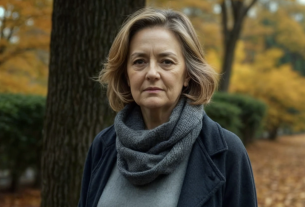
You’re nobody, got it? And you’re going to listen to me your whole life. And no more orders like—pick up our daughter. You hear me?”
“I hear you…” Anastasia said softly, and felt his grip loosen.
Anastasia had been married to Gennady for several years. He was the solid, dependable type—one of those men who, if he said he’d do something, he did it, and didn’t throw words to the wind. But he also had his “episodes”: excessive harshness, a need to control everything, and—worst of all—a constant urge to stress his own “importance,” not only at home but in life in general.
Nastya earned about a third less than her husband. She worked as a teacher, and to make significantly more she’d have had to run herself ragged. So she was fine with her income—life wasn’t only about work. What she did mattered, even if it wasn’t especially profitable.
Gennady regularly “needled” her for it, as if it were his personal achievement: he was the one carrying the family on his shoulders. And yes, he did work a lot and made good money—paid the bills—but he talked about it as though it were a great honor for Nastya simply to be near a man like him.
They lived in an apartment Gena had inherited from his mother. She’d passed away many years earlier, and the place had gone to him. Gennady often forgot that he himself had done absolutely nothing to “earn” that apartment.
Later, though, he and his wife had done a full renovation together: replaced the wiring, installed a new kitchen, set up a nursery, changed the windows, enclosed and insulated the balcony. They bought furniture, appliances, rugs, light fixtures—everything. Over twelve years, there wasn’t a single square meter there that Nastya hadn’t touched—physically or financially.
On top of that, during the marriage they’d bought a car each and were raising their daughter, Milana. The girl was already ten. On the surface, everything looked calm and stable—but family life is never a perfectly straight line.
They didn’t fight often, but when they did, it turned into real blowups.
That evening it started over something trivial. Anastasia asked Gena to pick Milana up from dance class. He was tired, stuck in traffic, got worked up, and said she was “sitting at home warm and cozy” and “dumping all the hardship on him.” Then he dredged up that a month ago she’d bought the wrong light bulbs for the chandelier, that she’d ruined a shirt in the washing machine, and that she “used to be more careful.”
“You didn’t even ask if it was convenient for me to go,” her husband snapped.
“I just asked. Once this week! The other two days I picked Milana up myself.”
“Fine,” Gennady barked, and hung up.
That day he did pick their daughter up, but he came home dark as a storm cloud.
Anastasia was at the stove, boiling pasta and stirring sauce—browned ground meat with tomato dressing and spices. Simple but tasty. She added a little basil and garlic, turned off the burner, and was just about to sit down and turn on the TV when she heard the front door slam.
Gena and Milana were home.
Their daughter walked past the kitchen without even glancing in. No smile, no “Hi, Mom,” not even a look. She just took off her jacket and disappeared into her room without a word. That wasn’t like her—Milana was usually affectionate and chatty, especially in the evenings with her mother.
Anastasia felt it immediately: something was wrong.
The confirmation came at once. Gennady appeared in the kitchen doorway. His face wasn’t just gloomy—he looked ready to breathe fire, his breathing so heavy. He glanced at the pot of pasta, then the pan of sauce, and smirked with undisguised contempt.
“This is dinner?”
“Yes,” Nastya answered evenly. “Pasta with meat sauce. Milana likes it.”
“Pasta,” he drew out slowly. “Wonderful. Very refined. I guess since you ‘rested’ today and didn’t pick up our daughter from dance, you could’ve tried a little harder. Made something normal, not just pasta.”
Nastya swallowed her irritation and took a deep breath, then stood up.
“I went to the hairdresser. I booked it a month ago—I wanted to freshen up my haircut. So no, I didn’t have free time.”
“Funny,” he cut her off. “So you did have time. And you spent it getting your hair cut instead of picking up our daughter?”
“Gena,” Nastya tried to keep her voice calm, “are you serious? You’re the one who always says a wife should look well-groomed.”
“I’m very serious—more serious than ever!” he snapped. “You’ve apparently forgotten where you even are.”
He stepped closer, crossed his arms, and, staring her in the face, threw out:
“Don’t forget whose apartment you’re living in. You’re here on borrowed rights. I’ll want it, and you’ll be out the door in no time.”
A second. Another. The air seemed to thicken, like before a thunderstorm.
Nastya froze, looking at the man she’d spent twelve years with, side by side. The man with whom she’d built not just a household, but a happy family. And now he was saying he’d throw her out on the street like a dog. She had poured so much effort into this place—and so many memories lived in these walls…
And now her husband was saying she was nobody. And that this apartment wasn’t her home.
Something inside her flinched, but Nastya didn’t answer. She wiped her hands on her apron, turned slowly, and began dishing dinner onto plates.
“Well? Are you going to say something?” Gena suddenly grabbed her by the wrist so hard the ladle fell from her hand, and with it bits of meat scattered across the floor.
Nastya gasped and looked into the eyes of someone who no longer resembled her husband.
“Let go of my hand!” she demanded, trying to pull free. “Let go!” she shouted louder.
But Gena didn’t relent—he only savored the moment of his strength.
“You’re nobody, got it? And you’re going to listen to me your whole life. And no more orders like—pick up our daughter. You hear me?”
“I hear you…” Nastya said softly, and felt his grip loosen.
She pulled herself together, picked up the ladle, cleaned the floor, and continued serving dinner under her husband’s watch. Then, still keeping her calm, she went to her daughter’s room. Milana sat with headphones on, watching some video on her phone.
Nastya carefully lifted one earbud so she wouldn’t startle her and whispered:
“It’s starting again with Dad. Quietly pack the essentials. I’ll handle everything, and we’ll leave carefully…”
Milana nodded. She already knew that tone. In ten years, they’d been through all kinds of things. If Mom said to pack, you listened.
Anastasia set out some snacks from the fridge and took a bottle of cognac from the top shelf—kept there for a “special occasion.” Sometimes that occasion was exactly this.
She watched Gena eat with gusto and wash it down with cognac, staring at the TV. Some stupid comedy was on; he chuckled now and then. Not a hint of remorse. If anything, he looked like a man who felt like a winner—because he’d “put his wife in her place.”
Nastya no longer felt fear. Only cold calculation and a surgeon’s calm before a difficult operation.
While Gena watched TV, she changed quickly—jeans, sweater, warm jacket. She took a bag with documents, a small backpack with clothes, and her wallet. On tiptoe she returned to Milana’s room—Milana was already ready: jacket, a change of underwear, schoolbooks. A small backpack on her shoulders.
“Quiet,” Nastya whispered. “Let’s go.”
They left the apartment without a sound. Nastya still remembered sneaking past her sleeping grandmother as a child so she wouldn’t be noticed—slipping out to a friend’s place. Now it was the same thing. Only the stakes were far higher.
Down by the entrance, Milana finally spoke:
“Mom… where are we going this time?”
“I don’t know yet, kitten. The main thing is—not here. And we’re not going to Grandma’s for now.”
She remembered how her mother, Valentina Mikhailovna, had said last time, wiping away tears:
“If you come to me again after his next outburst—you’ll stay forever. I won’t let you go back. Living with a man like that is dangerous. You never know what to expect from him.”
Nastya had nodded then and promised things would change. But they didn’t.
She and her daughter got into the car. Nastya started the engine, pulled onto the road, and drove several blocks away from home.
Parking on a quiet street under a streetlamp, she shut off the motor. A bruise was starting to bloom on her arm—the mark of Gennady’s grip. She rubbed it carefully, as if trying to erase not only the pain, but the memory.
Milana breathed quietly beside her. Nastya looked at her: she deserved a different childhood. Then Nastya took out her phone and opened her contacts list. Her fingers trembled, but she knew exactly who to call.
“Hello, Lenochka?” Nastya’s voice was quieter than usual.
“Hi, my dear! How are you?” her friend chirped.
“I… me and Milana. Can we come to you for one night? I’ll explain later. It’s just… we can’t go home right now.”
A short pause on the other end.
“Of course. Come. Are you okay?”
“Almost,” Nastya said softly. “I’ll tell you everything when I see you.”
She started the engine again.
Lena met them in a cozy pajama set, hair tied up in a little ponytail on top of her head, and wrapped them in warm hugs. Milana said hello politely and—almost without taking off her jacket—pressed herself to her mother. Nastya could feel her child holding back tears.
“Come on, sweetheart,” Lena whispered. “We’ll make you a cozy little nest to sleep in, and then your mom and Auntie Lena will talk in the kitchen.”
They set up a sleeping spot in the room of Lena’s daughter, Alina, who was happy to have a girl her age to talk to. Milana changed into home clothes. The girls chatted a bit, then went to bed.
In the kitchen, Lena poured her friend tea with honey, set out a plate of cookies and candies, and only then looked at her closely.
“Well? Tell me what happened.”
Nastya was silent for a long time. At first she just sat there. Then her lips trembled, and she began to cry. Her shoulders shook like a child who’d finally been allowed to come home after a long, terrifying day.
“Every time I endure it…” Nastya managed through tears. “His tone, his mockery. The way he calls me a ‘moocher,’ a ‘random passenger’ in front of our daughter. I swallow it all—but lately he’s started grabbing my arms, my throat, shoving me. I’m not scared for myself anymore—I’m scared for Milana.”
Lena listened without a word, but with each sentence her eyes widened more and more.
“Nastya… you should’ve divorced him a long time ago. How could you endure that for so long?”
“I know,” Nastya nodded. “I’ve already started thinking about renting an apartment. I’ll find one as soon as I get my advance. I can’t live like this… in fear, waiting for him to completely lose it.”
Lena suddenly frowned and said, offended:
“Are you trying to insult me? What apartment? You’ll live here as long as you need. A month, two—half a year if necessary. Not negotiable. I won’t let you wander from corner to corner with a child while that idiot goes looking for you.”
Nastya smiled through tears. For the first time in a long while, she felt it—she wasn’t alone.
In the morning she woke up before everyone else. Five missed calls from Gennady. Messages, one after another:
“So you really decided to ditch me like this?”
“Did you think about our daughter?”
“Come back before I come get you myself. Last warning.”
Her hands trembled again, but she didn’t reply.
Milana stayed home—Nastya didn’t take her to school and told the teacher her daughter was sick. Who knew what Gennady might do if he showed up there.
By lunchtime she finally gathered the courage to call her mother. Valentina Mikhailovna answered quickly.
“Nastya?”
“Mom, I can’t be silent anymore. We left Gena. And this time—for good. I’m filing for divorce.”
Her mother was silent only a few seconds, as if processing it. Then she exhaled:
“Thank God,” she whispered. “Where are you?”
“It doesn’t matter. The main thing is—we’re not with him. Don’t worry, we’re safe.”
“I’m not worried, Nastya. I’m proud of you. Don’t worry about anything—I’ll always help.”
Many of their mutual acquaintances knew Gennady had a difficult character. Some were amazed Nastya had lasted so many years. Some said it out loud, some whispered it after gatherings. Among relatives there’d long been an unspoken joke: “Only a saint of a woman could live with a man like that.” But even saints, as it turned out, have a limit.
When Nastya filed for divorce, Gennady completely lost it. He called her dozens of times a day. Then he started looking for her at work—showing up with flowers and threats at the same time, making scenes in the hallway until security escorted him out. He came to Milana’s school several times. Then he began staking out his mother-in-law’s building.
Nastya had been ready for it. She’d sensed it coming, which was why she’d asked her boss to find someone to cover for her for a while, explaining the situation. The principal turned out to be understanding—but the fear still wouldn’t let go.
She was afraid that one day she simply wouldn’t make it to the door in time.
It was Saturday. Lena’s husband, Pyotr, invited an old friend, Sergey, for dinner. They’d been friends since youth. Sergey was a lawyer and helped Pyotr with registering his business—tall, calm, with expressive eyes and a voice that carried confidence.
“Nastya, meet Sergey. A very good man. And we’re lucky he came today—because he’s a lawyer.”
“Nice to meet you,” Nastya said.
She hadn’t planned on sharing anything personal, but Lena had already told him everything in vivid detail, without asking permission.
Sergey looked at her seriously.
“I’ve heard. You’re in a pretty difficult situation. But you did the right thing by leaving. And even better that you didn’t go to your mother—Gennady would have gone there first.”
He spoke clearly and calmly. Not a drop of pity—only concrete facts. For some reason, that affected Nastya more than any sympathetic hugs. She didn’t want pity anymore. She wanted protection.
“You need to apply for a restraining order. I’ll help you file it. Also—file a police report regarding threats. And you absolutely need copies of messages. Screenshots. Video—if you have it.”
Over dinner they talked. For the first time in a long time, Nastya didn’t feel weak. She asked clarifying questions, and Sergey patiently explained where to seek help, how to collect documents, what to do if Gennady tried to “pressure” her through the school or relatives.
“You need to be extremely careful. Don’t go out alone. Try to go only with someone. If possible, don’t enable geolocation. And most importantly—don’t give in to pleading. There may be a phase of ‘please come back,’ but after that it will only get worse.”
Nastya nodded. She knew it—she’d just been afraid to admit it before.
Sergey truly helped. They prepared everything properly: the police report, the restraining order request, the court paperwork. He stayed in touch every day—called, asked how she was, advised her what to do in this or that situation.
When the case reached court, Anastasia was terrified. Sergey sat next to her, serious-faced, and it gave her strength and confidence.
Gennady snapped the moment he saw his wife wasn’t alone—with a man.
“There! There’s the truth!” he shouted, pointing at Sergey. “Cheater! Traitor! It’s because of you—you destroyed our marriage! You always wanted to humiliate me! You lied and manipulated!”
The judge sternly shut him down and threatened to remove him from the courtroom. But Nastya wasn’t as afraid anymore. She simply looked at her ex like he was a stranger.
Sergey wasn’t just there—he turned everything in Nastya’s favor. The apartment remained with Gennady—legally she had no rights to it—but it turned out he had savings he’d never mentioned. He’d been transferring money into an account every month, not even bothering with any “clever” schemes.
Sergey discovered it only recently. In the end, Nastya received not just her share of jointly acquired property, but what truly belonged to her—her car included. And now she had money to start from scratch.
By the time they left the courthouse, Gennady wasn’t shouting anymore. He just watched Nastya walk away—calm, confident, beside a man he couldn’t intimidate.
The money she received, plus the funds from selling Valentina Mikhailovna’s apartment, was enough to buy a spacious, bright three-bedroom place. Milana chose a room with windows facing the courtyard. Nastya put a wooden kitchen table in, the one she’d dreamed about. Everything was new—the home, the atmosphere, even herself.
She changed jobs so Gennady couldn’t find her. Milana transferred to another school. None of Gena’s acquaintances knew the new address. Nastya changed her phone number too.
Sergey started coming by more and more often—not only as a lawyer, but as a man genuinely interested in a wonderful woman. He didn’t ask for anything or demand too much; he was simply there. And one day Nastya said:
“I’m not afraid anymore. But now I know how important it is to have someone nearby who won’t leave when things get scary.”
She looked at him for the first time not as a lawyer, but as a man—the one you want to build a life with.
And Sergey smiled.
“I’m not going anywhere. I promise.