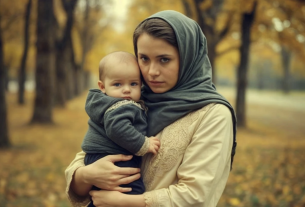
“Sonny!” Vera Antonovna cried out, suddenly freezing on the threshold of her apartment. Her eyes widened with astonishment and joy, her hands flew up like birds ready to take flight. She rushed to her son, who had just come in, leaving the door slightly ajar, as if she couldn’t believe her own eyes. “You scared me to death! Why didn’t you tell me? I thought you still had a whole six months behind bars! And the lawyer kept quiet like a partisan!”
She couldn’t hold herself back—she cupped his face in her palms, stroked his hair, his cheeks, his shoulders, as if checking whether he was real, alive, or if she was seeing him again in some nightmare. His body had grown thin, all angles, as though the years of confinement had drained the strength and youth from him. But his gaze… his gaze was the same—clear, straight, steady.
“Ilyusha, my dear… what happiness!” she sobbed, her voice trembling, overflowing with emotions that had waited years to break free.
“Mom, there you go again,” Ilya tried to calm her, pulling her close and kissing her tear-wet cheek. “It’s all behind me. I’m home. And about the lawyer… I asked him to keep quiet. I wanted to surprise you.”
“Oh, you rascal, you still are,” Vera Antonovna shook her head, but she was already bustling about. “I need to feed you, warm you up—so you forget what it’s like to eat from an aluminum bowl under a guard’s strict eye.”
She started to slip away toward the kitchen, but Ilya gently—yet firmly—stopped her, stepping between her and the door.
“Wait, Mom. Something’s off. You’re saying things… like you’re hiding something. What happened?”
Vera Antonovna lowered her eyes, and there were so many unspoken words in that simple motion that Ilya understood at once—the news was bad.
“Your Lera…” she whispered, as if saying the name hurt more than telling the truth. “She left as soon as you ended up behind bars. That’s what she’s like…”
Her guilty look, her uneven breathing, her whole posture—everything spoke volumes. But Ilya already knew the answer. He hadn’t seen her at a single visit, not one letter, not one call. She’d vanished without a trace.
“Yeah… I expected that,” he gave a bitter half-smile. “She never came once. God will judge her.”
“That’s right,” Vera Antonovna agreed shortly and, to distract herself from the heavy thoughts, headed to the kitchen. “I’ll go try to cook something tasty.”
“Mom,” Ilya called after her, hugging her again. “But first I want the bathroom. I’ve been dreaming about it for a year and a half. I want to relax, wash it off, forget the smell of that state-issued soap.”
“Of course, son, go,” she nodded, wiping her tears. “I even bought foam with cedar oil—like I knew you’d come back today.”
Lying in warm water, Ilya closed his eyes and slowly sank into memories. The scent of cedar tickled his nose, the bubbles played on his skin like old kisses from a beloved woman. He and Lera had married when she was only twenty-two, but back then it seemed she’d seen more of life than most people did in a lifetime. Smart, composed, with a piercing look and a cool smile—she was a mystery he never managed to solve.
After the wedding they moved into his home—a three-room apartment where one room belonged to his mother, and the other to them, the newlyweds. Ilya promised that soon he’d start working, start earning, and they’d move out. But time went by, and circumstances more and more often turned against them.
On their third wedding anniversary they decided to celebrate modestly, but everything went wrong. Lera drank a little too much, someone suggested walking a friend home, and she—laughing—tugged Ilya along.
“Come on, Ilyusha, let’s get some air!” her cheerful intonation rang out, but that evening the air felt thick, as if it sensed the trouble gathering.
Ilya agreed, though a knot of unease rose inside him. Even his mother, usually restrained, warned him:
“Son, maybe you shouldn’t? My heart isn’t at ease.”
“Oh, Mom, we’ll be quick,” he waved her off, not knowing that this night would change everything.
Outside it was dark; summer was leaning toward autumn, and groups of people flushed from drinking drifted along the sidewalks. Someone shouted, laughed—others simply hurried home. Tipsy, Lera accidentally brushed against a group of guys and snapped something sharp and insulting.
“Get lost, you half-baked freak!” she yelled back at someone’s provocative stare.
“You’ll answer for your words!” one of the guys shouted and, ignoring Ilya, grabbed Lera and yanked her toward him.
Ilya reacted instantly. He seized Lera by the hand and then struck the one who dared touch her. The guy went down like he’d been cut at the knees. Someone rushed to him; someone ran for an ambulance. But they couldn’t save him—pathologists determined the cause of death was an aneurysm that could have burst even from a sneeze.
But the dead man’s family was influential. Ilya got a sentence—for exceeding the limits of self-defense and causing death by negligence. Vera Antonovna, though she had connections, couldn’t do anything. The judge decided he needed to be punished as an example, so others wouldn’t get any ideas.
“Ilyusha, you didn’t drown in there, did you?” his mother’s voice came through the bathroom door.
“No, Mom, I’m coming out,” he answered, turning on the hot water again to warm up once more.
At the table a real feast awaited him—stewed cabbage, homemade buckwheat, pickled cucumbers, fish pie. Everything was so familiar, so dear, so desperately needed after months of monotonous food.
“Smells amazing!” Ilya closed his eyes, breathing it in. “I’ve missed this so much!”
“Eat, eat,” Vera Antonovna smiled. “And I’ll run to the store—no bread left, and I need to buy eggs for tomorrow. You like omelets, don’t you?”
With his mouth full, Ilya nodded eagerly and laughed.
The store was literally around the corner—walking distance was the only joy of their neighborhood. Vera Antonovna bought groceries, then headed to the kiosk where an Azerbaijani man named Akhmet always sold fruit—he’d known her since childhood and was now happy about her son’s return.
“We haven’t seen you in ages!” Akhmet exclaimed. “How are you? How’s your son?”
“Hello, Akhmet,” Vera Antonovna replied warmly. “Ilya’s back. They released him. Give me apples—the juiciest, the tastiest. For my son.”
Akhmet generously poured apples into a bag, as if trying to show his support that way.
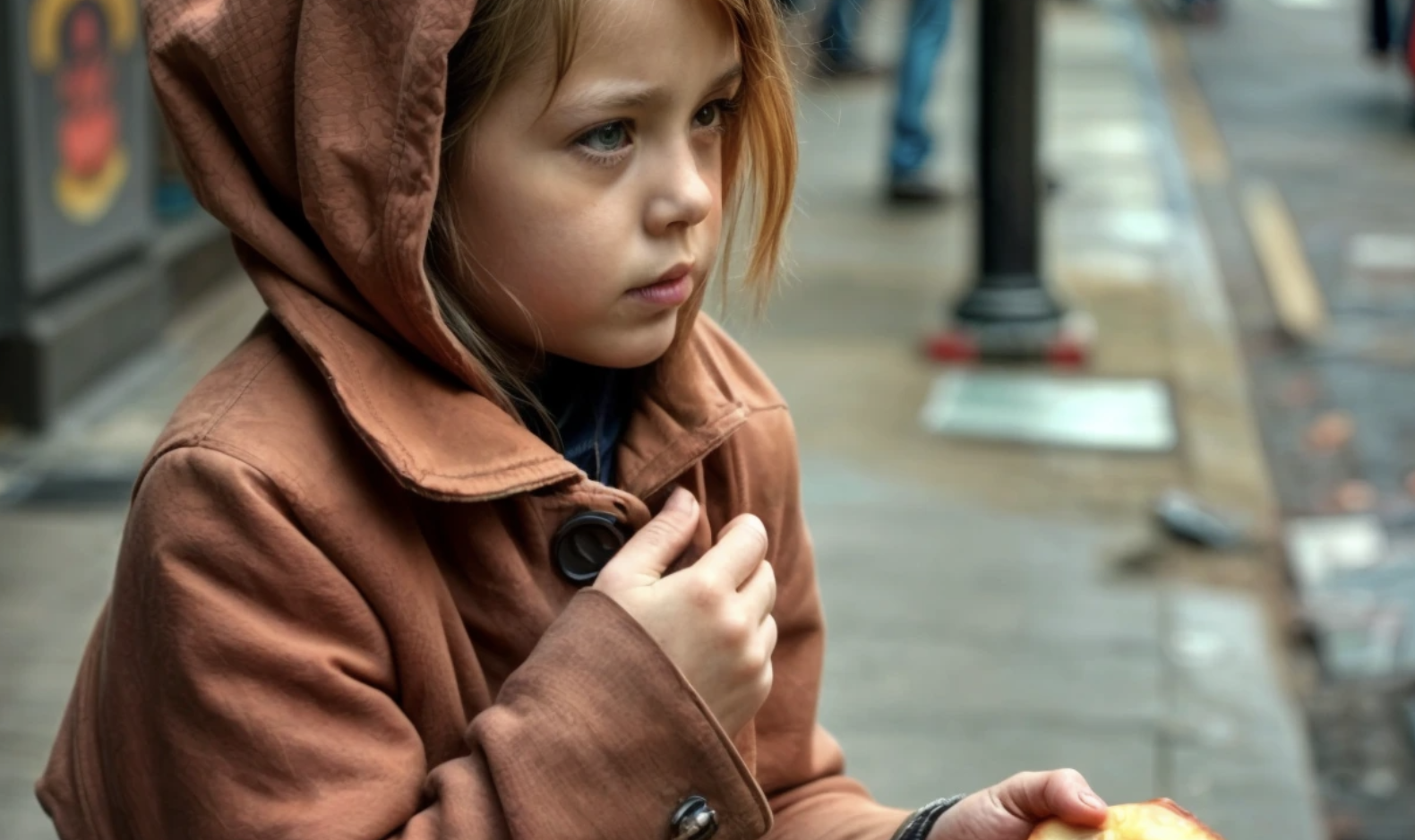
But then a little girl—five or six—tugged at the hem of Vera Antonovna’s dress. She wore a shabby little dress; her cheeks were dirty, her eyes enormous.
“Grandma, do you need a TV? I need money for medicine for my mom…”
“Where are your parents?” Vera Antonovna looked around, but no one was nearby.
“Mom’s at home, sick,” the girl answered quietly.
“And your dad?” the woman frowned.
“Dad died,” the girl said indifferently, as if she’d made peace with it long ago.
“Where do you live?”
“Over there,” the girl pointed to a half-collapsed wooden barrack.
“Come on, I’ll look at your TV,” Vera Antonovna decided.
On the way she learned the girl’s name was Nastya, and that she barely remembered her father—only moments of him shouting at her mother while her mother cried. The house they came to was in terrible condition: crooked, peeling, plywood instead of windows.
As they climbed the creaking stairs, Nastya warned:
“Careful—this step caves in.”
Inside, despite the ruin, it was clean and strangely cozy. Suddenly Vera Antonovna froze. On the wall hung a photograph—a young man she could never forget. It was the very guy because of whom her son had ended up in prison.
Slowly she shifted her gaze to the bed, where a woman lay burning with fever. Nastya came up and gently touched her mother’s forehead.
“Fever again. The lady doctor came, wrote prescriptions, but at the pharmacy they said there wasn’t enough money,” the girl explained. “And I thought… maybe we could sell the TV…”
“You poor things,” Vera Antonovna said, deep sorrow in her voice, stepping closer to the woman on the bed. Her palm softly touched the sick woman’s hot forehead, and the mother’s face twisted with pain. “Where’s the doctor’s prescription?”
Nastya silently held out a sheet of paper, covered in illegible scribbles, as if written in haste or under pressure.
“And do you have any food?” Vera Antonovna suddenly asked, eyeing the empty shelves and cupboards.
The girl lowered her eyes and sighed like an adult:
“I ate the last of it yesterday… And Mom only drinks water.”
“Take the apples. Eat—get your strength back, wake up your appetite. I’ll be back soon, I promise,” Vera Antonovna said, carefully setting the bag of fruit on the table.
“Auntie… Mom won’t die like Dad, will she?” Nastya whispered suddenly. Her voice trembled, as if she’d asked that question many nights in a row.
Vera Antonovna crouched in front of her, taking her hands.
“Of course not, sweetheart. Call me Aunt Vera, all right? I’ll be nearby now.”
“All right,” Nastya replied—and on her cheeks, streaked with tears, a smile blossomed for the first time in a long while: timid, but alive, like a spring sprout through cracked asphalt.
Without losing a minute, Vera Antonovna pulled out her phone and called her son.
“Son, we’ve got an emergency. I need your help. Urgently.”
She described the situation briefly, trying to speak clearly and calmly so she wouldn’t frighten him too soon.
“Wait there,” Ilya said simply—and hung up.
Half an hour later they met by the house where Katya and Nastya lived. The mother told him everything she’d seen, felt, understood. Her heart, which had endured so much pain because of her son, opened again to compassion.
“I’ll go to the pharmacy, and you go to the grocery,” Vera Antonovna suggested.
Ilya took the prescription, studied the notes carefully, and headed to the nearest pharmacy. At the counter he patiently waited his turn while the pharmacist looked over the paper with curiosity.
“This is for the flu,” the woman said, furrowing her brow. “Why didn’t you come earlier?”
“We only found out about the sick woman today,” Ilya explained. “And there was no one else to go. Do you have all this in stock?”
The pharmacist nodded and began laying out the medicines: paracetamol, an antiviral, throat rinse, vitamins.
“This one you don’t need anymore,” she pointed to one of the items. “It’s taken within the first forty-eight hours from the start of the illness. Don’t waste your money. But take these. Gargle, air out the room, drink plenty of warm fluids, eat light soups, brew rosehip tea, vitamin compotes. The main thing is warmth and care.”
“Thank you very much,” Ilya said, carefully packing the medicines into his bag.
“All the best to you,” the woman replied, a little moved by his seriousness and concern. “Get well.”
Meanwhile, Vera Antonovna wandered the aisles of the grocery store with an almost empty cart. She looked genuinely lost.
“Mom, what are you doing?” Ilya asked, surprised as he came up to her. “You’re going to walk around with an empty basket?”
“I just don’t know what to buy,” she sighed. “I don’t even remember what a young woman and a little girl need.”
“Then I’ll help,” Ilya said—and quickly began filling the cart: a plump chicken, fresh potatoes, onions, carrots, milk, bread, gingerbread cookies, candies, lemons, fragrant black and green tea. He added sausage, cheese, butter, and even a couple bottles of mineral water.
“And fruit?” he pondered, rubbing his chin.
“We’ll stop by Akhmet’s,” Vera Antonovna smiled. “He always has the best.”
They bought peaches, grapes, apples, and apricots, and soon the cart was overflowing with food.
“How are we going to carry all this?” Ilya laughed. “I’ll bring the car around.”
“Oh, what a woman!” Akhmet exclaimed, looking at Vera Antonovna. “A woman like that belongs in a portrait!”
“I agree—my mom’s a goddess,” Ilya laughed, tossing the bags into the trunk.
“Oh, you romantics,” Vera Antonovna said as she got into the car, smiling, though tears glittered in the corners of her eyes.
When they returned to Katya and Nastya’s house, the hostess tried to sit up when she saw them, but Vera Antonovna gently laid her back down.
“Lie still. Rest. We’ll manage.”
Katya’s pajamas were soaked with sweat—her fever seemed to be breaking. Vera Antonovna looked around.
“Where’s your clean bedding?”
Katya weakly waved toward the dresser. Ilya tactfully stepped out of the room, and his mother began changing the sick woman’s clothes and linens as if she’d done it all her life.
Meanwhile, Ilya took over the kitchen. He brewed tea, set potatoes to boil, made fluffy mashed potatoes, pulled the chicken from the broth, divided it into neat pieces, added carrots and onions. Everything smelled like home, like care, like hope.
“Who are you?” Katya rasped, struggling to open her eyes.
“Neighbors,” Vera Antonovna smiled. “Lie still. Don’t talk. Everything will be as it should.”
Ilya brought a mug of hot broth.
“Wait a little—let it cool. Then little by little, sip by sip.”
“Why are you doing this?” Katya asked, looking at them with confusion and gratitude at once.
“You need help, and there’s no one else left to wait for,” Vera Antonovna answered firmly, checking the broth’s temperature. “Drink in small sips.”
While his mother cared for Katya, Ilya repaired the broken steps on the creaking staircase and installed new railings by the entrance. He moved with confidence, as if he knew exactly what he was doing—and why.
“Mommy, Aunt Vera and Uncle Ilya are helping us so much!” Nastya burst in, glowing with a happiness that felt to her like something unbelievable—almost fairy-tale.
Katya looked at her daughter and felt a long-lost joy stirring inside. Lately Nastya had become too serious, too grown-up for her years. But now her eyes shone again with a child’s carefree light.
When Vera Antonovna and Ilya were about to leave, the woman said:
“Tomorrow we’ll definitely come. We’re not going anywhere.”
The next day Vera Antonovna went from pharmacy to pharmacy gathering what was needed, and Ilya visited Katya and Nastya again.
“How are you doing here?” he asked, peeking into the refrigerator, where there was less food—a good sign.
“Thank you, much better already,” Katya smiled shyly, pulling the blanket up.
Ilya shifted his gaze to the photograph on the wall—the very man who had once been the reason for his imprisonment.
“Who is that?”
Katya froze; her face turned to stone.
“That’s my ex-husband,” she answered quietly. “Oleg Pavlovich. Nickname ‘Bagor.’” She gave a bitter little laugh and went on, as if old pain had finally found an outlet. “I’m from an orphanage. After school I trained as a seamstress. There was a car repair shop nearby, Oleg worked there. He started walking me home, giving gifts, talking sweet. I thought he was in love. Then he proposed. The girls in the dorm told me who his father was, and I decided—I’d gotten lucky. He brought me here, to this shack, and said we’d move after the wedding.
“I got pregnant, Nastya was born, and he was hardly ever home—out drinking with friends. When Nastya turned three, an aneurysm killed him. They said someone hit him. The guy got sent to prison. Oleg’s father pulled strings. Later I found out his parents had thrown him out of the house, didn’t give him money. The workshop left only debts and this wreck. And after he died they came to me and said, ‘Don’t expect help.’ They left me the shack. Such generous people. Only… someone went behind bars because of them…”
“Was it you?” Katya gasped.
“Yes,” Ilya admitted. “Looks like fate decided you and I were going to meet again.”
“And your wife?” Katya asked unexpectedly.
“She left me,” Ilya replied calmly, but bitterness threaded through his voice. “And probably for the best. Otherwise I never would’ve met such wonderful people. Right, Nastenka?”
Nastya, sitting in front of the TV, looked up from cartoons and giggled, shaking her head.
“How did you live here alone for two years?” Ilya asked, handing Katya tea with lemon.
“All right, mostly,” Katya shrugged. “I finished college, sewed at home. Clients came. Nastya went to kindergarten until I got sick. It happened so suddenly—I didn’t even have time to prepare. A client of mine called the doctors, and Nastenka… she ran the whole house.”
“That little girl has been through too much,” Ilya sighed. “But it’s all behind you now, right, Nastenka?”
She nodded again, happy they hadn’t forgotten her.
With each day Katya grew stronger. Ilya and Vera Antonovna became regular guests in that house. He helped with repairs, bought things, made soups, played with Nastya. And when Ilya returned to his old job, they welcomed him with open arms—specialists like him are valued. Six months later, the state allocated Katya a small apartment. Ilya added his savings, and Vera Antonovna helped financially.
“Mom, I’ll pay you back,” he promised then.
They sold the old shack at a good price—neighbors were looking for a place for a dacha. And into the new three-room apartment, Ilya carried Katya in his arms like a bride. Ahead of them walked Nastya in a white dress with bows, shining like a holiday tree. Behind them, hand in hand, came Vera Antonovna and Akhmet—he, as always, smiling, and she, it seemed, feeling truly happy for the first time in many years.