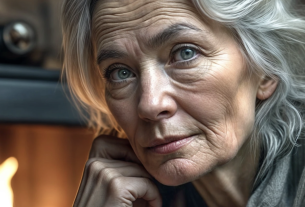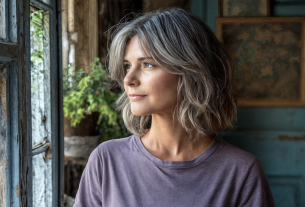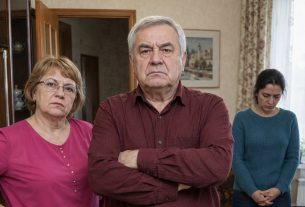
Olga had been holding the thick envelope bearing the notary office seal for nearly ten minutes before she finally worked up the courage to open it. Inside was an inheritance document. Her second cousin, Valentina Sergeyevna, with whom Olga had stayed in touch for almost twenty years—visiting her country house near Tver every summer, helping in the garden, and listening to endless stories about her youth—had left Olga everything she owned.
The amount was so large that Olga counted the zeros twice, almost afraid she had made a mistake. Then she reread the notary’s name, checking once more that the inheritance had not somehow been intended for someone else.
Igor came home late from work and found his wife sitting at the kitchen table with a cup of tea that had long since gone cold and several documents spread out in front of her.
“What happened?” he asked, taking off his jacket in the doorway without even removing his shoes.
“Aunt Valya,” Olga replied quietly, still looking down. “She left me an inheritance. Igor, it’s a very serious amount of money. I don’t even know how I’m supposed to react.”
 
Igor came closer, picked up the document, read the number, then read it again as though he could not believe it the first time. Slowly, he lowered himself into the chair beside her.
“That’s…” he began, then stopped and rubbed the bridge of his nose. “We’ve been talking about buying a house for years. Our own piece of land, peace and quiet, those imaginary vegetable beds you’re always dreaming about. Remember?”
“That was exactly what I was thinking about on the way home,” Olga admitted. “No loans. No mortgage. Just our own money—Aunt Valya’s money. What would you say if we bought a small house outside the city? Somewhere just for the two of us, somewhere to rest without rushing into anything?”
Igor smiled so broadly that the little dimple in his cheek appeared—a dimple Olga had not seen in a long time. Usually he came home exhausted and gloomy, but now he suddenly looked five years younger.
“I’d say we should have done it long ago,” he replied, covering her hand with his. “And you know what? It’ll be our place. Just ours, Olya. No big weekend crowds, no noisy gatherings, no endless guests.”
“That’s exactly what I’ve always wanted.” For the first time that evening, Olga smiled. “Peace and quiet. The forest. Maybe our own little sauna. And nobody telling us how we should live.”
Olga nodded, and those words brought an unexpected sense of calm. For the first time in a long while, it felt as though the decision had been made once and for all, and the future had finally taken on a clear shape.
The search lasted about a month. They looked at properties in three different districts, argued about the distance from the city, debated the condition of wells, and disagreed over whether it was better to buy a house with an established garden or plant one from scratch.
“This one is too close to the highway,” Olga said, shaking her head as she studied yet another listing on her phone. “The traffic noise will ruin the whole point of going there.”
“And that one is too far away,” Igor objected. “It’ll take us two hours each way. What’s the point of having a weekend house if we spend half the day sitting in traffic?”
Eventually, they settled on a log house with a crooked porch and a large but overgrown yard about forty minutes outside the city. The seller, an elderly man who was moving to another city to live with his daughter, willingly showed them all the documents and agreed to a quick sale.
The money was transferred in a single payment. No mortgage. No loans from relatives. Only the inheritance from Aunt Valya, carefully transferred to the seller through the notary.
 
For the next two months, Olga and Igor spent every weekend at the house.
Igor repaired the porch and painted the fence, climbing up a stepladder with a can of paint while cheerfully whistling some tune. Olga sorted through the belongings left behind by the previous owners, discovering rusty gardening shears, faded photographs of strangers’ children, and other forgotten objects while deciding where she wanted to plant apple trees.
They worked quietly and enthusiastically, occasionally exchanging a few words about lunch or something they still needed to buy at the hardware store.
The property gradually transformed. There was now a neat path, a freshly painted house, a tidy little sauna in the corner of the yard, and three young apple trees growing along the fence.
When the major work was finally finished, Olga brought up a subject she had deliberately postponed for several weeks. She chose a quiet evening when neither of them was in a hurry.
“Igor, I want us to agree from the beginning on how things are going to work here,” she said while he was lighting the barbecue in the yard. Thin smoke was already curling above the coals.
“What do you mean?” He looked up and wiped his hands.
“I don’t want this place turning into somewhere people come and go whenever they like. I don’t want crowds showing up without asking, the way it sometimes happens with other people’s country houses. This is supposed to be our place. Quiet. Peaceful.”
 
Igor shrugged as if the answer were completely obvious and he could hardly understand why she even felt the need to say it.
“I completely agree. Only you and I will have keys. We won’t hand out spare sets to anyone. You bought the house, so you get to decide. I’m perfectly fine with that.”
Olga smiled gratefully and hugged him from behind while he turned the coals with a pair of metal tongs.
“Thank you for understanding,” she said softly against his shoulder.
“What’s there to understand?” Igor turned his head and kissed her temple. “It’s the right thing to do. That’s all.”
The first few weeks in the new house were exactly what Olga had dreamed of.
On Saturday mornings, they drove out early, grilled meat, walked through the forest behind the property, and read books on the veranda while grasshoppers chirped in the warm air. Igor learned how to light the stove on the first attempt and proudly showed off his success to his wife every time.
Gradually, their trips to the countryside became a tradition they both looked forward to throughout the working week. Olga would look at her relaxed, content husband and at the neat property surrounding them, and she became more convinced every day that they had made the right decision.
The silence and privacy were worth every penny.
Their peaceful life lasted for about three months.
The first person in Igor’s family to learn about the house was his mother, Inna Pavlovna. One evening, Igor casually mentioned during a phone call that they now had somewhere to go on weekends. He did not realize that this small piece of information would trigger an endless stream of questions.
“Where exactly is the house?” Inna Pavlovna asked, becoming slightly more persistent every time. “How much land is there? Do you have a well, or did they install running water? And what about the sauna? Is it a real one or just something decorative?”
 
Igor tried to answer briefly and avoid details, but his mother had a talent for getting information out of anyone. Her questions became more specific, and before long, Inna Pavlovna knew almost as much about the house as Olga herself.
“Mom, enough about the house already,” Igor finally said one evening while the call was on speakerphone and Olga was preparing dinner nearby.
“Oh, come on, son. I’m only interested,” Inna Pavlovna replied in an offended voice. “Doesn’t a mother have the right to ask how her only son is living? You used to tell me everything. Now I have to drag every word out of you.”
Olga heard conversations like this almost every evening and tried not to attach too much importance to them, although her mother-in-law’s tone seemed slightly more demanding every time.
A couple of weeks later, the conversations changed.
Inna Pavlovna suddenly remembered that she had long wanted to take her grandchildren—the children of Igor’s sister Anastasia—to the countryside. They had only recently turned five and seven.
“Children need fresh air,” she told her son over the phone while Olga sat beside him at the table and could not help hearing every word. “They’re always stuck in the city, practically trapped between four walls. Now you have a house with a yard and a forest nearby. It would be wonderful for the grandchildren to run around there, kick a ball, maybe swim in the river if there’s one close by.”
“Mom, we’ve only just bought the place. We haven’t even properly settled in ourselves,” Igor tried to joke, giving Olga a wink.
“All the more reason to use it while it’s summer. Otherwise winter will come and the whole place will sit there for nothing,” Inna Pavlovna continued.
Olga tried not to interfere, but every conversation left her increasingly uneasy. The discussions about the house gradually stopped sounding like suggestions and began to sound like expectations—as if the visit had already been approved and the only thing left to decide was the date.
About a month later, Inna Pavlovna said something that made Olga genuinely wary.
 
“I hear you’ve set up a family house out there,” her mother-in-law remarked one Sunday during lunch at Igor’s parents’ home, where Olga and Igor had been invited for Anastasia’s birthday.
The table was festive and smelled of fresh pies, but the conversation quickly turned toward the familiar subject.
“A family house should be open to the whole family, not just two people,” Inna Pavlovna declared.
Igor gave an awkward laugh and tried to turn the comment into a joke while pouring tea.
“Mom, what family house? It’s just a country place.”
“As if I don’t know it was bought with Olga’s money,” Inna Pavlovna replied, narrowing her eyes at her daughter-in-law. “All the more reason. If the money came into the family, then the house belongs to the family too, doesn’t it?”
Olga said nothing. She simply tightened her grip around her cup.
She did not want to start an argument at the birthday table or ruin Anastasia’s celebration. Still, the sentence remained stuck in her mind for the rest of the evening.
On the drive home, Olga could no longer keep quiet.
“Igor, did you hear what your mother said? About the house being a family house?”
 
“I heard her.”
“And?”
“And what? Mom talks like that all the time. Don’t take it seriously. She likes making dramatic statements.”
“How am I supposed not to take it seriously when she openly says the house belongs to everyone? Igor, that isn’t a small thing.”
“Olya, enough.” Igor exhaled irritably and gripped the steering wheel more tightly. “She’s just talking. She gets bored, so she gets fixated on things. Try not to be so possessive about it, honestly.”
The word “possessive” hit Olga unpleasantly.
She turned toward the window and remained silent for the rest of the journey, watching streetlights flash past.
For the first time in a long while, an uncomfortable feeling settled inside her. It was as if something important was beginning to slip out of her hands while her husband refused to notice.
The following weeks were relatively peaceful, apart from Inna Pavlovna’s regular phone calls asking about the weather outside the city and what was growing in the garden.
Olga tried to convince herself there was nothing to worry about. Her mother-in-law simply liked knowing what was happening in her son’s life.
Still, every call left behind a faint unpleasant aftertaste.
 
The confrontation finally came on a beautiful Saturday when nothing seemed likely to go wrong.
Olga and Igor were sitting on the veranda with coffee, looking through photographs of the renovations on a laptop and laughing about how neglected the house had looked six months earlier.
Then they heard a car pull up outside.
A minute later, the gate swung open.
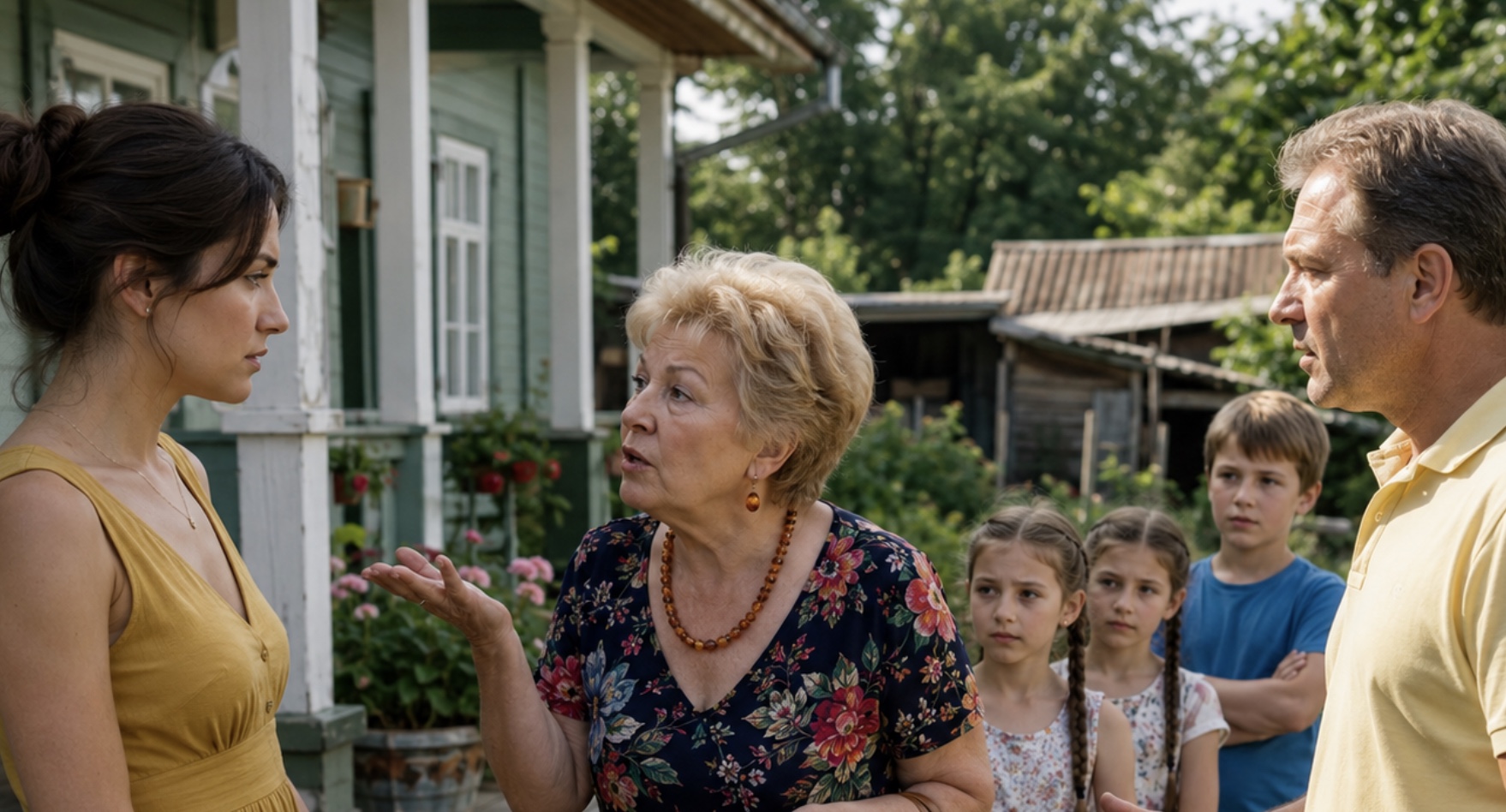
Inna Pavlovna walked into the yard carrying a large bag. Behind her came Anastasia with her two children, loaded down with shopping bags and an inflatable swimming ring.
“Here we are!” Inna Pavlovna announced cheerfully, surveying the property with the sharp eye of someone inspecting her own estate. “We thought we’d surprise you and not warn you in advance. Makes it more fun that way. Look how beautiful you’ve made everything!”
Olga stood up, hardly believing what she was seeing.
Nobody had called. Nobody had asked permission.
The children were already running around the yard.
“Inna Pavlovna, we weren’t expecting you today,” Olga began carefully, trying to keep her tone neutral.
“Why would we need to warn you? We’re not strangers,” her mother-in-law waved dismissively, already heading toward the house. “Igoryok, show me those renovation photos again. I want to see the whole transformation from the beginning, every detail.”
Without looking at his wife, Igor reopened the photographs and began scrolling through them while Inna Pavlovna settled comfortably into a chair beside him, looking perfectly at home.
“This room would be ideal for the children,” she said while studying a photograph of the second floor. “And I can put a folding bed in this one. I’ll probably be coming here often now—helping with the garden, watching the grandchildren. You should build a sandbox near the fence too. Nastya, that would be perfect for your kids.”
Anastasia nodded enthusiastically while taking towels from her bag and spreading them over the veranda railing as though the house belonged to her just as much as it belonged to its actual owners.
 
“Yes, definitely a sandbox,” she agreed. “And you could hang a swing from that tree. The kids love swings.”
Olga listened in silence.
A strange feeling was growing inside her.
It was as though her own house was being divided, assigned, and reorganized without her involvement. Her opinion did not seem to matter. She had somehow become an outsider watching other people make plans for property she had bought.
“Inna Pavlovna,” Olga said, stepping closer and forcing herself to stay calm even though her voice threatened to tremble. “I’m glad you like the house. But we will decide when to invite people here. Visits need to be arranged in advance. People cannot simply arrive without calling.”
Her mother-in-law looked away from the laptop and stared at her for a long moment, almost as though she could not believe what she had just heard.
“And why are you the only one who gets to have keys to the house? We’re family!” Inna Pavlovna exclaimed.
Her voice was so sharp that the children fell silent near the fence, while Anastasia stopped arranging the towels and turned toward her mother.
“Igor has one set of keys, and I have one set,” Olga answered evenly, straightening her back. “Nobody else has keys, and nobody else will. That rule applies to everyone.”
 
“Relatives don’t need invitations to come to a family home,” Inna Pavlovna declared, rising from her chair and no longer hiding her irritation. “This is supposed to be a shared place for people who are close to you, not your private fortress with guards at the entrance.”
Igor, who had remained silent and clearly uncomfortable between the two women, suddenly became involved.
“Olya, what if we really did make one spare set?” he suggested in a conciliatory tone. “For Mom. Then she wouldn’t have to call every time.”
Olga looked at her husband as though she were seeing him for the first time in ten years of marriage.
“Being family does not mean having unrestricted access to a house that was bought with my money,” she said firmly, looking directly at her mother-in-law. “This is my decision. It is not open for discussion now or in the future.”
Inna Pavlovna’s face turned crimson. She clenched her fists and took a step forward, almost bumping into the chair.
“So that’s what you really think of us! You’re simply greedy, that’s all! I always knew you were never good enough for my son,” she snapped, pointing at Olga. “Arrogant, cold, always trying to turn him against his own mother and separate him from his family!”
“Mom, enough,” Igor tried to interrupt, but no one was listening anymore.
Anastasia, who had stood to the side until then, stepped closer to her mother, making it obvious whose side she was on.
“My children haven’t done anything wrong, by the way,” she said, crossing her arms and pursing her lips. “They have nowhere to spend time outdoors, while this house sits empty half the week doing nothing. I don’t understand why we should have to ask permission to come here. We’re not strangers. We’re blood relatives.”
“Igor, tell her,” Inna Pavlovna demanded, turning sharply toward her son. “Give your mother a set of keys and let’s put an end to this. I’m asking for something perfectly normal.”
 
Igor rubbed the back of his neck, avoiding his wife’s eyes and shifting awkwardly from one foot to the other.
After a long, uncomfortable silence, he finally spoke.
“Olya, maybe we shouldn’t make such a big deal out of this. Just give Mom the keys and let her come whenever she wants. Everyone will be happier that way.”
At that moment, Olga understood everything.
Completely and finally.
Her husband had chosen his mother’s side instead of hers.
The realization left her feeling cold and empty.
“So that’s your position,” she said quietly, looking at Igor with almost stunned disbelief. “Now I understand.”
Then she turned toward everyone.
“Nobody is going to treat this house as communal family property,” Olga said, raising her voice enough for even the children by the fence to hear. “And after what happened today, I’m telling you right now: I will not invite any of you here again. Not for birthdays, not for holidays, not for New Year’s. Never.”
She barely finished speaking before the yard erupted.
 
Inna Pavlovna shouted about selfishness and ingratitude, waving her arms furiously. Anastasia joined in, accusing Olga of being heartless toward innocent children. Igor rushed between them, trying to calm his mother without making his wife even angrier, but every attempt only made things worse.
“You’re nothing but a selfish woman!” Inna Pavlovna shouted, nearly spitting with rage as red blotches spread across her face. “My son belonged to me his entire life, and now he can’t say a word without your permission! You’ve turned him into a spineless man under your heel!”
“And you’re a mother who interferes in someone else’s marriage and treats other people’s property as if it belongs to you!” Olga shot back, feeling her voice begin to shake from the strain.
“Other people’s property? I created this family! That is my son standing right there!”
“And apparently he’s ready to hand over the keys to my house to anyone as long as his mother doesn’t get upset,” Olga replied bitterly, looking at her husband with a strained smile that made her own eyes sting.
“From this moment on, I don’t consider you my daughter-in-law anymore!” Inna Pavlovna shouted, struggling to catch her breath as she fanned herself with one hand. “Take your henpecked husband and live however you want. Just don’t involve us in your life ever again!”
With that, she spun around, grabbed her bag, and marched toward the gate without looking back.
Anastasia quickly gathered the frightened children and the scattered bags and followed her mother, throwing one final contemptuous look at Olga.
A minute later, their car sped away, leaving a cloud of dust behind.
 
The yard fell into ringing silence, broken only by the rustling leaves of the young apple trees.
Igor remained standing in the middle of the yard, uncertain whether to follow his mother or approach his wife, who stood beside the porch with pale lips and slumped shoulders.
“Olya…” he began.
Then he stopped because he had no idea what to say.
“Not now, Igor,” Olga replied quietly.
She went into the house and closed the door behind her.
Almost two months passed after that day.
During that entire time, Olga did not invite any of Igor’s relatives to the country house even once.
She and Igor still went there on weekends, but now they often traveled in deliberate silence. The easy warmth they had once shared was gone. It felt as though an invisible wall had risen between them.
Igor tried several times to repair his relationship with his mother. He called her, visited his parents on weekends, explained what had happened, and attempted to smooth things over.
He also repeatedly tried to change Olga’s mind. He asked her to invite his mother over just once, to give everyone another chance and forget about the ugly argument.
“Olya, maybe we could invite Mom for tea sometime?” he suggested again one evening when they were both tired after work. “She’s willing to apologize. I talked to her a few days ago.”
“Igor, the house is mine, and the decision is mine,” Olga answered without looking up from her book. “I explained that from the beginning, long before any of this happened. You agreed with me then. Your mother received her answer, and it isn’t going to change no matter how many times you ask.”
“But she’s family,” Igor tried again.
“You and I are family,” Olga replied shortly. “We’ve already seen what happens when everyone else starts deciding what that word means.”
Igor would fall silent, realizing he could not change her mind. Sometimes he went into another room. Other times, he simply sat down beside her on the sofa without saying anything, unwilling to reopen the argument.
 
Inna Pavlovna, meanwhile, continued complaining to friends and neighbors about her supposedly cold-hearted daughter-in-law. She told anyone willing to listen how unfairly her poor grandchildren had been treated and how Olga had deprived them of fresh air and nature out of pure selfishness.
These stories occasionally reached Olga through mutual acquaintances, but she had long since stopped caring.
The only time she reacted was when yet another acquaintance repeated Inna Pavlovna’s complaints to her.
Olga merely smiled.
Her mother-in-law never received a set of keys to the country house—not that summer, and not the following summer either.
The house remained exactly what Olga had intended it to be from the very beginning: a quiet place for two people, where even the closest relatives came only when the owner invited them.
And after that confrontation, the invitation never came again.