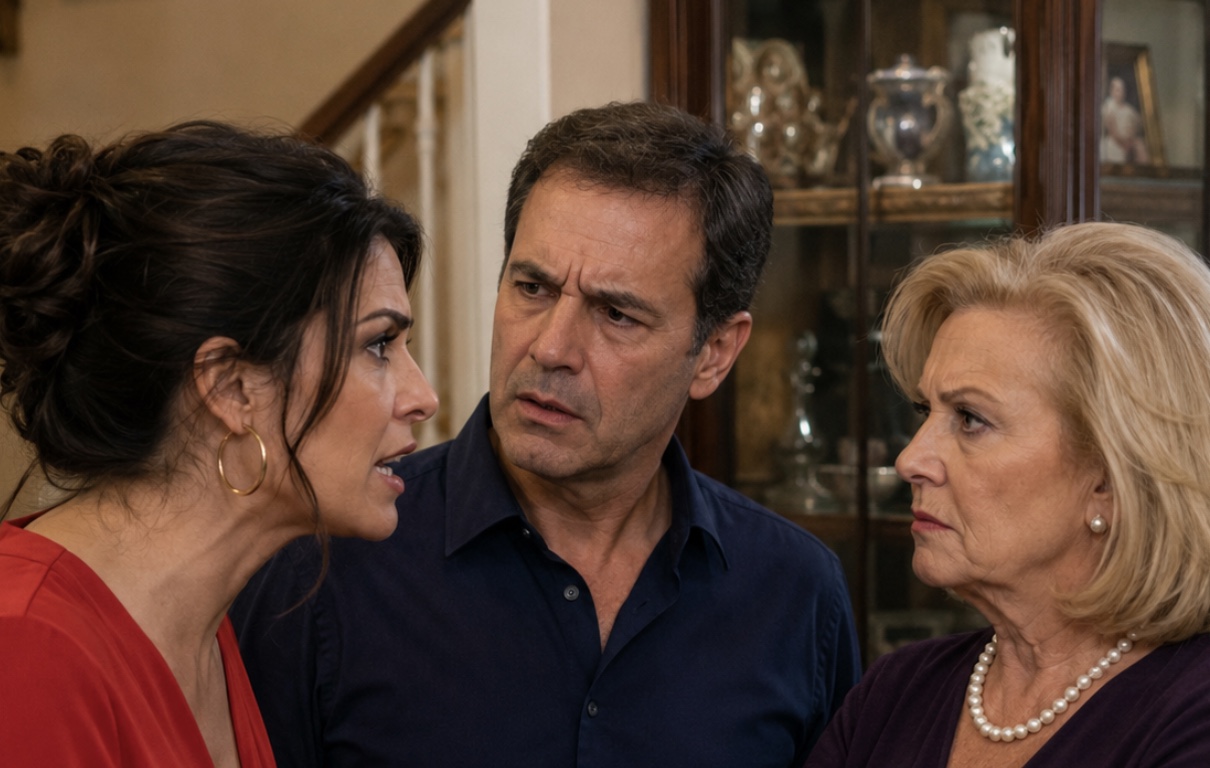
Alyona had long since stopped counting how many times over the past year she had heard Polina Viktorovna’s car pulling up outside the gates. Her mother-in-law never bothered to call ahead. She usually appeared on Wednesdays, precisely at lunchtime, and the habit had become so firmly established that Valentina, the housekeeper, automatically set the table for four even when Artyom was expected to stay late at work.
The house where the newlyweds lived was genuinely impressive: a two-story mansion outside the city, complete with a winter garden, a swimming pool, and a garage large enough for three cars. From the outside, the situation seemed obvious enough. A successful young man had provided his wife with a luxurious life.
That was exactly the version Polina Viktorovna loved telling friends, neighbors from her country house community, and distant relatives at family gatherings.
“Artyom achieved everything on his own, with his own intelligence and hard work,” she would say proudly while pouring tea in her daughter-in-law’s living room. “Look at the life he has given his wife—a beautiful house, cars, everything she could possibly want. You’re a very lucky woman, Alyona. Very lucky indeed.”
Alyona had learned to let those remarks pass without reacting. Or at least she tried to. Every time she heard them, something inside her tightened painfully at the sheer unfairness of it all.
 
The house belonged to her.
She had bought it using money from the sale of a valuable piece of land inherited from her grandmother, combined with savings she had accumulated through her successful consulting career. The cars—including the SUV Artyom drove every day—were also registered in her name and had been paid for long before she ever met her future husband.
Yet Artyom never seemed eager to correct his mother.
He simply remained silent, sometimes even nodding along, allowing Polina Viktorovna to believe the convenient little story she had created.
Her visits soon became an exhausting ritual.
Polina Viktorovna could find something wrong with absolutely anything. The soup was not salty enough. The curtains in the living room had been chosen poorly. Alyona spent too much money on cosmetics.
“In my day, women knew how to save money,” Polina Viktorovna remarked one afternoon over lunch, studying her daughter-in-law over the top of her glasses. “And now you’ve bought another handbag. Artyom must constantly have to reach into his wallet because of you.”
Alyona said nothing.
The handbag had been purchased with her own salary—a salary Polina Viktorovna apparently did not even realize existed.
 
Arguing seemed pointless. Her mother-in-law only heard what fit the version of reality she had already decided to believe.
“You have no idea how fortunate you are,” Polina Viktorovna repeated whenever the opportunity presented itself, like a record stuck on the same line. “Another woman in your position would be on her knees thanking fate for giving her a man like Artyom.”
Whenever his mother started speaking that way, Artyom usually found an excuse to leave the room. He suddenly needed his phone, or remembered something in the garage, or claimed he had forgotten to check something outside.
Once his mother finally drove away, he would return to the living room wearing the same guilty expression and make the same request.
“Just put up with her a little longer, okay? Mom is difficult, but eventually she’ll get used to you.”
“Could you tell her she’s wrong just once?” Alyona asked one evening, feeling her patience wearing thinner with every passing week. “Could you defend me even one time?”
“Why create a conflict? Let her say whatever she wants. The important thing is that you and I know the truth.”
Unfortunately, knowing the truth did nothing to change Alyona’s growing feeling that her opinion no longer mattered inside her own home.
 
A year after the wedding, Polina Viktorovna no longer behaved like a guest. She behaved like an owner.
She rearranged decorative vases according to her own taste. She criticized Valentina’s cleaning as though the housekeeper worked for her. One afternoon, Alyona even found her speaking to the gardener and giving detailed instructions about which shrubs should be transplanted in the spring.
“Polina Viktorovna, perhaps you could ask me before making decisions about my garden,” Alyona said, carefully controlling her tone.
“What is there to ask?” her mother-in-law replied dismissively without even turning around. “Sooner or later this house will belong to Artyom anyway. So there’s nothing wrong with me having a say.”
At the time, Alyona ignored the comment, assuming it was just another example of Polina Viktorovna exaggerating her importance.
But similar remarks became increasingly frequent.
Her mother-in-law openly discussed with acquaintances who would “eventually inherit the mansion.” She invited guests without asking Alyona’s permission. She organized small gatherings as though the property truly belonged to her.
Artyom continued saying nothing.
He remained silent when his mother made cruel remarks about his wife.
 
He remained silent when she rearranged furniture in rooms Alyona had spent years decorating according to her own taste.
He even remained silent when Polina Viktorovna scolded Valentina directly in front of Alyona, as though the actual owner of the house had no authority within her own walls.
“Are you ever going to stand up for me?” Alyona finally asked after one particularly unpleasant visit, watching her mother-in-law’s car disappear beyond the gates.
“This isn’t the right time,” Artyom replied automatically, without looking up from his phone.
“And when will the right time be, Artyom? Next year? Five years from now?”
As usual, he gave no answer.
The breaking point came during another family lunch at their house.
This time Polina Viktorovna had also invited Alina, a distant relative, along with her husband Matvey. She had dressed with particular care for the occasion, as though the meal were less a family gathering and more an official demonstration of her own importance.
“Artyom has accomplished so much entirely on his own,” Polina Viktorovna began almost as soon as everyone took their seats. “To own a house like this at his age is a remarkable achievement. Not everyone is capable of earning so much through hard work.”
Alina and Matvey nodded politely, openly admiring the elegant interior.
 
Alyona sat quietly, moving her fork around her plate while waiting to hear where the familiar speech would lead this time.
“Some women,” Polina Viktorovna continued, raising her voice slightly while allowing unmistakable contempt to creep into her tone, “deliberately choose wealthy men so they can spend the rest of their lives doing nothing. They live off someone else’s money and waste it on handbags and dresses.”
Her eyes settled directly on Alyona.
There was no doubt about whom she meant.
“You’re nothing but a gold digger!” Polina Viktorovna snapped.
For a moment, complete silence filled the dining room.
Alina awkwardly lowered her eyes toward her plate. Matvey coughed, clearly trying to hide his discomfort.
Artyom said nothing.
He stared at the tablecloth as though he had suddenly discovered something fascinating there.
Alyona slowly placed her fork down.
Then she looked directly at her husband, giving him one final opportunity to defend her.
Artyom did not lift his eyes.
 
“Very well,” Alyona said calmly. Her voice did not tremble, although inside she felt something harden into cold, unmistakable clarity. “Then allow me to explain one thing, Polina Viktorovna. There is no such thing as ‘someone else’s money’ in this house.”
Her mother-in-law frowned, obviously caught off guard.
“This house belongs to me,” Alyona continued, looking around the table. “The cars were purchased with my money. Everything you have spent the last year admiring was paid for by me or my family long before I ever met your son.”
“What nonsense are you talking about?” Polina Viktorovna tried to laugh, but the sound came out strained and uncertain. “Artyom achieved everything himself. He told me—”
“Artyom has known the truth from the beginning,” Alyona said, turning toward her husband. “He simply allowed you to believe whatever made him look more successful in your eyes. Unfortunately, he chose to do that at the expense of my dignity.”
For several seconds, Polina Viktorovna was completely speechless—a rare sight for a woman who always insisted on having the final word.
Then her face twisted with anger.
“You deliberately hid this from us!” she shouted, pointing at Alyona. “You made us look like fools in front of the entire family! How shameful!”
“I didn’t hide anything,” Alyona replied calmly.
 
Her composure only seemed to infuriate Polina Viktorovna further.
“No one ever asked who actually owned this house. Everyone preferred believing the version that was more convenient.”
At last, Artyom spoke.
“Alyona, listen, I never wanted conflict. Mom just—”
“The conflict was always there, Artyom,” Alyona interrupted.
She looked at him with the calm expression of someone who had finally reached a decision after months of hesitation.
“You simply chose your mother’s side every single day instead of mine.”
“That’s not true. I always—”
“The truth is that both of you failed the test,” Alyona continued. “Polina Viktorovna, because you judge people entirely by money. And you, Artyom, because you valued your own comfort more than my dignity.”
Across the table, Alina and Matvey sat frozen, visibly regretting having accepted the invitation.
Polina Viktorovna tried to launch into another attack, accusing Alyona of ingratitude and hypocrisy, but Alyona was no longer truly listening. Her mother-in-law’s voice seemed distant now, almost meaningless.
“I’m filing for divorce,” Alyona said firmly, looking directly at Artyom. “And I want both of you to leave my house immediately.”
“You can’t do this!” Polina Viktorovna jumped to her feet. “We’re family! After everything we’ve—”
“We’ve spent the last year and a half living like strangers under the same roof,” Alyona replied evenly. “The only difference is that now everyone knows it.”
Artyom slowly stood up.
He seemed to search desperately for words, but nothing came.
Without another argument, he walked toward the hallway, where Valentina—almost as though she had anticipated exactly how the afternoon would end—was already waiting with his jacket.
 
Polina Viktorovna continued trying to bargain for sympathy, appealing to Alyona’s conscience, but Alyona escorted both of them to the front door without responding.
She waited until the heavy oak door closed behind them.
Alina and Matvey quickly excused themselves as well, murmuring apologies about the uncomfortable situation and clearly relieved to escape the mansion as soon as possible.
Once everyone was gone, Alyona remained standing near the living-room window for several minutes.
She watched Polina Viktorovna’s car drive away from the gates.
A taxi followed shortly afterward, carrying Artyom.
Valentina cautiously appeared at the doorway, unsure whether she should disturb the silence.
“Valentina Sergeyevna,” Alyona said, feeling completely calm for the first time in months, “please tell security that neither Polina Viktorovna nor Artyom is to be allowed onto the property again. Under any circumstances.”
“Of course, Alyona Dmitrievna,” Valentina replied with a simple nod, asking no questions.
It was almost as if she had been waiting a long time to hear those words.
The divorce was finalized quickly.
There was very little to divide because nearly everything had belonged to Alyona from the beginning. A prenuptial agreement, signed before the wedding at the insistence of her own lawyer, removed any remaining uncertainty.
Artyom tried several times to contact his former wife.
 
He sent messages filled with apologies, explanations, and promises.
Alyona never replied.
It was not because she hated him. She simply no longer wanted to return to a relationship built on silence, cowardice, and the quiet acceptance of disrespect.
A few months later, Alyona finally began making the house truly her own again.
Not through some formal renovation meant to create the image of a perfect family home, but by changing the things she had wanted to change for years.
She repainted the bedroom walls in a calm gray-blue shade she had always loved but had repeatedly postponed because Polina Viktorovna insisted that light colors were “impractical.”
In the garden, she created a small rose bed where the rigid shrubs her mother-in-law had once demanded used to stand.
Sometimes, when Alyona passed through the living room, she could almost feel the faint echo of those exhausting family lunches.
But what she felt was not regret.
It was relief.
Quiet, peaceful relief.
A feeling that finally belonged entirely to her—just like the house itself, which had always, from the very beginning, been hers alone.