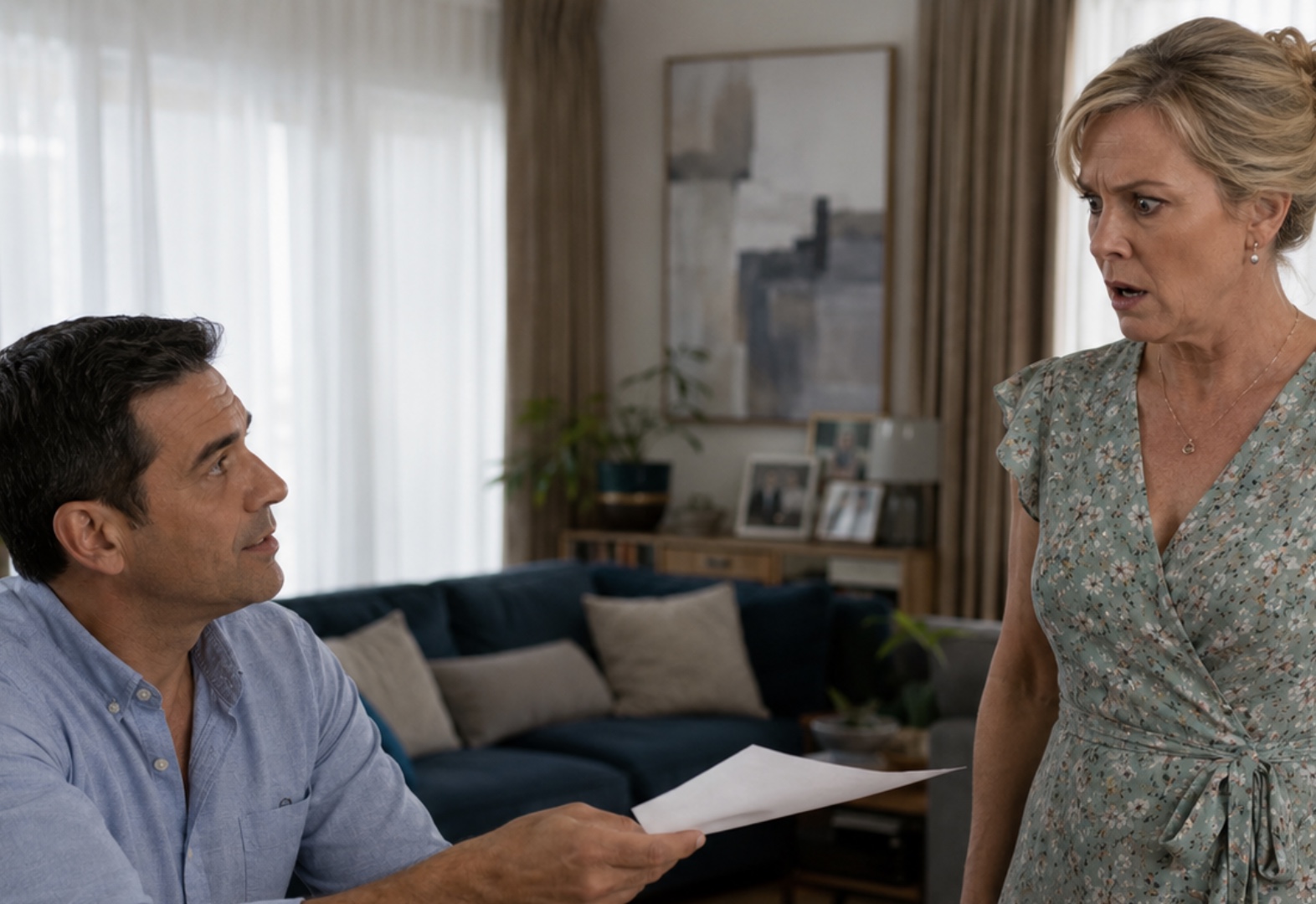
“Just look at how professionally this has been drawn up,” Igor said, spreading the papers across the dining table between two mugs and a little dish of stale cookies. “The lawyer is from one of the best firms in the city. I paid good money for this, by the way.”
His voice was calm, almost gentle. It was exactly the tone people used when they wanted you to overlook the trap.
Irina stood by the window and watched him. Not the documents—him. The slight tilt of his head. The way his fingers moved confidently along the edge of the pages, with the ease of someone who had done this before.
Igor had the kind of masculine attractiveness that only seemed to become more convincing with age. He was fifty-two but looked no older than forty-five. His shirts were always crisp, and he always smelled faintly of some expensive, woody cologne. Years ago, Irina had mistaken that scent for reliability.
“Igor,” she said quietly, “I’m not signing anything today.”
“Why not?”
He looked up. There was no anger in his eyes, only mild, almost professional surprise—the expression of a doctor whose patient had suddenly refused to take a prescribed pill.
“Ira, it’s only a legal transfer. The apartment will still be ours.”
“Then why do I need to sign anything?”
“Because technically it’s registered in your name. We need a loan for the business, and the bank wants the property transferred to a single owner—a legal entity. I’ve explained this.”
He had.
Three times.
And each time, he had explained it a little differently. Something in his story never quite fit, like a puzzle assembled with one piece from another box.
Irina stepped away from the window, walked into the hallway, and took a bottle of water from the shelf. She drank slowly while staring at the wall.
Behind that wall was their bedroom. On the nightstand on her side lay a book with a bookmark on page seventy-three. She had not read another page in three weeks.
Three weeks—ever since Igor had first mentioned these documents.
They had been married for four years.
Back then, Irina worked in the municipal administration, in the land relations department. It was a dull but secure job, predictable in all the ways she appreciated.
She had met Igor at a corporate event her friend had practically dragged her to. He had been cheerful, charming, endlessly talkative. He told stories about business ventures in Sochi and a yacht he was supposedly “about to buy.”
The yacht never materialized.
By then, however, Irina had already moved in with him—or rather, he had moved in with her.
The apartment belonged to Irina. She had inherited the three-bedroom property from her mother. It was in a good neighborhood, close to a park.
Igor had moved there because, as he explained, his own apartment was “tied up as collateral from an old business matter.”
For a long time, Irina did not ask what kind of business matter.
Eventually, she did.
“It’s all taken care of,” Igor told her. “Don’t worry about it.”
So she didn’t.
Foolish, perhaps.
But when you live with someone, eat at the same table, watch the same television series, go on vacations together, you gradually stop being cautious.
Maybe that was the whole point of sharing a life.
And maybe that was also what made it dangerous.
That evening, Igor left for a meeting. He said he would be home around ten.
At half past eight, Irina sat in the kitchen with her laptop, watching a free online seminar about investments. Lately she had been thinking more and more about changing something in her life, though she could not yet say exactly what.
Her phone vibrated.
Unknown number.
She almost ignored it.
Something made her answer.
“Are you Irina? Igor Severov’s wife?”
The woman’s voice sounded mature and calm. There was no hostility in it, which somehow made Irina even more alert.
“Yes. Who is this?”
“My name is Svetlana. I’m Igor’s first wife.”
Irina said nothing.
She simply listened to a moth tapping repeatedly against the kitchen window.
“I know he’s asking you to sign documents involving your apartment,” Svetlana continued. “His accountant called me. We know each other—it’s a long story. She saw the papers and decided someone should warn you. I thought it would be better if I called you myself.”
“How did you get my number?”
“Igor has never been especially careful with his phone. That’s one of his habits.”
There was no bitterness or triumph in Svetlana’s voice. Only the exhaustion of someone who had already survived the worst of it and was now simply completing a necessary task.
“Irina, I don’t want to interfere in your marriage. But I went through exactly the same thing. Almost word for word. The same explanations about the bank. The same story about transferring property to a company.”
“And what happened?”
There was a pause.
The moth stopped hitting the glass.
“Afterward,” Svetlana said simply, “I no longer had an apartment.”
Irina closed the laptop.
The investment seminar continued playing behind the darkened screen, but she no longer heard it.
“Can we meet?” she asked.
“Yes. Tomorrow morning, if you want. I live on the northern side of town, but I can come into the center. There’s a café near the drama theater. Do you know it?”
“I do.”
“Ten o’clock. I’ll be there.”
Irina ended the call and stared at the table for a long time.
The papers Igor had left “for her to look over” were stacked neatly and fastened with a blue paper clip.
She picked them up and read them again.
This time, slowly.
Every paragraph.
And the further she read, the more clearly she understood that something was wrong.
Not necessarily in the wording itself.
In the logic behind it.
In what the documents were designed not to say.
The front door lock clicked.
Igor had come home early.
“Still awake?” he called from the hallway as he removed his jacket. “Watching anything interesting?”
“Reading,” Irina replied evenly.
“The documents?”
“The documents.”
He smiled broadly, visibly relieved.
“See? It’s all written clearly. We can go to a notary tomorrow if you want. Then you’ll see everything is completely legitimate.”
“Yes,” Irina said. “We’ll go tomorrow.”
But first she intended to stop by the drama theater.
Svetlana looked nothing like Irina had imagined.
For some reason, Irina had pictured a disheveled woman with blazing eyes, the sort of ex-wife who burst into another woman’s life carrying a suitcase full of accusations and old resentment.
Instead, the woman waiting at the café was elegant and composed, around fifty-five, wearing a beige linen jacket and a short, neat haircut. Her expression belonged to someone who had grieved a long time ago and had finally finished grieving.
A cup of tea sat untouched in front of her.
“Sit down,” Svetlana said when Irina approached. “You look exactly the way I expected.”
“Is that good or bad?”
“Neither. Just exactly right.”
A faint smile crossed Svetlana’s face.
“He has a type. Independent women. Women who own property. Women without parents hovering nearby to interfere.”
Irina sat down.
A waitress came over, and Irina ordered coffee simply so she would have something to hold.
“Tell me everything,” she said.
And Svetlana did.
She had met Igor in 1999.
He was thirty at the time and seemed ambitious, promising. He had a small business, useful connections, plans for expansion.
Svetlana was a doctor. She owned a one-bedroom apartment in a new building, which she had received through a program for young medical professionals.
A year after their wedding, Igor introduced the idea of “restructuring the ownership.”
The explanation was different back then—something about taxes and joint ownership.
The lawyer Igor brought in sounded convincing.
Svetlana signed.
A year and a half later, Igor told her he was leaving.
By then, her apartment had already been transferred into his mother’s name through a series of transactions Svetlana had never fully understood.
She spent two years in court.
She never got the apartment back.
“How do you live now?” Irina asked.
“I rent. I’ve been renting for twenty years.”
Svetlana said it without self-pity, almost as though she were describing a medical diagnosis.
“I earn well. I’m fine financially. But that apartment was mine. That matters. Not only because of money. It simply matters.”
Irina wrapped both hands around her coffee cup.
Outside, the summer city hummed with life: a trolleybus passed, voices drifted through the open air, and a laughing group walked past the café window.
“You said his accountant contacted you. Does she still work for him?”
“Not anymore. She resigned last week. She’s young, and she has a conscience. She didn’t want to be part of it.”
Svetlana finally lifted her tea.
“The scheme isn’t complicated, Irina. Your apartment gets transferred to a legal entity. Then that company is dissolved. After that, the property ends up with a new owner who has no legal connection to you.”
“Is that legal?”
“At each individual stage, technically, yes. Taken as a whole—you understand.”
Irina did understand.
She had spent eight years working with property and land documentation. She had seen similar arrangements on paper.
She had simply never expected to see one laid out on her own dining table.
She left the café shortly after eleven.
For a moment, she stood on the steps, squinting in the bright July sun.
Then she took out her phone and called Igor.
“I’m going to be a little late,” she said. “I want to stop by the public services office and clarify a few things about the documents. You said yourself it was better to double-check everything.”
“Absolutely,” he said approvingly. “Good idea. Ask them about the registration timeline too.”
Irina ended the call.
Then she went somewhere else entirely.
She drove to see Vera Nikolaevna, a former colleague who had left the municipal administration three years earlier and opened a small legal office near Theater Square.
Vera was intelligent, tough, and precise. Irina had respected her for years.
She was the kind of person you remembered when you finally needed real help.
Vera Nikolaevna listened for twenty minutes.
Then she asked to see photographs of the documents. Irina had taken them that morning while Igor was asleep.
Vera scrolled through the images, enlarged several sections, then gave a dry little laugh.
“Well drafted,” she said. “His lawyer knows what he’s doing. But look here.”
She pointed to the screen.
“See this clause? ‘Without the right to subsequent claim.’ It means that once you transfer the property, you waive your ability to demand a share later, even through court. Legally, you disappear from the story.”
“What should I do?”
“Right now? Sign nothing. That’s the first and most important thing.”
Vera leaned back in her chair.
“Second, you need evidence that he pressured or persuaded you to sign. Messages would work. A voice recording of him explaining the arrangement would work too.”
“He always explained it verbally.”
“Then make him explain it again. Tell him you still don’t quite understand and ask him to send or record a voice explanation. He’ll do it. He thinks you’re almost ready to agree.”
Irina nodded.
Vera was right.
Igor had been behaving exactly like that—relaxed, confident, almost triumphant.
The way people behaved when they believed the difficult part was already over.
Irina returned home around three.
Igor was in the kitchen preparing lunch. He sometimes cooked when he was in a particularly good mood. It was one of his ways of showing that everything was going exactly as it should.
“So?” he asked without turning around. “Did you figure everything out?”
“Almost.”
She paused.
“Igor, can you explain the legal entity part one more time? I want to record it as a voice note so I don’t forget the details. You don’t mind, do you?”
He turned.
For a fraction of a second, something flashed across his face.
Then the smile returned.
“Of course not. Let’s just do it after lunch, okay? I made pasta.”
“Fine,” Irina said. “After lunch.”
She sat at the table and watched his back.
Watched the confident, familiar movements of a man who felt completely at home.
In her home.
The pasta smelled good.
Igor whistled softly while he cooked.
Outside, the poplar leaves rustled.
And suddenly Irina understood something with perfect clarity.
She was no longer the woman who had been unable to get beyond page seventy-three of her book for three weeks.
Something inside her had shifted.
Quietly.
Permanently.
Like the hand of a clock—you never hear it move, but it moves all the same.
The voice recording lasted four minutes and forty seconds.
Igor explained everything in detail and seemed almost to enjoy himself. He liked being listened to.
He talked about the legal entity, the bank, and how “the apartment isn’t going anywhere; technically, only the form of ownership will change.”
Irina nodded occasionally and asked a few calm questions, behaving exactly like someone who simply wanted to understand.
When he finished, she put the phone away.
“Thank you,” she said. “Now it makes sense.”
That evening, she forwarded the recording to Vera Nikolaevna.
The reply contained one word.
Excellent.
For the next two weeks, Irina lived two separate lives.
On the surface, everything remained normal.
Morning coffee. Casual conversations. Igor taking calls and going to meetings.
Inside, Irina was preparing.
Carefully.
Methodically.
Without rushing.
The way you pack for a long journey once you know you will never return.
She called the bank and asked how to close their joint account.
She transferred her personal savings to a separate account she opened herself at another branch.
She obtained a notarized copy of her property ownership certificate. The original remained in her personal document folder, while the copy was stored safely in Vera Nikolaevna’s office.
Igor noticed nothing.
Or pretended not to.
Sometimes Irina caught him looking at her—a quick, assessing glance—and wondered whether he suspected something.
But no.
He was too absorbed in his own certainty.
He still believed everything was going according to plan.
At the end of July, Irina filed for divorce.
Igor did not hear about it from her.
His lawyer received the official notice.
He called her at one-thirty in the afternoon while she was at work.
“Ira, what is going on?”
“We’re getting divorced, Igor. You received the papers.”
“Are you serious?”
For the first time, she heard genuine confusion in his voice.
“Why? What happened? We talked about everything. I explained—”
“You did explain,” she said. “I recorded it. Remember?”
Silence.
“Ira—”
“Igor, I have a meeting in ten minutes. From now on, all questions go through my lawyer.”
She ended the call and returned to her paperwork.
Her hands were perfectly steady.
The divorce took three months.
At first, Igor fought it. He hired his own attorney and tried to dispute aspects of the property settlement.
There was not much to divide.
The apartment had belonged to Irina before the marriage, and the documents proved it.
They had accumulated almost no jointly owned assets because Igor had always preferred registering valuable things in other people’s names.
That habit, in the end, worked against him.
Vera Nikolaevna handled the case cleanly and quietly.
At the final hearing, Igor looked at Irina for a long time.
She held his gaze.
He seemed to want to say something.
She could see it.
But he said nothing.
He left the courtroom first without saying goodbye.
Outside, the September sun was unexpectedly warm.
Irina stood for a while on the courthouse steps and lifted her face toward the sky.
Somewhere nearby, a market was bustling. The air smelled of apples and fresh bread.
She took out her phone and wrote to Svetlana.
It’s over. Thank you.
The reply came quickly.
Good for you. Now live peacefully.
Peace, however, took some getting used to.
Not because Irina missed Igor.
She hardly missed him at all, and that alone answered many questions.
It was simply that after so many months of tension, silence felt strange.
Unfamiliar.
She would come home and hear only herself—her footsteps, her breathing, the television she sometimes turned on merely to have some sound in the apartment.
Without Igor, the place changed.
For the better, strangely enough.
She rearranged the furniture in the living room, something she had wanted to do for years but Igor always resisted change.
She bought new curtains—light-colored linen ones.
And the book on her nightstand finally moved beyond page seventy-three.
At work, she was promoted.
They offered her the position of department head.
She accepted.
Irina met Svetlana again in November, completely by accident.
They ran into each other near an escalator in a shopping center, recognized one another, and laughed at the coincidence.
They had coffee in a small café on the second floor, surrounded by potted palms and children eating ice cream.
“How are you?” Irina asked.
“Good,” Svetlana replied.
And she seemed to mean it.
“My daughter visited last week. She brought my grandson. I’m a grandmother now. Imagine that.”
“Congratulations.”
“Thank you.”
Svetlana was quiet for a moment.
“You know, I spent a long time wondering whether I should have called you. It was your life, your marriage. Maybe I had no right to interfere.”
“You did,” Irina said simply.
Svetlana nodded.
They sat in silence for a moment, but it was a comfortable silence.
“Has Igor contacted you?”
“He sent one message. Something about wanting to ‘talk like civilized people.’ I didn’t answer.”
“Good.”
A fine rain fell outside the café windows.
Down on the street, people hurried along, opening umbrellas as they walked.
Irina watched them and thought about how, a year ago, she had been exactly like them—rushing everywhere, barely looking around, failing to notice what was happening right in front of her.
Now she noticed.
In December, Irina enrolled in a real estate course.
She had wanted for years to understand the field from more than just an administrative perspective.
The instructor was meticulous and a little boring, but he knew his subject thoroughly.
At the third class, Irina met a woman named Katya—loud, cheerful, and divorced for two years.
“You went through it too?” Katya asked while they drank tea in the hallway after class.
“Through what?”
“You know. Everything.”
Katya waved vaguely with one hand.
“All that woman-and-marriage-and-divorce stuff.”
Irina laughed.
It was the first genuine laugh she had had in a long time, and it surprised even her.
“I did,” she said. “And you know what’s strangest?”
“What?”
“I’m not afraid anymore.”
Katya looked at her with a kind of immediate respect, narrowing her eyes slightly—the way people look at someone they instinctively believe.
“That’s good,” she said. “Actually, that’s probably the most important thing.”
Outside, it was cold.
But spring was not so far away.
Irina knew that with certainty.
She had always been good at sensing when something was ending.
And when something new was beginning.
Spring arrived abruptly in the middle of April, almost without warning.
On Friday the weather had still been gray and damp.
On Saturday morning, Irina opened the window and heard birds.
Real birds, loud and insistent, as though they too had been waiting and had finally gotten what they wanted.
She made coffee, wrapped herself in a blanket, and stepped onto the balcony.
She simply stood there.
Looking down into the courtyard.
At the poplar trees showing their first sticky green leaves.
At the bench where an elderly woman was already sitting with a newspaper.
Nothing remarkable.
Just an ordinary morning.
And yet there was something in that ordinary morning that Irina had been missing for years.
Silence that did not weigh on her.
Space that belonged entirely to her.
In May, she traveled to St. Petersburg alone for four days.
She wandered along the embankments, sat in cafés with a book, and took a boat ride through the canals.
She took photographs for no one but herself.
She ate whatever she wanted, whenever she wanted.
She went to sleep without thinking about someone else’s routine.
On the third day, she suddenly realized she had not thought about Igor even once.
Not once.
It was the best discovery of the entire trip.
She sent Svetlana a postcard from St. Petersburg—a real paper postcard with a view of the Neva River.
She wrote only:
Everything is good. Thank you for calling me.
Svetlana replied after Irina was already home.
She said she had shown the postcard to her grandson, who immediately asked what beautiful city was pictured on it.
So she had to explain bridges and white nights to him.
Irina smiled and put down her phone.
Outside, May rustled through the trees.
The book that had once sat unfinished on her nightstand was finally complete.
Beside it lay a new one, unopened, with a perfectly straight bookmark resting on the first page.
Everything was only beginning.