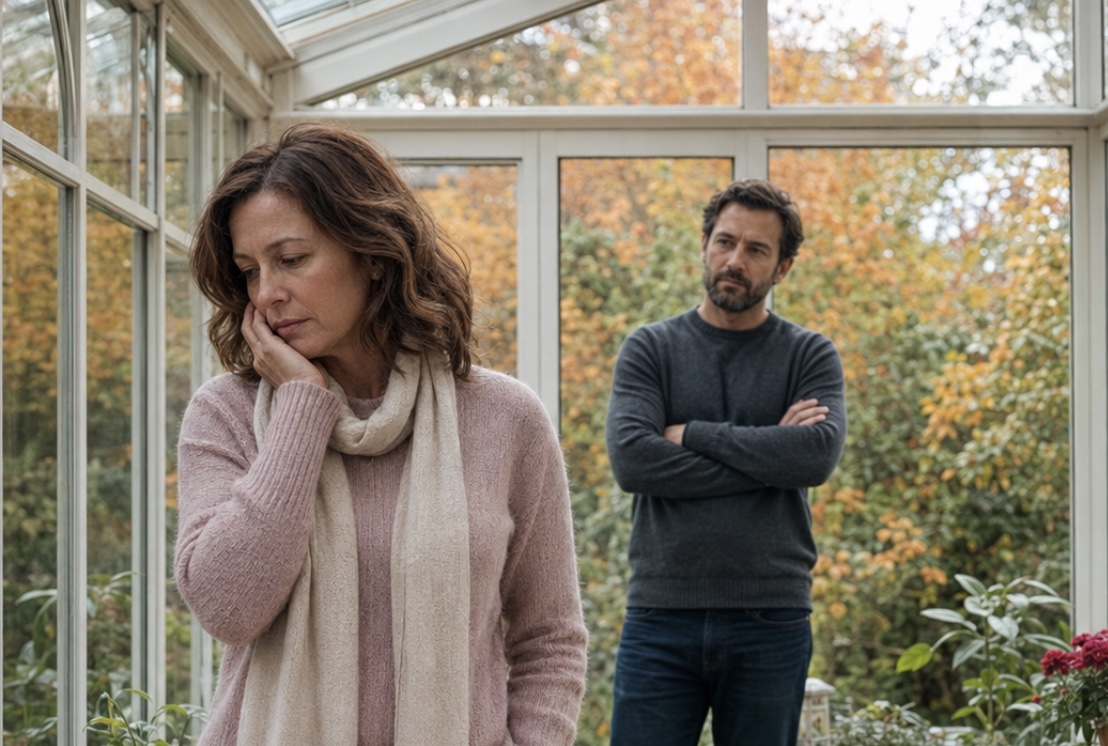
“Since you’re happier with her, I won’t stand in your way. Just leave the keys on the cabinet,” Katya said calmly.
Her husband had no idea how to respond. Vadim stood in the hallway with a travel bag in his hand, suddenly unable to find the words he had rehearsed. The conversation he had carefully planned for three days was not going the way he expected.
He had prepared himself thoroughly. He had chosen calm, convincing phrases to explain everything to Katya and make it clear that his decision was final. Vadim had expected tears, accusations, an argument—or at the very least, the question, “Why?”
After all, they had spent eight years together. He never imagined she would let him go so easily.
But Katya did not even look at him.
She quietly ironed his pale-blue shirt, the one he had planned to wear to work the next day. She carefully smoothed the fabric and moved the iron slowly from one section to another.
Vadim watched her for a moment, hesitated, then awkwardly zipped up his bag.
Happier with her…
Yes, everything with Angelika was completely different.
Life with Angelika seemed bright and exciting, untouched by unfinished renovations and ordinary household routines. Angelika did not walk around the apartment in old knit trousers, nor did she tie her hair into a funny little bun at the back of her head.
Angelika always looked perfect. She wore expensive perfume and drank only dry wine. She loved talking about freedom, independence, and how genuine passion was slowly destroyed by domestic life.
“You’re not like everyone else, Vadim,” she would whisper, lightly touching his chin with fingers tipped with dark cherry-colored nails. “You’re intelligent. There’s so much inside you. Why are you wasting yourself on such a dull life?”
And Vadim believed her.
He began to think of himself as a man with enormous untapped potential, someone destined for something greater.
Vadim’s father, Sergei Grigoryevich, was much less impressed.
He was a man who rarely praised anyone, and when he learned what his son was doing, his judgment was short and painfully clear.
“You’re a complete idiot, son,” he said without even looking up from the carburetor he was repairing in his garage. “Katya made a decent man out of you. You came out of university nervous, broke, and with absolutely nothing to your name. She started with you from zero. You counted every coin together in rented apartments and saved on everything you possibly could. And now suddenly you want the glamorous life?”
“Dad, you don’t understand!” Vadim protested angrily. “Katya and I are different people now. We’ve outgrown the relationship!”
His father slowly wiped the grease from his hands with a rag. Then he walked over and looked directly at his son.
At that moment, he did not see a thirty-year-old man standing before him. He saw a spoiled five-year-old child demanding yet another toy.
“Outgrown it?” his father asked quietly. “You think you’re the one who has outgrown something? Remember this, Vadim. A door can close very quickly behind you. And when the draft slams it shut, it can crush your fingers badly. Don’t come running to me afterward. I won’t listen.”
Vadim dismissed his warning.
What could his father possibly understand? He had spent his entire life working at a factory. His idea of romance was taking Vadim’s mother to their country house on weekends.
Vadim had met Katya during their third year at university.
That summer, he had failed his advanced mathematics exam and was seriously at risk of being expelled—and possibly drafted into the army.
Katya offered to help him prepare for the retake.
For three weeks, they studied together. Vadim struggled badly, became irritated, slammed textbooks shut, and complained constantly. Katya never lost patience. Again and again, she calmly explained differential equations until he finally began to understand them.
When Vadim passed the retake with a good grade, he was so excited that he grabbed Katya in front of the university’s main entrance, lifted her into the air, and spun her around.
Katya laughed freely and joyfully.
That was when Vadim first noticed how extraordinary her pale gray eyes were. They reminded him of the sky just before a thunderstorm.
Then came the years.
Ordinary life, where one day gradually began to resemble another.
They saved for the down payment on a two-bedroom apartment. Katya sang in the kitchen while baking her famous apple pie. She accepted Vadim’s night shifts without complaining when he was still struggling to build his career.
“Oh, come on, Vadik,” she would say with a smile. “We’ll get through it together.”
And they did.
Eventually there was more money. They bought a good car. They could afford vacations twice a year.
But with financial stability came silence.
Katya stopped laughing the way she once had. She became quieter, more responsible, more tired, more domestic.
And Vadim began to feel that they were simply spending the rest of their lives together out of habit, while all romance had disappeared long ago.
Then Angelika joined his department at work.
Vadim placed his keys on the cabinet, zipped his bag, and walked out of the apartment without receiving any reaction from Katya.
Deep inside, it bothered him.
No tears.
No accusations.
No desperate attempt to stop him.
It almost seemed as though she did not care at all.
But the moment the heavy front door closed behind him, his wounded pride disappeared. It was replaced by excitement about the new life waiting ahead.
The first six months with Angelika felt like an endless celebration.
Her apartment in a newly built residential complex was completely different from the warm, slightly cluttered home Vadim had shared with Katya. There were no family photographs, old blankets, sentimental objects, or accumulated belongings.
Everything was sleek, polished, glossy, and perfectly arranged.
Vadim felt almost heroic—as though he had escaped an ordinary, boring existence and entered a more sophisticated world.
But the glossy surface turned out to be cold.
Vadim quickly discovered that Angelika was not merely an “unusual personality.” She required constant attention and endless devotion to her ego.
“Vadim, what is that shirt?” she would complain the moment he returned home after an exhausting day. “You look like some low-level municipal clerk. And please take your shoes off immediately. You’ve brought dirt inside again.”
Instead of relaxing over a simple dinner and talking about their day, Vadim’s evenings became a series of exhausting social performances.
Angelika dragged him to invitation-only exhibitions featuring artists he did not understand, evening presentations, fashionable events, and conceptual bars.
Vadim felt completely out of place.
While everyone around him seriously discussed “the transcendental nature of postmodernism,” his stomach cramped from hunger and exhaustion.
Whenever he tried to talk about work or share a problem, Angelika responded with patronizing irritation.
“Vadim, please don’t drag me down into everyday nonsense. You know I can’t stand routine.”
Before long, Vadim realized that there was not even a small corner in Angelika’s apartment that truly belonged to him.
Dinner usually consisted of delivered raw fish with avocado or some exotic salad ingredients that he had to drive across the city to buy.
Vadim washed and ironed his own clothes late at night while Angelika slept or read poetry collections.
Gradually, the truth became impossible to ignore.
To Angelika, he was not a soulmate.
He was not an equal.
He was a convenient accessory—a predictable man who paid for her desires and was always expected to admire her.
Almost a year passed.
Vadim began to look worn down.
At night, he increasingly dreamed about his old apartment.
He dreamed of apple pie with cinnamon.
He remembered the soft rustle of pages while Katya prepared lessons for her students.
And he heard her calm voice saying, “We’ll get through it together.”
Sometimes he woke with an almost unbearable desire to bury his face against her shoulder.
But Angelika lay beside him—strange, distant, unreachable even in sleep.
The final break came unexpectedly.
Vadim returned home earlier than usual after an important project collapsed at work. His head was pounding.
Angelika was in the kitchen.
She was not alone.
A stylish photographer Vadim had seen before was sitting with her, and the two of them were enthusiastically discussing a trip to Bali.
“Oh, Vadim,” Angelika said without even turning around. “Why are you home so early? We’re discussing the concept for our trip. By the way, I need money for the tickets. You’ll transfer it tonight, right?”
Vadim stood in the hallway, pressing his fingers to his temples.
And suddenly he understood the full extent of his stupidity.
“Angelika… I’m exhausted. Can we not do this today? My project failed.”
Angelika slowly turned toward him.
There was no sympathy in her eyes.
Only cold irritation.
“Failed?” she repeated contemptuously. “You and those pathetic little projects again? I thought there was at least some spark in you. But you turned out to be nothing more than an ordinary, gray, boring man.”
“What?”
Vadim stared at her.
“You heard me!” she shouted, and all her cultivated elegance vanished in an instant. “Get out! Do you hear me? You poison the air in this apartment with your miserable mood! Pack your things and go back to your perfect ex-wife—assuming she even remembers you!”
She grabbed the first magazine within reach and threw it at him.
Vadim did not bother moving away.
He walked into the bedroom, pulled out his bag, and began stuffing clothes and documents into it.
His father’s words echoed in his head.
A door can close very quickly behind you. And when the draft slams it shut, it can crush your fingers badly.
Vadim rushed out of Angelika’s building without even calling a taxi.
Wet November snow was falling, but he barely noticed it. He simply walked faster, gripping the handles of his bag until his fingers hurt.
Only one thought filled his mind.
He had to get home.
He convinced himself that everything could still be repaired.
He would fall to his knees in front of Katya.
He would explain how terribly wrong he had been.
She was intelligent.
She was kind.
She was familiar.
She would understand.
But the windows of their third-floor apartment were dark.
Vadim ran upstairs and automatically reached into his pocket for his keys.
Then he remembered.
He had left them on the cabinet himself.
He pressed the doorbell.
“Why are you ringing that bell, Vadim?”
The voice came from behind him.
Their elderly neighbor, Aunt Masha, looked out from the apartment next door and stared at him over the top of her glasses.
Vadim suddenly felt cold inside.
“Aunt Masha… where’s Katya? Why isn’t she opening the door?”
“So you finally remembered her,” the old woman said, shaking her head. “She rented the apartment out. She doesn’t live here anymore.”
“Rented it out? Where is she?”
“Where do you think? At your father’s house. Sergei Grigoryevich had a heart attack about three months after you left. Worked himself half to death, and worrying about you didn’t help either. And your Katya… she was the only one who didn’t abandon him. She helped pay for a caregiver, went to see him after school, brought him soup, helped him recover while you were running around after pretty women. She got him back on his feet.”
Vadim’s knees nearly gave way.
The bag slipped from his hand and hit the dirty concrete floor with a heavy thud.
“My father… Is he okay?”
“He’s better now. Go see him.”
Vadim hurried toward the outskirts of the city.
The snow turned into freezing rain, but he noticed nothing.
He felt sick with shame.
The fence around his father’s house had recently been repainted. Light glowed from the windows.
Vadim pushed open the gate, crossed the yard, climbed onto the porch—and stopped.
Katya stood on the veranda, setting the table for tea.
Beside her stood his father, thinner and grayer than before, but looking strong again.
And near Katya’s feet was a little boy, perhaps a year and a half old, holding onto her skirt. He had large round eyes and a funny tuft of hair sticking up from his head.
“Katya…” Vadim whispered.
His father turned first.
He looked at Vadim sternly.
“Get out of here, Vadim.”
“Dad, wait… Katya…”
Katya turned toward him.
She was wearing a simple knitted sweater.
There was no anger in her eyes.
No resentment.
She simply looked at him calmly.
“Hello, Vadim,” she said softly.
“Katya… I understand everything now. I was such an idiot. Please forgive me. I’ll come back. I’ll fix everything. I’ll finish the renovation, I’ll—”
“You don’t need to,” she interrupted.
Her voice was exactly as calm as it had been on the day he left.
“Nothing needs fixing.”
“But… what about the child? Whose is he?”
“Mine,” Katya replied.
She looked at the little boy and smiled gently.
“His name is Ilya. You probably don’t know my husband. It doesn’t really matter.”
Vadim stared at her, unable to process what he had heard.
“You… You got married that quickly? You forgot everything?”
“I didn’t forget anything,” Katya replied, meeting his eyes. “I simply closed the door. Just as you wanted me to. You told me you were unhappy with me. I didn’t stop you. But I still had to go on living.”
She bent down, lifted her son into her arms, and held him close.
“You can come inside and talk to your father if you came here sincerely. He missed you. But forget about you and me, Vadim. There’s nothing left there anymore.”
She turned and went inside.
Vadim heard the quiet clinking of teacups, a child’s muffled laughter, and smelled freshly baked apple pie.
He remained on the wet porch for another moment.
Then he turned around and walked away.
Three years passed.
One weekend, Vadim was walking through a crowded city park with his new wife, Olya, a quiet young woman with whom he was slowly and carefully learning how to build a family life again.
“Vadim, look—the carousel!” Olya said cheerfully, adjusting her scarf. “Should we get some ice cream?”
“Sure,” Vadim answered with a smile.
Then he suddenly stopped.
A family was walking toward them along the main path.
A tall, broad-shouldered man carried five-year-old Ilya on his shoulders.
Katya walked beside them.
Her husband had one arm around her and leaned closer to whisper something into her ear.
Katya smiled and rested against his shoulder.
She looked completely happy.
They passed Vadim without even noticing him among the crowd.
“Why do you look so sad?” Olya asked quietly, studying his face. “Thinking about your ex-wife again? Do you regret what happened?”
Vadim exhaled slowly and tightened his grip on Olya’s hand.
“No, Olya. I don’t regret it. A bird in the hand is worth two in the bush. The important thing is not to let go of the one already beside you.”
He looked into Olya’s eyes, holding back the emotion rising in his throat.
“Come on,” he said softly. “Let’s get that ice cream. My treat.”