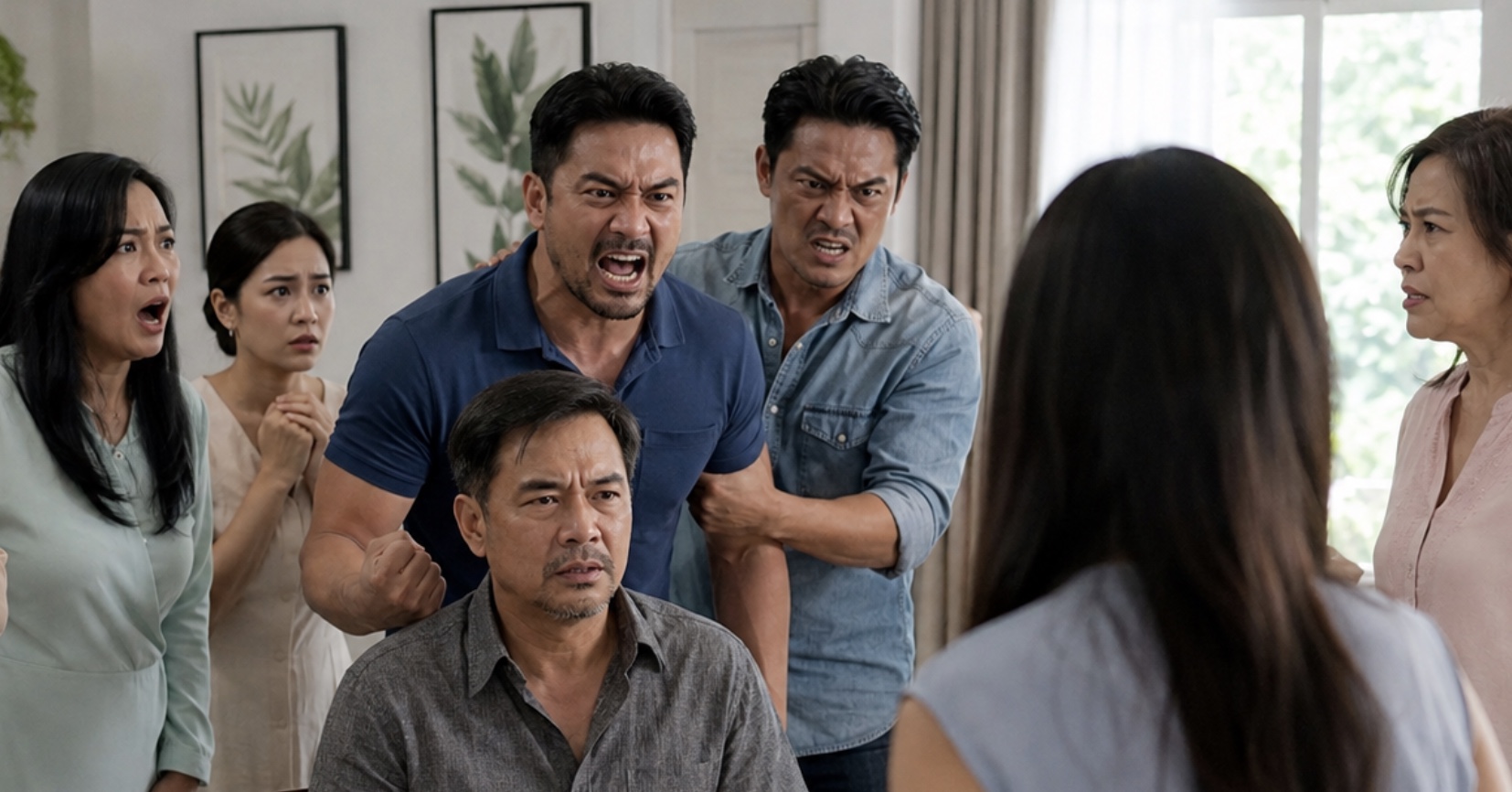
“Listen, I need to tell you something,” Andrei said in the same tone people used when mentioning something trivial. It was almost exactly how he had once announced that he had lost his job—calmly, casually, as though he were commenting on the weather. “Dad left everything to you.”
Natasha looked up from her magazine.
“What do you mean, everything?”
“The apartment in Moscow. The country house outside the city. And eight million rubles in cash. All of it. To you.”
She stared at her husband, trying to understand whether he was joking or testing her reaction. During their eight years of marriage, Andrei had taught her not to trust first impressions. He had a remarkable ability to speak seriously about nonsense and casually about things that mattered.
But this time, he was not joking.
Her father-in-law, Boris Semyonovich, had died quietly in July, almost unnoticed by everyone except the doctors. He was eighty-one. His heart had finally given out.
It was true that Natasha had visited him in the hospital more often than Andrei had. She brought homemade soup in a thermos, read aloud from the newspapers he liked, and listened to him talk about his garden and his youth.
Andrei stopped by once a week, sat for twenty minutes while staring at his phone, and left with obvious relief.
“The notary said the documents will be ready in two weeks,” Andrei added, already looking at his screen again. “Congratulations, I suppose.”
There was no hostility in his voice. Only a faint irritation, the sort a person felt when he was jealous but did not want anyone to notice.
Natasha stared out of the window for a long time. Beyond the glass, the August evening drifted slowly by—heavy and humid, carrying the smell of hot asphalt and a distant thunderstorm.
She was not thinking about the money or the apartment.
She was thinking about the fact that Boris Semyonovich had understood everything.
He had seen how she carried the marriage almost entirely on her own. He had noticed the way her mother-in-law, Rimma Arkadyevna, looked at her from the doorway of someone else’s kitchen. He had watched Andrei turn into an overgrown, demanding little boy every time his mother was nearby.
The old man had seen it all—and made his own decision.
The relatives found out on Friday.
By Saturday morning, everyone had already called.
Rimma Arkadyevna was the first, naturally. Her voice sounded as though she had just learned about a natural disaster.
“Andryusha, are you coming? I need to speak to you. To both of you. To everyone.”
Of course, Andrei immediately began getting ready.
Natasha watched him wander around the apartment looking for his car keys. He pulled his T-shirt on backward without noticing and obediently called his mother to say, “We’re coming.”
By lunchtime on Saturday, about ten people had gathered at Rimma Arkadyevna’s apartment.
Natasha knew them all.
There was Aunt Zoya, Rimma Arkadyevna’s sister, a large woman with a permanent wave and the penetrating gaze of an investigator. There was Andrei’s cousin Kostya, a soft, heavy man in his mid-forties who announced at every family gathering that he was about to start his own business.
There was Larisa, another relative, accompanied by her husband Gennady, a quiet man who always found a corner, sat down, and ate without saying much.
Several other people were there as well—relatives Natasha saw perhaps once a year at birthday gatherings and remembered only by name.
Rimma Arkadyevna’s apartment was large and furnished with the sort of old-fashioned solidity that was no longer fashionable but not yet antique.
A carpet hung on the wall. Crystal glasses stood inside the display cabinet. Framed photographs covered the shelves—Andrei at three years old, Andrei at school, Andrei on graduation day.
In eight years, Natasha had never appeared in a single one of them.
It was not that anyone had deliberately excluded her.
They had simply never thought to include her.
The table was heavily laden with food: meat jelly, sliced cold cuts, roasted chicken, and pickled cucumbers from the previous summer.
Rimma Arkadyevna always cooked a great deal, and she cooked well. Natasha admitted that honestly. She fed her son as though he were still in the ninth grade.
“Natashenka, wouldn’t you like to help with the salad?” Aunt Zoya asked sweetly the moment Natasha stepped through the door.
Not hello.
Not how are you.
Straight to work.
“I’ll help,” Natasha replied.
She went into the kitchen, chopped cucumbers, mixed the salad, and arranged the plates.
All the while, people whispered behind her back.
Only fragments reached her.
“Unfair.”
“Boris was always strange.”
“The daughter-in-law.”
“We need to sort this out.”
For the first half hour at the table, everyone talked about nothing in particular—the heat, the garden at the country house, rising prices.
Kostya described the business he was supposedly about to launch.
Gennady ate.
Larisa smiled with the sort of smile that concealed absolutely nothing because there was nothing behind it.
Then Rimma Arkadyevna carefully placed her cup on its saucer. It made a soft, delicate sound.
She looked directly at Natasha.
“I think we all need to speak honestly,” she said. “As a family.”
Sitting among the crystal glasses and plates of meat jelly, Natasha sensed the beginning of something that did not yet have a name.
It was slow, courteous, and restrained—which made it particularly unpleasant.
“Your father was no longer entirely healthy,” Rimma Arkadyevna continued. “We all understand that. He may have made a decision without fully realizing what he was doing. Andryusha, surely you understand what I mean?”
Andrei nodded.
He always nodded when his mother spoke. It was automatic, like agreeing with something so familiar that it no longer required thought.
Natasha looked at him and thought: There he is, my husband. A forty-year-old man with a receding hairline and expensive sneakers—and he is nodding.
Simply nodding.
Because his mother has spoken.
“Boris Semyonovich was of sound mind,” Natasha said calmly. “I went to the notary with him three months ago.”
The room became noticeably quieter.
Aunt Zoya exchanged a glance with Larisa.
Kostya stopped chewing.
“Three months ago?” Rimma Arkadyevna repeated.
For the first time, something genuine entered her voice. It was no longer maternal concern or polite hospitality. It was something sharp and real.
“So you knew in advance…”
“He called me himself,” Natasha said. “He asked me to drive him there. So I did.”
She offered no further explanation.
She did not mention that Boris Semyonovich had called her rather than his own son.
She did not tell them that afterward, they had sat together in a small café near the notary’s office, drinking coffee, while he said quietly:
“You are a good woman. You stayed with him even though you could have left a long time ago.”
That moment belonged to her.
Only to her.
Rimma Arkadyevna slowly rose from the table and went into the kitchen.
They could hear dishes clattering—loudly, nervously, nothing like the careful way she usually handled them.
Andrei stared at his plate.
Kostya resumed talking about his business.
Natasha sat upright, drank her fruit compote, and understood that this was only the beginning.
After lunch, the men moved into the living room to watch a football match no one particularly cared about. It gave them a socially acceptable excuse not to participate in the conversation.
Gennady settled into an armchair and appeared to fall asleep with a fork still in his hand.
Kostya opened a beer and pretended to follow the game.
The women remained at the table.
Rimma Arkadyevna returned from the kitchen looking calm and collected, as though several minutes alone with the dishes had completely restored her composure.
She resumed her place at the head of the table, folded her hands, and looked at Natasha with a particular smile Natasha had learned to recognize over eight years.
It was not an angry smile.
It was worse.
It was patient.
“Natasha, I want you to understand me correctly,” she began. “I am not against you. I have never been against you. But some things concern the entire family.”
“Which family exactly?” Natasha asked.
Rimma Arkadyevna raised her eyebrows slightly.
“What do you mean, which family? Ours. Boris was part of this family. And everything he accumulated…”
“He accumulated it himself,” Natasha interrupted. “And he decided what to do with it himself. He had every right.”
Aunt Zoya sighed loudly, like someone forced to witness another person’s embarrassing behavior.
Larisa twisted a napkin between her fingers and said nothing, although there was something active and expectant in her silence.
She was clearly waiting for the right moment.
It arrived quickly.
“Listen, Natasha,” she said, adopting a simple, almost friendly tone. “Have you considered that the decent thing might be to sell the apartment and divide the money? Just human to human. We are family, after all.”
Natasha studied her carefully.
Larisa was about five years younger than she was, wore long painted nails, and worked for some kind of real estate agency.
Natasha remembered that last detail at that exact moment, and everything immediately became clear.
“No,” she answered. “I haven’t.”
Outside, the August day stretched on, slow and suffocating.
Children shouted in the courtyard. Somewhere nearby, a small window slammed shut.
It was an ordinary Moscow Saturday during which nothing seemed to be happening—and yet everything was happening at once.
Natasha stood, collected several plates, and carried them into the kitchen.
She simply needed to leave the room for two minutes, breathe different air, and look through the window at someone else’s courtyard.
She remained there exactly long enough to calm herself, and not a second longer.
Then she returned.
She and Andrei left at around six in the evening.
He remained silent in the elevator. He was silent in the car as well, almost until they reached the Moscow Ring Road.
Natasha did not hurry him.
She watched the road, the overheated sky above the highway, and the billboards that appeared for a moment before disappearing and being forgotten.
“Mom says we should consult a lawyer,” Andrei finally said.
“About what?”
He hesitated.
“Well… about the will.”
Natasha nodded.
She was neither surprised nor offended. She simply nodded because this was exactly what she had expected.
Boris Semyonovich had probably expected something like this too, which was why he had arranged everything in advance, carefully and without legal weakness.
The old man had been intelligent.
Quiet, unremarkable, almost entirely domestic—but intelligent.
“She can consult anyone she likes,” Natasha said evenly.
Andrei glanced sideways at her.
“You’re not angry?”
“No.”
It was the truth.
Anger was too simple an emotion for what she felt.
It was closer to exhaustion.
The particular kind of exhaustion that did not accumulate over a day, but over years—years spent pretending everything was fine until one day you no longer had the strength to pretend.
At home, Andrei stretched out on the sofa with his phone.
Natasha made tea, stepped onto the balcony, and stood looking at the city for a long time.
Moscow in August was a world of its own—dusty, dark green, slightly deserted, smelling of heated stone and, somewhere in the distance, the river.
She loved the city.
She always had, ever since she arrived from Voronezh at twenty-three with a single suitcase and the completely unreasonable conviction that everything would work out.
Some things had worked out.
Not the way she had planned, but they had worked out nonetheless.
She thought about the apartment.
It was a three-bedroom place in southwestern Moscow. Boris Semyonovich had bought it in the nineties, when doing so had seemed almost insane.
Natasha had visited it several times. It was spacious and bright, with enormous windows and old parquet flooring that creaked in one particular spot near the entrance.
Boris Semyonovich used to say that the creaking was a good sign.
It meant the home was alive.
Then there was the country house—forty minutes from Moscow, twenty hundred square meters of land, an old wooden home with a veranda, and apple trees that had been growing there for around thirty years.
And eight million rubles.
Natasha felt no joy.
Not because she did not need the money, but because behind all of it stood an old man who had died in a hospital room in July.
During her final visit, she had held his hand, and he had said something she would never forget.
“You’ll be all right. You’re one of those people who always survive.”
Her phone vibrated.
An unfamiliar number appeared on the screen.
Natasha looked at it for a moment before answering.
“Natalia Sergeyevna?” A man’s voice spoke in a professional, unfamiliar manner. “My name is Igor Valentinovich. I acted as Boris Semyonovich’s legal representative. We need to meet. There is something he asked me to tell you in person. Not over the telephone.”
Natasha slowly straightened.
Behind her, inside the apartment, Andrei was speaking to his mother on the phone. Natasha could hear his voice through the glass balcony door—quiet and soothing, the way he always spoke to his mother.
“When?” Natasha asked.
“Monday, if that is convenient. I’ll send you the address.”
She put the phone away and looked out at the city again.
Something had changed.
Not outside her, but within.
It was as though Boris Semyonovich, speaking from somewhere beyond his quiet July disappearance, had placed a hand on her shoulder and said:
“Wait. This isn’t everything.”
Monday began with oppressive heat.
Natasha woke before her alarm and lay staring at the ceiling.
Andrei slept heavily beside her, breathing with a slight whistle and occupying three-quarters of the bed, as he always did.
She carefully got up, went to the kitchen, made coffee, and drank it while standing by the window.
In the courtyard below, the caretaker slowly pushed litter along the curb with his broom.
The address had arrived on Sunday evening.
It was an office in the Moscow City business district, on the twenty-third floor.
Natasha dressed carefully—not elegantly, but seriously. She chose a light blouse, dark trousers, and shoes with a modest heel.
Looking at herself in the mirror, she thought Boris Semyonovich would have approved.
He liked people to look composed.
She told Andrei that she had an appointment.
He did not ask what it concerned.
The law firm looked exactly the way an office on the twenty-third floor of Moscow City was supposed to look—glass, gray stone, silence softened by expensive carpeting.
A secretary escorted Natasha into a conference room where Igor Valentinovich was already waiting.
He was about fifty-five, broad-built, with neatly trimmed gray hair and the tired eyes of a man who knew more about people than they would have liked him to know.
He stood, shook her hand, and offered her water.
“Boris Semyonovich asked me to give this to you personally,” he said, placing an envelope on the table. “And to explain several things.”
It was an ordinary sealed white envelope with her name handwritten across the front.
Natasha picked it up.
The paper was thick and slightly yellowed. It seemed that he had written it some time ago.
“In addition to the property and money you already know about,” Igor Valentinovich continued, “Boris Semyonovich left you another asset. It is not particularly large, but it is… unexpected, shall we say. He owned a thirty-percent share in a publishing company. He held it for twenty years and never publicized the fact. The other partners know that his share has passed to you. They are prepared to meet with you.”
Natasha said nothing for several seconds.
“He never mentioned it.”
“No. He did not like talking about money.” The lawyer smiled faintly. “He preferred talking about people. He spoke about you often.”
Natasha left the office an hour later.
She paused beside the panoramic window in the elevator lobby and looked down over Moscow—the river, the bridges, green islands of parkland scattered between gray buildings.
It was the city she had once arrived to conquer.
In the end, it had simply become home.
The envelope rested inside her handbag.
She decided to open it at home, in peace and quiet.
There was no peace and quiet waiting for her.
When Natasha returned, Rimma Arkadyevna’s car was parked outside the entrance—an old dark-blue foreign model she drove herself, with impressive speed and absolutely no concessions to age.
Her mother-in-law sat on a bench by the door, fully prepared for battle.
Her back was straight, her handbag rested on her knees, and she wore the expression of someone who had arrived to settle a matter.
“I’ve been waiting for you,” she said.
“I can see that,” Natasha replied.
They went upstairs.
Andrei was at home. He greeted his mother with such genuine, childlike delight that it looked strange in a forty-year-old man.
He fussed around her, put on the kettle, and brought out biscuits.
Rimma Arkadyevna sat down and surveyed the apartment as though assessing the situation before moving directly to the point.
“Natasha, I want to offer you a reasonable solution. We sell the apartment and divide the money equally. The country house remains with us because Andryusha grew up there. It is part of his childhood and our family’s memories. The eight million rubles remain yours. I am not claiming any part of that.”
She spoke calmly, even kindly, like someone entirely convinced that her proposal was sensible.
Natasha looked at Andrei.
He stared into his cup.
“Andrei,” she said, “do you agree with her?”
The pause lasted a long time.
He raised his eyes, lowered them, and then looked at her again.
“Well… Mom says the fair thing would be…”
“I understand,” Natasha said.
She got up, walked into the bedroom, and closed the door behind her.
She did not slam it.
She simply closed it.
Then she took the envelope from her handbag.
Boris Semyonovich’s handwriting was small, neat, and old-fashioned—the handwriting of someone who had first learned to write with a fountain pen.
“Natasha,
You are reading this after everything has already happened. Forgive me for not telling you while I was alive. I have never known how to speak aloud about such matters.
You were closer to me than many people who are considered family by blood. You saw me as a human being rather than a burden. That is worth more than most people understand.
Do not sell the apartment. Live there, or rent it out if that is what you decide.
The country house should remain yours as well. It is beautiful there in August. You will see for yourself.
Igor will explain everything about the publishing company. They are good people. You will get along with them.
And one more thing—you made the right decision a long time ago. It is simply not always possible to see that immediately.
B. S.”
Natasha folded the letter, returned it to the envelope, and sat on the edge of the bed for a long time, staring at the wall.
Behind the door, Rimma Arkadyevna was saying something quietly to Andrei.
He answered in short, almost inaudible phrases.
Eventually, Natasha stood, returned to the living room, and looked calmly at her mother-in-law.
“Rimma Arkadyevna, I am not selling the apartment. I am not giving up the country house either. If you have legal grounds to challenge the will, you have every right to do so. But I believe Igor Valentinovich prepared the documents without leaving a single opening.”
Her mother-in-law stared at her like someone who had just experienced something unexpected—not openly offensive, but deeply unpleasant.
“You’ve changed,” Rimma Arkadyevna said at last.
“No,” Natasha replied. “I’m simply tired of pretending I don’t notice what is obvious.”
Rimma Arkadyevna picked up her handbag and rose.
Andrei went downstairs to walk her to the car, as he always did.
Natasha heard the apartment door close, followed by the distant movement of the elevator.
She went into the kitchen, poured away the cold tea, made a fresh cup, and returned to the balcony.
August was burning itself out above the city.
The sunset was heavy and copper-colored. The first streetlights came on, and the heated air of the day was finally beginning to cool.
Somewhere below, a car door slammed.
The dark-blue car pulled away.
When Andrei returned, he stood in the balcony doorway for a long time without speaking.
Then he asked quietly, almost helplessly:
“You really won’t sell it?”
“No. I won’t.”
He nodded and returned to the other room.
Natasha heard him typing a message to his mother. He paused repeatedly, apparently struggling to choose the right words.
Natasha thought about the apartment with its enormous windows and creaking parquet.
She thought about the country house with its veranda and apple trees.
She thought about the letter inside the envelope, which she would read again later, after everything had calmed down.
And she thought about the fact that Boris Semyonovich had been right.
Sometimes, the right decision was not immediately visible.
Eventually, however, it revealed itself.
Three Months Later
Natasha moved into the apartment in southwestern Moscow at the end of September.
There was no unnecessary drama and no solemn farewell.
She simply packed one suitcase, then another, and later asked an acquaintance to help her move the sofa.
Andrei did not try to stop her.
He stood in the hallway looking confused and said nothing—the way people remain silent when they have known for a long time that something is going to happen but still fail to prepare themselves for it.
The parquet near the entrance creaked exactly as Natasha remembered.
Rimma Arkadyevna did consult a lawyer.
The lawyer examined the documents, accepted his fee, and told her exactly what Natasha had expected him to say: the will was legally flawless, challenging it would be impossible, and she should not waste her time.
After that, Rimma Arkadyevna stopped calling.
At least, she stopped calling Natasha.
Judging by everything, she continued calling Andrei every day.
Kostya never opened his business.
Larisa sent Natasha a message filled with polite phrases and smiling emojis. She offered to help evaluate the apartment, “just in case you ever change your mind.”
Natasha read the message, put down her phone, and did not reply.
She met the other owners of the publishing company in October.
They were two elderly men who had known Boris Semyonovich since the nineties. They regarded Natasha with cautious curiosity, and she looked at them in much the same way.
The conversation was long, honest, and free of unnecessary words.
As she was leaving, one of them said:
“Boris understood people very well.”
Natasha did not respond.
She simply nodded.
She visited the country house once, in October, when half the leaves had already fallen.
She walked around the property, stood on the veranda, and looked at the old apple trees.
Inside the house, the air smelled of wood and time.
She decided she would repair the veranda in the spring.
Andrei called once, late one evening in November.
He spoke for a long time, stumbling over his words. He said everything could have been different. He said his mother had not meant any harm. He said he understood now.
Natasha listened without interrupting.
When he finally finished, she said calmly:
“I know, Andrei. Everything is all right.”
And it was true.
Everything was all right.
Outside the apartment’s enormous windows, the first fine rain of the season was falling.
The parquet creaked near the entrance.
Natasha barely noticed the sound anymore.
It had simply become part of the silence.
Boris Semyonovich had been right.
The house was alive.