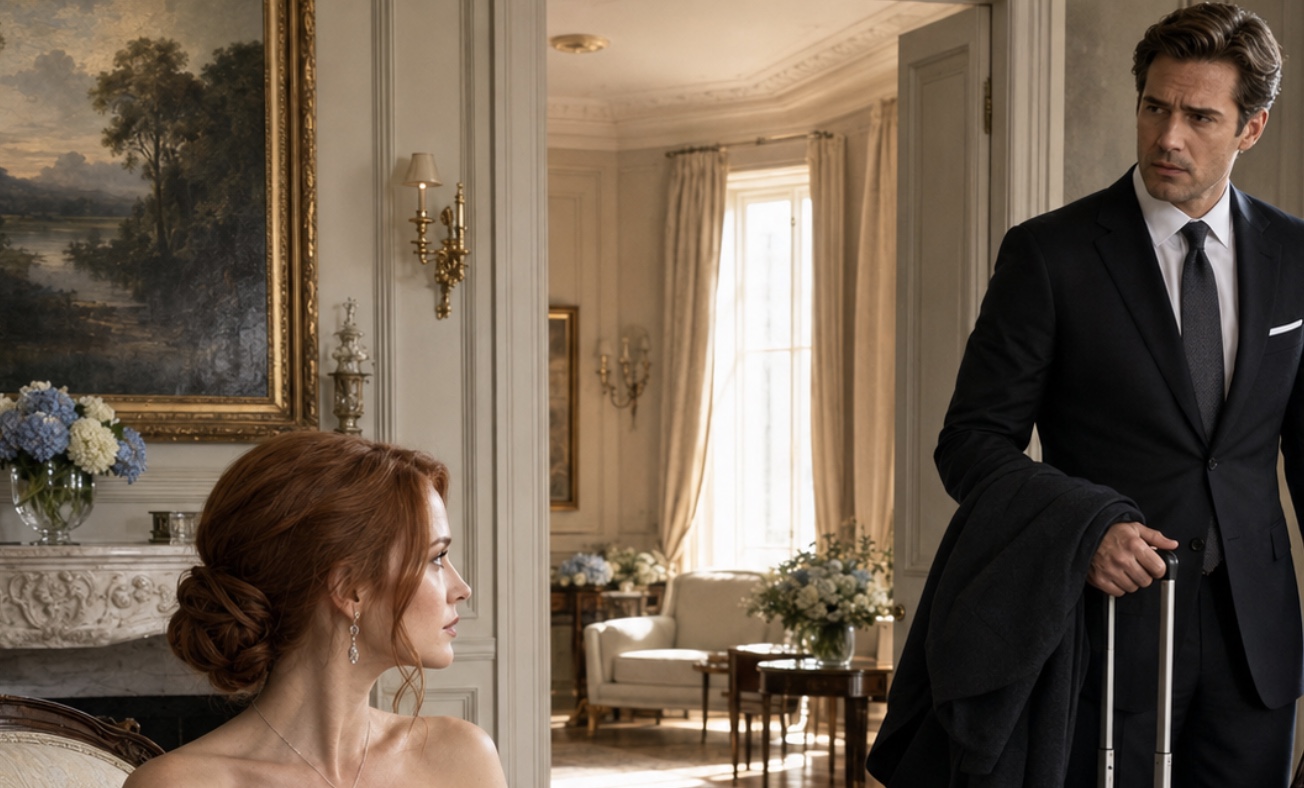
“I’m leaving you for another woman,” Artyom said.
Katya placed a mug in front of him, stirred in the sugar, and asked calmly,
“Are you going to finish your tea, or leave right away?”
He froze with his mouth half-open. He had prepared himself for tears, shouting, pleading—for anything except that even, almost gentle voice. Steam curled from the mug in a thin ribbon toward the lamp.
“Did you even understand what I just said?” His voice rose. “I’m leaving. For good.”
“I understood the first time.” Katya sat opposite him and rested her cheek against her hand. “I simply don’t like wasting tea. You’re always the one complaining when I make a cup and let it go cold.”
“Katya…” He faltered. “Couldn’t you at least… say something normal?”
“All right. What’s her name?”
He looked away, rolled the teaspoon between his fingers, and muttered the name as though it burned his tongue.
“Veronica.”
“Pretty name.” Katya nodded. “How long has it been going on?”
“What difference does it make now?” Artyom shrugged irritably. “Six months. Eight, maybe. I didn’t keep track.”
“I kept track of our fourteen years,” she said softly. “I remember every one of them. The year we couldn’t afford a proper stove and I heated the kettle on two broken burners. The year you broke your leg and I pulled you to the bus stop on a sled.”
He grimaced as though he had a toothache.
“Don’t start with that. Don’t try to make me feel guilty.”
“I’m not trying to make you feel anything.” She shrugged. “I’m remembering. Those are two different things.”
He had expected a scene, and the absence of one infuriated him. For some reason, he needed her to scream. Then he could have felt justified—an offended man escaping from a hysterical wife.
“You know what’s most unbearable about you?” He leaned forward. “This calmness. You’re like a slab of cold jelly. It’s impossible to live with you because you don’t feel anything.”
“I feel plenty, Artyom.” Katya took a sip from her mug. “I’m simply not going to turn my feelings into a performance for an audience of one.”
“At least Veronica is alive!” he spat. “She laughs. She wants to travel, to enjoy life—not sit hunched over those ridiculous paper houses with a magnifying glass.”
Katya built miniature mechanical models—cities, bridges, entire streets that came alive when a brass handle was turned. Those “paper houses,” as Artyom called them, had supported them for the past five years while everything he attempted fell apart.
“Those paper houses,” she said evenly, “paid for your car. And for the vacation where, apparently, you found your lively Veronica.”
“There you go again, making everything about money!” He slammed his palm against the table. “You always reduce everything to money!”
“You’re the one who brought it up,” Katya replied. “I merely confirmed the facts.”
He rose, paced across the kitchen, and ran both hands through his hair. He wanted to slam the door dramatically, to make a grand exit and have her run after him. But she remained seated, quietly drinking her tea, and somehow that ruined the entire effect.
“You’re not even going to ask me to stay?” he finally demanded.
“No.” Katya looked straight at him. “Why would I want a man who has to be held here by force? You hold an elevator so the doors don’t close on someone. Holding on to a husband who wants to leave is humiliating.”
“Humiliating, is it?” He gave a bitter laugh. “We’ll see what tune you’re singing in a month.”
“In a month, I’ll probably be putting new wallpaper in the bedroom,” she said thoughtfully. “I’ve disliked the old pattern for years. You liked it, so I kept quiet.”
Artyom moved into Veronica’s spacious rented apartment with its high ceilings.
Ten days later, he sat in a small corner café, nervously rotating a sugar bowl between his hands. Katya had been the one to ask him to meet.
“I thought you were going to beg me,” he said the moment she sat down.
“No. I want to discuss the car and our savings.” Katya removed her gloves. “No begging. Just business.”
“You see?” He pointed at her triumphantly. “I told you everything comes down to money with you. Take off the mask already.”
“The car was bought with the money I earned from my commissions,” Katya said calmly. “The savings came from our joint account, so technically they should be divided equally. But I’m offering you the car while I keep the money. I think that’s fair.”
He looked confused. He had arrived ready for battle, armed with a dozen cruel remarks, only to discover that there was no one willing to fight him.
“Why are you suddenly being so… agreeable?” he asked suspiciously. “What’s the catch?”
“There isn’t one.” She shrugged. “You love the car. Half your soul lives inside it. I need the money more because I want to buy new equipment and materials. We each take what matters to us.”
“Veronica says”—Artyom straightened in his chair—“that you’re probably planning to rob me blind. She says quiet women are always the most calculating.”
“Tell Veronica,” Katya said after taking a sip of water, “that it is technically difficult to rob a man who arrived empty-handed. No special cunning is required.”
His face turned red.
It was true. He owned nothing of his own—no apartment, no savings, not even a stable career in recent years. Their whole life had been supported by her brass handles and miniature paper bridges.
“You’re doing this on purpose, aren’t you?” he hissed. “You’re deliberately reminding me that I’m nobody without you.”
“I’m not reminding you of anything, Artyom,” she said wearily. “I’ve simply stopped covering for you. I used to tell everyone you were going through a difficult period. Four years of a difficult period. At some point, it stops being a phase and becomes a way of life.”
“When I finally take off, when everything starts going my way, you’ll regret this,” he said in a low, unpleasant voice.
“Artyom,” she replied with a faint smile, “you’ve been promising to take off for fourteen years. I’m tired of sweeping your runway.”
“Veronica believes in me!” he nearly shouted. “She says I’m underestimated. She says nobody has ever truly seen my potential.”
“Wonderful.” Katya took a folder from her bag. “She can keep looking. In the meantime, sign here. These papers transfer the car to you, so there can be no accusations later that I cheated you.”
He snatched the documents and scanned every line, searching for a trap.
There wasn’t one.
Everything was exactly as she had promised: he kept the car, she kept the savings, and neither of them would have any further financial claims.
“Why are you rushing all this?” He dropped the pen onto the table. “Normal wives cling on. They delay things. They wait.”
“I’m not a normal wife,” Katya replied. “I’m an ex-wife. And an ex-wife values her time. I’m not going to waste a year of my life waiting for you to get used to the idea that we no longer exist.”
He signed.
His hand trembled slightly on the final letter, surprising even him. He had wanted to leave. He had started all of this. Yet somehow, it felt as though he were the one being abandoned.
“And that’s it?” he asked, bewildered. “Just like that?”
“Just like that.” Katya collected the folder. “Would you like some tea? They say the thyme blend here is good.”
“Are you mocking me?”
“No. You simply have a habit of leaving without finishing your tea. And leaving everything else unfinished too. I thought perhaps, for once, you might drink the whole cup.”
Three weeks later, they met again at Katya’s parents’ country house, where Artyom had come to collect his old tools and several boxes of belongings.
He brought Veronica with him, apparently for moral support. She immediately walked onto the property and began inspecting the apple trees with the expression of a future owner.
“Charming little place,” Veronica drawled. “Neglected, though. I’d tear everything down and rebuild it from scratch.”
“It isn’t yours to tear down,” Katya said gently as she stepped onto the porch. “My grandfather built this house himself. Every log was placed by his own hands.”
“Oh, I didn’t mean to offend anyone.” Veronica gave her a false smile. “I’m merely speaking as someone with taste.”
“Someone with taste.” Katya nodded. “Clearly. Especially when it comes to choosing other women’s husbands.”
“Katya!” Artyom cut in. “Don’t start. We came for my things, and then we’re leaving.”
“I’m not starting anything.” She walked down the steps. “The boxes are in the shed. I packed and labeled them myself. I didn’t throw away a single thing that belonged to you. You may check.”
At that moment, Gleb, Artyom’s younger brother, came through the gate. Nobody had invited him, but rumors spread through their large family faster than the wind.
“So, what have we got here?” Gleb planted his hands on his hips. “Artyom, have you completely lost your mind? Why did you leave Katya? Where do you think you’ll find another woman like her?”
“Stay out of it, Gleb,” Artyom snapped. “This is between us.”
“This concerns the whole family!” Gleb turned toward Veronica and looked her up and down. “And I assume this is the woman you’re destroying everything for?”
“And who exactly are you to judge me?” Veronica lifted her chin.
“I’m the man who has known this family for fourteen years,” Gleb shot back. “Katya took care of my brother when he broke his leg. She paid off his debts when he got involved with dangerous people when he was younger. And this is how he repays her—by replacing her with you.”
“Gleb, enough,” Katya said quietly. “There’s no need. I don’t need a lawyer. I’ve already made my own decision.”
“Exactly!” Artyom jumped in, relieved by the interruption. “You heard her. She decided everything herself. We’re separating like civilized adults. No scandals.”
“Civilized?” Katya looked at him for a long moment. “Artyom, you brought your new woman to my grandfather’s house so you could collect your junk in front of her and feel like a victorious man. That isn’t civilized behavior. It’s cowardice dressed up as good manners.”
Veronica snorted.
“You’re sharper than I expected. Artyom said you were quiet, but look at you.”
“I can be many things,” Katya replied calmly. “With people who respect me, I’m quiet. With everyone else, it depends on the circumstances. Sometimes I’m perfectly capable of kicking someone out.”
“All right, let’s load the boxes and go,” Artyom said quickly, sensing that the ground beneath him was becoming unstable. “Gleb, give me a hand instead of standing there.”
“I’m not helping you.” Gleb folded his arms. “Carry them yourself. You’re independent and underestimated now, remember?”
Veronica wandered across the veranda, ran one finger along the railing, and wrinkled her nose.
“Artyom, there’s dust everywhere. How much longer is this going to take? I’m not spending the entire day stuck in this village.”
“One minute, kitten.” He hurried away with the first box.
And suddenly, in all that fuss, the truth became obvious.
Katya saw how he scurried back and forth, how eagerly he watched Veronica’s face, how terrified he was of displeasing her. She observed him with clear, almost scientific curiosity.
“You know what’s funny?” she said quietly. “You left me because I was too calm. Now you run in circles around a woman who snaps her fingers at you. You traded someone who respected you for someone you have to serve.”
“Shut up!” he shouted, almost dropping the box.
“I’m quiet.” Katya raised her hands. “Carry on. I’ll even bring you some tea. It’s a long drive.”
“No tea!” Veronica cried. “We didn’t come here for a tea party! Artyom, move faster. I have plans tonight.”
“Yes, yes, I’m coming.” He nearly ran to the car, clutching the boxes against his chest.
Gleb smirked and spoke quietly to Katya.
“You know he’s going to suffer with her. She’ll twist him around her little finger.”
“That’s no longer my concern.” Katya shrugged. “I’ve already spent fourteen years worrying about him.”
When the last box had been loaded, Artyom walked over to Katya, uncertain what to say.
He still expected her to break, even now. He wanted her to say something emotional, something that would leave a small opening for him to return one day.
“Well… goodbye, I suppose,” he managed.
“Goodbye,” Katya replied evenly. “Leave the apartment key. You can keep it as a souvenir if you like, but I’m changing the lock anyway.”
“You’ve already arranged that?” He attempted a mocking smile. “You move fast.”
“I do everything quickly, Artyom,” she said. “You’re the one accustomed to dragging things out. I’m not.”
Two months passed.
Katya stood in a spacious exhibition hall where her mechanical cities were being displayed publicly for the first time. Visitors moved from one model to another, admiring the tiny buildings and turning the brass handles. Miniature bridges lifted, trains disappeared into tunnels, and little windows flickered with light.
Her friend Liza stood beside her, commenting under her breath.
“Look how many people came, Katya. And that idiot used to call them paper houses.”
“He did.” Katya adjusted one of the exhibits. “He said many things. I listened for far too long.”
Then Artyom appeared in the doorway.
He was alone, without Veronica, and his face looked lost. He approached with both hands buried in his pockets, as if he didn’t know what else to do with them.
“Hello,” he said. “I saw the poster. I wanted to congratulate you.”
“Thank you.” Katya nodded. “You’ve congratulated me. Was there something else?”
“Katya…” He lowered his voice. “Things with Veronica didn’t work out. She wasn’t who I thought she was. She was greedy and cold. She counted every penny. She kept reminding me that I hadn’t accomplished anything.”
“How surprising,” Katya said without smiling.
“I made a mistake.” He stepped closer. “I finally understand that you were the only person who truly… appreciated me. Maybe we could start again. Begin with a clean slate.”
Beside them, Liza turned away to hide a laugh.
Katya looked at her former husband calmly. There was no triumph or satisfaction in her expression. She looked at him the way one might look at a closed door behind which a room had once existed, but no longer did.
“Artyom,” she said, “do you remember leaving without finishing your tea?”
“I remember.” He swallowed. “What does tea have to do with this?”
“Everything. You treat your whole life that way,” she explained gently. “You take something, taste it, abandon it, and move on. You did it with Veronica. You would do it with me again. You’re not returning because you love me. You’re returning because Veronica didn’t work out, and now you need someone to sweep your runway again.”
“That isn’t true,” he whispered. “I’ve changed.”
“A changed man would have come here simply to congratulate me,” Katya replied. “You asked to come back in your second sentence. That isn’t change. It’s a habit of searching for a warm place to land.”
“So the answer is no?” He pressed his lips together. “You won’t even talk about it? You’ve become so proud. You used to be easier.”
“I used to be convenient,” Katya corrected him. “That isn’t the same as being easy. And I’m no longer interested in being convenient.”
“Who needs you and your stupid machines anyway?” he suddenly snapped, dropping the last of his pretenses. “Do you think men are lining up outside? You’ll grow old and end up alone with your toy trains.”
“Perhaps,” she agreed calmly. “But I’ll be alone because I chose to be, not because someone ran away and then returned as though my home were a hotel.”
He opened his mouth to deliver another insult, but two visitors approached Katya with questions about the exhibits.
She turned toward them, smiling politely as she answered and demonstrated one of the mechanisms.
She simply stopped noticing Artyom.
Not theatrically or deliberately, but naturally—the way people stop noticing a lamp after it has been switched off.
Artyom stood there for a little longer, shifting from one foot to the other. Then he turned and headed for the exit.
At the door, he looked back, expecting to find her watching him leave.
She wasn’t.
She was showing a little girl how a tiny elevator emerged from a paper tower.
“Has he gone?” Liza asked quietly as she returned.
“He has.” Katya nodded.
“And how do you feel? Are you all right?”
“You know,” Katya said, straightening and looking around the hall filled with her living miniature cities, “when he left that first evening, he kept waiting for me to be devastated. But I was hurt only once—when I realized that the man I had spent fourteen years with valued me no more than the paper houses I built. That hurt. After that, I let him go.”
“He still looks hurt,” Liza said with a smirk. “He truly expected you to cry and cling to him.”
“That was always his problem.” Katya smiled, a little sadly. “He never understood one simple thing. Leaving isn’t frightening when someone is trying to hold you back. It becomes frightening when they release you calmly. That’s when you see that life hasn’t stopped without you. The kettle still boils, the trains keep moving, and someone still turns the handle. Only now, they do it without you.”
She bent toward the little girl, who laughed with delight, and skillfully started the next mechanism.
The tiny city came alive. Small windows began to glow, and somewhere inside it, a miniature tram started moving—steadily along its own rails, certain of where it was going.
As for the cup of tea Artyom had left unfinished that first night, it had dried out long ago.
Katya had washed the mug that very same day.
She had never liked leaving anything unfinished.