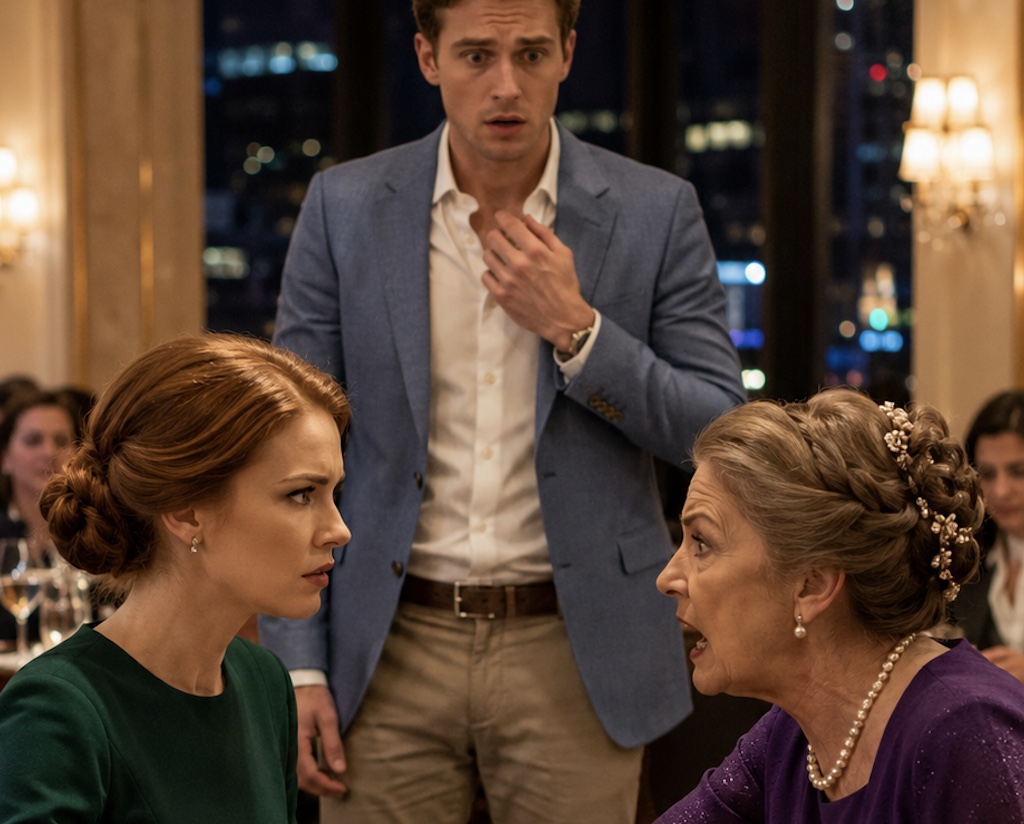
The taste of humiliation clung to Katya’s palate, mingling with the metallic tang of the spoon, even though this restaurant—proudly displaying three stars on its façade—used silver-plated cutlery.
She sat across from her mother-in-law and watched the older woman sip water through a straw, her lips pursed as though every swallow caused her physical pain.
Tatiana Ivanovna placed her glass on the tablecloth.
She looked at Katya.
Then at Artyom.
Then back at Katya again.
“Well, Katenka, are you sure you won’t reconsider? I see they have foie gras today. It arrived this morning, apparently. But perhaps we shouldn’t go overboard. Foie gras isn’t really your level. Besides, considering where you come from, you should learn to appreciate simple food. There’s no need to spoil your stomach. Don’t you agree, Artyom?”
Artyom adjusted the collar of his shirt.
He always did that whenever his mother started discussing Katya’s origins.
The crisp white fabric dug into his neck, leaving red marks on his skin. Once, twice, three times—the same nervous gesture every time.
Without lifting his eyes from his plate, he coughed into his fist.
“Mom, can’t we just have dinner? Why do you have to start this again?”
“What exactly am I starting? I’m only stating the truth. Your wife grew up with no family and no roots. There’s nothing wrong with reminding her of that. Isn’t that right, Katenka? You’re not offended, are you? You’re a strong girl. Growing up in an orphanage toughens a person. Someone like you won’t fall apart just because she’s called rootless.”
Katya slowly raised her eyes.
Her expression was calm.
Far too calm for a woman who had just been publicly dragged through the mud.
A waiter standing beside the neighboring table shifted the menu nervously from one hand to the other before retreating to a safer distance. He had heard plenty during his years working in expensive restaurants, but even he did not often witness a pearl-wearing older woman take such obvious pleasure in destroying her daughter-in-law.
“I’m not offended, Tatiana Ivanovna. I’ve thought about what you said, and perhaps you’re right. I really should try foie gras. Although I think I’ll have the Kamchatka crab instead. And the dessert with edible gold. You did say I should try new things and broaden my horizons.”
Her mother-in-law’s face hardened.
First the left corner of her mouth twitched, then the right.
She placed her utensils across each other on the tablecloth. A bad omen, according to her own late mother-in-law.
“What do you think you’re doing? Do you even understand who is paying for this dinner?”
“You are, Tatiana Ivanovna. You’re paying. You invited us here to celebrate your bonus, remember? How could I possibly refuse? A family evening and all that.”
Artyom shifted restlessly in his chair. Sweat appeared on his forehead. He adjusted his collar again, though by now the fabric was soaked through.
“Katya, listen, maybe you really should—”
“No, Artyom. Your mother wants to celebrate. We should respect her wishes. We’re family, after all, and families are supposed to respect their elders. Isn’t that what you always say, Tatiana Ivanovna?”
The waiter brought Katya’s order.
The Kamchatka crab occupied nearly half the table. Its boiled shell glowed orange beneath the warm wall lights. On a separate plate, the dessert shimmered beneath flakes of genuine edible gold, tiny and weightless, like captured fragments of sunlight.
Tatiana Ivanovna did not touch her food.
She sat perfectly straight, as tense as a drawn wire, staring at Katya with an expression that combined disbelief, fury and something resembling the excitement of a predator that had finally sensed resistance from its prey.
“Well, since you’re feeling so bold, you can pay for it yourself.”
“No,” Katya replied, gently blotting the corners of her mouth with her napkin. “You’ll pay. You invited us. You chose the restaurant. You said, ‘My treat.’ I merely accepted your offer.”
“Artyom, tell your wife to stop this circus.”
“Katya, stop.”
“I’m the circus? I’m having dinner. Quietly. I haven’t said a word for the last ten minutes while Tatiana Ivanovna explains my proper place in the world. My background. The orphanage. My lack of family. I’m simply eating and listening like an obedient daughter-in-law.”
With a sharp movement, Tatiana Ivanovna summoned the waiter.
He approached carrying the bill folder, which he had clearly prepared in advance.
She threw her card at him—a black premium bank card embossed with the owner’s name in gold.
It was a gesture she had perfected over the years. She always paid that way: quickly, carelessly and without looking. It was another method of demonstrating superiority.
Look who is in charge.
Look who has the money.
The waiter walked over to the payment terminal.
He returned a minute later with tension visible on his face.
“I’m very sorry, but the card has been blocked. Do you have another payment method?”
Silence settled over the table, thick and sticky.
Tatiana Ivanovna went pale.
First the knuckles gripping the edge of the table lost their color. Then her neck. Then her entire face.
She snatched the card from the waiter as though the problem were somehow his fault.
“That’s impossible. Try it again. I have premium service. I’m a regular customer here. Is this your first day on the job?”
“I tried twice. The card is blocked. You may pay in cash or make a bank transfer.”
Artyom reached into his pocket for his phone. His trembling fingers repeatedly missed the unlock buttons.
He looked at his mother, then at Katya, then back at his mother.
“Mom, I have thirty thousand on my card. I could—”
“Don’t you dare!”
Her shout was loud enough to make several diners at nearby tables turn around.
“I’ll handle it myself. I’ll transfer the money from another card. Give me a minute.”
That was when Katya stood up.
Slowly and gracefully, almost as though she were performing a carefully rehearsed dance.
She placed her napkin on the table—not crumpled, but neatly folded in half.
She picked up her handbag, adjusted her hair and looked directly into her mother-in-law’s eyes.
“I’m leaving. You wanted a family dinner, Tatiana Ivanovna. Now you can pay for your family.”
Artyom tried to grab her arm.
His fingers closed around her wrist so tightly that white marks appeared on her skin.
“Katya, wait! What are you doing? Sit down!”
She pulled away sharply, without hesitation.
Her handbag swung against the edge of the chair, but she did not turn around.
She walked toward the exit, her heels striking the marble floor in a clear, measured rhythm.
It was not the hurried pace of someone escaping.
It was the steady walk of someone leaving for good.
Behind her, her mother-in-law’s voice erupted in a low, guttural growl.
“What do you think you’re doing, you rootless nobody? You’re walking out of the restaurant, and I’m supposed to pay?”
Katya pushed open the glass door and stepped outside.
The evening air smelled of gasoline and linden blossoms.
She approached the curb and raised her hand. A taxi stopped almost immediately.
Katya climbed into the back seat, gave the driver her address and rested her head against the headrest.
Only when the restaurant lights disappeared around the corner did she allow herself to take a deep breath.
She reached into her handbag and found the voice recorder.
The red light had been glowing the entire time.
It was still recording.
Katya paused it, saved the file under the name “Dinner,” and uploaded a copy to cloud storage.
Then, looking out the window at the streetlights rushing past, she said:
“I know exactly what happens next.”
The driver glanced at her in the rearview mirror but said nothing.
—
The apartment greeted her with silence.
The apartment she shared with Artyom.
Or rather, the apartment she had once believed belonged to both of them.
Two years earlier, when they had just married, Katya had sincerely believed she was beginning a new life.
Back then, she did not know the apartment was registered in Tatiana Ivanovna’s name.
She did not know that her own inheritance from her grandmother—a two-bedroom apartment in a residential district and a modest bank account—had passed into her mother-in-law’s hands through a carefully arranged series of fraudulent gift agreements.
How could she have been so naïve?
At eighteen, after leaving the orphanage, Katya had suddenly discovered a grandmother on her father’s side. She was the only person who had managed to speak warm, loving words to Katya before dying.
Then her grandmother was gone.
All that remained was the apartment, the savings and a handwritten note:
“Build yourself a home, my girl. Let yourself have roots.”
Katya had cried over that note for two weeks.
Then she met Artyom.
He had seemed reliable.
Calm, sensible, always certain about what should be done.
He told her they were one family now.
He said his mother would help them.
His mother, he explained, was a financial genius. She worked as an accountant, owned her own firm and knew how to arrange documents properly so they would not have to pay outrageous taxes.
Katya believed him.
Her grandmother’s apartment was transferred to Tatiana Ivanovna for “temporary safekeeping and tax optimization.”
Then came another document.
Another signature.
By the end of it, Katya was merely registered as a resident in an apartment that had once belonged to her grandmother.
She was permitted to stay there out of kindness.
Like a rootless dependent living on someone else’s mercy.
Katya entered the bedroom, removed her shoes and sat down on the bed.
Then she rose abruptly, walked to the wall and reached behind the ventilation grille.
Her fingers touched the edge of a blue folder.
It was still there.
Thick, worn and stuffed with documents.
She had begun assembling it two months earlier.
It had all started by accident.
Katya had checked the mailbox. Artyom usually ignored paper correspondence and preferred electronic notifications.
Inside she found an envelope from a microfinance company addressed to her.
The letter demanded immediate payment of an overdue debt.
Thirty thousand rubles.
Katya had never taken out a microloan.
She called the company and was told that the loan had been issued online using scanned copies of her passport and a signed power of attorney.
The authorization was forged.
The signature looked like hers, but it was not.
Katya requested her full credit history.
There were three microloans, all opened during the previous year.
The amounts were relatively small: thirty thousand, forty thousand and fifty thousand.
Tatiana Ivanovna had been borrowing the money to cover temporary cash shortages in her accounting business.
Small amounts were easy to overlook and easy to conceal. They rarely triggered serious suspicion from banks.
Katya finally understood.
She was being used.
Slowly.
Systematically.
Cynically.
Then came the argument during which Artyom called her rootless.
For the first time, he said it aloud while looking directly into her eyes.
Something inside Katya burned out.
It did not break.
It burned through, like a fuse that had spent years protecting the last fragments of her love before finally melting into ash.
She began to investigate.
At first, it was simple curiosity.
Then curiosity became cold, calculated rage.
Tatiana Ivanovna was no financial genius.
She was an ordinary fraudster.
Katya obtained call records through the family phone plan. She had access because her mother-in-law had once insisted they all use the same account.
She discovered the contact details of the real-estate agent with whom Tatiana Ivanovna had discussed selling Katya’s grandmother’s apartment.
She found bank statements belonging to her mother-in-law’s firm.
The company had been balancing on the edge of bankruptcy for two years. Tatiana Ivanovna borrowed money, refinanced debts and moved funds from one place to another, doing whatever she could to keep the business alive.
And she used Katya as a financial cushion.
A rootless daughter-in-law with no relatives to ask questions.
The perfect victim.
But the most horrifying discovery came the day before the restaurant dinner.
While listening to another recorded phone conversation between her mother-in-law and an unknown person, Katya heard a sentence that turned her blood cold.
“We need to plant something more serious on her. Drugs, perhaps. Then they’ll lock the rootless little nobody away, and we can sell the apartment without any trouble.”
Katya listened to the recording five times.
Her hands trembled, but her mind remained icy and clear.
Tatiana Ivanovna was not merely stealing from her.
She was prepared to destroy her life completely.
That was when Katya understood there could be no more delays.
Tomorrow.
Everything would happen tomorrow.
Now she sat on the bedroom floor with the contents of the blue folder spread around her, remembering.
The orphanage.
She was eight years old.
A tired caregiver with permanently pursed lips was telling her:
“You don’t have a home or a family, you rootless child. So close your mouth and do as you’re told.”
Katya closed her mouth.
She washed floors.
She peeled potatoes.
She took care of the younger children.
She was a good girl.
Obedient.
Strong.
The adults praised her for being easy to manage.
Then she grew up.
She met Artyom.
And his mother used exactly the same word.
Rootless.
Only now it was spoken with a smile at a family dinner beneath the delicate clinking of wine glasses.
That made it hurt even more.
At the orphanage, at least Katya had understood she did not belong.
But here, inside the family she had entered with an open heart, carrying her grandmother’s inheritance and dreaming of finally having roots, being treated like an outsider was unbearable.
Her phone rang.
The screen displayed the name Alyona Kondratyeva.
Artyom’s sister.
A remarkable woman whom Katya had met under unusual circumstances six months earlier.
At the time, Katya had joined an anonymous online group called “Survivors of Toxic Relatives,” desperately trying to determine whether she was losing her mind.
A woman using the nickname “RunawaySister” replied to her post.
They began talking.
One message led to another, and eventually they realized they were discussing the same family.
The same Tatiana Ivanovna.
Alyona described how her mother had driven her away after she dared to marry a man from “the wrong social circle.”
How she had pushed her daughter into a nervous breakdown.
How she had taken away Alyona’s inheritance.
Alyona had escaped five years earlier and had spent all that time collecting evidence of her mother’s domestic abuse and financial schemes.
It was Alyona who sent Katya the first incriminating documents.
Alyona who introduced her to an attorney.
Alyona who told her:
“You’re not alone. We’re sisters in the same nightmare, and together we’re going to stop that monster.”
Katya answered the call.
“Hello.”
“I have it,” Alyona said. Her voice sounded subdued but triumphant. “The entire archive. Recordings, statements, witness accounts. And do you know what else I found? A recording of her discussing the sale of your apartment with the real-estate agent. Dates, amounts, account numbers—everything. I also found bank transactions showing money being transferred from shell accounts into hers. Your attorney says there’s more than enough evidence for a criminal case.”
“What about the plan to plant drugs?”
“That’s in another recording. I only finished transcribing it this morning. I’m sending you the file now. You were right—this could qualify as extortion under Article 163, along with preparation to commit another crime. They could face real prison time.”
“She,” Katya corrected her. “She could face real prison time.”
“Yes. Of course. She could.” Alyona paused. “Are you ready?”
“Yes. Tomorrow at ten in the morning. Here.”
“I’ll come. The attorney will be there too. Did you send the complaint?”
“I’m scheduling it now. It will be delivered to the Investigative Committee at nine tomorrow morning. At ten, the family council begins.”
Alyona gave a quiet laugh.
“That sounds like the title of a television series.”
“More like the title of a verdict,” Katya replied before ending the call.
She checked everything three times.
Call records.
Bank statements.
Copies of fraudulent gift agreements.
The police complaint.
Audio recordings.
Written transcripts.
A flash drive containing the principal files.
The recorder with the restaurant conversation.
The projector she had rented a week earlier and hidden in the storage room while waiting for the right moment.
Everything was ready.
Around midnight, a key scraped in the lock.
Katya sat in the kitchen, drinking tea and watching the door.
Tatiana Ivanovna entered first.
Artyom followed behind her.
He looked pathetic.
His shirt was wrinkled, his eyes were red, and his hands were trembling.
His mother looked completely different.
She swept into the apartment like a hurricane, not even bothering to remove her shoes, despite always demanding that everyone else take theirs off in the hallway.
“You!”
She pointed a finger at Katya.
“Do you understand what you’ve done? You humiliated me in front of the entire restaurant! I had to transfer money from a credit card charging almost two hundred percent interest! You’ve pushed me into a mountain of debt, you miserable little snake!”
Artyom stood in the doorway and said nothing.
He only adjusted his collar.
“Tell her, son! Tell your rootless wife that she has completely lost her sense of shame!”
“Mom, perhaps we shouldn’t—”
“What do you mean, ‘we shouldn’t’? She is taking advantage of you financially, and all you can say is that we shouldn’t argue? Tomorrow, she will transfer her share of the business to you. She will also give me her debit card and the PIN. She should be grateful I’m willing to keep her in the family at all. If she refuses, you divorce her. Then she can take her orphanage name and go wherever the road leads.”
Artyom nodded.
He actually nodded.
Like a toy figure whose head moved automatically.
Then he looked at Katya expectantly.
Come on.
Agree.
Do not make things worse.
Mother knows best.
She has experience.
She understands tradition.
Katya finished her tea.
She placed the cup on the table and stood.
“All right. I’ll sign everything. Just give me until morning to collect my thoughts.”
Tatiana Ivanovna froze.
For a fraction of a second, something like disappointment appeared in her eyes.
She had expected resistance.
Shouting.
A fight.
Instead, she received obedience.
How boring.
But a moment later, her face lit up with triumph.
“You see, son? Traditional discipline works wonders. A woman must be controlled firmly. Then she becomes as soft as silk. That is what respect for one’s elders looks like.”
She wrapped an arm around Artyom’s shoulders and turned him toward the door.
“Tomorrow at ten. Don’t be late, Katenka. Prepare all the documents related to the business. Everything must be clean and proper.
Like family.”
When the door closed behind them, Katya exhaled.
She sent Alyona a message:
“Tomorrow at ten. Everything is ready.”
Then she removed another printout from the blue folder.
It was a copy of a text-message exchange Katya had discovered accidentally while clearing files from Artyom’s laptop one month earlier.
He had forgotten to delete it.
The messages had been written one month before their wedding.
Artyom had told his mistress:
“Be patient. Katya and her grandmother’s inheritance are our golden key. Mom will handle everything.”
Katya read the message ten times while sitting alone in the kitchen.
Then she returned the printout to the folder.
And cried.
For the first time in many years.
Quietly, almost without a sound, biting down on her own fist.
She did not cry because of the money.
She did not cry because of the apartment.
She cried because his tender words—“You’re my girl. You’re my family. Now you finally have roots”—had been nothing more than part of the plan.
A performance.
A game of love in which Katya had been the only person playing sincerely.
By morning, she had regained control.
She washed her face with ice-cold water and studied her reflection for a long time.
She saw the face of a twenty-eight-year-old woman from whom everything had been taken.
But she also saw something new.
Not a victim.
A hunter.
At nine o’clock, she received confirmation that her complaint had been delivered to the Investigative Committee.
At nine twenty, Alyona sent a message:
“We’re on our way.”
At nine forty-five, attorney Elena Romanovna—a stern, slender woman with an unreadable expression—was seated in the living room, arranging folders of evidence.
“They believe you intend to sign the documents,” Elena Romanovna said, adjusting her glasses. “That is useful. Surprise is our greatest advantage. The police will arrive approximately fifteen minutes after my call. Is everything prepared?”
Katya nodded.
The projector was ready.
The laptop was connected.
A white bedsheet had been stretched across the wall to serve as a screen.
Blank sheets of paper and a pen lay on the table.
There were no contracts.
Only bait.
At exactly ten o’clock, the doorbell rang.
Tatiana Ivanovna swept into the living room like a queen.
Pearls around her neck.
Hair perfectly arranged.
Expensive perfume filling the room.
Artyom shuffled behind her, pale and exhausted, his shirt collar wrinkled once again.
His mother removed her shoes, entered the room and cast a disgusted glance at the bedsheet on the wall.
“What is this ridiculous decoration?”
“It’s necessary for what we’re about to do,” Katya answered calmly. “Please sit down.”
Katya sat on one side of the table.
Tatiana Ivanovna and Artyom took their places opposite her.
Then Alyona stepped out of the kitchen and stood beside the door.
Tatiana Ivanovna flinched when she saw her daughter, but quickly recovered.
“So you’re here too, you traitor? Very well. The entire family council is present. Let’s get this over with, Katya. Sign the documents. I have prepared the agreement transferring your share of the marketing agency. You will give your fifty percent to Artyom. You will also surrender your debit card and PIN to me, as punishment for yesterday. Then we will forget the incident ever happened. I will even allow you to remain part of the family. Tradition is important, but mercy is also a virtue.”
She placed a printed document on the table.
Katya picked it up and skimmed through it.
It was real.
A gift agreement transferring her business share.
No compensation.
No protection of her rights.
A straightforward act of theft.
“All right,” Katya said. “I’ll sign it. But first, I would like to show you something.”
She pressed a button on the remote.
The projector came alive.
The first image appeared on the white sheet.
A scanned power of attorney bearing a forged signature.
Tatiana Ivanovna opened her mouth to speak, but Katya advanced to the next slide.
Her credit report.
Microloans.
Katya’s name.
Katya’s passport information.
Someone else’s signature.
Her mother-in-law began to rise.
“Sit down,” Katya said coldly. “We are nowhere near finished.”
Then the recording began.
Tatiana Ivanovna’s voice filled the room, unmistakable in its roughness and familiar intonation.
“We need to plant something more serious on her. Drugs, perhaps. Then they’ll lock the rootless little nobody away, and we can sell the apartment without any trouble.”
Artyom turned white.
His fingers pulled so violently at his collar that the upper button snapped off and rolled beneath the table.
“It’s edited!” Tatiana Ivanovna screamed. “A fabrication! Alyona, you miserable snake, you arranged all of this!”
Alyona stepped forward.
Her face was calm, but tears shone in her eyes.
She looked at her mother and smiled.
It was a frightening, exhausted smile—the expression of someone who had waited five years for this moment.
“No, Mom,” Alyona said evenly, almost tenderly. “You arranged it yourself when you decided family values meant having the right to crush anyone weaker than you. You already broke me. You assumed Katya would break just as easily.
You were wrong.”
Katya changed the slide.
Bank statements now appeared on the sheet.
Transfers from shell accounts into accounts belonging to Tatiana Ivanovna’s company.
Amounts.
Dates.
Transaction numbers.
Everything documented.
“You wanted me to become a traditional wife?” Katya asked. “To endure, remain silent and hand over my money?”
Her voice was quiet, almost a whisper, but the room was so still that every word struck like a bell.
“Then you can have a traditional criminal prosecution. Article 159: fraud. Article 163: extortion. The police have already accepted my complaint. Copies have also been sent to the prosecutor.”
“You’re bluffing,” Tatiana Ivanovna hissed, though her voice trembled for the first time. “You have no evidence. All of this has been fabricated.”
“Why don’t we ask the professionals?”
Katya nodded toward Elena Romanovna.
The attorney dialed a number and spoke only a few words.
A minute later, the doorbell rang.
Artyom jerked so violently that he nearly fell from his chair.
“Who is it?” he whispered.
“The police,” Katya answered. “An investigative team. I told you—the complaint has already been accepted.”
Tatiana Ivanovna leaped to her feet.
Her pearl necklace broke, scattering white beads across the wooden floor.
She tried to move toward the door, but Alyona blocked her path.
“Don’t, Mom. Don’t run away. You spent our entire lives teaching us that people must answer for their actions.”
Three people entered the room.
Two wore uniforms.
The third was dressed in plain clothes.
They were polite, composed and clearly accustomed to emotional scenes.
They introduced themselves and showed their identification.
Tatiana Ivanovna screamed, cried and even attempted to faint.
But the paramedic who entered behind the officers confirmed that she was physically fine.
The woman was taken away.
In handcuffs.
Artyom remained behind.
He sat at the table, staring blankly at the final image frozen on the white sheet.
His collar was open.
The missing button lay somewhere under the table.
He tried to speak, but his lips barely moved.
“I didn’t know about the loans,” he finally managed. “I thought everything was for us. I truly didn’t know.”
Katya walked over to the laptop and opened another file.
The recording from the restaurant played.
Artyom heard his own voice:
“You’ve completely lost your mind, you rootless nobody. My mother works herself to death for us, and all you do is complain.”
“You knew the most important thing,” Katya said, stopping the recording. “You knew I could be humiliated without consequences. And you chose to be her son instead of my husband.”
“Katya, forgive me. I was an idiot. She… she damaged me psychologically. Since childhood. I didn’t understand what I was doing.”
“You understood. You understood everything.”
Katya removed the final page from the folder.
The printed text-message exchange.
She placed it in front of him.
Artyom read it, and his face turned gray, like an old newspaper.
“‘Be patient. Katya and her grandmother’s inheritance are our golden key. Mom will handle everything,’” Katya read aloud. “One month before the wedding. Even then, you knew your family was functioning like a criminal operation and that I was nothing more than a bag of money.”
Artyom began to cry.
Not quietly, but with the uncontrolled sobbing of a frightened child being punished for breaking something.
Tears streamed down his face and soaked into his wrinkled collar.
Katya looked at him and felt nothing.
Nothing at all.
The emptiness inside her was peaceful and filled with light.
“I’ve started therapy,” he whispered through his tears. “I genuinely want to change. Please.”
“I’m glad you’ve started treatment. I sincerely hope you recover. But I cannot remain part of that process. I spent too long being a tool for all of you.
Now I am a person.”
She turned and walked into the bedroom.
She closed the door firmly behind her.
Then she sat on the bed and ran one hand over the blanket.
She had done it.
—
Three months later, Katya stood on the balcony of her new apartment.
The studio was bright and sunny, with large windows overlooking a park.
She and Alyona were renting it together while the court proceedings continued.
Soon, however, the court was expected to restore Katya’s ownership of her grandmother’s apartment.
Her attorney said the likelihood of success was almost one hundred percent.
Tatiana Ivanovna’s company had been auctioned off to cover its debts.
Her mother-in-law remained in pretrial detention awaiting sentencing.
Artyom was undergoing psychiatric treatment, and occasionally Katya caught herself hoping he would genuinely recover.
But without her.
Their marketing agency, “The Sisters,” had won its first major contract.
Katya and Alyona worked sixteen-hour days, drank coffee by the liter and argued themselves hoarse over the color of the company logo.
They were happy.
A ficus stood on the windowsill in a new pot.
The same kind of plant Tatiana Ivanovna had once forbidden, claiming it attracted poverty.
Every morning, Katya watered it, wiped its leaves with a damp cloth and spoke to it.
The plant answered with healthy green growth.
Her phone rang.
She did not recognize the number, but she answered.
“Katya? It’s Artyom. I’m sorry for calling.”
“Hello. Has something happened?”
“No. Well… yes. I only wanted to tell you that I’m writing you a letter. A long one. And I wanted to give you something. The keys to your grandmother’s apartment. I secretly made a duplicate while the legal proceedings were going on. The court will return the apartment to you anyway, but you can move in now instead of waiting for the decision. I’m not asking you to forgive me. I’m not asking for an answer. I only want you to have a place that truly belongs to you.”
Katya remained silent for a moment.
“All right. Send them.”
She did not say anything else.
She ended the call, stepped onto the balcony and looked down at the park.
People walked their dogs along the paths.
Children played in the sandbox.
“I have roots now,” she said aloud. “I grew them myself.”
A breeze moved through the room, and the ficus swayed one of its leaves as though agreeing with her.
That evening, Katya opened her laptop and visited the website of the city’s social-support foundation.
She found the section titled “Mentorship for Young Adults Leaving Orphanages.”
She completed the application.
In the field asking why she wanted to become a mentor, she wrote one sentence:
“I want to pass roots on to someone else.”
She clicked “Submit.”
Then she smiled.
Now she understood with absolute certainty that family was not blood.
It was not paperwork.
It was not a collection of traditions imposed through power and fear.
Family was a choice.
Her choice.
And she had finally made it.