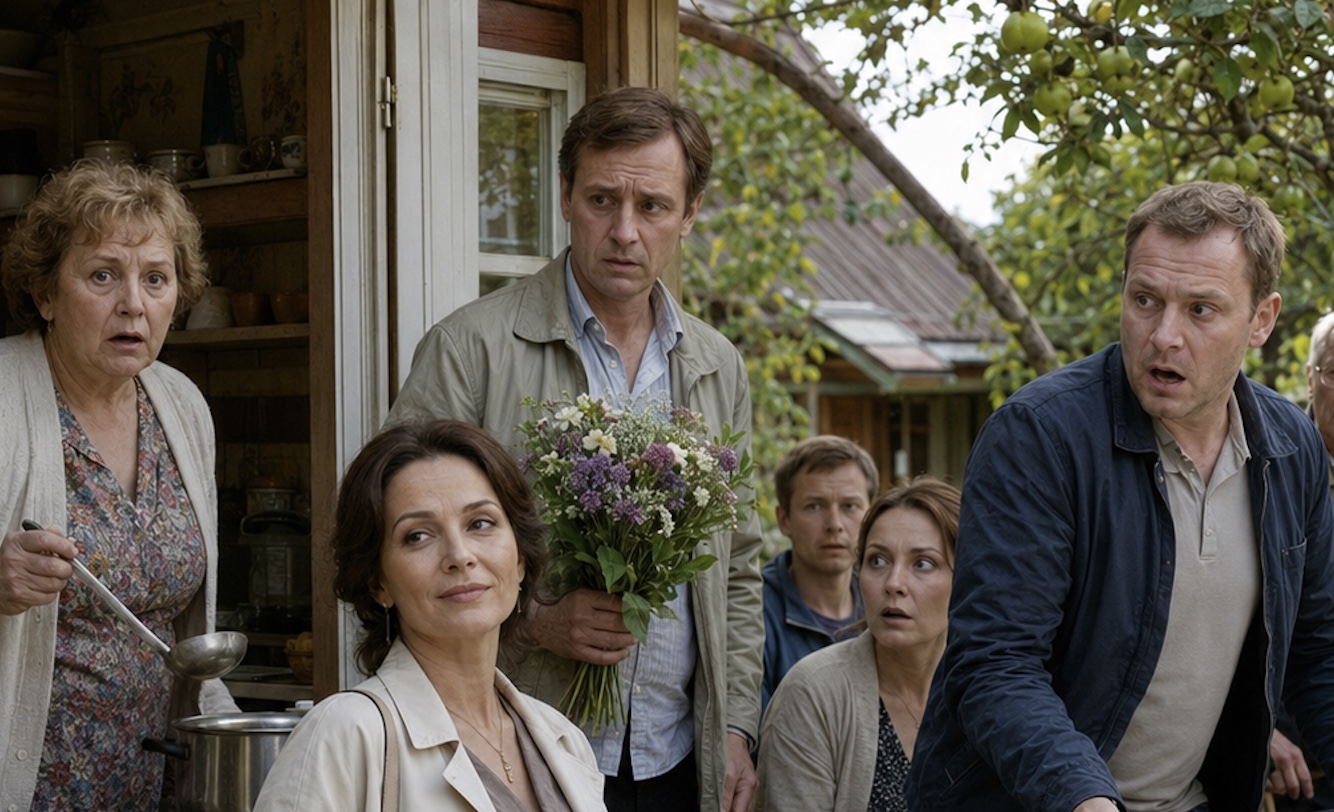
The mother-in-law froze with the ladle still in her hand, suspended halfway to the pot. Her husband’s brother, Stas, sprang up from the table so abruptly that he caught the edge of the tablecloth. A plate of lightly salted cucumbers rocked dangerously and nearly spilled into his wife’s lap. She stared at Alla as though she had just seen a ghost walk into the middle of lunch.
“Alla… you… but how did you…?” her mother-in-law stammered, unable to finish a sentence. Her gaze darted from Alla to her son, as if she expected Dima to explain everything, apologize, and assure them that this was all some ridiculous misunderstanding.
Alla stood in the doorway of the country-house kitchen wearing a pale coat and carrying a small purse over one shoulder. There were no cakes, no flowers, and none of the heavy grocery bags she normally dragged to every family gathering.
Just a purse and a calm, almost lazy expression.
“Why is everyone standing around?” she asked, looking over the stunned group gathered at the long table beneath the apple tree. “It’s a birthday party. The guests have arrived. Go on, set the table.”
The silence was so thick that they could hear a neighbor’s dog barking somewhere beyond the fence.
“What guests?” Stas’s wife, Lena, muttered, clearly unsure whether Alla was joking.
“We’re the guests,” Alla replied with a thin smile.
She walked over to an empty chair, pulled it out, and sat down as comfortably as if she were settling into her own living room.
“Well, now it’s your turn to serve us. We never let you leave our place empty-handed, do we?”
Dima, Alla’s husband, had been standing behind her the whole time holding a bouquet. He was the only one who had brought anything at all, because he could not bring himself to arrive completely empty-handed.
His face turned so pale that the freckles across his nose suddenly stood out.
He stepped forward and opened his mouth, clearly preparing to defuse the situation, apologize, or claim that Alla was only joking.
Without even looking at him, Alla repeated:
“I said set the table. Why are you all frozen like statues?”
To understand how an ordinary, well-mannered middle-aged woman had reached the point of saying something like that in her mother-in-law’s home, it was necessary to go back several months.
Back to the country house Alla and Dima had spent ten years building, investing every vacation, bonus, weekend, and ounce of patience they had.
The house stood on a plot of land Dima’s father had given them shortly before he died, his final generous gesture to his son.
Alla still remembered how she and Dima, young and full of energy back then, had cleared the weeds from the overgrown property. They had carried bricks, argued with contractors, saved money on interior finishes so they would not have to cut corners on the roof.
The country house was their shared creation. They had poured themselves into it in the most literal sense: every spare minute, every saved coin, every bit of strength.
Then the relatives started coming.
At first, everything seemed harmless.
Dima’s mother came to see how her son had settled in. She brought a jar of homemade jam and stayed for a couple of days. Alla did not object. She was his mother, after all. How could they refuse her?
Then Stas and Lena arrived for the weekend.
“Our apartment is being renovated,” they explained. “There’s dust everywhere. We just want to escape to the countryside and get some fresh air.”
Alla did not object that time either. Stas was Dima’s brother, not a stranger.
But those “couple of days” and occasional “weekends” gradually turned into a permanent arrangement.
Her mother-in-law claimed an entire room for herself. She brought over a warm blanket, her favorite mug, and a pair of slippers, as if she had officially moved in.
Stas and Lena began arriving every weekend like clockwork, bringing only their children and their appetites.
Soon others followed: Dima’s aunt, distant cousins, and relatives Alla had never even known existed.
The country house became a public resort.
The worst part was that the guests did not treat the place like someone else’s home. They behaved as though it were their own private vacation lodge.
They arrived on Friday evening and left on Sunday well-fed, rested, and refreshed, never bringing anything in return.
Alla alone hauled groceries from the city.
Alla alone cooked.
Alla alone stood over the stove while everyone else splashed in the pool, stretched out in hammocks, or sat drinking beneath the trees.
Her mother-in-law occasionally offered to help, but somehow everything still ended up falling back on Alla. The salt was never the right kind, the potatoes took too long to peel, or her back suddenly hurt from bending over the sink.
“Maybe we should stop putting up with this,” Alla said to Dima after one of those weekends, when the relatives had finally left and the kitchen looked as though a storm had torn through it. “Couldn’t we ask them to bring groceries? Or at least visit less often?”
Dima always looked away whenever she raised the subject.
“Alla, they’re my family. How am I supposed to tell them not to come?”
“I’m not saying they can never come,” she replied. “I’m asking them not to show up every weekend. Or at least to help. We gave up nearly all our free time to build this place, and they treat it like a free health resort.”
“You’re exaggerating. So they came to relax. They’re relatives.”
“Relatives who never lift a finger and still complain when something isn’t cooked exactly the way they like.”
Dima would sigh as though the conversation physically hurt him. Then he would ask Alla not to start, not to make things worse, and not to ruin his relationship with his family.
The issue remained hanging in the air, unresolved but never forgotten.
Dima expertly avoided every attempt to discuss it further by changing the subject.
Meanwhile, the family kept coming.
As summer settled in, the country house became busier than ever. There was always some excuse: a cousin’s birthday, a desire for fresh air, or a week without running water in someone’s apartment.
Alla eventually stopped being surprised that no one bothered to ask for permission.
Stas irritated her more than anyone else.
Unlike his mother, he did not even pretend to be modest.
He arrived with groups of friends, took over the gazebo, organized barbecues, and then had the nerve to criticize the house.
The property was too small.
The pool should have been bigger.
The grill was outdated.
“Maybe you should buy your own country house if this one doesn’t meet your standards,” Alla snapped one day after hearing yet another complaint about the grill.
Stas took offense, complained to his brother, and Dima once again lectured Alla for being confrontational, rude, and incapable of getting along with people.
The incident with the cellar was the clearest example of all.
Alla and Dima had spent a considerable amount of money building it. They installed shelves, storage racks, and temperature controls so they could preserve vegetables, fruit, and homemade food through winter.
When they arrived in the fall to collect their supplies, half the jars and preserves were missing.
Without the slightest embarrassment, Dima’s mother admitted that she had taken them.
“You won’t mind,” she said. “You had so much anyway.”
Alla did not shout.
She did not cry.
She simply walked out of the cellar, sat inside the car, and stared straight ahead for twenty minutes.
Dima eventually came after her and tapped on the window.
“Come on, Alla. They’re only jars. We always have extra.”
“Dima,” Alla said quietly.
Her calm voice was worse than any scream.
“I’m tired. I’m genuinely exhausted. This is our home. We put everything we had into it. Your relatives treat it like a public building where they can take whatever they want without asking.”
“You don’t understand. They’re family.”
“I understand perfectly. For some reason, in this family, I’m always the one who cooks, cleans, tolerates everything, and still gets blamed if I dare to say a word.”
Dima said nothing.
That silence hurt more than an argument would have.
Alla understood that her husband had no intention of changing anything.
He would continue ignoring his relatives’ shameless behavior for as long as possible, just to avoid confronting his mother and brother.
Alla would be left to deal with the consequences.
She could either keep tolerating it or become the “rude daughter-in-law” everyone would gossip about behind her back.
The solution did not come immediately.
Alla spent a long time considering her options.
A direct conversation with her mother-in-law would inevitably end in tears, wounded pride, and accusations of ingratitude.
A confrontation with Stas would make Dima accuse her of damaging the brothers’ relationship.
A silent boycott would accomplish nothing because the relatives would simply keep coming without noticing her coldness.
Then Alla thought of another approach.
She would not argue.
She would show them.
She discovered that Stas’s birthday was approaching and that the celebration would be held at her mother-in-law’s country house, the same property Dima’s late father had built for the whole family.
That house was simpler than Alla and Dima’s. It had no swimming pool or elegant gazebo, but it was larger.
Naturally, Alla and Dima had not been invited.
It was not the first time.
Alla had long noticed the family’s selective understanding of hospitality. They invited everyone to their own celebrations, but they visited Alla and Dima without invitations whenever they pleased.
Apparently, there was no reason to invite the people whose food you regularly ate. Hosting them would only cost money.
Alla made her decision.
They would go anyway.
Without an invitation.
Exactly as the relatives had always come to them.
“Have you lost your mind?” Dima asked when she announced her plan. “We weren’t invited.”
“No one invited your mother to practically move into our country house either,” Alla replied calmly, putting her phone and keys into her purse. “Get ready. We’re going.”
“Alla, this is inappropriate.”
“It seems perfectly appropriate when your relatives arrive at our place every weekend without calling. But the moment we decide to visit once without an invitation, it becomes inappropriate? Where is the logic in that?”
Dima tried to talk her out of it during the entire drive.
He muttered that she would ruin the party, embarrass him, upset his mother, and make everyone uncomfortable.
Alla kept her eyes on the road and said nothing.
She thought about all the times she had been the one left upset, standing alone in a kitchen filled with dirty dishes after yet another “quick weekend visit.”
When they arrived, the celebration was already in full swing.
Almost the entire family clan was there: aunts, uncles, cousins, Stas, Lena, their children, and several friends.
Her mother-in-law rushed around a table crowded with appetizers, salads, and meat, everything Alla usually bought and prepared when these same people came to her house.
The arrival of Alla and Dima had the effect of an explosion.
Every conversation stopped.
Someone froze with a fork halfway to their mouth.
That was when Alla delivered the sentence no one would forget.
“Well, now it’s your turn to set the table,” she repeated, settling comfortably into her chair and folding her hands in her lap. “We’ve hosted you plenty of times. Today it’s your turn.”
Stas was the first to recover, though his voice trembled.
“Alla, you… you arrived without calling. We didn’t know you were coming.”
“Do you call before coming to our place?” Alla asked with a gentle smile that made him visibly uneasy. “No? How strange. I thought we were family and everyone was equal. Aren’t we?”
Her mother-in-law finally pulled herself together and tried to regain control of the situation.
“Of course, Alla, of course. Sit down. We’ll arrange everything.”
She hurried around placing plates on the table, clearly confused and unsure how to respond.
Dima stood nearby, red with embarrassment, shifting from one foot to the other as though he wished the ground would swallow him.
He kept trying to catch Alla’s eye, silently begging her to stop.
She deliberately ignored him and focused on the plate Lena had pushed toward her.
“Would you like some wine?” one of Dima’s aunts offered, trying to lighten the mood.
“No, thank you. I’m driving,” Alla replied.
She picked up her fork and tasted the salad.
Her expression changed slightly.
“It needs more salt,” she remarked casually. “Still, no one can cook perfectly every time. I don’t always manage to season everything properly either, especially when fifteen people suddenly turn up at our house.”
The meaning behind the remark was impossible to miss.
A funeral-like silence fell over the table.
Everyone understood exactly what she meant.
Stas attempted to laugh it off.
“We’re family, Alla. Why are you keeping score?”
“Of course I’m not keeping score,” she agreed calmly. “That’s what I tell myself every time you visit us. No calculations, no ceremony. Sometimes I just want to arrive as a guest too, without calling or bringing anything. Since that’s how things are done in our family.”
She ate a few more spoonfuls of salad, tried the meat, and commented that it was slightly dry.
She refused dessert, saying sweets were bad for her figure in the evening, though everyone knew Alla normally enjoyed dessert at any hour.
The party, which was supposed to continue late into the night with music, singing, and grilled meat, quickly lost its cheerful atmosphere.
People spoke in hushed voices and exchanged nervous glances, afraid of saying the wrong thing.
Her mother-in-law tried several times to start a neutral conversation with Alla about the weather or someone’s health.
Alla answered politely but briefly, treating her like a distant acquaintance.
After sitting at the table just long enough to maintain the appearance of good manners, Alla stood up.
“Well, thank you for having us,” she said, brushing imaginary crumbs from her skirt. “We should go. We still have things to do. Dima?”
Dima, who had barely spoken all evening, stood up and muttered a few awkward congratulations and apologies to his brother.
The words sounded especially out of place after everything that had happened.
They left as quickly as they had arrived, without hugs, long farewells, or any of the warmth that usually accompanied family gatherings.
Dima exploded as soon as they had driven a reasonable distance from his mother’s house.
“What was that? Do you even understand what you did? It was my brother’s birthday, and you turned it into a circus!”
“A circus?” Alla did not even turn her head. She kept her eyes on the road. “I came as a guest, exactly as all of you are used to doing. I arrived without an invitation, brought no food, and expected to be served. What is the difference?”
“The difference is that you can’t behave so shamelessly.”
“Shamelessly?”
Alla gave a bitter laugh.
“When your mother lives at our country house for weeks and takes food from our cellar without asking, that isn’t shameless? When Stas brings a group of friends, takes over our gazebo, and criticizes our grill, that’s polite?”
Dima fell silent.
But this silence was different.
It was not the evasive silence he normally used to escape the conversation.
It was the silence of a man who suddenly had no answer.
“I’m not going to tolerate this quietly anymore,” Alla continued, feeling years of suppressed frustration finally break through. “I’m tired of cooking, cleaning, and smiling while your relatives behave as though our home belongs to them. I’m tired of staying silent just to preserve your comfort. Today I showed them exactly how their behavior looks from the outside. Maybe now they’ll understand.”
“You didn’t show them anything. You humiliated me in front of my entire family.”
“And your family humiliates me every weekend by forcing me to tolerate behavior you choose not to see.”
They drove the rest of the way in oppressive silence.
Nothing about it suggested that the evening at home would be pleasant.
The effect of Alla’s visit was stronger than even she had expected.
A few days later, Dima’s mother called him.
Judging by the way his expression changed during the conversation, the news was not favorable.
“Mom says you behaved disgracefully,” he announced after hanging up. He looked like a man caught between two opposing sides. “Stas is furious. He says you humiliated him in front of his friends. My aunt called too. She said she had never witnessed such rudeness.”
Alla was washing dishes and did not even turn around.
“Rudeness,” she repeated thoughtfully. “I wonder what they call the way they’ve behaved in our home all these years.”
“That’s different.”
“Of course it is,” Alla replied. “When your relatives take over our house without asking, it’s natural and acceptable. When I arrive once and expect to be fed, it’s rude and shameless. Perfectly logical, Dima. Absolutely brilliant.”
Dima could not think of a response.
He left the kitchen, clearly frustrated but unable to produce a convincing argument.
Several weeks passed.
At first, Alla expected the relatives to recover from the shock and return to the country house as though nothing had happened. Their behavior had become too deeply rooted to disappear overnight.
But something had changed.
Her mother-in-law began calling before visiting and asking whether it was convenient.
Her visits became shorter and more restrained.
Stas stopped coming altogether, sending cold greetings through his mother.
The aunts, cousins, and other relatives quietly disappeared from their weekends, almost as though they had never been there.
For the first time in years, the country house belonged only to Alla and Dima.
The quiet felt strange at first.
Alla sometimes caught herself listening for the sound of a car pulling up, voices at the gate, or children shouting outside.
But no one came.
Dima struggled with guilt in the beginning.
He occasionally wanted to call his relatives, make peace, and explain that Alla had not meant to hurt them, that she had simply been tired.
Alla did not forbid him from doing so, but she did not encourage him either.
“If they would rather remain offended over one honest lesson than acknowledge years of their own behavior, that is their choice,” she said calmly. “I am not required to compensate for their hurt feelings by sacrificing myself forever.”
Some time later, as she and Dima sat together on the veranda watching the sunset over the quiet garden, he finally admitted:
“You know, it really is peaceful now. I’d forgotten what it felt like to relax at our own country house without other people constantly surrounding us.”
Alla said nothing.
She simply nodded and took another sip of tea, enjoying the peace that had finally returned to their home.
She knew the relatives would remember that birthday for years as proof of her arrogance and bad manners.
She knew that, in Stas’s and his aunt’s eyes, she would forever be the daughter-in-law who had ruined the celebration.
But she knew something else too.
For the first time in years, she no longer felt like unpaid staff in her own home.
That peace, that freedom from demanding and inconsiderate relatives, was worth every offended remark and every piece of gossip that was probably spreading through the family group chats.
Sometimes, while preparing dinner for only herself and Dima, with no need to anticipate everyone else’s tastes and preferences, Alla smiled as she remembered the stunned faces around that table and the disbelieving silence that followed her words.
She knew she had done the right thing.
No amount of family outrage could convince her otherwise.