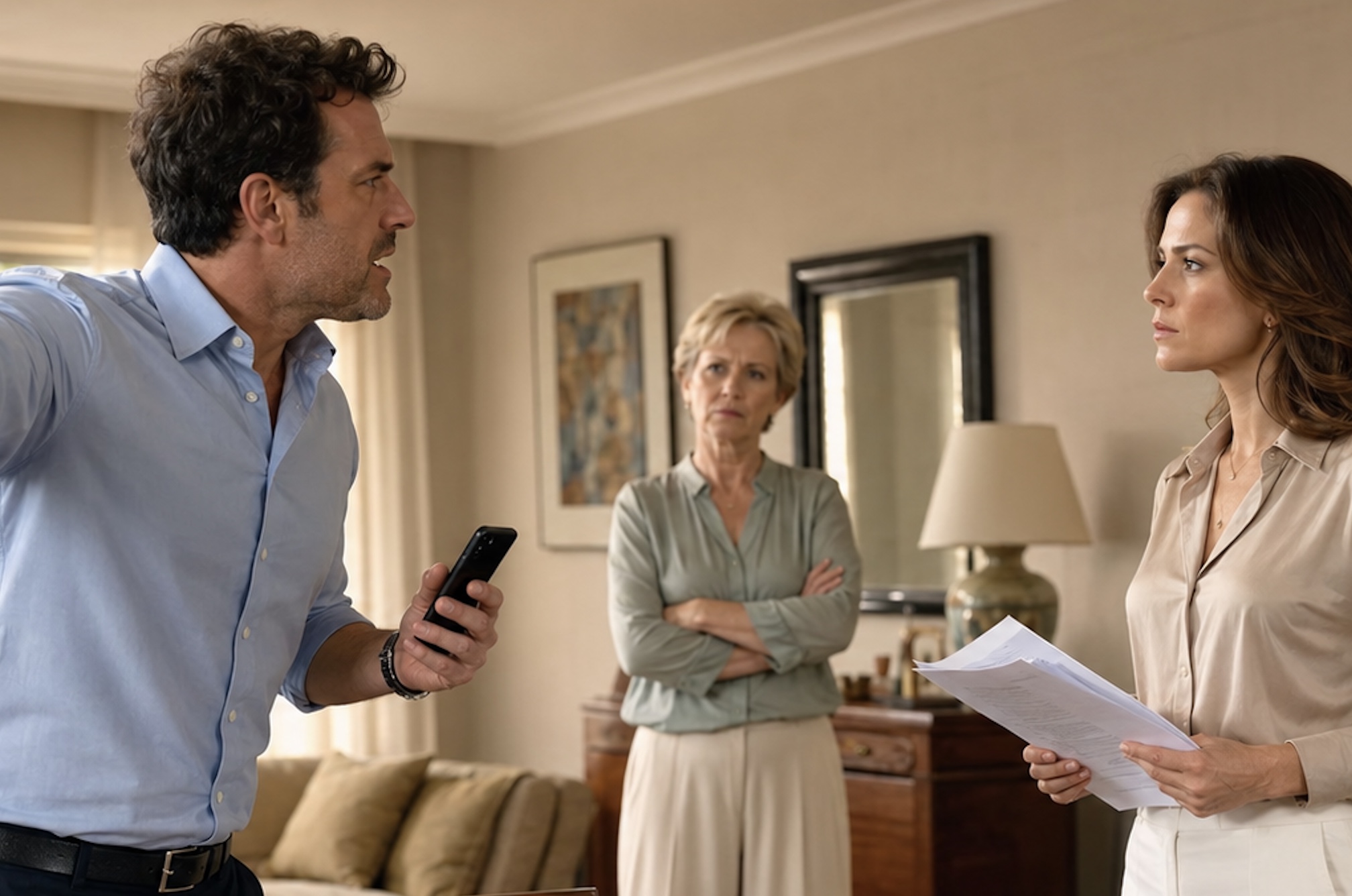
“Pack your things. Mom said it’s time for you to move out,” Dmitry said in such an ordinary tone, as if he were asking her to buy bread on the way home.
Elizaveta slowly turned toward him. In her hands was the blue folder of documents she had just taken out of the wardrobe. Hot July air drifted in through the open window, children screamed by the swings in the courtyard, and the refrigerator hummed steadily in the kitchen. Everything around them felt far too ordinary for a sentence that should have made any decent person’s conscience at least twitch.
Dmitry stood by the bedroom door in a home T-shirt, looking not at his wife, but somewhere over her shoulder. There was no anger on his face, no confusion either. Only a strange businesslike focus, as if he had memorized the words in advance and was now afraid of getting them wrong.
Elizaveta closed the folder, ran her palm along its plastic spine, and only then asked:
“Repeat that.”
“Liza, don’t start,” he grimaced. “Mom and I have discussed everything. This will be better for everyone.”
“For everyone? Who exactly is everyone?”
“For me. For Mom. And for you too, if you think calmly.”
Elizaveta looked at him more carefully. Dmitry’s gaze was stubborn but hollow, like that of a man who had arrived with someone else’s thought in his head and was now trying to pass it off as his own. She knew that look. Valentina Sergeevna had a talent for placing ready-made decisions into her son’s mind so neatly that within a day he already believed they were his own.
“So I’m supposed to pack my things and move out of my own apartment because your mother said so?”
Dmitry finally met her eyes. For a second, his confidence cracked, but he quickly straightened up.
“Don’t cling to wording. The apartment is yours on paper, of course. But we’re a family. We’ve lived here for almost six years. I’ve invested in it too.”
Elizaveta slowly raised an eyebrow.
“Invested?”
“Yes. I lived here. I helped. We did renovations.”
“The renovations were done by professionals. I paid for them. You chose the handles for the wardrobe and then spent three weeks telling everyone how exhausted you were from construction work.”
Dmitry exhaled loudly.
“This is exactly why it’s impossible to talk to you. You always twist everything so that I look like nobody.”
“In my apartment, you are currently suggesting I walk out the door. Which one of us is making the other nobody?”
He walked over to the dresser and picked up his phone. He did not unlock it; he simply squeezed it in his hand like a support.
“Mom thinks you suppress me. I can’t make normal decisions around you. You control everything: money, documents, vacations, household matters.”
“I control my documents, my expenses, and my apartment. If that frightens you, you could have said so earlier.”
“There!” Dmitry suddenly became animated, as if he had caught her confessing. “You keep saying ‘mine.’ A man should feel like the master of his home.”
Elizaveta gave a short laugh. Not a happy one, but the kind of laugh people make when someone drops a very cheap line into the room.
“The master of someone else’s property?”
“It’s not someone else’s. I’m your husband.”
“Husband is a marital status, Dima. Not a property right.”
She opened the folder and pulled out the first document. The property extract, the purchase agreement, the old bank certificate showing the mortgage had been closed before the marriage. Everything was neatly arranged in transparent sleeves. Elizaveta kept her papers in order for a reason. She worked as an administrator at a private clinic and knew that chaos began wherever people relied on memory and good intentions.
“Look carefully,” she said, placing the documents on the dresser in front of him. “The apartment was bought by me two years before we met. The mortgage was closed by me before we got married. You moved in here with two sports bags and a box of mugs. One of those mugs, by the way, is still cracked.”
“Are you trying to humiliate me?”
“No. I’m establishing reality.”
Dmitry’s cheekbones flushed. He hated it when Elizaveta spoke calmly. Shouting could be called hysteria. Tears could be called manipulation. But calmness knocked the usual excuses out of his hands.
“Mom said you’ll keep me on a short leash forever. That’s why I decided: the apartment stays with me for now, and you go live with your mother. Then we’ll decide what happens next.”
Elizaveta froze. Not from fear. From astonishment at such nerve. Slowly, she placed her palm on the folder and nodded, as if she had just heard an important detail.
“For now?”
“Yes. Until we sort things out.”
“And who decides when this ‘for now’ ends?”
“Don’t twist things.”
“I’m clarifying the terms of the takeover.”
“Oh, for God’s sake, Liza!” Dmitry waved his hand sharply. “Nobody is taking anything over. You’ll just move out so we can both breathe.”
“Have you already breathed? Or has your mother not given you permission yet?”
He stepped closer.
“Don’t you dare speak about her in that tone.”
Elizaveta did not step back. She stood barefoot on the cool floor, in a light summer dress, her hair tied into a low ponytail, and she looked much calmer than Dmitry felt. He had expected shouting, offense, a woman’s “how could you?” Instead, he got a person who had already begun mentally making a list of actions.
In six years of marriage, Elizaveta had learned to see where stupidity ended and a plan began. Dmitry was not a villain from a cheap story. He was a convenient son to his mother, a grown man with the habit of hiding his own decisions behind other people’s advice. But in this situation, stupidity alone was not enough. He had spoken too confidently about her leaving. He had chosen his words too carefully. And too often during the past week Valentina Sergeevna had stayed with him in the kitchen and gone silent the moment Elizaveta entered.
“Fine,” Elizaveta said. “I heard you.”
Dmitry blinked.
“What do you mean?”
“Exactly what I said. You want me to leave my own apartment. I heard you.”
He had clearly expected something else. A cautious joy appeared on his face.
“So you agree?”
“No.”
The joy disappeared.
“Then why are you saying ‘fine’?”
“Because now I understand what I’m dealing with.”
Elizaveta took the documents, placed them back in the folder, and headed toward the bedroom door.
“Where are you going?”
“To the kitchen. To drink some water. It’s summer, it’s hot, and our conversation, as it turns out, is going to be long.”
The kitchen was bright. The sun hit the glass so strongly that tiny drops near the sink glittered on the countertop. Elizaveta poured herself water, took several sips, and placed the glass beside the cutting board. Dmitry followed her in, irritated by her calmness.
“Stop dragging this out. Tell me properly what you’ve decided.”
“I’ve decided that tonight you’re sleeping in the living room.”
“What?”
“And tomorrow you start looking for somewhere to move. You have a mother, friends, hotels, rental apartments. Plenty of options.”
“You’re throwing me out?”
“Out of my apartment, yes.”
Dmitry recoiled as if she had spoken a language he finally understood.
“You have no right!”
“I do. You’re not the owner. You’re not a tenant. You’re not permanently registered here. I allowed you to live with me as my husband. Now you have informed me that you plan to force me out of my own home. That changes the rules.”
“Mom was right,” he hissed. “You’re cruel.”
“No. I’m teachable.”
At that moment Dmitry’s phone rang. The screen displayed: “Mom.” He looked at Elizaveta as though she was supposed to be embarrassed by the coincidence, and answered the call.
“Yes, Mom… No, I’m talking… She’s refusing… Yes, wait…”
Elizaveta extended her hand.
“Put it on speaker.”
“Why should I?”
“Because you’re discussing me and my apartment. Don’t hide the director behind the curtain.”
Dmitry hesitated. Then, wanting to show he had nothing to hide, he pressed the button.
Valentina Sergeevna’s voice burst out sharply, confidently, with a metallic note Elizaveta knew almost by heart.
“Liza, stop putting on a performance. Dima is not a boy. He needs space. You’re at work all day anyway, and the apartment is too big for one woman. You’ll live with your mother and think about your behavior.”
Elizaveta leaned her shoulder against the kitchen cabinet.
“Valentina Sergeevna, are you currently suggesting that I leave an apartment that belongs to me?”
“Don’t cling to little papers. Not everything in life is measured by paperwork.”
“When it comes to real estate, it is exactly measured by paperwork.”
“You’ve always been petty,” her mother-in-law said sharply. “A man should feel that he has a home.”
“Then buy your son a home.”
For a second, the line went silent.
Dmitry lowered his eyes abruptly.
“Liza, don’t.”
“Why not? This is a practical conversation. You want Dima to have space. Excellent. Buy him an apartment, a house, a room, a summer cottage — whatever you can afford. He can move there and feel like the master. My apartment already has a master. Me.”
“Oh, so that’s how you’re speaking now,” Valentina Sergeevna’s voice dropped lower. “And what about the fact that my son wasted the best years of his life on you?”
“He lived rent-free in the city center, used my appliances, my furniture, and for six years told your acquaintances that ‘they had an apartment.’ Let’s not talk about losses.”
Dmitry jerked the phone.
“That’s enough!”
“No, it isn’t,” Elizaveta said, looking straight at him. “Now we’re getting to the interesting part. Valentina Sergeevna, why did you ask me last week for a copy of my passport under the excuse of arranging a holiday trip for Dmitry?”
Dmitry sharply raised his head.
“What copy?”
A small movement sounded through the phone, as if his mother had shifted the receiver to her other ear.
“Don’t make things up. I didn’t ask for anything.”
“You did. On Monday. You said you had an acquaintance at a sanatorium who was checking spouses’ details for a family discount. I didn’t give you the copy. I said I would fill out the form myself. After that, for some reason, you stopped talking about the sanatorium and started talking to Dima about ‘space.’”
Dmitry frowned.
“Mom?”
“Don’t listen to her,” Valentina Sergeevna said quickly. “She wants to turn you against me.”
Elizaveta pushed away from the cabinet and walked to the table.
“Dima, open the family chat with your mother. The one where she sent you the photo of the listing.”
“What listing?”
“Let’s skip the acting. I saw the pop-up notification yesterday evening when you left your phone charging. The beginning of the message said: ‘If Liza moves out, we’ll show the room right away…’ A very interesting phrase.”
Dmitry’s face stretched. Valentina Sergeevna suddenly spoke sharply through the phone:
“She’s going through your phone! Do you hear me? That’s not normal!”
“I didn’t go through anything,” Elizaveta said. “The notification appeared on the screen. But now, Dima, I’m genuinely curious. Were you planning to rent out a room in my apartment?”
He was silent. For too long.
And that was when Elizaveta understood completely: this was not just his mother’s tantrum. It was a scheme. Brazen, poorly thought out, but still a scheme. Push her out to her mother’s place, leave Dmitry in the apartment, then move someone in “temporarily,” and later pressure her with the usual arguments: the people had nowhere to go, the money had already been taken, there was no need to ruin relationships. Elizaveta even noted inwardly that Valentina Sergeevna was not stupid. She was simply used to the fact that arrogance often works faster than the law when a person is too ashamed to defend what is theirs.
“Put the phone on the table,” Elizaveta said.
“What?” Dmitry was stunned.
“The phone. On the table. Right now, you open the messages and show me what you discussed.”
“Don’t order me around.”
“Then I call the police and say that there is a person in my apartment who refuses to leave after trying to force the owner out of her home. I’ll also show them the property documents. And in front of them, you can explain how your mother ordered you to become the master.”
Dmitry squeezed the phone so tightly his fingers turned white.
“You wouldn’t dare.”
Elizaveta picked up her own phone from the windowsill and unlocked the screen.
“Shall we test that?”
Valentina Sergeevna exhaled sharply through the phone.
“Dima, don’t you dare show her anything. That’s your family correspondence.”
“It is no longer family correspondence,” Elizaveta cut in. “It’s preparation to evict the owner from her home.”
Dmitry ended the call. The kitchen immediately became quiet. From outside came the laughter of teenagers, then the entrance door of the building slammed.
“You ruined everything,” he said hoarsely.
“What exactly? The plan to rent out my room?”
“Mom wanted to help. She knows a woman with a daughter who’s looking for housing for a couple of months. We could have gotten money and covered part of the debts.”
Elizaveta slowly placed her phone on the countertop.
“What debts?”
Dmitry looked away.
Now the puzzle finally came together. During the past months he had become more nervous, stayed out late more often, flinched at bank notifications, though he insisted everything was fine. Elizaveta had not interfered in his personal expenses, but she had seen it: the man was hiding something. She had not pushed. She had waited for facts. And now the facts had walked into her kitchen on a July evening.
“Dima,” she said evenly. “What debts?”
“Mine. It doesn’t concern you.”
“If because of them you decided to rent out part of my apartment, it concerns me.”
He sat down on a stool and ran his hand over his face.
“I invested in a project. It went badly. Then I borrowed more to cover it. Then…”
“Then your mother decided it was easier to throw me out than admit her son had made a mess.”
“Don’t say that.”
“How should I say it? Carefully? Gently? You just told me to pack my things by order of your mother.”
Dmitry was silent. A drop of sweat appeared at his temple. The kitchen had grown hot during the day, but Elizaveta felt a cold clarity. Not anger. Not hurt. Calculation.
“Here’s what’s going to happen,” she said. “Today you pack the essentials and go to your mother’s. You’ll collect the rest in my presence on the weekend. You leave the keys now.”
“I’m not leaving.”
“You are.”
“This is my home too!”
“No. This is a place where you were allowed to live. You’re about to understand the difference.”
Dmitry jumped to his feet.
“You’ll regret this. The court will consider that I lived here.”
“The court will consider the documents. And the court will also consider that you tried to force the owner out of her premarital apartment. I don’t mind. It might even be useful to have that officially recorded.”
“You’re some kind of monster.”
“No, Dima. A monster is someone who tells his wife to pack her things from her own apartment because his mother ordered him to. I’m simply not a victim.”
He left the kitchen. A minute later, a wardrobe door slammed in the bedroom. Elizaveta did not follow him. She opened the notes app on her phone and began writing: date, time, exact phrases, the phone conversation with Valentina Sergeevna, the mention of renting out the room and debts. Then she photographed the apartment documents, emailed copies to herself, and uploaded them to a private cloud folder. After that, she called her neighbor from the third floor, Sergey Andreevich, a former district police officer with whom she had exchanged greetings for many years.
“Sergey Andreevich, good evening. I’m sorry for calling so late. I have a family conflict. My husband may refuse to leave my apartment. Could you be a witness if I have to call the police?”
“I’ll be down in five minutes,” he said without unnecessary questions.
Elizaveta put away the phone. That was what she loved about prepared people: they understood that sometimes help is not advice, but a calm presence.
Dmitry came out of the bedroom with a backpack and a sports bag. His face had turned angry.
“Have you already called someone?”
“Yes.”
“That was fast.”
“I don’t like wasting time.”
The doorbell rang. Dmitry flinched.
“Who is that?”
“A witness.”
He tightened his grip on the bag strap.
“Have you completely lost your mind?”
“Careful with your wording. I’m remembering everything.”
Sergey Andreevich entered the apartment in a light shirt and with the attentive face of a man who had seen enough of other people’s performances in life and had long stopped being surprised. Elizaveta showed him the apartment documents and briefly explained the situation. Dmitry tried to interrupt, but the neighbor raised his hand.
“Young man, if the apartment is not yours and the owner is asking you to leave the premises, it is better not to bring this to the point of calling a patrol. Pack what you need, agree on a time to take the rest, and separate calmly.”
“This is a family matter,” Dmitry snapped.
“As long as there is no fight and no threats, it’s a family matter. After that, it becomes administrative, maybe worse. Do you need that?”
Dmitry looked at Elizaveta. She stood by the door, holding his set of keys, which she had taken from the hook in the hallway while he was packing.
“Give them back,” he said.
“No. The keys stay with the owner.”
“There’s a key to the entrance.”
“People go in and out of the courtyard. You’ll get to your car.”
“Liza…”
For the first time, there was not anger in his voice, but a plea. Late, clumsy, almost pitiful. Elizaveta could see how badly he wanted to roll the conversation back, to pretend everything had been “emotional,” “misunderstood,” that “Mom went too far.” But she knew the price of such rollbacks too well. Today he would leave guilty, tomorrow he would return offended, and the day after that Valentina Sergeevna would again start explaining to him that he was the man of the house. No. A door must be closed while a person still has the strength to close it themselves.
“Dima,” she said calmly. “You chose a side. And you chose the method. Now live with the consequences.”
He picked up the bag, walked out into the stairwell, and stopped on the landing. It was obvious he was waiting for one last attempt to stop him. Elizaveta did not move. Sergey Andreevich stood slightly to the side.
“You’ll collect the rest of your things on Saturday at noon. With a witness present. If you don’t come, I’ll pack them into boxes and send them through your mother.”
“You’ll regret this,” Dmitry said more quietly now.
“Possibly. But not because I kept my apartment for myself.”
She closed the door and turned the lock.
Only after that did Elizaveta allow herself to sit down on the edge of a chair. Her hands were not shaking, but her fingers had gone cold. She looked at Dmitry’s keychain: the apartment key, the mailbox key, the magnetic entrance key, the small car-shaped charm. That morning, all of it had seemed like ordinary family clutter. By evening, it had become an inventory of access.
“You should change the locks,” Sergey Andreevich said. “Quietly. Call a locksmith tomorrow morning, or tonight if you find a twenty-four-hour one.”
“I’m already looking,” Elizaveta replied.
And she really was already dialing a service. No declarations, no mythical permissions, no requests to anyone. An owner changes the locks in her own apartment. She simply calls a professional and pays for the work.
The locksmith arrived a little over an hour later. A young man in a cap quickly replaced the cylinder, checked the key movement, and handed over a new set. Elizaveta paid him, put the new keys in a separate pocket of her bag, and only after the locksmith left did she feel the apartment had become different. Quieter. Cleaner. Not in terms of the floor or the air, but in terms of boundaries.
She did not sleep that night. Dmitry wrote in short bursts. First he demanded that she open the door. Then he accused her. Then he sent a long message saying she was destroying the marriage. An hour later, Valentina Sergeevna appeared: “You will regret it if you leave my son on the street.” Elizaveta took screenshots and did not answer. In the morning she called the lawyer who had once handled the apartment paperwork.
“A divorce through court,” she said. “My husband is in conflict with me, and there is a risk of property claims, although the apartment is premarital. Everything needs to be done carefully.”
The lawyer, Vera Konstantinovna, listened, asked several clarifying questions, and said:
“You were right not to leave. You were right to take the keys. Save all correspondence. Hand over his belongings with a witness present, preferably with a simple inventory of what he takes. Do not get into long conversations.”
“Can he demand a share?”
“He can demand anything. Getting it is another matter. According to your documents, the apartment is your personal property. If he can prove significant investments in improving the property using joint funds, he may try to argue for compensation, but the court looks at evidence, not his mother’s words.”
Elizaveta wrote everything down in a notebook. She was not afraid of court. She was afraid of people who hoped that a woman would surrender out of shame and exhaustion. She decided to speak to such people only through documents.
On Saturday, Dmitry came with Valentina Sergeevna. Exactly at noon. Elizaveta did not open the door immediately: first she started recording on her phone and placed it face down on the hallway shelf. Sergey Andreevich was beside her. In the kitchen sat her friend Oksana, a procurement specialist and a woman with the face of someone who could stop a mover, a driver, and a warehouse director with one look.
“Why are there strangers here?” Valentina Sergeevna asked at once as she stepped into the hallway.
She wore a light summer suit, her hair neatly styled, and carried a large bag, as if she had not come to collect her son’s things but to conduct an inspection.
“For everyone’s peace of mind,” Elizaveta replied. “Dima is taking his belongings. He does not walk through the rooms without me. Whatever he takes, we say out loud.”
“Why not make an inventory while you’re at it?” her mother-in-law snorted.
“Already done.”
Elizaveta handed her a sheet of paper. Valentina Sergeevna looked at it and would have pursed her lips if she knew how not to show emotion so clearly. Instead, her lips simply became thinner.
“His laptop, his tools, his clothes, his documents, his books,” Elizaveta listed. “He is not taking appliances, furniture, dishes, bedding, or household items bought by me.”
“You’re even sorry to give up dishes,” Valentina Sergeevna said with venom.
“I’m sorry for your son because after six years you still didn’t teach him to buy his own.”
Oksana coughed loudly in the kitchen. Sergey Andreevich turned toward the door.
Dmitry flushed.
“Mom, be quiet.”
It was the first sensible thing he had said in several days.
The packing took forty minutes. Dmitry was gloomy, but he no longer argued. Valentina Sergeevna tried to open the wardrobe in the hallway, and Elizaveta calmly placed her hand on the door.
“That’s mine.”
“I’m just looking.”
“Look in your own home.”
Her mother-in-law narrowed her eyes.
“You think you won?”
“I think you overestimated people’s habit of feeling ashamed.”
Before leaving, Dmitry stopped at the threshold.
“Liza, let’s talk without them.”
“No.”
“I didn’t want it to turn out this way.”
“But you did want me to move out.”
He clenched his jaw. There was no answer.
“Work with that,” Elizaveta said. “At your place. Not here.”
She closed the door behind them calmly, without slamming it. Then she checked the lock, put the signed inventory into the folder, and for the first time in several days turned on music. Not sad music, not triumphant music. Just an ordinary summer radio station where the hosts were laughing about something completely unimportant.
The divorce did not take one day, and not one week. At first Dmitry refused to agree, then tried to send conditions through his mother. Valentina Sergeevna called Nadezhda Ivanovna, Elizaveta’s mother, hinting that her daughter was “breaking a man” and would “end up alone in her square meters.” Nadezhda Ivanovna, a gentle woman but not a spineless one, listened once and replied:
“My daughter will not leave her own apartment. And I did not raise your son, so I am not going to educate him now.”
After that, the calls stopped.
In court, Dmitry looked tired. The former pressure was gone. He tried to say that he had considered the apartment a family home, that he had invested effort, that he had counted on a shared future. Elizaveta did not interrupt. Her representative calmly presented the documents: the date of purchase, the date the obligations had been closed before the marriage, the absence of any confirmed major investments by Dmitry, the messages demanding that she move out, Valentina Sergeevna’s texts, and the attempt to discuss renting out the room.
The judge listened without emotion. For her, it was not a drama, but a case. That was exactly what Elizaveta liked. In court, other people’s outbursts either became facts or disappeared.
The marriage was dissolved. The apartment remained with Elizaveta, as it should have. There were no beautiful reconciliation scenes. After the hearing, Dmitry approached her near the exit.
“You could have at least not shown the messages with Mom.”
Elizaveta put the documents into her bag.
“You could have at least not tried to throw me out of my own apartment.”
He lowered his eyes.
“I was in debt back then. Mom was pressuring me. I wasn’t thinking clearly.”
“You were thinking clearly. You just thought I would give in.”
Dmitry said nothing. And that was more honest than all his previous excuses.
In August, Elizaveta finally sorted through the last box after his departure. Inside, she found Dmitry’s cracked mug, the very same one he had once arrived with. She turned it in her hands and remembered the young man with two bags at her door, his embarrassed smile, their first dinners on the floor among boxes, their vacation plans, their silly arguments about what bath mat to buy. Not everything had been bad. And that was exactly why it was so important not to let the bad rewrite her entire life.
She did not smash the mug or stage a symbolic ritual. She simply wrapped it in an old newspaper and placed it in a bag of things to throw away. Without anger. Without theater. What is unnecessary should leave quietly.
By the end of summer, the apartment had become entirely hers. Not on paper — in feeling. Elizaveta had changed the lock, reorganized the wardrobes, removed the remaining men’s belongings, and cleared the bathroom shelf where Dmitry’s bottles used to stand. On a weekend morning, she woke up early, opened the window, and let the hot August air into the room. Down below, the yard keeper was watering the asphalt with a hose; the water darkened in the sun, and the smell of wet dust rose from the ground.
Her phone flashed with a message from an unknown number.
“Liza, this is Valentina Sergeevna. Dima has gone to stay with an acquaintance for a while. I wanted to say… perhaps we went too far back then.”
Elizaveta read the message twice. Then she blocked the number.
Not because she was petty. But because not every late “we went too far” deserves an entrance ticket back into someone’s life.
That evening, she met Oksana on the summer terrace of a small restaurant. People laughed at nearby tables, glasses clinked, and a waiter quickly moved between the rows with a tray. Oksana looked at her friend carefully.
“So, a free woman?”
“A property owner without lodgers,” Elizaveta corrected.
“That sounds even better.”
Elizaveta smiled. The smile came easily, without effort.
“You know what’s strangest? I thought it would hurt more.”
“And?”
“It turns out that when a person is carried out of your life together with his mother and their claims to your apartment, it becomes easier to breathe almost immediately.”
Oksana raised her glass of lemonade.
“To square meters that didn’t fall into greedy hands.”
“To women who know how to read documents,” Elizaveta added.
They laughed. And there was no bitterness in that laughter, no forced bravado. Only a clear understanding: sometimes a family story ends not when love disappears, but when one person suddenly decides that another person’s restraint is weakness.
Elizaveta was not weak. Earlier, she had simply felt sorry for destroying something that could still be explained by tiredness, a mother’s influence, temporary difficulties. But on that July evening, Dmitry himself had said the sentence after which pity became a dangerous luxury.
Pack your things.
He had been wrong about only one thing.
The one who packed was him.